








CPT Code 19301: Partial mastectomy billing, modifiers, and reimbursement
CPT Code 19301 is the billable procedure code for a partial mastectomy. The desc...

Last Updated: Sep 7, 2026


CPT code 74160 covers computed tomography of the abdomen with contrast material, and its scope stops at the abdomen.
Two facts on the report pick the code, namely how far the scan reached and which contrast phases were acquired.
A payable 74160 claim needs a signed order, a contrast administration record, and an ICD-10-CM code that supports necessity.
Billing 74160 and 74177 on the same date trips an NCCI edit, and the lower-RVU code denies automatically.
Practice management software like Pabau pre-fills the claim from the patient record and checks required fields before it sends.
CPT code 74160 is the billing code for a CT scan of the abdomen taken with contrast material. Scope is what decides the claim. 74160 stops at the abdomen, so a study that also covers the pelvis belongs to 74177 or 74178 instead.
Payers test that boundary against the radiology report, not the order. A coder working from the order alone can bill a scope the report never supports, then defend it in an audit months later.
The sections below cover the official descriptor, the component modifiers, and the diagnosis pairings that carry medical necessity. They finish with the checks that clear a 74160 claim first time.
The official descriptor reads “Computed tomography, abdomen; with contrast material(s).” Two conditions sit inside that line. The anatomy is the abdomen, and contrast has to be given and documented.
The American Medical Association’s CPT code set files it under Diagnostic Radiology with the rest of the 741xx imaging family.
Contrast can be intravenous, oral, or rectal, and any of the three satisfies the descriptor. What the descriptor will not stretch to is the pelvis. Once the radiologist reads pelvic structures from the same acquisition, the study has left 74160 behind.
The claim itself is unremarkable once it leaves the practice. What makes it fragile is how many hands touch the scope of the study before anyone bills it. Here’s the path a single abdominal CT takes:
Stage four is where the money is won or lost. The steps before it are clinical judgment, and the steps after it are arithmetic. Practices running claims software for radiology keep the coded charge attached to the record it came from. The claim line and the report then cannot drift apart.
Medicare’s coverage rules for abdominal CT sit in CMS Article A56421. That article ties payment to documented medical necessity linked to a qualifying ICD-10-CM diagnosis. When a Medicare contractor questions a 74160 claim, A56421 is the reference they work from.
74160 is a global service by default, so one claim covers the scanner and technologist as well as the radiologist’s interpretation. Split billing changes which line carries what.
A 74160 claim survives a necessity review when the record says why contrast-enhanced CT of the abdomen was the right test. “Abdominal pain” on its own rarely holds up. “Right upper quadrant pain, hepatic lesion seen on ultrasound” does, because it names what the radiologist was asked to look for.
The American College of Radiology publishes appropriateness criteria for abdominal imaging, and those recommendations give a physician something concrete to cite.
Local Coverage Determinations from your Medicare Administrative Contractor can add regional criteria on top of CMS Article A56421.
A claim that reaches the payer without a contrast administration record usually denies on the first pass. So does one without a diagnosis code the policy recognizes. Rework then costs more staff time than the original check would have taken.
Confirm the contrast route matches the stated indication before you submit. IV contrast suits vascular and parenchymal evaluation, and oral contrast suits bowel assessment. A route that does not fit the indication is a common audit trigger on this code.
Modifier selection follows from the global service structure, so the list is short. Six modifiers cover almost every situation a radiology biller meets on 74160.
Here’s how that plays out in a hospital setting. A radiology group reads an abdominal CT taken in the hospital’s outpatient department, so the group bills 74160-26. The hospital claims its technical side under OPPS instead. Neither party reports the global code, and neither one appends -TC.
Check any modifier against the current-year fee schedule or a MAC bulletin before you use it. Modifiers borrowed from general radiology habit are the ones that draw NCCI edits and audit attention.
Medicare pays 74160 from the relative value unit formula in the Physician Fee Schedule. Three RVU components are added together, adjusted for your geographic locality, then multiplied by the annual conversion factor.
Dollar amounts move every year and vary by MAC locality. Pull yours from the CMS Physician Fee Schedule lookup tool rather than a printed rate sheet.
What stays stable is the structure below, and which component travels with which modifier.
The site-of-service differential is material on this code. In a hospital outpatient department or an ambulatory surgery center, the practice expense RVUs are lower, because Medicare pays the facility separately under OPPS.
In a freestanding radiology center or a physician office, the non-facility practice expense RVUs are higher, since the practice carries the scanner and the overhead.
Practices billing office-based CT have two details to confirm. First, that the rates they quote come from the non-facility column. Second, that the place of service code on the claim agrees with them. POS 11 paired with facility rates is the kind of mismatch a payer notices before you do.
Pairing 74160 with a supporting ICD-10-CM diagnosis is how medical necessity reaches the payer. CMS Article A56421 lists the diagnoses that support coverage nationally.
MAC Local Coverage Determinations then expand or narrow that list by region. Check your own contractor’s policy rather than relying on the national article alone.
Treat that list as a starting point rather than a permission slip. Payer acceptance varies, and a diagnosis that clears Medicare in one state can fail a commercial plan in the next. Verify the pairing against the applicable policy before the claim goes out.
The 741xx family reads like a list of near-identical codes until you notice it is a grid. One axis is how far the scan reached. The other is which contrast phases the technologist acquired. Read both off the report and one code is left standing.
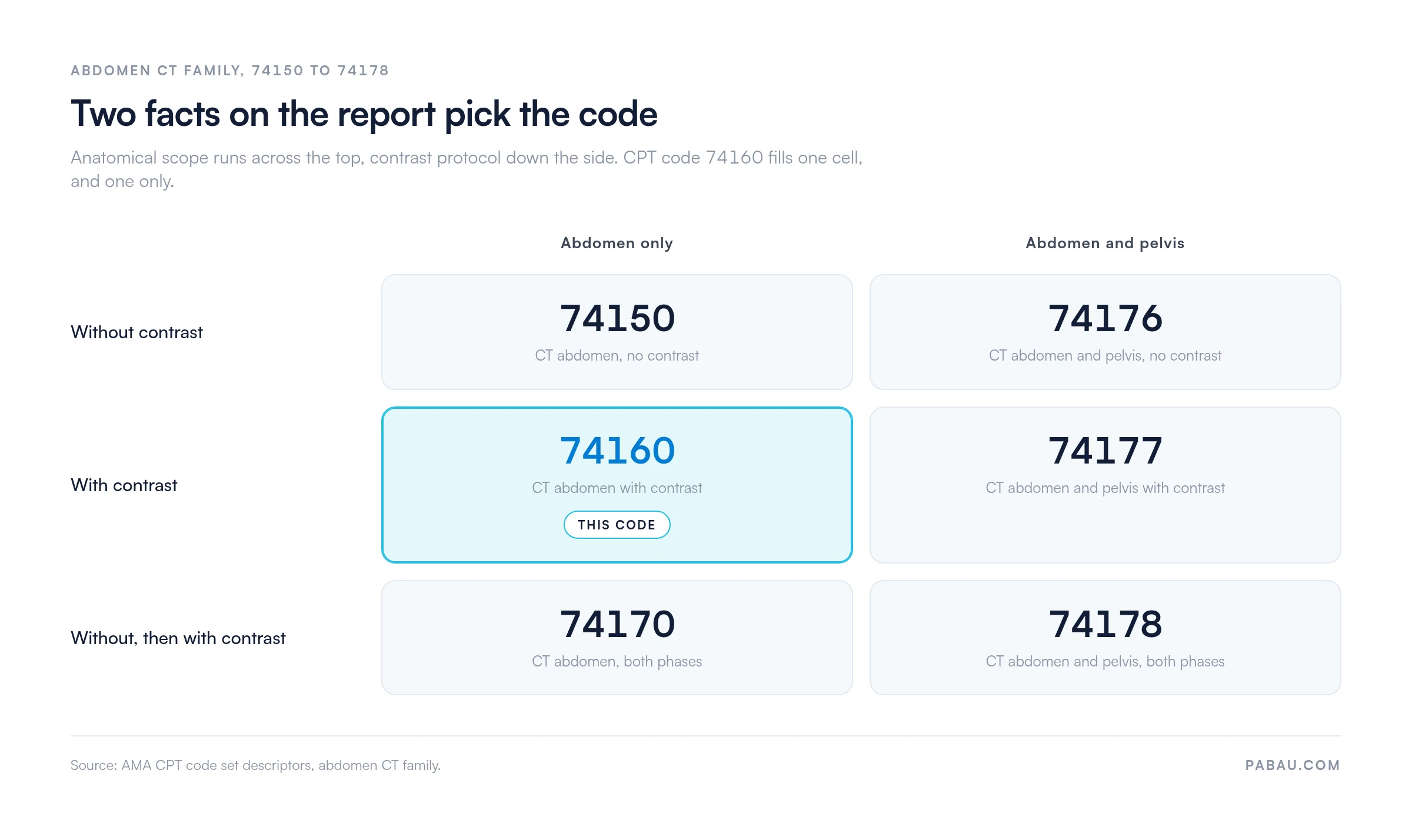
The grid tells you which code to bill. The table below gives the shorthand each cell stands for, in the terms a payer will quote back at you.
Did the scan include the pelvis? That’s the whole test. If the order and the report both say abdomen only, 74160 is correct.
If the pelvis was read from the same acquisition, the claim moves to 74177, or to 74178 when a non-contrast phase was acquired too. Work through it in this order.
Radiology billing errors cluster around a handful of repeating patterns, and prevention costs far less than remediation. These five account for the bulk of 74160 rejections:
Sorting denials by code family and reason code finds systematic errors faster than reviewing them claim by claim.
A practice that watches its 741xx rejection rate spots a scope habit in a week. A practice working the queue one claim at a time can miss it for a quarter.
74160 pays for the imaging service. Whether the contrast agent earns its own line depends on where the scan happened and who the payer is. Three questions settle most cases.
Document the contrast type, concentration, and volume either way. The record has to support the imaging code even when the agent is never billed on its own. Supply codes like Q9967 sit outside CPT, and our HCPCS code guides cover the ones radiology practices reach for most.
If you do bill Q9967 separately, put the contrast lot number and NDC on the claim line beside the HCPCS code. Some MACs expect that detail on contrast lines, and leaving it off is a low-effort denial that holds up payment for weeks.
Most 74160 denials are catchable at the charge-entry screen. Six checks, in this order, take under a minute per claim:
The diagnosis pointer trips people up most often. On a CMS-1500, a supporting code listed in box 21 has no effect unless box 24E points the service line at it. The claim looks complete on screen and still denies for medical necessity.
In most radiology practices, the coded charge gets re-keyed. Someone reads the report, picks the CPT code, then types it into a separate billing system with the diagnosis and the modifier. Each re-key is another chance for the claim and the report to disagree.
Practice management software like Pabau keeps that step inside one record. The CPT code attached to the service lands on the charge line, and the ICD-10-CM slots are seeded from the patient’s recorded problem list.
Built-in CPT, HCPCS, and ICD-10-CM lookup libraries sit behind a search icon, so a coder weighing 74160 against 74177 never has to leave the claim.
Pabau also checks that the fields a claim cannot travel without are complete before the send button unlocks. On the US pipeline, our Claim.MD integration runs real-time eligibility checks against thousands of US payers, tracks claim status, and posts electronic remittance advice automatically.
Your team sees what each line paid without matching remittances by hand.

Pabau pre-fills CPT and ICD-10-CM codes from the patient record, checks required claim fields before submission, and posts remittances automatically. Your team spends less time reworking denials and more time on patient care.

74160 is a narrow code, and its narrowness is the whole story. Abdomen, with contrast, no pelvis. Coders who read the report’s anatomical coverage before they open the code list get this right almost every time.
The habit worth building is smaller than a policy. Check the scope, check the contrast record, then check that the diagnosis pointer lands on the 74160 line. Three checks, and the claim usually clears on the first pass. Skip them and you’re appealing a denial that never had to happen.
Accurate radiology coding still depends on the coded charge surviving the trip from report to claim. Book a demo to see how Pabau keeps CPT and ICD-10-CM codes attached to the record they came from, right through to the remittance.

Billing a scan that reached the pelvis? CPT code 74177 covers CT of the abdomen and pelvis with contrast, including the documentation that separates it from 74160.
Both contrast phases on the same study? CPT code 74178 walks through the abdomen and pelvis code for a non-contrast phase followed by contrast.
Want fewer first-pass rejections? What makes a clean claim sets out the fields a payer checks before your claim is ever adjudicated.
Sitting on a stack of denials already? Denial management in healthcare covers how to work, appeal, and prevent the rejections radiology sees most.
Not sure how a claim reaches the payer? Medical claims clearinghouse guide explains how clearinghouses validate, translate, and route 837P files on your behalf.
No. The imaging code covers administering the contrast, so a CT study carries no separate injection code. The contrast material itself is a supply, and only some non-facility payers pay for it under a HCPCS Q code.
Yes, when the abdomen is scanned again on the same date for a documented reason. Append modifier -76 to the repeat line, and make sure the report explains why a second study was clinically necessary.
Medicare fee-for-service does not require it for outpatient abdominal CT. Most commercial plans and Medicare Advantage plans route advanced imaging through a radiology benefit manager, so verify the requirement before the appointment.
The radiologist reports 74160 with modifier -26 for the interpretation. The hospital’s technical component is folded into the inpatient DRG payment, so nobody bills the technical side of the scan separately.
The treating physician, or a non-physician practitioner working within their state scope. Medicare expects the order to come from the practitioner who uses the result to manage the patient, and the record should show that link.