



CCSD code G5100: Bypass of duodenum billing guide
CCSD code G5100 bills a bypass that leaves the duodenum in place CCSD code G5100...

Last Updated: Oct 16, 2026

CPT code 29823 covers arthroscopic shoulder debridement of three or more discrete structures, and 29822 covers one or two.
Medicare’s 2026 national unadjusted allowable is $558.80, built from 16.73 facility RVUs and a conversion factor of $33.4009.
A structure you debride and then repair in the same session cannot be counted toward the three-structure threshold.
NCCI names only 29824, 29827 and 29828 as codes you may report with 29823, and only for a different area.
Pabau’s claims management pre-fills the claim from the record and holds submission until every required field is complete.
CPT code 29823 covers arthroscopic shoulder debridement of three or more discrete structures in a single session. That count is the code. Debride one or two structures instead and you report 29822, which pays about $43 less per case.
Medicare’s 2026 national unadjusted allowable for 29823 is $558.80, and CMS publishes no office rate for it at all. Denials on this line come from two places, and both are avoidable. Either the operative note cannot support the structure count, or a bundling edit went unchecked before submission.
Below is what the code pays, what it bundles with, and what the record has to show.
The AMA descriptor reads “arthroscopy, shoulder, surgical; debridement, extensive, 3 or more discrete structures.” The parenthetical then lists the structures that qualify.
Both codes carry the same list. The only difference is how many of those structures the surgeon debrided. The AMA rewrote both descriptors on January 1, 2021, and the counting rule arrived with that revision.
Twelve structures count. They are anatomical rather than pathological, and that distinction decides the count:
Note that the articular and bursal sides of the rotator cuff are listed separately. Debride both and you have two structures, not one. A frayed labrum with two separate tears, by contrast, is still one structure. Count the anatomy the surgeon named, never the number of lesions.
A structure debrided as part of another procedure reported in the same session cannot be counted. This one rule turns more 29823 claims into 29822 claims than any other. If the supraspinatus is debrided and then repaired, the repair code owns that structure, so it drops out of the debridement tally.
Work through a case. The surgeon debrides the labrum, the biceps tendon, the subacromial bursa and the articular cartilage of the glenoid.
Four structures, so 29823 looks correct. Then read further and you find a biceps tenodesis and a labral repair in the same note. Two of the four structures now belong to those repairs. You are left with two, which means 29822.
Ask your coders to write the structure count into the charge note as a list, not a number. “Bursa, glenoid cartilage, articular cuff” survives an audit. “3 structures” does not, because a reviewer cannot tell whether one of them was repaired later in the same operative note.
The 2026 national unadjusted Medicare allowable is $558.80. That figure comes from 16.73 total facility RVUs multiplied by the year’s conversion factor of $33.4009.
Practices in a qualifying alternative payment model use the higher conversion factor of $33.5675, which lifts the same line to $561.58. CMS publishes both values in the relative value files it updates every quarter.
One row deserves a second look. CMS flags the non-facility practice expense for 29823 as not applicable, so there is no office rate to bill. The professional fee is a facility fee wherever the case happens.
Put place of service 22, 19 or 24 on the claim and the line prices correctly. Put 11 on it and the line will not price at all.
Geographic practice cost indices adjust each component before the conversion factor lands. Across all 2026 Medicare localities, the same 29823 line ranges from $498.72 to $681.38.
Run your own figure through the CMS fee schedule lookup before you quote a patient or set a fee.
Bill 29823 with another shoulder arthroscopy code and Medicare does not apply the usual 50% multiple-procedure reduction. It applies the multiple endoscopy rule instead, and that rule pays noticeably less.
CMS assigns 29823 a multiple-procedure indicator of 3 and names 29805, diagnostic shoulder arthroscopy, as its base endoscopy.
Here is how the math runs. The higher-valued code pays in full. For the lower-valued code, Medicare pays only the difference between its own allowable and the base endoscopy’s allowable.
Take a case billing 29824 and 29823 together, with the debridement in a different area:
Under the standard 50% rule those two lines would have paid $918.36. The endoscopy rule costs the practice roughly $170 on that single case.
Build that into your fee analysis rather than discovering it on the remittance advice. The reduction is correct, so there is nothing to appeal.
Only three: 29824, 29827 and 29828. Every other code in the shoulder arthroscopy family either absorbs 29823 or is absorbed by it. The edit table itself is the clearest proof, and it sorts the family into three groups.
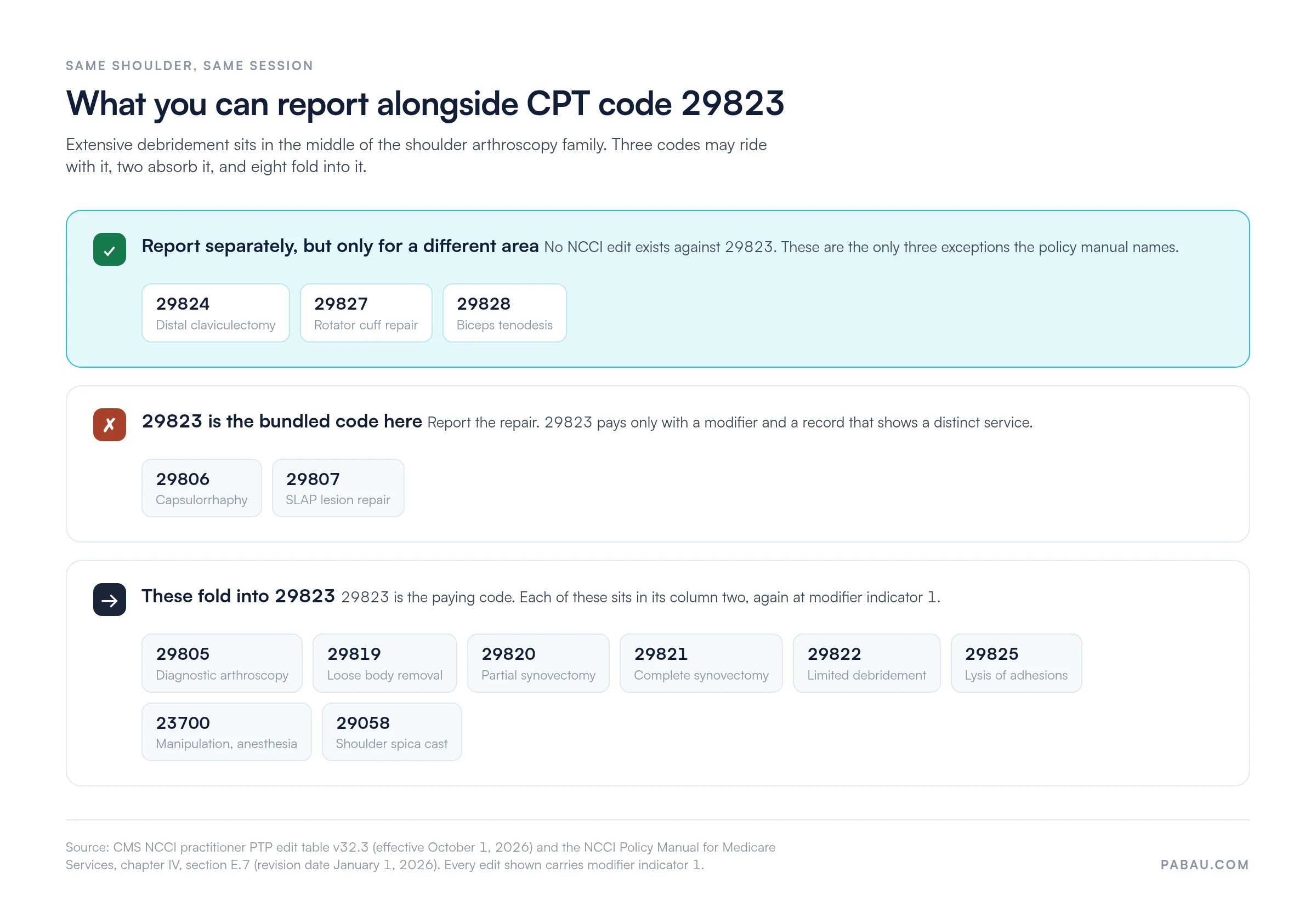
The NCCI policy manual spells out the reasoning in chapter four. Shoulder arthroscopy procedures include extensive debridement even when it happens in a different area of the same shoulder. Then it carves out three exceptions by name, and 29824, 29827 and 29828 are those three. Compare that with limited debridement, which has no exceptions at all.
You can see the asymmetry in the edits. Limited debridement, 29822, sits in the column two list of 29824, 29827 and 29828. Extensive debridement, 29823, does not appear against any of them. So a rotator cuff repair reported as CPT code 29827 can carry a 29823 line, while the same case can never carry a 29822 line.
Two more relationships are worth knowing. Add-on code 29826 has no edit against 29823 either, so a documented subacromial decompression is separately reportable. And where 29823 is the column two code, under 29806 or 29807, the edit carries modifier indicator 1. That means modifier XS or 59 can bypass it when the record shows a different area.
Laterality and the distinct-service modifier do most of the work on this code. The rest turn up in specific situations, and using one wrongly is worse than leaving it off.
Watch the modifier 59 habit. Coders trained on other specialties reach for it whenever an edit fires, and on 29823 that instinct produces a payable claim with an unsupportable record. The edit is bypassable, not optional.
If the note does not name a different area of the shoulder, drop the line. A modifier is not the fix. CMS also caps this code at one unit per date of service, and that medically unlikely edit cannot be appealed.
Pair 29823 with a laterality-specific diagnosis that names the structure treated. Payers read the diagnosis against their local coverage determination before they read anything else. A general shoulder pain code will not clear that check, however complete the rest of the claim is.
Every code below is valid for the current fiscal year. Look each one up in the ICD-10-CM code reference before you build the claim.
Match the diagnosis to the structures in your count. If the note lists bursal debridement and the claim carries only an osteoarthritis code, the payer sees a mismatch.
Two or three linked diagnoses read better than one broad one, and each should trace to a named structure in the operative report.
An LCD can go further than screening a diagnosis. LCD L37176 enumerates the covered indications for HCPCS code J2820, so off-label sargramostim is not reported under that code on Medicare claims.
A 29823 claim moves through five hands, and each one can stop it:
Most losses happen at step two, long before anyone sees a denial code. A coder who cannot see the structure list has no way to defend the code.
Run this list before the claim leaves the building:
Add a structure-count field to your operative note template and make it required. Surgeons fill it in seconds while the case is fresh, and it gives coders a defensible count without a query. Practices that do this see fewer 29823 claims downgraded to 29822 at audit.
In most orthopedic practices the operative note lives in one system and the claim gets rebuilt by hand in another. Someone reads the note, types 29823 into a claim form, looks up the diagnosis codes, adds laterality, and hopes nothing was mistyped. Every one of those keystrokes is a chance to lose the line.
Practice management software like Pabau closes that distance. Pabau’s claims management software pre-fills the claim straight from the client record. The CPT code attached to the service lands on the charge line.
Recorded diagnoses seed the ICD-10 slots. Built-in CPT and ICD-10-CM lookup libraries sit beside those fields, refreshed with each official release, so coders search rather than retype.
Pabau also validates that the fields a claim needs are complete before the send button unlocks. Missing authorization numbers and membership details get caught in the practice, not at the payer.
The Claim.MD connection goes further on US claims. It runs eligibility checks, submits electronically, tracks claim status and posts ERA remittances. Your team reads denial reasons the same week, not the following month.
What Pabau does not do is choose your modifiers or count your structures. Those judgments stay with the coder, where they belong. The platform’s job is to make sure the decision the coder made is the one that reaches the payer, intact and on the first submission.

Pabau pre-fills the claim from the client record and keeps CPT and ICD-10-CM lookup libraries beside the fields. Submission stays locked until every required field is complete. Your team spends its time on coding judgment instead of data entry.

CPT code 29823 rewards practices that treat the operative note as a billing document. The count of structures decides the code, the repairs decide the count, and the edit table decides what can ride alongside it. Get those three right and this line pays on first submission almost every time.
The trade-off worth remembering is that 29823 is not a code you can rescue after the fact. A missing structure list cannot be reconstructed, and an unsupported modifier is a compliance risk rather than a revenue win. The work happens at dictation and at charge entry, which is where your process should focus.
Retyping surgical claims from the record costs orthopedic teams hours every week. Book a demo to see how Pabau builds a 29823 claim from the note it already holds.

Need the billing rules for the distal claviculectomy that can ride with 29823? CPT code 29824 covers its RVUs, modifiers and documentation requirements in full.
Billing a biceps tenodesis in the same session? CPT code 29828 walks through the third of the three codes NCCI lets you report with extensive debridement.
Unsure how an add-on code changes the payment math? CPT code 29826 explains why a ZZZ global period escapes the multiple procedure reduction.
Want the field-by-field standard a payer checks first? Clean claim requirements sets out what has to be complete before a surgical claim can adjudicate.
Tracking why arthroscopy lines come back unpaid? Denial codes in medical billing decodes the CARC and RARC values that show up on bundled surgical claims.
CPT 29823 carries a 90-day global period. CMS splits its value 10% pre-operative, 69% intra-operative and 21% post-operative. Routine follow-up inside those 90 days is not separately payable. An unrelated visit needs modifier 24, and a return to the operating room needs 78 or 79.
Yes. CMS gives 29823 an assistant-at-surgery indicator of 2, so no payment restriction applies. Report modifier 80 for a physician assistant surgeon, 82 where no qualified resident was available, or AS for a physician assistant or nurse practitioner. The operative note must name the assistant’s role.
Medicare fee-for-service does not require prior authorization for 29823. Many Medicare Advantage and commercial plans do, and most want documented conservative care first. Check the plan’s surgical policy before the case. A missing authorization number denies the line however strong the clinical record is.
One. CMS sets the practitioner limit at one unit with an adjudication indicator of 2, which is a date-of-service policy edit. No modifier and no appeal recovers a second unit. Report both shoulders on a single line with modifier 50 rather than as two units.
No. The knee rule is built around compartments rather than structures, and it runs through HCPCS code G0289. That code is reportable with 29880 or 29881 only for a loose body or a chondroplasty in a different compartment of the same knee.



