



CCSD code G5100: Bypass of duodenum billing guide
CCSD code G5100 bills a bypass that leaves the duodenum in place CCSD code G5100...

Last Updated: Oct 16, 2026

CPT code 97803 covers medical nutrition therapy (MNT) reassessment and intervention, billed in 15-minute units after an initial 97802 assessment.
Medicare Part B covers 97803 for diabetes, chronic kidney disease, or post-kidney-transplant status, and only on a physician (MD or DO) referral.
MNT is a Medicare preventive service, so beneficiaries pay no Part B deductible and no coinsurance on a covered 97803 claim.
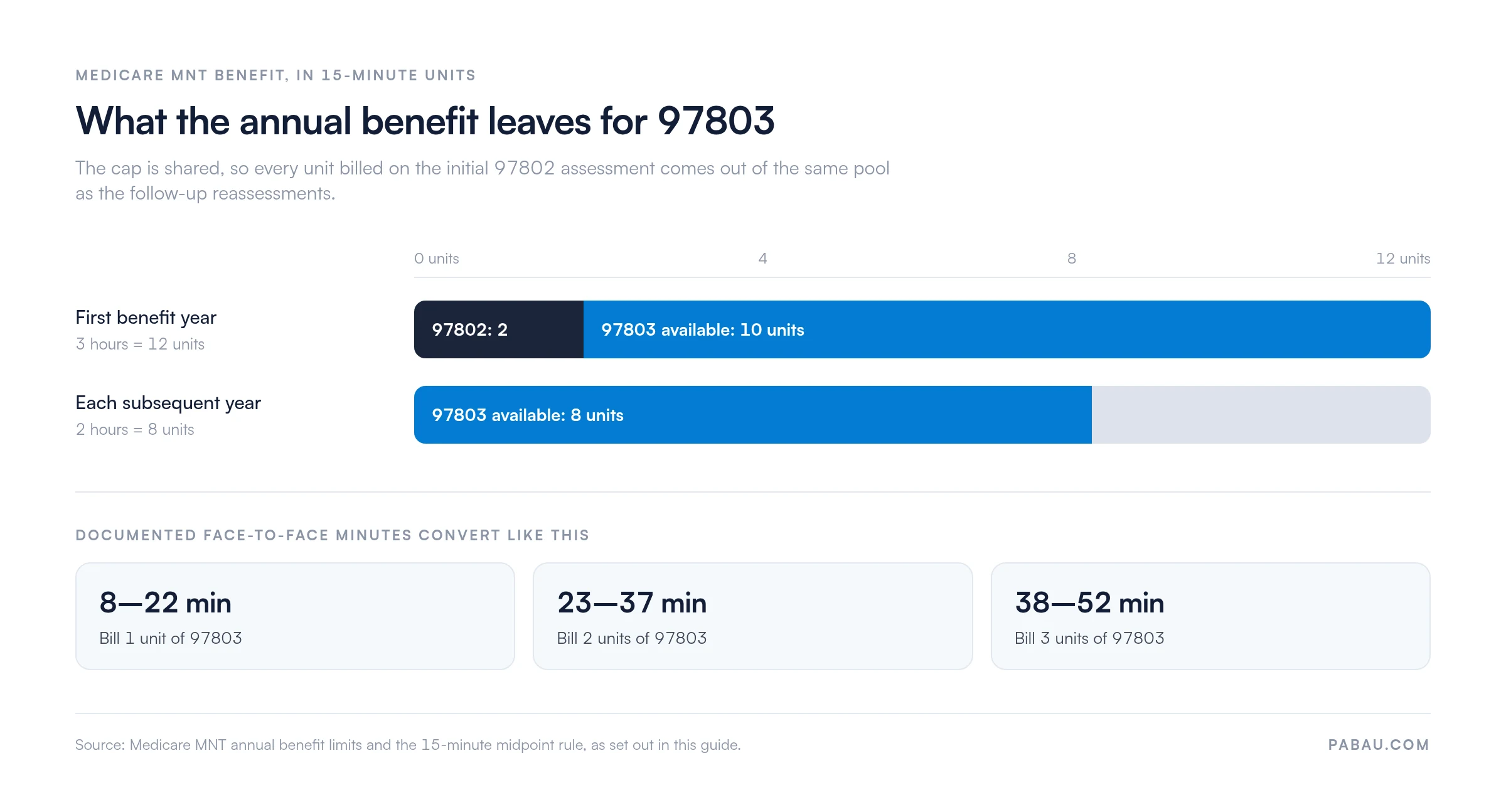
Exceeding the annual benefit cap is the top denial trigger. Medicare allows 3 hours in the first benefit year and 2 hours after.
Practice management software like Pabau converts documented session time into units and tracks each patient’s remaining benefit hours.
CPT code 97803 bills medical nutrition therapy (MNT) reassessment and intervention, individual, face-to-face with the patient, each 15 minutes.
It is the follow-up code to 97802, so it applies to every MNT visit after the initial assessment. Registered Dietitian Nutritionists (RDNs) bill it in 15-minute units against documented face-to-face time.
This guide covers the 97802 versus 97803 distinction, Medicare coverage, and the annual benefit cap. It also covers 2026 reimbursement rates, documentation, telehealth rules, and the errors that cause denials. It is written for RDNs, medical billers, and practice managers who submit MNT claims.
CPT code 97803 describes: Medical nutrition therapy; reassessment and intervention, individual, face-to-face with the patient, each 15 minutes. The American Medical Association (AMA) maintains this code in the 97800 series for medical nutrition therapy services. You can verify the official descriptor through the AMA’s CPT code set overview.
97803 is a reassessment code, not an initial assessment. It applies only after a patient has already had an initial MNT session coded under 97802. Every face-to-face nutrition visit with that patient after the first one uses 97803, billed in 15-minute units.
Confusing 97802 and 97803 is the fastest way to generate a payer rejection. The two codes cover the same service category but different stages of the patient relationship. The full reference for CPT 97802 sets out how the initial assessment is scoped and timed.
A practical workflow: bill 97802 with 2 units for the 30-minute first visit. On every follow-up visit, bill 97803 with the unit count the documented time supports. Never bill 97802 again for the same patient unless a new diagnosable condition calls for a full initial assessment.
Medicare requires that MNT services be delivered by a Registered Dietitian Nutritionist (RDN) or a nutrition professional who meets specific credentialing requirements. Billing by an unqualified provider is a common audit trigger, so keep credential records current alongside the billing setup.
Scope of practice for dietitians varies by state. Verify your state’s licensure requirements and your Medicare Administrative Contractor’s provider enrollment policy before you bill.
Medicare covers CPT code 97803 only when the patient has a covered diagnosis. Billing 97803 against a non-covered ICD-10 code guarantees a denial. The covered conditions are statutory under the Medicare MNT benefit established by the Balanced Budget Act. Check the current descriptor in the ICD-10 code library before you link a diagnosis to the claim.
Private insurers may cover MNT for additional diagnoses, including obesity (E66.x), hypertension, and eating disorders. Check each payer’s policy individually. Do not assume a private payer mirrors Medicare’s covered diagnosis list.
CPT code 97803 is a time-based code. Every unit billed must correspond to 15 minutes of face-to-face service. Billing more units than the documented time supports is a compliance violation, not a clerical slip.
The annual benefit and the unit count are the same arithmetic, shown below. Three hours in the first benefit year equals 12 units across 97802 and 97803 combined. Two hours in subsequent years equals 8 units. Units spent on 97802 at the initial visit reduce the pool left for 97803 reassessments.
Medicare Part B covers CPT code 97803 under the medical nutrition therapy benefit. Coverage is conditional, so specific requirements must be met before a claim will process. The CMS Physician Fee Schedule lookup tool lets you verify current payment amounts by locality before billing.
According to the Centers for Medicare and Medicaid Services (CMS), MNT delivered by telehealth is covered when the other coverage criteria are met. The claim must carry the correct place-of-service code. Confirm current telehealth rules with your Medicare Administrative Contractor (MAC), because post-Public Health Emergency policy continues to change.
Medicare reimburses CPT code 97803 at roughly $30 to $45 per 15-minute unit nationally in 2026, based on available fee schedule data. Rates vary by locality through the Geographic Practice Cost Index (GPCI). Treat those figures as approximate. Confirm your own locality’s rate in the CMS fee schedule, which the 2026 final rule governs.
For practices submitting claims electronically, Claim.MD is Pabau’s US clearinghouse partner. It supports the CMS-1500 and 837P formats used for 97803 billing. It also returns real-time eligibility checks and electronic remittance advice (ERA). Reading the ERA line by line for 97803 surfaces locality rate adjustments and any systematic underpayment.
Before billing a 97803 claim to Medicare, run a real-time eligibility check to confirm the patient’s benefit year start date. A patient whose first MNT visit fell in November is in year two by March of the following calendar year, not year one. Miscalculating the benefit year is the second most common cause of annual cap denials.
Every 97803 claim needs documentation that supports the units billed. Incomplete records are a leading audit finding for MNT codes. A clinical note template built around MNT payer requirements makes it harder to close a visit with a required element missing.

The encounter record should carry the unit count in writing. Do not leave the billing team to reconstruct time from a session note. Write “30 minutes of face-to-face reassessment = 2 units of 97803” directly into the clinical record.
CPT code 97803 is eligible for telehealth billing under Medicare when all coverage criteria are met. According to HHS telehealth guidance for nutrition services, RDNs can bill Medicare for telenutrition using 97802 and 97803.
Telehealth rules for MNT changed during and after the COVID-19 Public Health Emergency. Confirm current eligibility with the MAC for your jurisdiction, whether that is Novitas, Noridian, CGS, NGS, or Palmetto.
Private and commercial payers handle medical nutrition therapy billing differently from Medicare. There is no uniform standard. Coverage, prior authorization requirements, and eligible diagnoses all vary by plan.
When you verify benefits for 97803, ask the payer four specific questions rather than a general coverage question.
A general nutrition counseling benefit does not always map to 97803. Get the covered code list in writing before the first visit.
Denials on 97803 claims follow predictable patterns, and most are preventable. The checks that catch them belong before the claim goes out, not after the rejection arrives. Five elements are worth confirming on every billing run.
Tracking 15-minute units, annual benefit hours, and per-patient referral records by hand creates significant administrative load for RDN practices. Pabau’s automated claims management software takes that work off the billing team. Session time logged at the point of care becomes a unit count, and each patient’s remaining benefit hours sit on their record.
Audit your last 90 days of 97803 claims for unit count consistency. Pull every claim where units exceed 3 per visit, which is more than 45 documented minutes. If sessions run long but the documentation is thin, that is both a compliance risk and an audit target. Tighten the documentation first, then check whether the unit count was accurate.

Pabau tracks time-based CPT units, holds your MNT documentation templates, and submits claims electronically. Your team spends less time reconciling units and more time with patients.

97803 is a simple code with a strict envelope around it. The service itself is 15 minutes of documented reassessment. The envelope is a physician referral, a covered diagnosis, and a shared annual cap that 97802 has already drawn on.
So the decision worth making now is where the referral, the covered diagnosis, and the running minute total live. Keep all three on the patient record and the unit count writes itself. Keep them in three separate places and someone has to reconstruct them under audit.
Book a demo to see how Pabau tracks MNT units and remaining benefit hours against each patient record, before the claim ever goes out.

Need to know what belongs on the encounter record? Superbill documentation sets out the billing elements every MNT encounter record has to carry.
Claims coming back rejected? Denial management in healthcare covers how to build a systematic response to payer rejections and spot recurring patterns.
Want the checks that stop a rejection before it happens? Clean claim submission explains what has to be right on a claim for it to pay on the first pass.
Submitting electronically to Medicare or commercial payers? Claim.MD clearinghouse guide explains how a clearinghouse validates a claim before it reaches the payer.
Worried about an MNT audit? Medical billing compliance walks through the documentation standards that time-based codes are held to.
CPT code 97803 bills medical nutrition therapy reassessment and intervention, individual and face-to-face, in 15-minute units. It is the follow-up code to CPT 97802, the initial MNT assessment. Use it for every nutrition therapy visit after that first one.
CPT 97802 covers the initial MNT assessment, typically billed at 2 units for a 30-minute first visit. CPT 97803 covers every reassessment and intervention visit after it. You cannot bill 97803 without a prior 97802 visit on record for the same patient and condition. Both codes use 15-minute units and share the Medicare annual benefit cap.
Medicare allows 3 hours in the first benefit year and 2 hours in each year after, shared across 97802 and 97803. At 15 minutes per unit, that is 12 units in year one and 8 units after. A physician can refer for additional hours where medical necessity is documented. Those extra hours must be ordered before the service is delivered.
Yes. Medicare Part B covers 97803 for beneficiaries with diabetes (E10.x, E11.x, or a related subcategory) or chronic kidney disease (N18.x). It also covers post-kidney-transplant status (Z94.0) within 36 months of the transplant. A physician referral is required, and an RDN enrolled with Medicare must deliver the service. MNT is a preventive service, so the beneficiary pays no Part B deductible and no coinsurance.
Yes. Medicare pays for telehealth 97803 and identifies the claim by its place-of-service code rather than a modifier. Use POS 10 when the patient is at home, and POS 02 when they are elsewhere. Modifier GT was eliminated for professional Medicare telehealth claims in 2018. Modifier 95 is now used mainly by commercial and Medicare Advantage payers. Verify current requirements with your MAC before billing telehealth 97803.
Yes, for Medicare claims. The written referral must come from a physician, meaning an MD or a DO. Nurse practitioners, physician assistants, and clinical nurse specialists cannot currently refer patients for MNT. The order has to be in the patient record before 97803 is billed. Private payers may or may not require a referral, so check each plan’s policy.



