CCSD code H4430: Examination of rectum under anaesthetic
CCSD code H4430 pays for the examination alone CCSD code H4430 is the UK private...

Last Updated: Oct 20, 2026

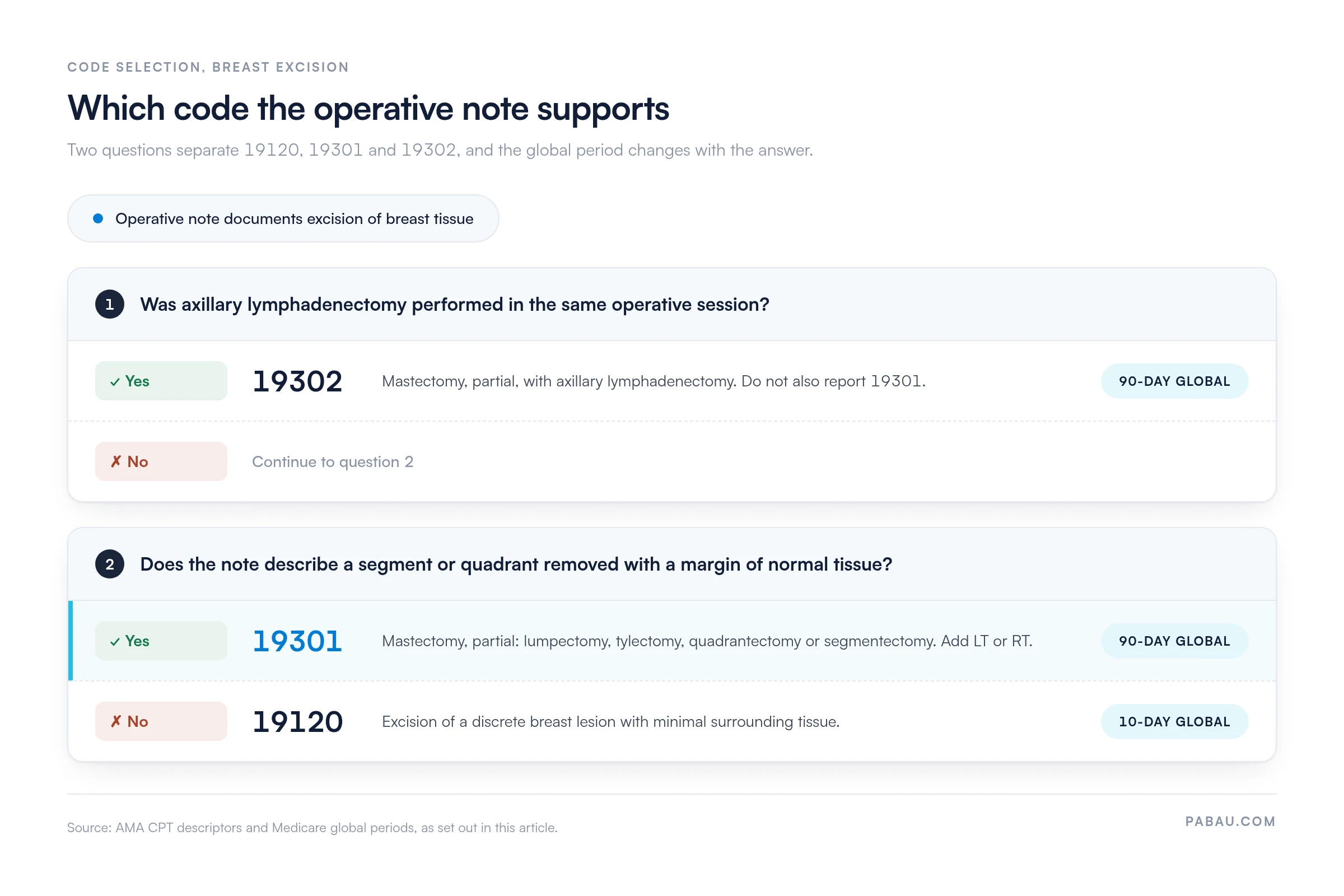
CPT Code 19301 describes partial mastectomy, meaning lumpectomy, tylectomy, quadrantectomy, or segmentectomy, without axillary dissection.
Report 19302 instead when axillary lymphadenectomy happens in the same session, and 19120 for a discrete lesion with minimal surrounding tissue.
Every 19301 line item needs a laterality modifier, either LT or RT. Modifier 50 applies only to bilateral procedures in one session.
The 90-day global period means most post-operative visits cannot be billed separately during that window.
Practice management software like Pabau submits 19301 claims electronically and checks patient eligibility before the visit.
CPT Code 19301 is the billable procedure code for a partial mastectomy.
The descriptor covers lumpectomy, tylectomy, quadrantectomy, and segmentectomy. It covers removal of part of the breast along with a margin of normal tissue, and it excludes axillary lymph node dissection.
Most 19301 denials trace back to one of four errors, and each one is catchable before the claim leaves the practice. This reference covers the official descriptor, the ICD-10-CM pairings, and 2026 Medicare rates. It then works through the modifiers, the bundling rules for sentinel node and localization procedures, and the 90-day global period.
CPT Code 19301 is maintained by the American Medical Association (AMA) and describes: Mastectomy, partial (eg, lumpectomy, tylectomy, quadrantectomy, segmentectomy).
The procedure removes a portion of breast tissue along with a surrounding margin of normal tissue. The surgeon’s aim is excising a malignant or suspicious lesion while preserving the rest of the breast structure. CPT Code 19301 does NOT include axillary lymph node dissection. If axillary dissection happens at the same operative session, report CPT 19302 instead.
The code applies to any partial excision of malignant, suspicious, or benign breast tissue, whatever term the surgeon prefers. Lumpectomy, quadrantectomy, and segmentectomy all map to 19301 when axillary dissection is absent.
During a partial mastectomy, the surgeon excises the targeted breast tissue with a margin of surrounding normal tissue. The specimen usually goes for intraoperative pathological margin assessment, to confirm clear margins before closing.
The line between what sits inside the bundle and what sits outside it is the most common source of audit exposure.
Surgeons who place a localization wire immediately before the lumpectomy may assume it is bundled. It is not. Separate reporting under CPT 19281-19288 is allowed when the criteria in the localization section below are met.
Medical necessity for 19301 rests on the ICD-10-CM diagnosis code you put on the claim. Payers define which diagnoses qualify in their Local Coverage Determinations (LCDs). Check the LCD that applies before you assume coverage. The codes below are the ones payers accept most often, and Pabau’s ICD-10-CM code library carries the full descriptors.
Specificity matters. Where the operative report documents a side, select the code for that side, such as D05.11 for the right breast rather than D05.10. Submitting an unspecified code against a record that names left or right is a clean-claim failure, and payers flag it.
Medicare pays 19301 from two separate fee schedules, depending on where the procedure happens. The Medicare Physician Fee Schedule (MPFS) governs non-facility settings. The Outpatient Prospective Payment System (OPPS) governs hospital outpatient departments.
Practices billing from a surgery center or an office use the non-facility MPFS rate. A surgeon billing the professional component at a hospital outpatient department uses the facility MPFS rate. The hospital bills its facility component separately under OPPS.
Use the CMS Physician Fee Schedule lookup tool to pull the current national and locality-specific rates for your MAC jurisdiction. The table below shows 2026 national average estimates. Geographic adjustments apply through GPCI multipliers, so your allowable will differ from the national figure.
Rates vary widely by geographic payment locality. The FastRVU 2026 RVU lookup tool returns the Work RVU, PE RVU, and MP RVU values. Use it to calculate your locality-adjusted rate before you submit.
Verify your locality-adjusted rate before billing. The national average for CPT Code 19301 is a reference point only. High-cost localities such as San Francisco, Manhattan, and Alaska can run 30-40% above it. Rural localities may fall 15-20% below. Pull your own MAC locality payment from the CMS MPFS lookup each October, when the final rule publishes.
Modifier selection is the single largest source of 19301 claim denials. Partial mastectomy is a unilateral procedure by definition, so every claim must identify which breast was operated on. Most payers treat missing laterality as an incomplete claim.
LT/RT vs. modifier 50: Most Medicare contractors and commercial payers prefer LT and RT on separate line items. They accept modifier 50 on a single line less often, so verify your MAC’s preference before submitting bilateral 19301 claims. Incorrect modifier format is a common reason for bilateral rejections, even when the underlying coding is correct.
The mastectomy code family shares overlapping terminology. Choosing wrongly between 19301, 19302, 19303, and 19120 is one of the top upcoding audit triggers for breast surgery practices. Excision of glandular male breast tissue for gynecomastia falls to CPT code 19300, not to a partial mastectomy code. The table below sets out each code’s scope.
This distinction is a known NCCI audit trigger. CPT 19120 describes excision of a single breast lesion with a narrow margin. CPT Code 19301 describes removal of a larger tissue segment, such as a quadrant or a lumpectomy cavity, with a substantive surrounding margin.
The operative note must support whichever code is selected. When the surgeon’s dictation uses the terms interchangeably, a documentation review before billing settles it. Two questions do most of that work, and the answer also fixes the global period.
Sentinel lymph node biopsy (SLNB) is routinely performed alongside CPT Code 19301 for breast cancer staging. Two codes support SLNB when reported separately from 19301.
Verify current NCCI edit status before reporting 38900 or 38525 alongside 19301. The National Correct Coding Initiative edits for these code pairs change quarterly.
If a column 1 / column 2 edit exists without a modifier indicator of 1, the codes cannot be unbundled. Confirm the current edit through the AAPC Codify CPT lookup or the CMS NCCI policy manual before billing.
Image-guided localization often happens before a partial mastectomy, to help the surgeon find a non-palpable lesion. CPT codes 19281-19288 cover placement of a localization device, such as a wire, a radioactive seed, or a magnetic seed. They are separately reportable from 19301 under the conditions below.
Practices performing localization and partial mastectomy at the same facility should confirm which provider’s claim carries each code. Putting a localization code on the surgeon’s claim when the radiologist did the localization is a billing error. It carries compliance exposure, not just a denial.
Four error categories account for most 19301 denials and audit findings. Sorting them by category makes each one easier to catch before submission. A clean claim for breast surgery means clearing all four before you hit send.
Practices with high 19301 denial rates should run a root-cause analysis by these four categories. Categorizing first, then resubmitting, beats reworking claims one at a time.
CPT Code 19301 carries a 90-day global period. The MPFS rate already covers routine post-operative care for the 90 days after the procedure. Billing those visits separately creates an overpayment, and it is subject to recovery.
Practices moving patients to oncology follow-up inside the 90-day window should confirm which provider billed 19301. If that same surgeon sees the patient for a separate issue, the visit needs modifier 24. The record has to name the separate diagnosis.
Breast surgery billing teams repeat the same four checks on every 19301 claim.
Run those four by hand across a full surgical schedule and a claim will go out short one detail. It comes back weeks later as a denial, by which point the coder has to reconstruct what happened in theater.
Practice management software like Pabau handles the submission side of that work. Pabau’s claims management software checks patient eligibility in real time before the visit, then submits the claim electronically through the Claim.MD clearinghouse. Claim status comes back into the same screen, and ERA remittance files post against the claim they belong to.
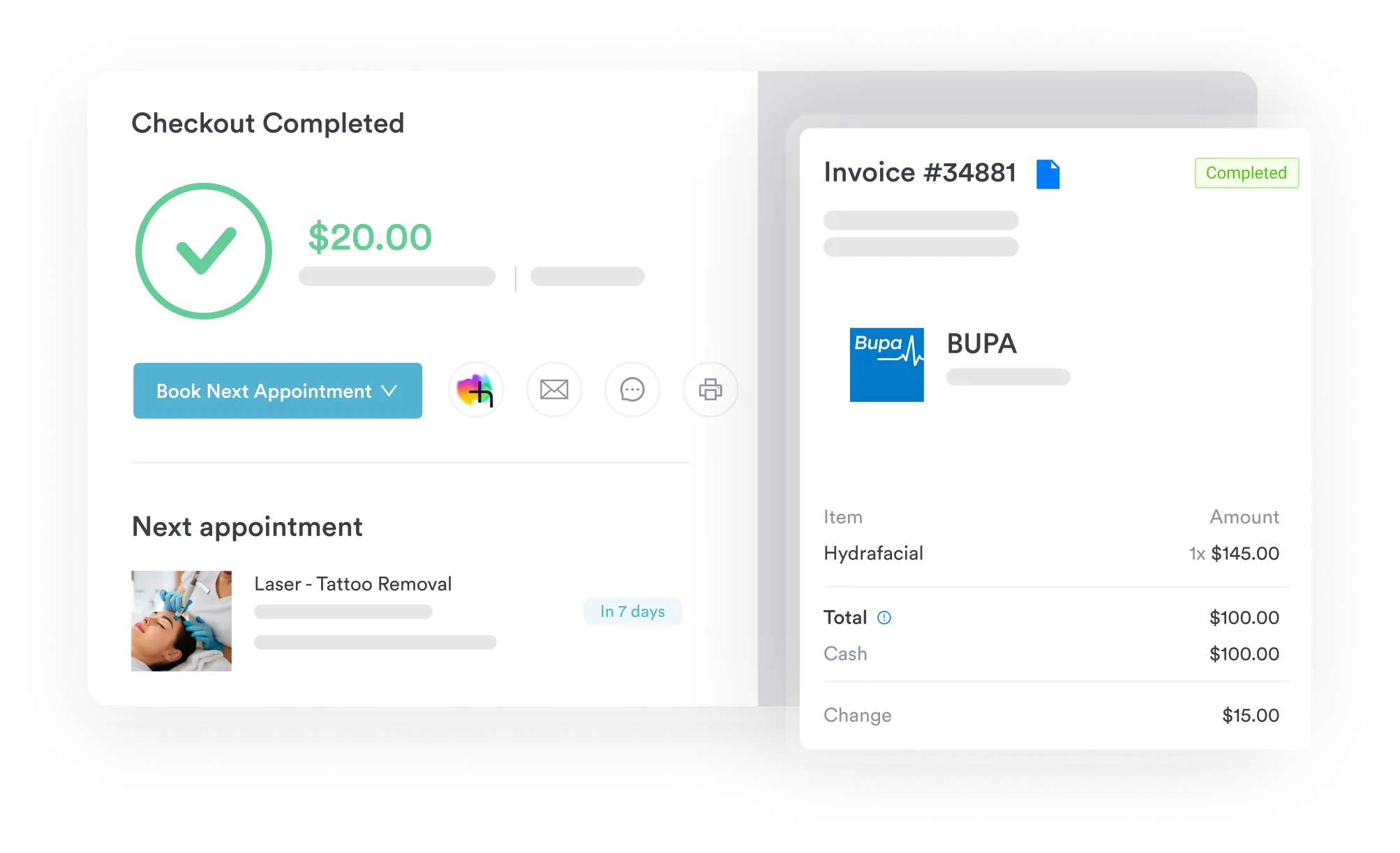
That saves the coder a trip to the payer portal for every status update. It also removes the manual work of matching a remittance file back to a claim. The 19301 line item, its modifiers, and its diagnosis code stay attached to the visit that produced them.

Pabau’s claims management software checks eligibility in real time and submits 19301 claims electronically through Claim.MD. Claim status and ERA remittances land back in the same patient record.

19301 is a plain descriptor sitting on top of an unforgiving claim. The denial almost never comes from the surgery. It comes from a missing LT, an unbundled sentinel node code, or a diagnosis vaguer than the operative note.
So the work is front-loaded. Read the operative note before you pick the code. Check the quarter’s NCCI table before you co-bill. Note the global period end date the day you submit.
Do those three and the claim usually needs no follow-up. Book a demo to see how Pabau submits and tracks surgical claims straight from the visit record.

Managing surgical claim denials across procedure codes? Denial management in healthcare covers root-cause analysis frameworks and resubmission workflows for surgical specialties.
Need a reference for clean claim requirements? Medical superbill guide explains what elements a compliant surgical superbill must include to support CPT code billing.
Evaluating clearinghouse options for surgical billing? Medical claims clearinghouse guide breaks down how clearinghouses validate and route claims for Medicare and commercial payers.
CPT Code 19301 is the AMA procedure code for partial mastectomy, including lumpectomy, tylectomy, quadrantectomy, and segmentectomy. It covers removal of part of the breast with a surrounding margin of normal tissue. Axillary lymph node dissection is not included. It carries a 90-day global period under Medicare.
CPT 19302 includes axillary lymphadenectomy in addition to the partial mastectomy. CPT 19301 does not. When the surgeon performs both partial mastectomy and axillary dissection in the same session, report 19302 only. Reporting both 19301 and 19302 for the same encounter is a bundling violation.
The most common pairings are C50.911 and C50.912 for malignant neoplasm of the right or left breast. D05.10 to D05.12 cover intraductal carcinoma in situ, D24.1 and D24.2 cover benign neoplasms, and N63.10 covers an unspecified lump. Always select the laterality-specific code when the operative report documents a specific side.
Laterality modifiers LT (left) or RT (right) are required on every 19301 claim. Modifier 50 applies to bilateral procedures in the same session. Modifier 59, or a more specific X-modifier, applies when co-billing sentinel node or localization codes. Use it where NCCI edits would otherwise bundle them. Modifier 24 applies to unrelated E/M visits during the 90-day global period.
CPT 19301 carries a 90-day global period. Routine post-operative visits, wound checks, and follow-up care are included in the surgical fee. They cannot be billed separately during that window. Unrelated conditions and complications requiring a return to the OR may be billed separately with the appropriate modifier.
Yes. Localization device placement codes 19281-19288 may be reported separately from 19301 when a different provider performs the localization. The same applies when it is documented as a distinct pre-operative procedure. Verify current NCCI edit status quarterly, because bundling rules for this pair change.