HCPCS Code L0472: Hyperextension TLSO billing guide
HCPCS code L0472: Official descriptor and device definition HCPCS code L0472 des...

Last Updated: Nov 5, 2026
72149 is the CPT code for magnetic resonance imaging, spinal canal and contents, lumbar; with contrast material(s). Report it when contrast is the only enhancement in the study, with no pre-contrast series in the same session.
A study without contrast is 72148, and a study with both series is 72158. Under the 2026 Medicare fee schedule, 72149 carries 8.07 total RVUs, about $269.55 nationally before locality adjustment. Three checks protect the claim: prior authorization, contrast documentation and a diagnosis that justifies contrast.
Let Pabau's smart automation suggest the right codes, reduce claim denials, and keep your practice compliant—effortlessly.
Automate repetitive tasks and focus on what matters most—your patients.
Reduce coding errors and ensure compliance with the latest regulations.
Clean claims, fewer denials, and faster reimbursements.
Powerful insights and reporting to help your practice thrive.
HIPAA compliant SOC 2 certified GDPR-compliant Trusted by 4,000+ clinics worldwide

CPT code 72149 is lumbar spine MRI with contrast only. Use 72148 without contrast and 72158 when both series are acquired.
Missing prior authorization and missing contrast documentation are two of the most frequent reasons 72149 claims are denied.
Under the 2026 Medicare fee schedule, 72149 carries a work RVU of 1.74 and 8.07 total RVUs in every setting.
Degenerative disc disease alone is often not enough, so pair 72149 with a diagnosis that explains why contrast was needed.
Pabau’s claims management software pre-fills the claim from the patient record and checks required fields, such as authorization numbers, before submission.
CPT code 72149 reports magnetic resonance imaging of the lumbar spinal canal and its contents, with contrast material. It sits in the Radiology section of the American Medical Association’s CPT code set, among the imaging codes for the spine and pelvis.
The study covers the lumbar and lumbosacral spine. A gadolinium-based contrast agent (GBCA) is given intravenously, and the images are taken after it. Use 72149 only when contrast is the only enhancement, with no pre-contrast series.
A clean 72149 claim shows that contrast was both ordered and given during the study. The radiology report must say so plainly. A note that contrast was available doesn’t count.
The order should request contrast-enhanced imaging and state the clinical indication. Payers look hard at that indication, especially for post-operative spines and suspected tumors. A generic indication such as “lumbar pain” is a frequent reason for a documentation denial.
Record the agent by name, because the contrast itself may be billed on its own line. In a physician office, gadobutrol is reported with A9585, for example. Under Medicare’s hospital outpatient system, the contrast is packaged into the scan’s payment.
Three codes cover lumbar spine MRI, and they differ only in how contrast was used. If no contrast was given at any point, the study is 72148, whatever the order said. Picking the wrong one is a common error in this family.
Two questions settle it every time, and the diagram below walks through them. Answer both from the report’s sequence list before you finalize the code.
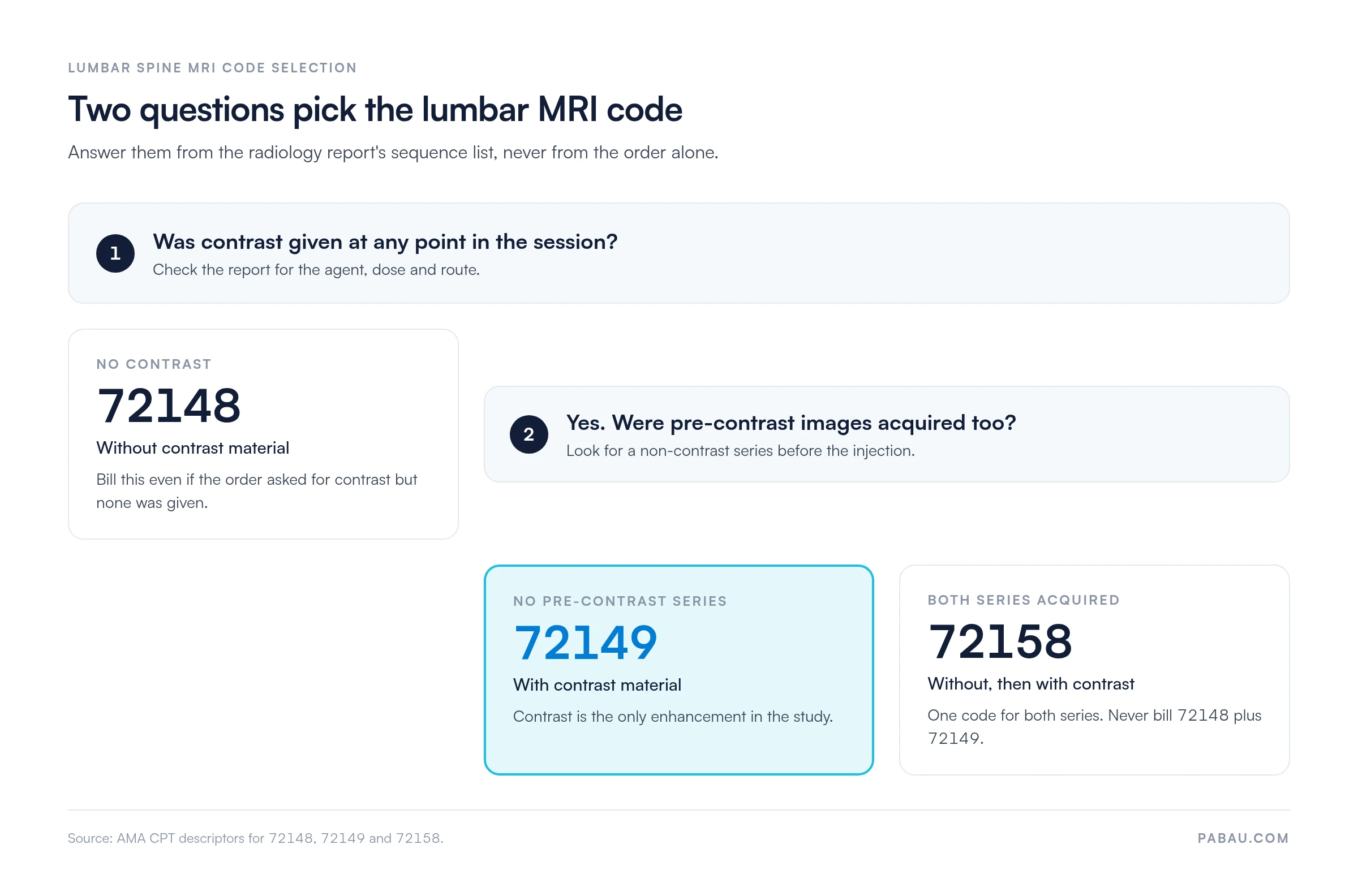
A patient two years after a lumbar fusion reports new leg pain and fever. The order reads “MRI lumbar spine with contrast, rule out hardware infection.”
The report lists post-contrast sequences only and documents IV gadobutrol, with its dose and route. That makes the study 72149. Had the report listed a non-contrast series first, the code would be 72158.
Diagnosis coding follows the report. If infection is confirmed, T84.63XA applies. If not, code the presenting signs and symptoms, because outpatient rules don’t allow coding a “rule out” diagnosis.
A contrast study needs a diagnosis that explains why gadolinium was used. For many payers, degenerative disc disease alone is not enough. The pairings below are common for 72149, but coverage still varies by payer.
Read code titles closely. M51.16 covers disc disorders with radiculopathy, not simple disc degeneration. Lumbar stenosis also needs a sixth character. Use M48.061 without neurogenic claudication and M48.062 with it.
Then check the pairing against the payer’s coverage policy, or the local coverage determination (LCD) for Medicare claims.
Medicare sets the 72149 rate through the CMS Physician Fee Schedule (MPFS). For 2026, the code carries 8.07 total RVUs. At the $33.4009 conversion factor, that works out to about $269.55 nationally.
Practice expense is the same in facility and non-facility settings, so the total doesn’t change by site. Your payment still moves with the geographic practice cost index (GPCI) for your locality.
The figures below come from FastRVU’s 2026 lookup for 72149, which mirrors CMS data.
The global payment covers two parts. The professional component is the radiologist’s read, and the technical component is the scanner, staff and supplies. When the two are billed separately, modifiers 26 and TC apply.
Note: RVUs change every year with the final MPFS rule, so check the current values before you set fees. Commercial rates depend on each payer’s contract. Confirm them against your own fee schedules.
72149 follows standard radiology modifier rules. The wrong modifier, or a missing one on a split claim, is a common way to lose payment on a contrast study.
When a physician group and a hospital split the global service, both claims need the same date of service. The 26 and TC claims must also carry matching diagnosis codes.
Before splitting a 72149 global claim into modifier 26 and TC components, verify whether the payer requires a single global claim. Some commercial plans deny split-component billing unless the physician and facility have separate contracts with the payer. Check the payer’s radiology billing guidelines before submission.
Each handoff in a 72149 claim is a chance to lose the authorization or the contrast detail. Here’s the usual path, step by step.
Denials on 72149 cluster around three causes: missing prior authorization, weak medical necessity documentation and the wrong code. Missing prior authorization and missing contrast documentation are two of the most frequent. A structured denial management workflow helps your team spot repeat patterns early.
Prior authorization is the step most worth tightening. Our guide to the prior authorization process walks through each step from request to approval. Pair it with insurance eligibility verification at scheduling, so coverage and authorization are confirmed before the patient arrives.
72149 belongs to a family of spinal MRI codes, split by region and contrast protocol. Knowing the full set helps prevent cross-region errors when a study covers adjacent segments.
When one session covers two regions, such as lumbar and thoracic, each region has its own code. Check the current NCCI edit pair before billing both. Add 59 or an X modifier only when documentation supports a distinct service.
For descriptors and bundling notes on each code, see the AAPC CPT code reference. Our CPT code library covers the rest of the radiology range.
Many imaging teams track authorization numbers in one place and build claims in another. A missing authorization number or a blank member ID then shows up only when the denial arrives.
Pabau, the practice management and billing platform we build, pre-fills the claim from the patient record. Its CPT and ICD-10 lookup libraries let coders find 72149 and its diagnosis codes in one search. Our claims management software also checks that required fields are complete before the claim can be sent.
In the US, claims go out through Claim.MD, with real-time eligibility checks and claim tracking. So your team sees coverage problems before the scan, and claim status without calling the payer.
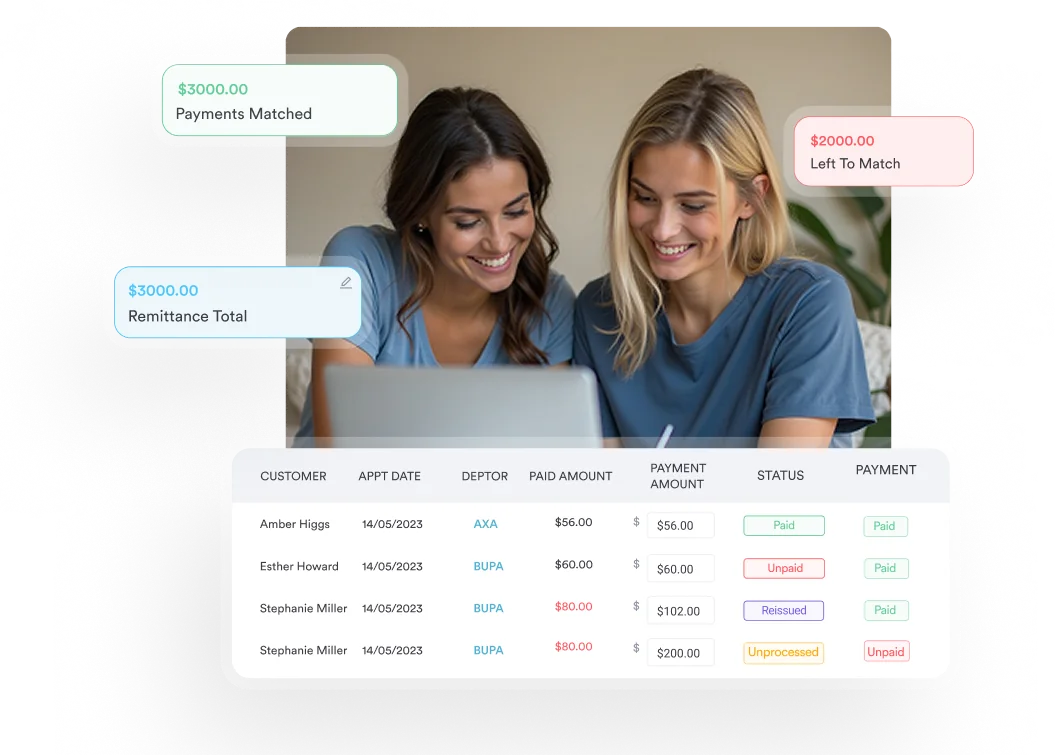

Pabau pre-fills claims from the patient record and checks required fields, like authorization numbers, before sending. US claims go through Claim.MD with real-time eligibility checks.

72149 claims usually fail before the patient leaves the building. The order didn’t request contrast, the authorization wasn’t confirmed, or the report didn’t document the gadolinium. Fixing those habits at the point of care costs far less than working denials later.
Start with the sequence list and the authorization number, because those two checks catch errors that are expensive to fix later. If you want claims that leave complete, book a demo to see how Pabau checks required fields before submission.

Need to understand how clearinghouse claims submission works? Medical claims clearinghouse guide covers how claims move from your system to the payer and where they break down.
Seeing repeated claim rejections on imaging codes? Denial codes in medical billing breaks down the most common CARC codes and what each one requires for appeal.
Racing a payer’s filing deadline? Timely filing limits explains how filing windows work and how to stay inside them.
Need a standard form for authorization requests? Medical prior authorization form gives your team a template for the details payers ask for.
Want to streamline your revenue cycle end to end? Revenue cycle management fundamentals explains the full workflow from eligibility verification to payment posting.
Not always. In a physician office or imaging center, the agent is usually billed separately with its HCPCS code, such as A9585 for gadobutrol. In a hospital outpatient department, Medicare packages the contrast into the payment for the scan.
Not for one lumbar session. When the radiologist acquires images without and then with contrast, report 72158 alone. Billing 72148 plus 72149 for the same study unbundles the service and invites a denial.
Traditional Medicare generally doesn’t require prior authorization for a lumbar MRI. Medicare Advantage and commercial plans often do, and their rules differ by plan. Confirm with the payer before scheduling, and record the authorization number against 72149.
The 2026 national amount is about $269.55, from 8.07 total RVUs at a conversion factor of $33.4009. The work RVU is 1.74. Your local payment changes with the geographic adjustment for your locality.
Payers usually accept diagnoses that explain why contrast was needed. Examples include C79.49 or D43.4 for tumors, M46.46 for lumbar discitis and T84.63XA for spinal hardware infection. Degenerative disc disease alone is often not enough, so check the payer’s coverage policy.
No. CMS assigns 72149 the global indicator XXX, so the global surgery concept doesn’t apply. Each study is billed on its own date of service.