

HCPCS Code L0472: Hyperextension TLSO billing guide
HCPCS code L0472: Official descriptor and device definition HCPCS code L0472 des...

Last Updated: Nov 5, 2026
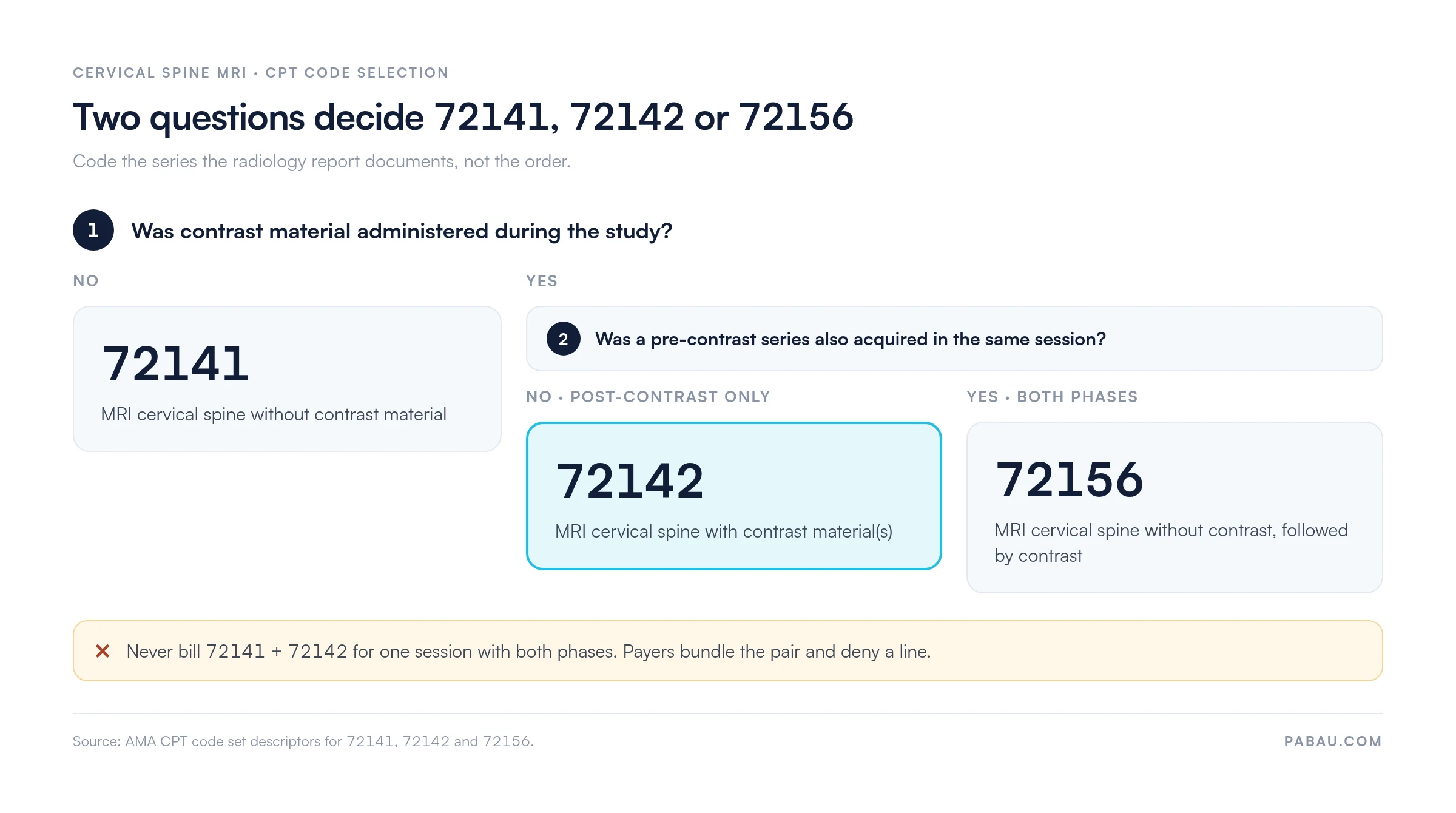
72142 is the CPT code for magnetic resonance (eg, proton) imaging of the cervical spinal canal and contents with contrast material(s). It covers a cervical spine MRI in which only a post-contrast series is acquired.
Without contrast, the study is 72141. When a pre-contrast and a post-contrast series are acquired in the same session, the correct code is 72156.
Let Pabau's smart automation suggest the right codes, reduce claim denials, and keep your practice compliant—effortlessly.
Automate repetitive tasks and focus on what matters most—your patients.
Reduce coding errors and ensure compliance with the latest regulations.
Clean claims, fewer denials, and faster reimbursements.
Powerful insights and reporting to help your practice thrive.
HIPAA compliant SOC 2 certified GDPR-compliant Trusted by 4,000+ clinics worldwide

CPT code 72142 covers a cervical spine MRI with a post-contrast series only. Use 72141 without contrast and 72156 for both phases.
The radiology report must explicitly confirm contrast administration; missing that confirmation is the leading documentation denial.
Most commercial payers and Medicare Advantage plans require prior authorization for 72142 before the scan is performed.
Pabau’s claims management software links clinical documentation to charge capture, so contrast confirmation is checked before a 72142 claim goes out.
CPT code 72142 describes “magnetic resonance (eg, proton) imaging, spinal canal and contents, cervical; with contrast material(s).”
The American Medical Association’s CPT code set places it in the Diagnostic Radiology subsection covering spinal MRI studies (72141-72158). The code is active, billable, and has remained stable across recent code cycles.
Three conditions must all be true, and documented, for 72142 to be the correct code:
Use PGM Billing’s CPT lookup tool to cross-reference the descriptor and confirm any annual edits before billing.
Confirm the official descriptor annually. The AMA publishes the updated CPT code set each September, effective January 1, and procedure descriptors occasionally change. Using a stale descriptor on a prior authorization request can trigger a mismatch with the payer’s code database.
These three codes are a frequent source of cervical MRI miscoding. A coder who defaults to 72141 when the report says “MRI neck” underbills a contrast study. A coder who bills 72142 when contrast was ordered but never given creates an overpayment the payer can recover on audit.
The clinical driver for choosing 72142 over 72141 is the reason contrast is needed. Gadolinium-based contrast agents enhance vascular structures, areas of inflammation, and neoplastic tissue. Contrast is clinically appropriate when the ordering physician suspects a cervical cord tumor, an epidural abscess, or an active multiple sclerosis plaque. It also fits the evaluation of surgical changes at a post-operative site.
When both a pre-contrast and post-contrast series are acquired in the same session, bill 72156, not a combination of 72141 and 72142. Unbundling the two codes is a billing error. Payers deny one line and may flag the account for review.
The choice comes down to two questions about what the radiology report documents, not what the order said.
Modifier selection for 72142 depends on who performs the study and who interprets it. It also depends on whether the service is distinct from another procedure that day.
The global code (no modifier) is billed when the same group both performs and interprets the scan. Modifier 26 applies when a radiologist employed by a private group reads studies at a hospital-owned scanner. Never append both 26 and TC to the same line, because the two are mutually exclusive.
Medical necessity is established by pairing 72142 with an ICD-10-CM diagnosis code that justifies contrast-enhanced cervical imaging. Without a matching diagnosis, most payers will deny on medical necessity grounds regardless of what the radiologist documents.
Always verify diagnosis code pairings against your MAC’s Local Coverage Determination for spinal MRI. LCD policies vary by jurisdiction and are updated independently of the CPT code set. A diagnosis that supports 72141 does not automatically support 72142.
Multiple sclerosis needs extra care since October 1, 2025, when G35 became a non-billable category. Report the most specific subcode the record supports, or G35.D when the type is not documented.
CPT code 72142 reimbursement under Medicare’s Physician Fee Schedule varies by setting and geographic adjustment. The RVUs below come from the FastRVU 2026 lookup, and your payment depends on the GPCI (Geographic Practice Cost Index) for your locality. Verify current values through the CMS Physician Fee Schedule look-up tool.
Use the FastRVU 2026 RVU lookup tool for current work, practice expense, and malpractice RVU values with geographic adjustment built in. Commercial payer rates are negotiated separately and are typically higher than Medicare. Never apply Medicare rates to commercial claims without checking your contract.
Prior authorization is required by most commercial payers and many Medicare Advantage plans before a cervical spine MRI with contrast is performed. Traditional Medicare (Parts A and B) does not require prior authorization for outpatient MRI, but Medicare Advantage organizations set their own PA rules.
Build the PA check into scheduling, so an imaging order is flagged before the appointment is booked rather than after the scan.
PA requirements vary by payer, plan, and geographic MAC jurisdiction. Never assume a prior authorization rule applies universally; verify with each individual payer before scheduling.
A clean 72142 claim requires documentation in two places: The ordering physician’s note and the radiologist’s report. Both must exist and must agree with each other, because a report that doesn’t match the order is what triggers the downstream denial.
A clean claim for 72142 passes all payer edits on first submission. The documentation checklist above is what separates a first-pass approval from a request for additional information that delays payment by 30-45 days.
Denial patterns for 72142 are consistent across payer types. Effective denial management starts with knowing which denial reason is most likely before the claim goes out.
Review the medical billing denial codes guide to understand the CARC/RARC reason codes that accompany these denials and to build an efficient appeal workflow.
Run a monthly report on 72142 claims filtered by denial reason code. If CO-15 (missing or invalid authorization) is in your top three denial reasons, the PA check is failing at scheduling. Fix that step before you retrain billers.
A denied CPT 72142 claim is recoverable in most cases when documentation supports the original billing decision. The appeal window varies by payer. Medicare requires the first-level redetermination request within 120 days of receiving the initial determination (the remittance advice date plus 5 days is presumed receipt). Commercial payers typically allow 60-180 days, depending on plan terms.
CPT code 72142 sits within a broader family of spinal MRI codes covering cervical, thoracic, and lumbar regions. Use this reference table when billing multi-level spine imaging or cross-checking code selection across body regions.
A 72142 denial usually traces back to a manual check that slipped. Someone has to confirm contrast in the radiology report, attach a live prior authorization number, and match the diagnosis to the LCD. When those checks sit in separate systems, a claim can go out with one of them missing.
Pabau, the practice management platform we build, ties each clinical note to charge capture through its claims management software. The code, modifier and diagnosis are set where the visit is documented, and the fee schedule rate applies when the claim is generated.
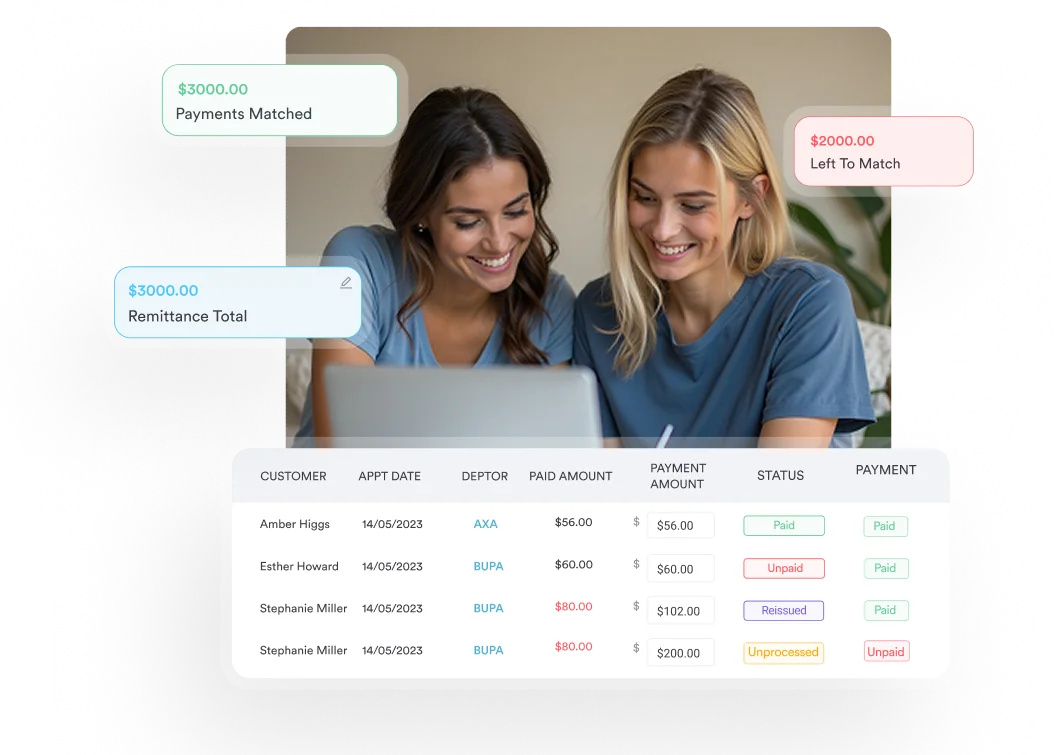
Finished claims go out through Pabau’s Claim.MD integration as electronic CMS-1500 claims to thousands of US payers. Denials return on the ERA with their reason codes, so your team can correct and resubmit while the documentation is fresh.

Pabau connects clinical documentation to charge capture so contrast confirmation, modifier selection, and prior auth status are all resolved before the claim is submitted.

Treat 72142 as a documentation code first and a coding decision second. Once the radiology report confirms contrast, names the agent and matches the order, the choice between 72141, 72142 and 72156 settles itself.
The trade-off is effort moved to the front of the process. Checking prior authorization and the LCD diagnosis at scheduling takes minutes per order, while a denied claim can take a 120-day redetermination cycle to recover.
Book a demo to see how Pabau checks contrast and prior authorization before a 72142 claim goes out.

Need a clearinghouse that handles 837P radiology claims? Medical claims clearinghouse guide explains how clearinghouses validate and route imaging claims before they reach the payer.
Seeing high denial rates across your radiology billing? Medical billing compliance overview covers the documentation and regulatory standards that keep imaging claims clean.
Want to understand how remittance data flows back after claim submission? Electronic remittance advice (ERA) guide walks through how 835 remittance files carry denial reasons and payment details back to your billing system.
CPT code 72142 covers magnetic resonance imaging of the cervical spine performed with contrast material, specifically gadolinium-based contrast agents administered intravenously during the scan. The code captures the full imaging service when contrast is administered, distinguishing it from the without-contrast code 72141 and the combined without-and-with-contrast code 72156.
72141 is MRI of the cervical spine without contrast; 72142 is the same study performed with gadolinium contrast. Use 72142 when the ordering physician needs enhancement patterns that point to neoplasm, infection, active demyelination, or post-surgical changes. If contrast is ordered but not administered, bill 72141. If both pre- and post-contrast series are acquired, bill 72156 instead.
Yes, in most cases. Most commercial payers and Medicare Advantage plans require prior authorization for cervical spine MRI with contrast before the scan is performed. Traditional Medicare (Parts A and B) does not require prior authorization for outpatient MRI, but authorization requirements vary by payer and plan. Always verify with the specific payer before scheduling.
The most common modifiers are 26, TC and 59. Modifier 26 is the professional component, used when the radiologist interprets but does not own the equipment. TC is the technical component, billed by the facility for the scanner and contrast. Modifier 59 marks a distinct service, such as another imaging study on a different body part that day. Never append both 26 and TC to the same line, and never add LT or RT to cervical spine imaging.
The most frequent denial reasons are missing or expired prior authorization and medical necessity missing from the ordering note. Wrong code selection is next, such as billing 72142 when no contrast was given. A radiology report that never confirms contrast administration also triggers denials. Unbundling 72141 and 72142 on the same claim instead of billing 72156 also triggers automatic denial edits.
Use 72142 when only a post-contrast cervical spine series is acquired. Use 72156 when both a pre-contrast and a post-contrast series are acquired in the same session. Never bill 72141 and 72142 together for a single study that covered both phases; payers will bundle them and deny one line.



