

HCPCS Code L0472: Hyperextension TLSO billing guide
HCPCS code L0472: Official descriptor and device definition HCPCS code L0472 des...

Last Updated: Nov 5, 2026
62380 is the CPT code for endoscopic decompression of the lumbar spinal cord or nerve roots at one interspace. It covers laminotomy, partial facetectomy, foraminotomy, discectomy, and herniated disc excision, all performed through an endoscope.
The AMA created it in 2016, effective for the 2017 code year, as the first dedicated endoscopic spine code. All decompression at one level bills as a single unit, and open surgery at the same level uses 63030. Medicare pays it at a rate each contractor sets, because CMS assigns it no national RVUs.
Let Pabau's smart automation suggest the right codes, reduce claim denials, and keep your practice compliant—effortlessly.
Automate repetitive tasks and focus on what matters most—your patients.
Reduce coding errors and ensure compliance with the latest regulations.
Clean claims, fewer denials, and faster reimbursements.
Powerful insights and reporting to help your practice thrive.
HIPAA compliant SOC 2 certified GDPR-compliant Trusted by 4,000+ clinics worldwide

CPT Code 62380 covers endoscopic lumbar decompression at one interspace. It bundles laminotomy, partial facetectomy, foraminotomy, and discectomy into a single unit.
62380 applies only to the endoscopic approach. Open laminotomy or discectomy at the same level is reported with CPT 63030.
CMS assigns 62380 no national RVUs. The code is contractor-priced, so each Medicare Administrative Contractor sets its own payment.
Some MACs and commercial payers classify endoscopic lumbar decompression as investigational, so prior authorization and LCD checks come before scheduling.
Pabau’s claims management software stores each prior authorization as a case, so the authorization code follows the appointment through to the claim.
CPT Code 62380 is the American Medical Association’s code for endoscopic decompression of the lumbar spinal cord or nerve roots at one interspace.
Its descriptor reads: “Endoscopic decompression of spinal cord, nerve root(s), including laminotomy, partial facetectomy, foraminotomy, discectomy and/or excision of herniated intervertebral disc, 1 interspace, lumbar.”
The AMA CPT Editorial Panel created 62380 in 2016 as the first CPT code specific to the endoscopic lumbar approach. Before it, practices reported these procedures with unlisted or open-surgery codes.
Three attributes define the code’s scope. First, the approach must be endoscopic, with a rigid or semi-rigid working-channel scope providing both the view and the instrument corridor. Second, the work is limited to one lumbar interspace. Third, the descriptor covers every decompressive maneuver at that level, so laminotomy and discectomy at one interspace never appear as separate line items.
The surgeon inserts a series of dilators through a small incision and advances a rigid working-channel endoscope to the target interspace. Decompression then happens entirely under endoscopic visualization, with no open retractor system. Each of those steps is something the operative note has to describe.
At the target level, the surgeon may perform any combination of these decompressive maneuvers, all bundled into 62380 at a single interspace:
The scope provides illumination and magnification, so the surgeon can confirm adequate decompression before closure. That confirmation matters for documentation. The operative note must state that the nerve root was visualized and decompressed, not merely that instruments were passed.
The code bundles all decompressive work at one lumbar interspace into a single unit. Billing those components as separate line items is unbundling, which triggers audits and can amount to fraudulent billing. The table below shows what is and is not separately reportable alongside 62380.
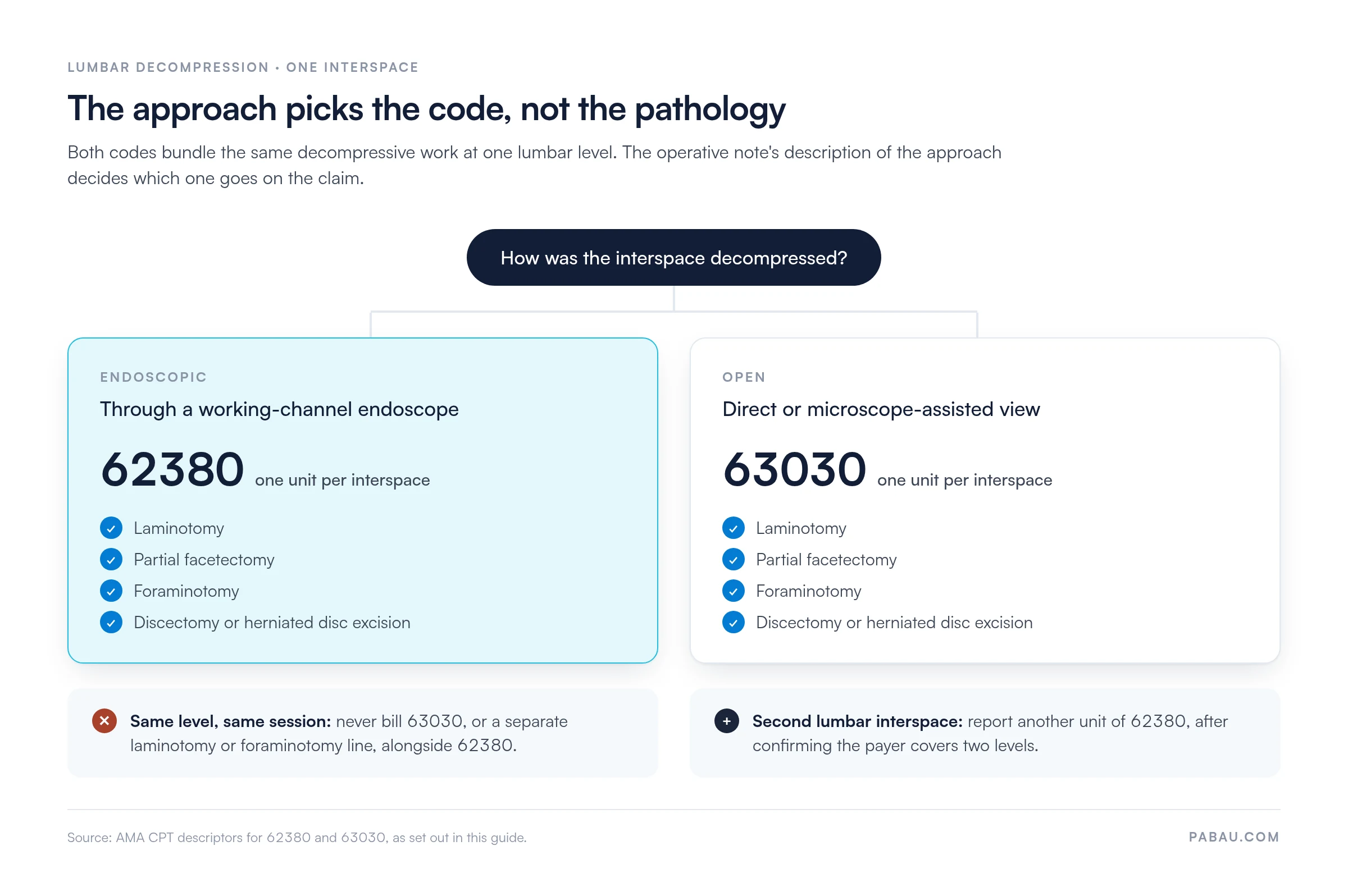
CPT 63030 describes an open laminotomy with decompression at a single lumbar interspace. The two codes cover the same anatomy at the same level, so the approach decides between them.
Endoscopic means 62380, and open means 63030. Submitting 63030 when the operative note documents a working-channel endoscope is a code-selection error that leads to a corrected claim or an audit.
Because both codes bundle the same maneuvers, the bundled list never settles the choice. The decision comes down to one question about the approach, as the chart below shows.
Several adjacent codes often appear on the same claim or in the same operative session as 62380. Knowing their rules avoids bundling errors and missed charges.
Documentation failures are the most common reason 62380 claims are denied on audit. The operative report must describe the endoscopic approach and confirm each decompressive step, not just name the procedure.
Follow clean claim submission practices by checking that each element below is in the note before the claim leaves the practice.
Run a documentation checklist before the operative note is finalized. Flag any note that names the procedure without describing the endoscopic approach, the specific interspace, or the nerve root visualization step. Each of those omissions is a common denial trigger on CPT Code 62380 claims.
Medicare coverage for CPT Code 62380 varies by jurisdiction. Each Medicare Administrative Contractor (MAC) issues its own Local Coverage Determination (LCD), and those LCDs differ significantly.
Some MACs cover endoscopic lumbar decompression when specific clinical criteria are met. Others classify it as investigational and issue non-coverage determinations.
Check your MAC’s current LCD before scheduling the procedure for a Medicare beneficiary. The CMS Physician Fee Schedule lookup shows the code’s payment status, but that status does not override a MAC’s non-coverage LCD.
Medical billing compliance at the payer level means checking both the fee schedule and the applicable LCD before filing.
Commercial payers add another layer. Several large insurers file endoscopic lumbar decompression under a percutaneous spinal surgery medical policy, sometimes cited as SURG.00071.
Where that policy applies, the insurer typically wants peer-reviewed evidence for the specific endoscopic technique. It also wants documentation of failed conservative treatment.
Prior authorization is effectively mandatory for CPT 62380 with most payers, including many Medicare Advantage plans. Run insurance eligibility verification and confirm benefit details at scheduling. Then submit the authorization request with these supporting documents:
If the first request is denied, obtain a written denial with the specific clinical reason. Then appeal with peer-reviewed literature supporting endoscopic outcomes for the documented pathology. North American Spine Society (NASS) coding and coverage resources can support the clinical rationale.
CMS assigns CPT Code 62380 no national RVUs. The code is contractor-priced, carrying status indicator C on the Medicare Physician Fee Schedule.
Each Medicare Administrative Contractor therefore sets its own payment amount for the procedure. Get your MAC’s current rate before quoting reimbursement estimates to surgeons or administrators.
Commercial payer rates for endoscopic spine procedures also vary widely. Some commercial contracts reimburse at a multiple of a Medicare rate, while others use negotiated case rates. Confirm contracted rates with each payer separately.
Ask your MAC for its 62380 rate in writing before quoting reimbursement to surgeons or practice administrators. Because CMS sets no national value for the code, a figure from another jurisdiction or an old spreadsheet does not apply to your claims.
Denials on CPT Code 62380 cluster around a predictable set of triggers. Knowing them in advance makes the difference between a clean claim and a 90-day appeals cycle. Denial management workflows for spine practices should address each one before submission.
When a denial arrives, review the medical billing denial codes on the remittance advice before drafting an appeal. The CARC and RARC codes identify the precise denial reason and point to the correct appeal route.
When claims run through the Claim.MD clearinghouse, electronic remittance advice comes back with each denial code attached.
No. As of the most recent AMA CPT Editorial Panel updates, CPT Code 62380 remains active, with no retirement or deletion date. What sources such as Becker’s Spine Review have reported is a policy debate in the spine surgery community, not an AMA action.
Critics argue that one global code for every endoscopic lumbar decompression ignores differences in pathology complexity and surgical effort. In their view, that structure limits reimbursement differentiation and may deter surgeons from offering the technique.
If 62380 were revised, deleted, or split into complexity-based codes, the AMA would publish an effective date in its annual code change announcement. That release typically comes in the third quarter for the following January.
Monitor the AMA CPT code set overview and the AAPC’s annual code change resources for any revision. The AAPC Codify CPT lookup confirms active status at any point in the billing cycle.
A 62380 claim depends on three records lining up: the payer’s authorization, the operative note, and the code on the claim. In many spine practices those sit in three places, so a lost authorization number or an outdated code only surfaces after the denial.
Pabau, the practice management platform we build, keeps them in one record. Its claims management software stores each prior authorization as a case attached to the booking. The authorization code then follows the appointment through to the CMS-1500 claim, which Pabau submits through Claim.MD.
Eligibility checks run before the visit, and the claims dashboard lets the billing team search by claim number, patient, or authorization code. A 62380 claim that comes back denied can be traced to its authorization in seconds rather than rebuilt from paper files.

Pabau stores each prior authorization as a case, carries its code from booking to claim, and submits CPT 62380 claims through Claim.MD. See how it works for a spine practice.

The approach sentence in the operative note decides a 62380 claim before anything else does. If the note names the working-channel endoscope and the interspace, the code follows. If it does not, no authorization letter will rescue the claim.
Payment is the other moving part. With no national RVU, the rate your MAC sets is the only figure worth quoting. Coverage can also differ from one MAC jurisdiction to the next. Confirm both before the surgery date, not after the remittance arrives.
Book a demo to see how Pabau keeps prior authorizations and spine surgery claims in one workflow.

Confused about remittance denial codes? Electronic remittance advice explained breaks down how to read ERA files, match CARC codes to denial reasons, and automate reconciliation.
Looking for a spine surgery billing overview? Medical billing fundamentals covers the billing cycle from charge capture through payment posting for surgical specialties.
CPT Code 62380 is the AMA code for endoscopic decompression of the lumbar spinal cord or nerve roots at one interspace. It bundles laminotomy, partial facetectomy, foraminotomy, discectomy, and disc excision into a single unit. It applies only to the endoscopic approach, and open procedures at the same level use CPT 63030.
Coverage depends on the Medicare Administrative Contractor (MAC) for the jurisdiction. Some MACs cover CPT Code 62380 when clinical criteria are met, while others classify it as investigational and issue non-coverage LCDs. Check the MAC’s current LCD before scheduling a Medicare beneficiary for this procedure.
The difference is the surgical approach. CPT 62380 requires an endoscopic working-channel technique, while CPT 63030 describes an open laminotomy with decompression. Both codes apply to a single lumbar interspace. Submitting 63030 when the operative note documents endoscopic visualization is a code-selection error that leads to a corrected claim or audit.
CMS assigns CPT 62380 no national work RVUs, and no practice expense or malpractice RVUs either. The code is contractor-priced (status C), so each MAC sets its own payment amount. Ask your MAC for its current rate before quoting reimbursement figures.
Critics argue that 62380 is a single global code covering every endoscopic lumbar decompression, whatever the pathology complexity or surgical difficulty. Because the code does not separate straightforward from complex cases, some surgeons contend it undervalues complex procedures. They argue this may discourage surgeons from offering the technique, which indirectly limits patient access to minimally invasive options.
Most payers require the specific ICD-10-CM diagnosis code, documentation of at least six weeks of failed conservative treatment, and current MRI or CT imaging. They also want an operative plan naming CPT 62380 by code number. A generic authorization for “lumbar surgery” does not protect the claim.



