

CCSD Code D1010: Radical mastoidectomy including meatoplasty
CCSD Code D1010: Definition and clinical scope CCSD Code D1010 is the UK private...

Last Updated: Nov 25, 2026
V2660 is the CCSD code for revision of decompression for central spinal stenosis in the lumbar spine. It applies when a surgeon reopens an earlier decompression at the same level, usually for recurrent stenosis or scar tissue.
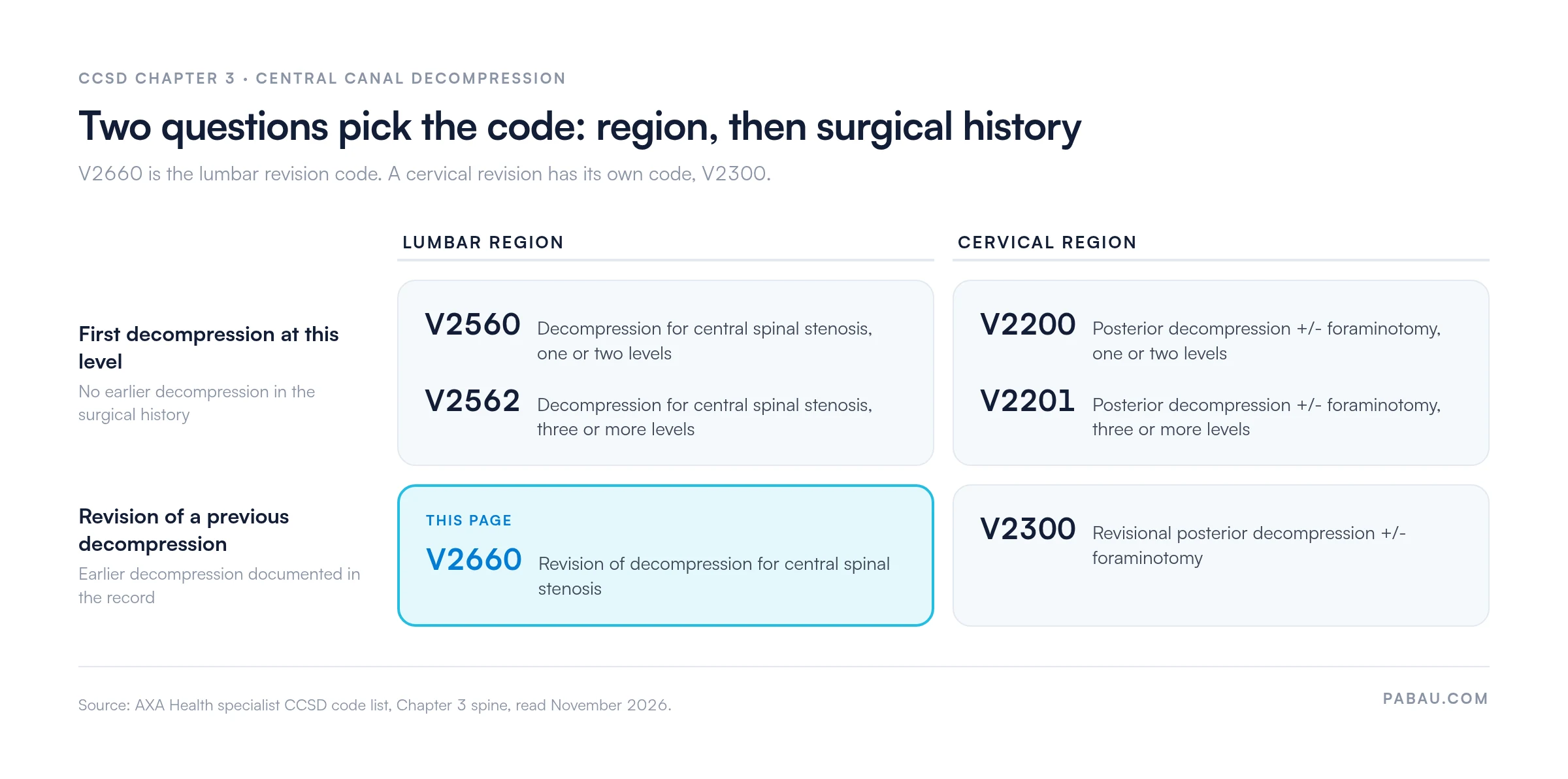
The code sits in Chapter 3 of the CCSD schedule, under the lumbar region, and is classed as a complex procedure. A first lumbar decompression uses V2560 or V2562 instead, and a cervical revision uses V2300.
Let Pabau's smart automation suggest the right codes, reduce claim denials, and keep your practice compliant—effortlessly.
Automate repetitive tasks and focus on what matters most—your patients.
Reduce coding errors and ensure compliance with the latest regulations.
Clean claims, fewer denials, and faster reimbursements.
Powerful insights and reporting to help your practice thrive.
HIPAA compliant SOC 2 certified GDPR-compliant Trusted by 4,000+ clinics worldwide

CCSD Code V2660 covers surgical revision of an earlier central canal decompression in the lumbar spine. It cannot be used for a first-time procedure.
A cervical revision decompression takes its own CCSD code, V2300, and a first lumbar decompression is coded V2560 or V2562.
Prior authorisation from Bupa, AXA Health, Vitality, and Freedom Health is required before the procedure, and claims submitted without it are routinely rejected.
Operative notes must confirm prior decompression history, intraoperative findings such as scar tissue or residual canal narrowing, and supporting imaging. Missing any element risks denial.
Pabau’s billing and clinical notes tools help private practices track V2660 pre-authorisations, attach operative documentation, and submit CCSD-coded claims accurately.
CCSD Code V2660 is the procedure code for revision of decompression for central spinal stenosis in the lumbar spine. AXA Health’s specialist code list files it under the lumbar region of Chapter 3, which covers the spine, spinal cord, and peripheral nerves.
The code comes from the CCSD schedule, the standard procedure codes for UK private healthcare. Insurers such as Bupa, AXA Health, Vitality, and Freedom Health use it for billing.
The descriptor describes a surgeon reopening and extending a previous decompression of the lumbar spinal canal. The operative word is “revision.” If the patient’s surgical history holds no earlier decompression, V2660 is the wrong code.
Revision of decompression for central spinal stenosis treats renewed narrowing of the lumbar spinal canal where a prior decompression has become insufficient. The code covers the following surgical acts when they are performed as part of that revision:
These elements are bundled within V2660. Coders should not unbundle them as separate line items. The code applies to lumbar levels only. The stenosis must also be central (affecting the main spinal canal) rather than foraminal (affecting the nerve root exit channels). A cervical revision decompression is coded separately, as V2300.
Several related procedures fall outside V2660 and carry their own CCSD codes. Applying V2660 to these is a coding error that commonly triggers claim rejection. A revision that removes disc material with a facetectomy, for example, is coded V2543 instead. Fusion is coded separately too. A combined anterior and posterior lumbar fusion has its own code, V3350.
Central spinal stenosis is a narrowing of the main spinal canal that compresses the cauda equina and nerve roots in the lower back. When a primary decompression fails to give lasting relief, or when stenosis recurs, a revision procedure may be required. The most common clinical indications include:
Patients typically present with recurrence of neurogenic claudication (leg pain and weakness brought on by walking), diminished standing tolerance, or renewed radiculopathy. Pre-operative MRI spine or CT myelogram is essential both for surgical planning and for insurer documentation requirements.
Revision spinal decompression for central stenosis is more demanding than the primary procedure. Scar tissue and altered anatomy from the original surgery make re-exposure and dissection harder. The surgeon follows this general sequence:
The operative note must capture each of these phases explicitly. Payers and medical reviewers reference the note when adjudicating the claim.
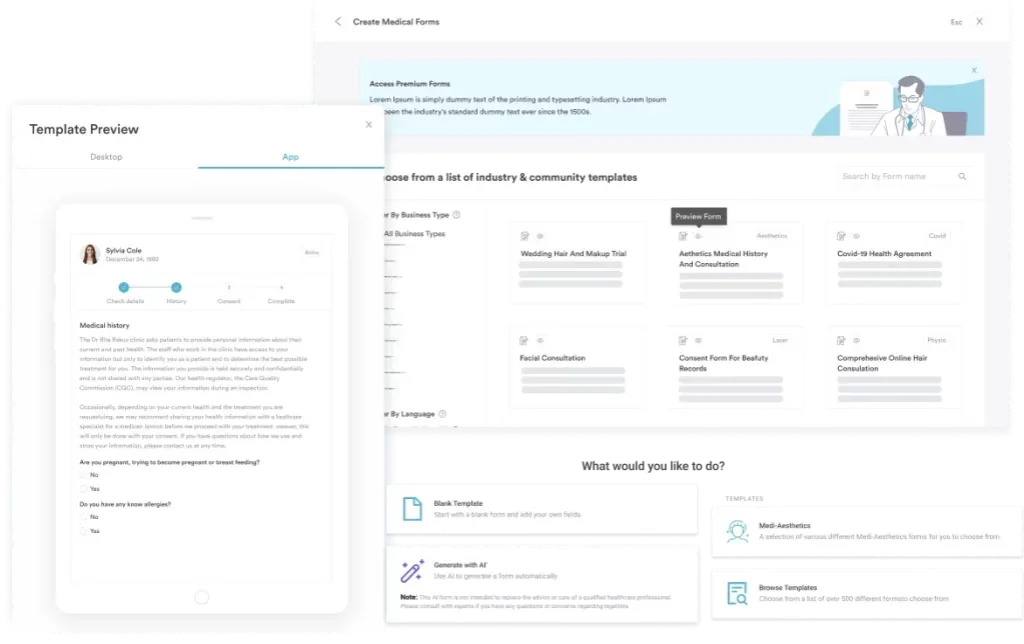
A V2660 claim stands or falls on the clinical record. Digital clinical forms and a structured patient record capture each required element at the point of care. The operative note must contain:
The clinical record should also hold the spinal surgeon’s pre-operative letter on medical necessity. Add the results of failed conservative management and the patient consent documentation.
Audit every V2660 claim before submission: check that the operative note explicitly states ‘revision of a previous decompression’ rather than ‘re-exploration’ or ‘return to theatre’. Insurers’ medical reviewers read the operative language to confirm the code fits.
All major UK private health insurers require prior authorisation before a V2660 procedure is performed. A claim submitted without pre-approval is routinely rejected for spinal revision surgery.
Confirm current requirements on each payer’s provider portal before proceeding, as policies are updated periodically. Our Bupa CCSD codes guide covers Bupa-specific coding requirements in detail.
Always verify requirements with the specific payer portal. The table above reflects typical requirements and is not a guarantee of approval.
Several CCSD codes sit adjacent to V2660 in Chapter 3 and share clinical territory. Selecting the wrong one is a common and easily avoided error. Our CCSD codes library covers the rest of the schedule. Cement injection into a fractured vertebral body, also in Chapter 3, is coded CCSD code V2570 for one level.
Spinal fusion has codes of its own, and a posterior cervical fusion of one or two levels is coded CCSD Code V3720. Scoliosis surgery has its own family in the same chapter, and a combined anterior and posterior correction takes CCSD code V4000.
Read as a decision, the choice turns on two questions: which region was operated on, and whether that level was decompressed before. The grid below sets out the code for each answer.
Central spinal stenosis frequently affects more than one vertebral level, and the CCSD Technical Guide governs how multi-level and bilateral procedures are reported. Refer to the CCSD Technical Guide (October 2025) for the current rules, as they are updated periodically. General principles for V2660 in multi-level scenarios include:
Payer rules on multi-level coding vary. Flag any multi-level V2660 claim for pre-authorisation that explicitly names each level to be revised.
Several CCSD codes are routinely billed with V2660. Understanding which are separately billable and which are considered bundled prevents unbundling errors that prompt clawback requests from insurers.
V2660 claims attract scrutiny because revision spinal surgery is high-cost and requires clear medical necessity. The five denial patterns listed below account for most rejections.
Revision spinal surgery is high-value, its documentation is exacting, and insurers review it closely. Pabau’s claims management software keeps the pre-authorisation, the operative note and the claim on one patient record. A V2660 claim then goes out with the evidence the insurer will ask for.
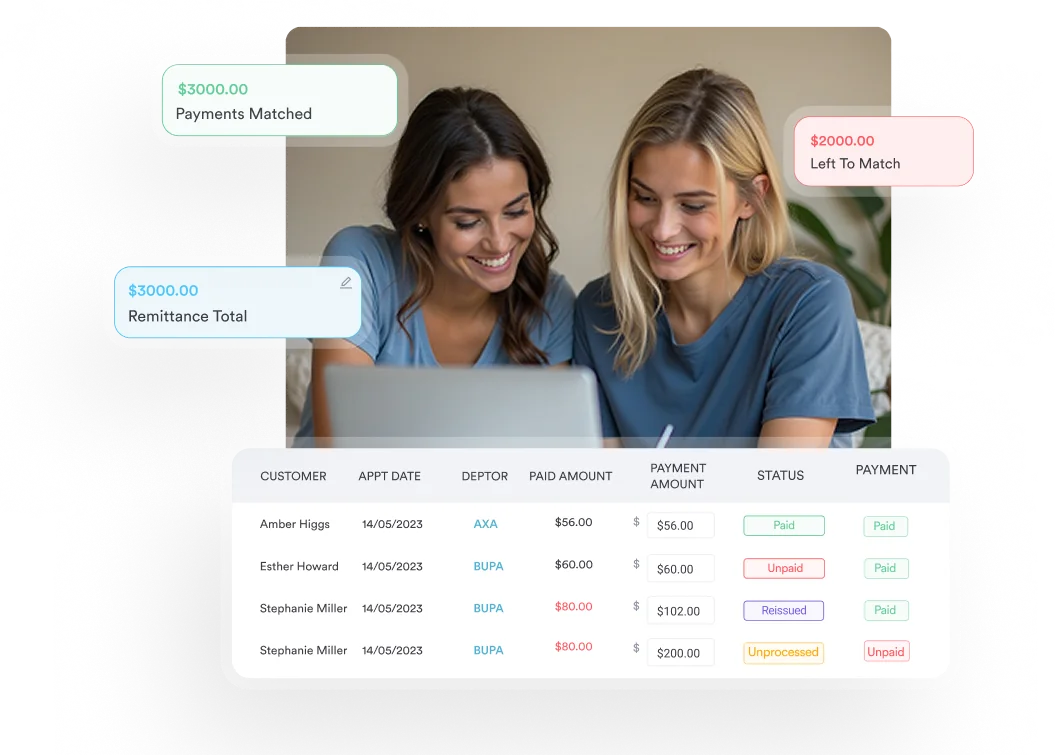
For practices running several surgical specialties, Pabau keeps CCSD billing, clinical documentation, and insurer correspondence in one system.

Pabau helps private practices submit accurate CCSD-coded claims, track pre-authorisation status, and maintain complete operative documentation for spinal procedures.

V2660 belongs on a claim only when three facts line up: the lumbar region, central stenosis, and an earlier decompression at that level. Confirm all three, along with the authorisation number, before the patient goes to theatre.
The preventable rejections come from paperwork, such as a missing authorisation number or an absent previous operative report. A pre-theatre checklist that asks for both stops them at source, and the coder never has to chase the surgeon afterwards.
Pabau’s clinical record and claims management tools help neurosurgical and spinal practices build the documentation workflows that keep V2660 claims clean on first submission. Book a demo to see how Pabau supports private CCSD billing from pre-authorisation through to claim settlement.

Looking to streamline private healthcare claim submissions? Claims management software from Pabau handles CCSD-coded billing, insurer tracking, and documentation attachment in one workflow.
CCSD Code V2660 is the UK private healthcare procedure code for revision of decompression for central spinal stenosis in the lumbar spine. It covers re-exploration and extension of a previous spinal canal decompression. That includes adhesiolysis of epidural fibrosis, further bone or ligament removal, and dural protection. It does not apply to first-time (primary) decompression procedures.
The primary decompression code applies when no prior decompression exists in the patient’s surgical history. V2660 applies only when a previous decompression has been performed and a revision is now required. Using the primary code when V2660 is correct constitutes a coding error and is a common denial trigger.
Yes. Both Bupa and AXA Health require pre-authorisation before a V2660 procedure is performed. Submitting a claim without an authorisation reference number is the most common cause of rejection for spinal revision procedures. Always confirm current requirements on the payer’s provider portal before the procedure date.
No. V2660 applies only to the lumbar region, where it sits in Chapter 3 of the CCSD schedule. A revision decompression in the cervical spine takes a separate CCSD code, V2300. For V2660, the stenosis must also be central rather than foraminal, with a prior decompression at the same lumbar level.
The most common rejection reasons are a missing prior authorisation and no previous operative report to confirm the original decompression. Insurers also reject claims with thin imaging evidence, the primary code in place of the revision code, or unbundled procedures that V2660 already includes. Each of these is a documentation or workflow failure rather than a clinical one.
Codes regularly billed alongside V2660 include the anaesthetist’s own CCSD anaesthesia codes and assistant surgeon codes, subject to payer approval. Post-operative outpatient consultation codes and additional-level codes for further levels in the same sitting also appear. Spinal fusion and instrumentation codes are separately billable when those procedures are also performed.




