

CPT Code 30801: Superficial turbinate ablation billing guide
CPT Code 30801: Official descriptor and procedure overview The American Medical ...

Last Updated: Nov 27, 2026
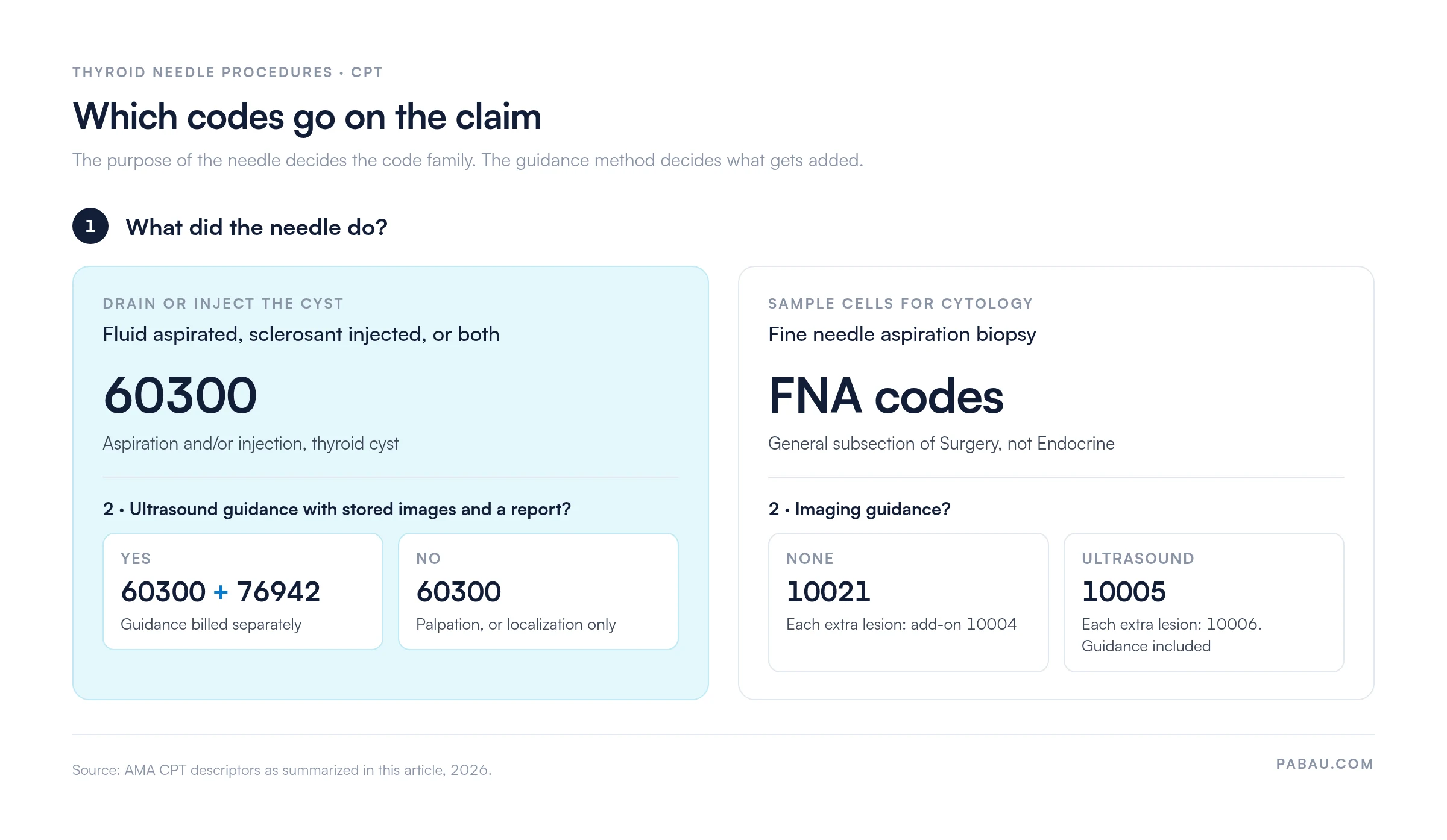
60300 is the CPT code for aspiration and/or injection, thyroid cyst. It covers draining fluid from a thyroid cyst, injecting a sclerosing agent such as ethanol into it, or both in one session.
60300 sits in the Thyroid Gland subsection of the CPT Endocrine System range. Fine needle aspiration biopsy of a thyroid nodule is coded separately, with 10021 or 10005, and ultrasound guidance for 60300 is reported with 76942.
Let Pabau's smart automation suggest the right codes, reduce claim denials, and keep your practice compliant—effortlessly.
Automate repetitive tasks and focus on what matters most—your patients.
Reduce coding errors and ensure compliance with the latest regulations.
Clean claims, fewer denials, and faster reimbursements.
Powerful insights and reporting to help your practice thrive.
HIPAA compliant SOC 2 certified GDPR-compliant Trusted by 4,000+ clinics worldwide

CPT code 60300 covers both aspiration and injection of a thyroid cyst under a single code.
E04.1 and E04.2 are common supporting diagnosis codes, so confirm payer LCD acceptance before you submit.
CPT 76942 (ultrasound guidance) is separately billable with 60300 only when a permanent image record is stored and documented.
Under the 2026 MPFS, 60300 carries 0.95 work RVUs and pays about $103-104 in an office or about $42 in a facility.
Claims management software such as Pabau helps submit and track the claim, with procedure notes kept in the same patient record.
CPT code 60300 covers aspiration and/or injection of a thyroid cyst, billed once whether the clinician drains fluid, injects a sclerosing agent, or does both. The descriptor comes from the AMA’s CPT code set, maintained by the CPT Editorial Panel, and reads “Aspiration and/or injection, thyroid cyst.” The code sits in the Thyroid Gland subsection of the Endocrine System range, 60000-60699.
That Endocrine System range also covers parathyroid, thymus, adrenal and pancreas procedures. The “and/or” in the descriptor matters, because aspiration alone, injection alone, and both together all report as one unit of 60300.
Three distinct clinical scenarios justify billing CPT code 60300. Each has a different primary purpose, and payers expect the documentation to reflect which one applied.
Payers classify CPT code 60300 as a minor surgical procedure. Prior authorization requirements vary by plan, so verify with the specific payer before scheduling. Commercial policies also differ by plan type and policy year, so one payer’s rule does not carry over to the next.
Every CPT code 60300 claim needs at least one ICD-10-CM diagnosis code establishing medical necessity. The following codes cover the most common presentations. Verify acceptance against the payer’s current LCD (Local Coverage Determination) before submission, as coverage lists are payer-specific.
The ICD-10-CM index sends “cyst, thyroid” to E04.1, which is why that code supports most solitary cyst aspirations. Confirm codes against the current-year ICD-10-CM tabular list via the CDC/NCHS ICD-10-CM web tool before submission. Code descriptions and validity are updated annually on October 1.
Payers reviewing CPT code 60300 claims look for a procedure note that traces every step. Medical billing compliance for thyroid procedures depends on documentation that maps the clinical event to the code billed. The minimum elements are:
A note that simply states “thyroid cyst aspirated” without fluid volume, guidance method, or specimen disposition will not survive a payer audit. When building a clean claim for this code, attach the operative note or the structured procedure note as the supporting documentation.
Document the cyst’s pre-aspiration size (in cm) from imaging or palpation and its post-aspiration appearance. This single detail supports medical necessity for the aspiration and gives a reviewer a measurable reason for the procedure.
CPT 76942 covers ultrasonic guidance for needle placement, including imaging supervision and interpretation. It may be billed alongside CPT code 60300 when two conditions are met. The physician performed and interpreted the ultrasound guidance in real time, and a permanent image record was stored and documented in the report. Without both, 76942 is not separately reportable.
NCCI (National Correct Coding Initiative) edits govern the 60300/76942 code pair. Verify the current-quarter NCCI edit table before billing both codes together, as edit versions update quarterly and bundling policies can change. When both are billed together and the edit allows it, modifier 59 may be required to indicate a distinct service.
Modifier selection for CPT code 60300 depends on whether other procedures happened in the same session. It also depends on whether the service was reduced or lateralized. The table below covers the modifiers coders encounter most frequently with this code.
Not every payer recognizes LT/RT modifiers for thyroid procedures. Check the specific payer’s modifier policy before appending them to avoid a CO-4 (incorrect modifier) denial.
Three code families create confusion with CPT code 60300. The most consequential is the FNA group, where miscoding is both common and auditable.
The FNA distinction is the highest-stakes error. The 2019 CPT revision reorganized the FNA codes. They now sit in the General subsection at the start of the Surgery section, reflecting their tissue-sampling purpose. 10021 covers FNA without imaging guidance, and add-on 10004 reports each additional lesion without imaging guidance.
Ultrasound-guided FNA is 10005 for the first lesion and 10006 for each additional one. Both include the guidance, so 76942 is not added to them. CPT code 60300 covers fluid aspiration and sclerosant injection specifically. Billing 60300 when FNA was performed, or the reverse, is miscoding that can trigger a CO-97 (service included in another) denial or a payer audit.
Two questions settle the code: what the needle did, and how it was guided.
The CMS Medicare Physician Fee Schedule (MPFS) sets the national payment rates for CPT code 60300. Rates below come from the 2026 MPFS national values. Actual payment adjusts by the Geographic Practice Cost Index (GPCI) for the practice’s location. Submitting through a clearinghouse such as Claim.MD adds real-time patient insurance eligibility checks before the claim reaches the payer.
The payment row multiplies total RVUs by the two 2026 conversion factors, $33.4009 and $33.5675. RVU values are subject to annual CMS revision. Use the FastRVU 2026 RVU lookup tool to confirm current-year values and calculate location-adjusted reimbursement using your practice’s GPCI. The non-facility rate applies when the procedure is performed in a physician office. The facility rate applies in an ASC or hospital outpatient setting.
CPT code 60300 denials cluster around four problems: Weak ICD-10 linkage, documentation gaps, 76942 unbundling errors, and modifier omission. Effective denial management workflows for endocrine codes require a pre-submission checklist that addresses each one before the claim leaves the practice.
When a CO-97 denial arrives on a 76942 claim, review the operative note first. If the image storage and interpretation requirement was met but modifier 59 was not appended, file a corrected claim with the modifier. If the image was not stored, the denial is correct and 76942 should not have been billed. A CARC denial code guide maps each remittance code to its correction path, so billing staff can pick the right fix for other 60300 denials.
Run a quarterly audit of all CPT code 60300 claims against their corresponding procedure notes. Flag any note missing fluid volume or guidance method documentation before payer recoupment requests arrive. A note fixed before submission takes minutes. One fixed after a RAC recoupment request means refunds and appeals.
Many 60300 denials trace back to the procedure note. When scheduling, notes, and claims sit in separate tools, the biller rekeys cyst size, guidance method, and fluid volume before anyone checks them.
Pabau, a practice management platform, keeps the appointment, the procedure note, and the claim on one patient record. Its denial-tracking claims software submits the 60300 claim and follows it through to payment or denial.
Your coder still chooses 60300, 76942, and the diagnosis code. The biller can then check the claim against the note before it goes out, and read a denial beside the record that explains it.

Pabau keeps the procedure note, the 60300 claim, and the payer response on one patient record. Your billers check documentation before submission and work denials without switching systems.

Treat every 60300 claim as two decisions. First, confirm the needle drained or injected the cyst rather than sampled cells for FNA. Second, check that the ultrasound record supports 76942 before you add it.
The trade-off is a few extra minutes per note, spent recording cyst size, fluid volume, and stored images. That time costs less than a corrected claim or a recoupment request.
Claims management software helps submit and track the claim, with procedure notes kept in the same patient record. Book a demo to see how Pabau handles endocrine procedure billing for your practice.

Need a clearinghouse that handles CPT submissions end to end? Pabau’s Claim.MD clearinghouse guide explains how the integration connects your claim data to 4,000+ US payers.
Struggling with claim denials across your endocrine procedure codes? What is revenue cycle management breaks down the end-to-end billing process from eligibility through payment posting.
Want to benchmark your billing accuracy? Best medical billing software for US practices compares clearinghouse integrations and claim tracking features across leading platforms.
Billing a core needle thyroid biopsy instead? CPT code 60100 covers percutaneous core needle biopsy of the thyroid and its documentation.
CPT code 60300 covers aspiration and/or injection of a thyroid cyst. It applies when a clinician removes fluid from the cyst, injects a sclerosing agent into it, or does both in one session. It does not cover fine needle aspiration biopsy, which is coded separately under the 10004-10021 range.
Modifier 51 applies to CPT code 60300 when it is performed as the secondary procedure in a session where another surgical procedure is also performed. The primary procedure is reimbursed at 100%; 60300 as the secondary procedure is typically reimbursed at 50% with modifier 51 appended.
CPT 60300 is specifically for aspiration or injection of a thyroid cyst, meaning fluid removal or sclerosant administration. Fine needle aspiration codes obtain cellular tissue samples for cytologic analysis instead. 10021 covers FNA without imaging guidance, with add-on 10004 for each additional lesion. Ultrasound-guided FNA is 10005 for the first lesion and 10006 for each additional one. The FNA codes sit in the General subsection of Surgery, not the Endocrine System section.
The 2026 MPFS assigns CPT code 60300 a work RVU of 0.95. Total RVUs are about 3.09 in a non-facility setting and 1.25 in a facility setting. That works out to roughly $103-104 and $42 nationally before geographic adjustment. Check the CMS Physician Fee Schedule lookup for current-year values.




