

ICD-10 Code R63.4: Abnormal weight loss
ICD-10 code R63.4: Definition, billability and code structure ICD-10 code R63.4 ...

Last Updated: Nov 13, 2026
Billable Code Specific Code
E04.1 is the billable ICD-10-CM code for nontoxic single thyroid nodule. It covers one thyroid nodule, or a uninodular goiter, in a patient whose thyroid function is normal.
The code sits in category E04 (Other nontoxic goiter) within block E00-E07, Disorders of thyroid gland. Two or more nodules point to E04.2 instead, and a suppressed TSH with a hot nodule points to E05.10 or E05.11.
Let Pabau's smart automation suggest the right codes, reduce claim denials, and keep your practice compliant—effortlessly.
Automate repetitive tasks and focus on what matters most—your patients.
Reduce coding errors and ensure compliance with the latest regulations.
Clean claims, fewer denials, and faster reimbursements.
Powerful insights and reporting to help your practice thrive.
HIPAA compliant SOC 2 certified GDPR-compliant Trusted by 4,000+ clinics worldwide

ICD-10 code E04.1 is the billable code for a nontoxic single thyroid nodule, meaning one nodule in a patient with normal thyroid function.
Nontoxic uninodular goiter, thyroid (cystic) nodule NOS and colloid nodule are inclusion terms that also code to E04.1.
Two or more nodules move the code to E04.2, and a suppressed TSH with a hot nodule moves it to E05.10 or E05.11.
Congenital goiter (E03.0) and iodine-deficiency goiter (E00-E02) are Excludes1 conditions, so they are never coded with E04.1.
Pabau, the practice management platform we build, pre-fills claims from the patient record and checks required claim fields before sending.
ICD-10 code E04.1 is the billable ICD-10-CM code for a nontoxic single thyroid nodule. Use it when the record shows one discrete thyroid nodule and thyroid function tests within the normal range. Nontoxic uninodular goiter, thyroid (cystic) nodule NOS and colloid nodule are inclusion terms that code here too.
Typical examples are a colloid nodule on ultrasound, a single nodule with a benign FNA result, or one palpable nodule with a normal thyroid panel.
ICD-10-CM is maintained by the CDC’s National Center for Health Statistics (diagnosis codes) and CMS (procedure codes). You can check its codes in the CDC/NCHS ICD-10-CM browser tool.
The “nontoxic” part of the descriptor is what decides the code. It means thyroid hormone output is normal, so the patient is euthyroid, with TSH, T3 and T4 in their reference ranges. A suppressed TSH, a raised free T4 or clinical signs of hyperthyroidism point away from E04.1. They point toward the E05.1- codes for a toxic single thyroid nodule.
Category E04 carries Excludes1 notes that apply to every E04 code, E04.1 included. An Excludes1 note means the two conditions are never coded together, so the excluded code replaces E04.1.
Two close neighbors are differentials rather than Excludes1 notes. A toxic single nodule codes to E05.10 or E05.11, and two or more nodules code to E04.2. When pathology confirms a follicular adenoma, the benign neoplasm code D34 describes the nodule more precisely.
Most E04.1 coding errors come from picking the wrong code inside E04, or from crossing into E05.1- before thyroid function is known. The path below shows the order to work in, with thyroid function first and nodule count second.
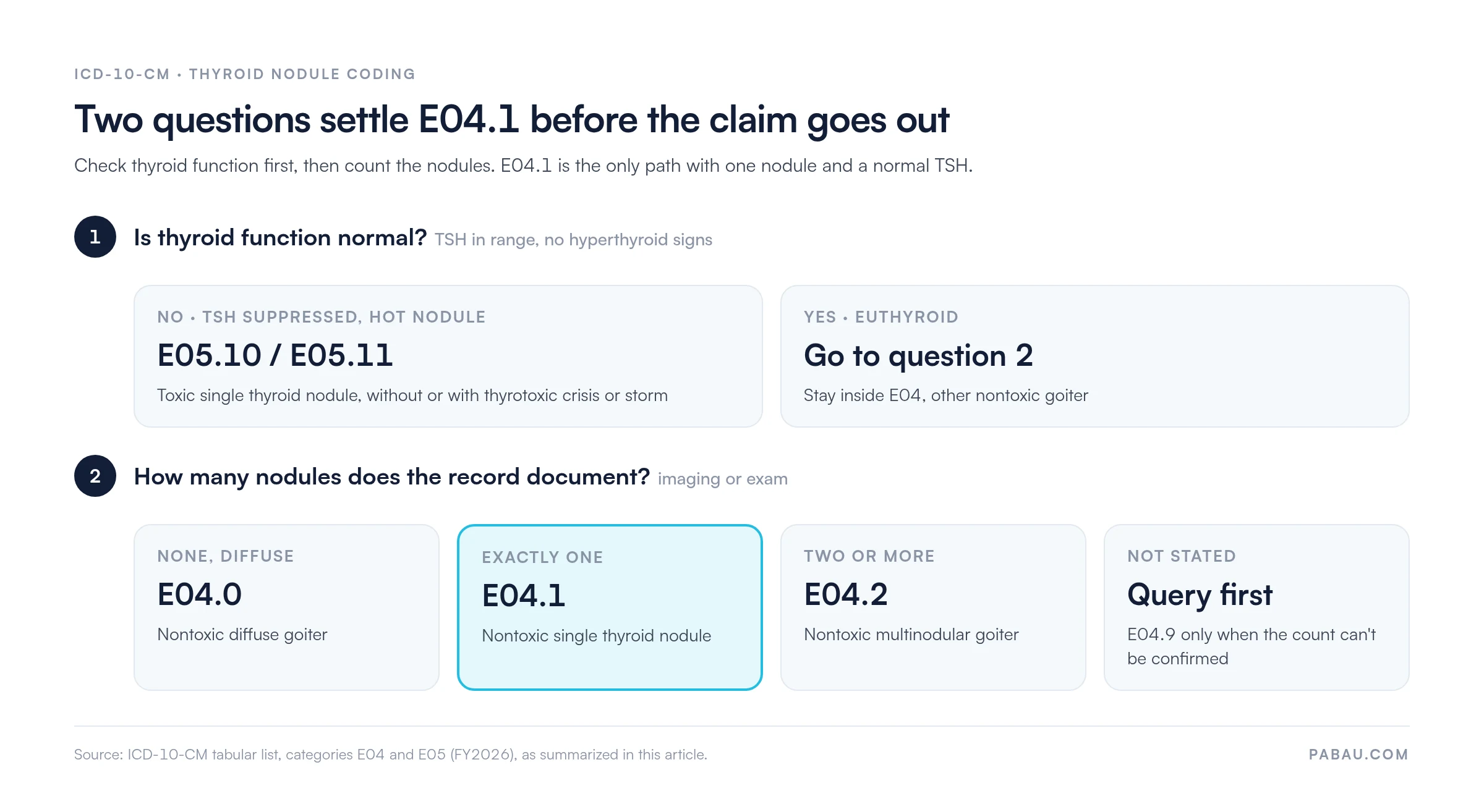
The table puts the same choices side by side, with the nodule count and thyroid function each code expects.
Confirm each descriptor in the ICD List code browser before you put it on a claim. If the note is missing the nodule count or the thyroid function result, query the chart before coding rather than defaulting to E04.9.
Before selecting E04.1, confirm two facts in the physician note. The first is a single nodule seen on imaging or palpation. The second is a TSH within normal limits. If either is missing, query the physician rather than defaulting to E04.9, because an unspecified code next to specific documentation can draw extra review.
A clean E04.1 claim rests on the physician record. It has to support both parts of the descriptor, a nontoxic thyroid and a single nodule, in words a coder can point to.
Look for these elements in the clinical record before E04.1 goes on the claim:
Watch for vague phrases such as “thyroid fullness” or “possible goiter.” They don’t confirm a nodule, so a coder can’t assign E04.1 from them, and a physician query is the next step.
Each case below turns on what the physician documented, not on what the coder assumed.
A 52-year-old patient attends an endocrinology follow-up. The ultrasound report reads: “Single hypoechoic nodule measuring 1.4 cm in the right lobe. No additional nodularity identified.” TSH is 1.8 mIU/L, within the reference range, and the physician orders a repeat ultrasound in 12 months.
Correct code: E04.1. One nodule is documented, TSH confirms a normal thyroid, and there are no toxic symptoms. Pair it with CPT 76536 for the ultrasound and CPT 99214 for the visit, if the visit supports that level.
A patient returns for surveillance imaging. The radiologist reports “Two discrete solid nodules: 0.9 cm in the left lobe and 1.1 cm in the right lobe. No diffuse enlargement.” TSH is normal, and the physician writes “nontoxic multinodular goiter” in the assessment.
Correct code: E04.2, not E04.1. Two distinct nodules on imaging make the goiter multinodular. Even if the assessment only said “goiter,” the radiology report supplies the count needed to code E04.2.
A 44-year-old presents with palpitations and unintentional weight loss. The exam finds a palpable right lobe nodule, TSH is 0.08 mIU/L and free T4 is raised. Thyroid scintigraphy shows a hot nodule with suppression of the surrounding tissue.
Correct code: E05.10 (thyrotoxicosis with toxic single thyroid nodule without thyrotoxic crisis or storm), not E04.1. The suppressed TSH and hyperthyroid picture rule out “nontoxic.” E04.1 here would misstate the condition, and it can invite an audit if radioactive iodine or surgery is billed against it.
The AAPC’s ICD-10-CM code lookup lists the full descriptor and excludes notes for each of these codes. If you manage medical billing compliance across several providers, keep a short internal note on why each code was chosen. It helps if a payer audits the claim.
E04.1 supports office visits, imaging, biopsy and surgery, depending on how far the workup goes. Each CPT line needs documentation that matches the diagnosis linked to it.
Thyroid ultrasound is the pairing you’ll see most often, and our 76536 guide covers its billing rules. An FNA done under ultrasound guidance codes to 10005 rather than 10021.
Before you bill E04.1 with 76536, check whether your MAC’s local coverage policy for thyroid ultrasound lists E04.1. Coverage varies by jurisdiction.
E04.1 alone rarely triggers prior authorization for office visits or lab work. That changes when the workup moves toward intervention, because FNA, advanced imaging and thyroid surgery often need approval from commercial and Medicare Advantage plans.
Running insurance eligibility verification at scheduling, not on the day of service, leaves time to gather what the payer asks for.
Payer authorization rules change, so confirm them at the time of service rather than relying on last year’s experience with the same plan.
A thyroid nodule claim passes through several hands, and each one can stop it. Here is the usual path for an office workup.
Most E04.1 denials trace back to missing documentation or the wrong code, and both can be caught before submission. The table maps each trigger to its cause and fix.
Each denial arrives with a reason code, and our guide to denial codes explains what each one means. Track which reasons repeat on E04.x claims, because a repeat usually points to one step in the workflow above.
Audit your E04.1 claims each quarter. Filter the denial report by E04.x codes and compare it with your E04.2 submissions. If E04.1 denials cluster around one payer, that MAC’s local policy may ask for documentation you are not sending. Update your pre-submission review to match.
Run through these checks on every claim that carries E04.1. A clean claim paid the first time beats any appeal.
In many practices, the thyroid note lives in one system while the claim gets built in another. Coders retype the nodule count, the TSH date and the codes by hand, and one typo becomes a denial.
Pabau keeps the note and the claim in one patient record. Its claims software for practices pre-fills the claim from that record, with ICD-10-CM and CPT lookup libraries built in. Required claim fields, such as membership numbers and authorization codes, must be complete before the claim can be sent.
In the US, claims go out through Claim.MD, which adds real-time eligibility checks, claim-status tracking and ERA remittance posting. Your team spends less time rekeying data and more time on the coding decisions this guide covers.
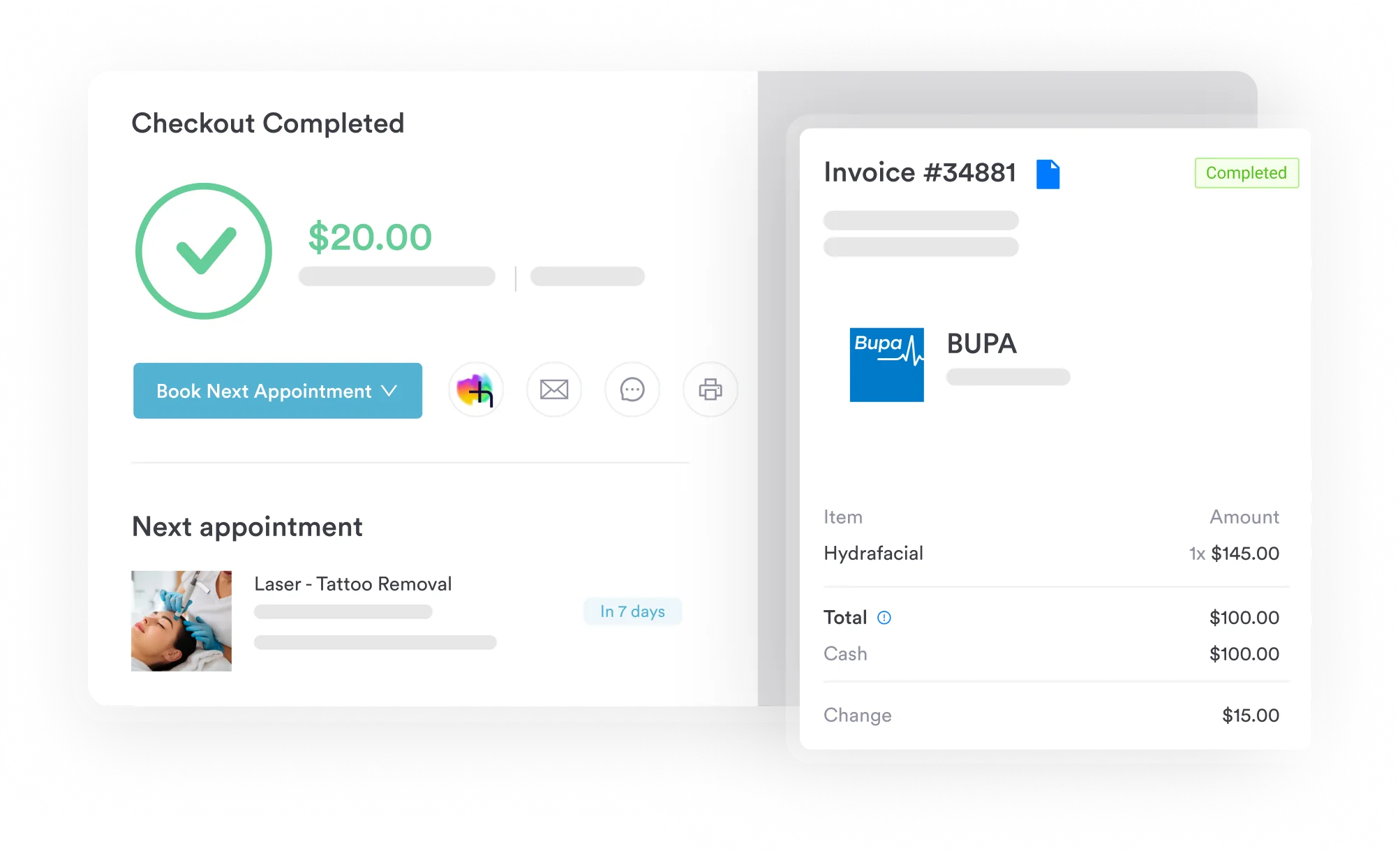

Pabau pre-fills claims from the patient record and checks required claim fields before sending. In the US, Claim.MD adds eligibility checks, claim tracking and ERA posting.

E04.1 rewards one habit. Confirm the nodule count and the TSH before anyone picks a code. Those two facts settle almost every choice in this guide, from E04.2 to E05.10.
When either fact is missing, query the physician rather than reaching for E04.9. A short query today costs far less than a corrected claim next month.
Book a demo to see how Pabau carries the thyroid note into a pre-filled claim, so your coders check E04.1 instead of retyping it.

Struggling with claim denials on thyroid codes? Denial management in healthcare covers root-cause analysis and appeals for common payer rejections.
Need a walkthrough of the medical billing process? What is medical billing explains the revenue cycle from diagnosis coding to payment posting.
Has the FNA come back indeterminate? CPT code 60100 covers billing for a percutaneous core needle biopsy of the thyroid.
Is the nodule heading to surgery? CPT code 60220 explains billing and modifiers for a thyroid lobectomy.
Did pathology confirm a malignancy? ICD-10 code C73 covers coding for malignant neoplasm of the thyroid gland.
A thyroid cyst usually codes to E04.1. The tabular list includes thyroid (cystic) nodule NOS and colloid nodule (cystic) under E04.1, so a single cyst in a euthyroid patient fits there.
Not clinically. A goiter is an enlarged thyroid, while a nodule is a lump that may not enlarge the gland. ICD-10-CM still groups a single nontoxic nodule with uninodular goiter under E04.1.
No. E04.1 has no laterality, so the same code applies whichever lobe holds the nodule. Record the lobe in the note anyway, because it supports the ultrasound and any biopsy billed later.
The same rules apply. If the report describes one nodule and thyroid function is normal, E04.1 fits. If function hasn’t been tested yet, the physician should confirm it before the code is final.
No. A benign (Bethesda II) result confirms the nodule isn’t cancer, and E04.1 still describes a single nontoxic nodule. The code changes only if pathology finds an adenoma or malignancy.



