CCSD code A2720: Proximal gastric vagotomy billing guide
What is CCSD code A2720? CCSD code A2720 is the procedure billing code assigned ...

Last Updated: Oct 8, 2026
60100 is the CPT code for biopsy thyroid, percutaneous core needle. It covers a core needle passed through the skin into the thyroid to remove an intact tissue sample for histologic analysis.
Fine needle aspiration (FNA) is coded with 10005 or 10021 instead, because it draws loose cells rather than a tissue core. Imaging guidance is not included in 60100, so documented real-time ultrasound guidance may be reported separately with CPT 76942.
Let Pabau's smart automation suggest the right codes, reduce claim denials, and keep your practice compliant—effortlessly.
Automate repetitive tasks and focus on what matters most—your patients.
Reduce coding errors and ensure compliance with the latest regulations.
Clean claims, fewer denials, and faster reimbursements.
Powerful insights and reporting to help your practice thrive.
HIPAA compliant SOC 2 certified GDPR-compliant Trusted by 4,000+ clinics worldwide

CPT code 60100 covers percutaneous core needle biopsy of the thyroid, which yields a histologic tissue core.
Fine needle aspiration (FNA) is billed with 10005 or 10021, so the procedure note must name the needle type and specimen.
Imaging guidance is not included in 60100, and CPT 76942 may be reported separately when real-time ultrasound is documented.
Billing 60100 for an FNA, or the reverse, misstates the service and can create False Claims Act exposure.
Pabau, the practice management platform we build, tracks denials by CPT code and payer, so repeat 60100 errors surface early.
CPT code 60100 is a surgical biopsy code for one clinical action. A core needle is advanced through the skin into thyroid tissue to remove a cylindrical sample for histologic analysis. The official AMA descriptor is: Biopsy thyroid, percutaneous core needle.
60100 sits in the Surgery section of the CPT code set, under Endocrine System, in the Excision Procedures on the Thyroid Gland family (60100-60281). Specimen type separates it from adjacent codes. A core needle extracts intact tissue architecture, while fine needle aspiration draws loose cells. That difference decides the code family and the documentation behind it.
The 0-day global period matters for scheduling. A distinct procedure on the same day as 60100 may need modifier -59 to avoid automatic bundling by payers. A significant, separately identifiable E/M visit takes modifier -25 instead.
The procedure note must document each of the following steps to support billing and withstand a payer audit. Generic documentation (“biopsy performed”) is not enough for CPT 60100.
Each of these elements has a billing consequence. A missing needle-type notation is a frequent audit trigger for 60100 claims. Without it, the payer can’t verify that a core needle was used rather than a fine needle.
The most common miscoding error in thyroid biopsy billing is submitting CPT 60100 for a procedure that was an FNA, or the reverse. The two code families are mutually exclusive. The clinical record must support whichever code is billed, and billing the wrong one can create False Claims Act exposure.
The pathology report settles it. If it documents a “tissue core” or “core biopsy specimen”, bill 60100. If it documents “aspirated material”, “cytology smears” or a “cell block”, the procedure was an FNA. Then bill 10005 with ultrasound guidance, or 10021 without imaging guidance. Never infer needle type from imaging guidance alone, as the diagram below shows.
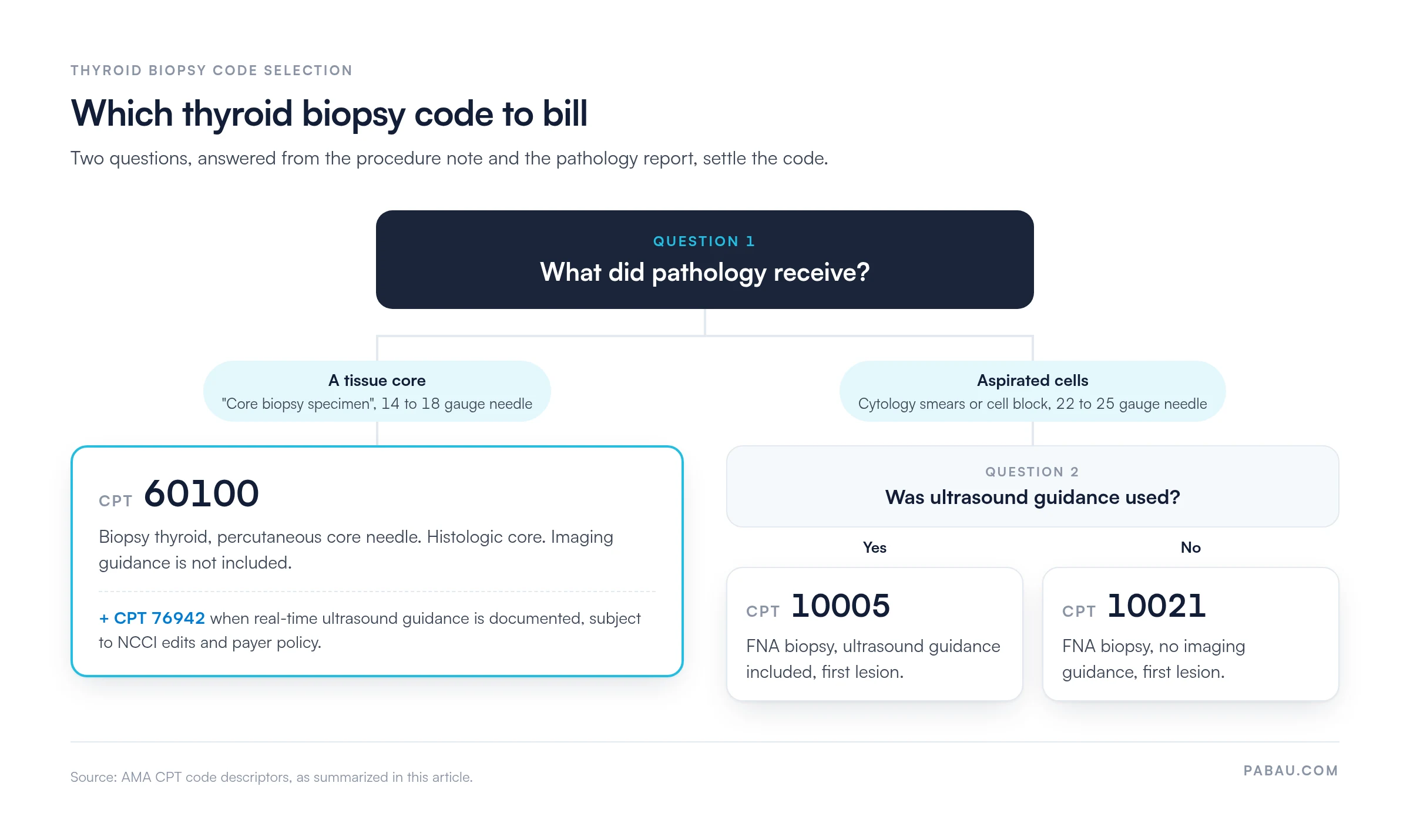
Ask clinicians to note the specimen collection method and needle gauge on every pathology requisition. A slip reading “core biopsy specimen” next to a 14-gauge needle makes 60100 the clear choice, so the claim isn’t held for a coder query.
No. CPT 60100 does not include imaging guidance. When ultrasound guides needle placement during a thyroid core biopsy, CPT 76942 may be reported separately, subject to NCCI edit review and payer policy. That code covers ultrasonic guidance for needle placement, with imaging supervision and interpretation, and report.
Before billing 76942 alongside CPT code 60100, run three checks:
Some payers apply local coverage determination (LCD) restrictions that limit separate billing of 76942 with thyroid biopsy codes. Always check payer policy before filing. When in doubt, use the CMS Physician Fee Schedule lookup tool to confirm the current payment status indicator for 76942 in your setting.
Modifier selection errors are a common root cause of CPT code 60100 denials. The table below covers the modifiers most often applied to thyroid biopsy claims.
Medicare does not routinely accept modifier -50 on thyroid biopsy codes. Most MACs prefer bilateral billing as two line items, 60100-LT and 60100-RT. The first unit pays at 100% of the fee schedule and the second at 50%. Verify your MAC’s bilateral billing policy before submitting.
The figures below reflect 2026 Medicare Physician Fee Schedule data for CPT code 60100, at the CMS CY2026 conversion factor of $33.40. Rates update every year and vary by geographic practice cost index (GPCI). Check current amounts in the CMS PFS lookup tool or the FastRVU 2026 RVU lookup before billing.
Commercial payer rates vary, so verify them against your contracted fee schedule. Practices billing 60100 through Pabau send claims via the Claim.MD clearinghouse, which supports CMS-1500 and 837P electronic claims to thousands of US payers. Its real-time eligibility check confirms the patient’s plan covers thyroid core biopsy in your setting before the procedure date.
Missing documentation is the main audit trigger for CPT code 60100 claims. Every element below belongs in the procedure note or linked records before the claim is filed. Treat it as a pre-submission checklist rather than a post-denial fix.
A detailed procedure note paired with a well-structured superbill lets the claim go out clean the first time. A procedure note template can prompt for each field above, so a missing needle gauge is caught before the claim reaches the billing queue.
Prior authorization (PA) requirements for CPT code 60100 vary by payer and plan year. Medicare and most Medicaid programs don’t require PA for thyroid core biopsy under standard medical necessity criteria. Many commercial insurers and managed care plans do, so verify with each payer before scheduling.
Common medical necessity criteria payers apply when reviewing PA requests for 60100 include:
Use the payer’s prior authorization lookup tool or provider services line to confirm PA requirements before each case. Run insurance eligibility verification at scheduling, not only at check-in. A PA denial found after the claim is filed is far harder to appeal than one caught in advance.
The National Correct Coding Initiative (NCCI) governs which codes can be billed with CPT code 60100 and which are bundled into it. Edits update quarterly, so always check the current CMS NCCI table for the exact edit status.
The NCCI Policy Manual notes that procedures in the same anatomical area and the same operative session are generally bundled. Separate reporting needs a clear clinical distinction. Document the clinical reason for any separately billed service in the procedure note.
Most CPT code 60100 denials fall into five categories. Each has a documented root cause and a specific corrective action.
Structured denial management in healthcare tracks denial codes by CPT code, payer and root cause. When 60100 denials cluster on one payer, a policy step is usually missing. Look first at the PA lookup, the modifier rule and the note template. A list of medical billing denial codes helps you map each CARC to its root cause.
Run a quarterly denial audit filtered to CPT 60100 and sort it by denial reason code (CARC). If more than 20% of denials share one CARC, fix the upstream process rather than appealing each claim.
Most 60100 denials start before the claim is built. The procedure note leaves out the needle type, eligibility gets checked at check-in, or a modifier rule is missed. A coder then finds the problem after the payer has already rejected the claim.
Pabau connects the procedure note to the claim. Note templates prompt for needle type, gauge, passes and real-time guidance, and built-in CPT and ICD-10 catalogs cut code-entry errors. Claims then go out as 837P files through Claim.MD, with ERA (835) remittances posted back against them.
Pabau’s specialty practice claims software tracks denials by CPT code and payer. When 60100 rejections cluster on one payer, your billing team sees it in the dashboard. They can fix the template or the PA step before the next case.

Pabau helps endocrine and surgical practices document procedures, submit claims electronically and track denials by code. Your CPT 60100 claims reach payers with the right supporting detail the first time.

Start every thyroid biopsy claim with the pathology report. If it says tissue core, bill 60100. If it says aspirate, the FNA codes apply, and no modifier changes that.
The bigger win sits upstream. Build needle type, gauge and real-time guidance into the procedure note template, and move eligibility and PA checks to scheduling. Coders stop querying clinicians, and the denials that remain are the ones that need a judgment call.
The trade-off is a few extra fields for the clinician on each case, which is cheaper than reworking a denied claim. Book a demo to see how Pabau carries a thyroid biopsy from procedure note to paid claim.

Want to understand how the clearinghouse fits into claim submission? Medical claims clearinghouse guide covers how 837P files move from the practice to the payer and where errors are caught.
Looking for guidance on electronic remittance? Electronic remittance advice (ERA) breaks down how 835 files work and how to reconcile payments against submitted claims.
Billing the same procedure for a UK insurer? CCSD code B1230: core biopsy of thyroid gland covers the UK private billing equivalent of CPT 60100.
Imaging the nodule before the biopsy? CPT code 76536 explains how to bill the diagnostic thyroid and head and neck ultrasound.
CPT code 60100 describes a percutaneous core needle biopsy of the thyroid gland. A core needle, typically 14-18 gauge, is advanced through the skin to extract a histologic tissue core. The code sits in the Excision Procedures on the Thyroid Gland range (60100-60281). Fine needle aspiration (FNA) codes differ, because they yield cytologic aspirates rather than tissue cores.
CPT 60100 covers core needle biopsy with a histologic tissue yield. CPT 10005 covers fine needle aspiration biopsy with ultrasound guidance, which yields a cytologic aspirate. The procedures are mutually exclusive, so the code must match the needle used and the specimen obtained. The procedure note and pathology requisition confirm which one applies. Billing 60100 when an FNA was performed can create False Claims Act exposure.
No. CPT 60100 does not include imaging guidance. When real-time ultrasound is used during the biopsy, CPT 76942 may be reported separately, subject to NCCI edit review and payer policy. The procedure note must document real-time guidance, not simply that ultrasound was available.
It depends on the payer and plan. Medicare does not generally require PA for 60100 under standard medical necessity criteria, but many commercial payers do. Verify PA requirements with each payer before scheduling. Confirm eligibility at scheduling too, using the payer’s authorization lookup or provider services line.
CPT 60100 has a 0-day global period, so no postoperative follow-up is included in its payment. Same-day services may still need modifier -59, or -25 for a separately identifiable E/M visit, to avoid automatic bundling. The right modifier depends on the code pair and the NCCI edits that apply.
The usual causes are wrong code selection, with FNA billed as core or the reverse, and missing real-time ultrasound documentation when 76942 is billed. NCCI edit violations, missing prior authorization and global period bundling errors complete the list. A documentation checklist, a PA step at scheduling and an NCCI check before filing prevent most of them.