

CPT Code 30801: Superficial turbinate ablation billing guide
CPT Code 30801: Official descriptor and procedure overview The American Medical ...

Last Updated: Nov 27, 2026
55110 is the CPT code for scrotal exploration. In this open procedure, the surgeon incises the scrotum and examines the testis, epididymis, and spermatic cord. It sits in the 55100-55120 incision procedures within the 55100-55180 scrotum subsection.
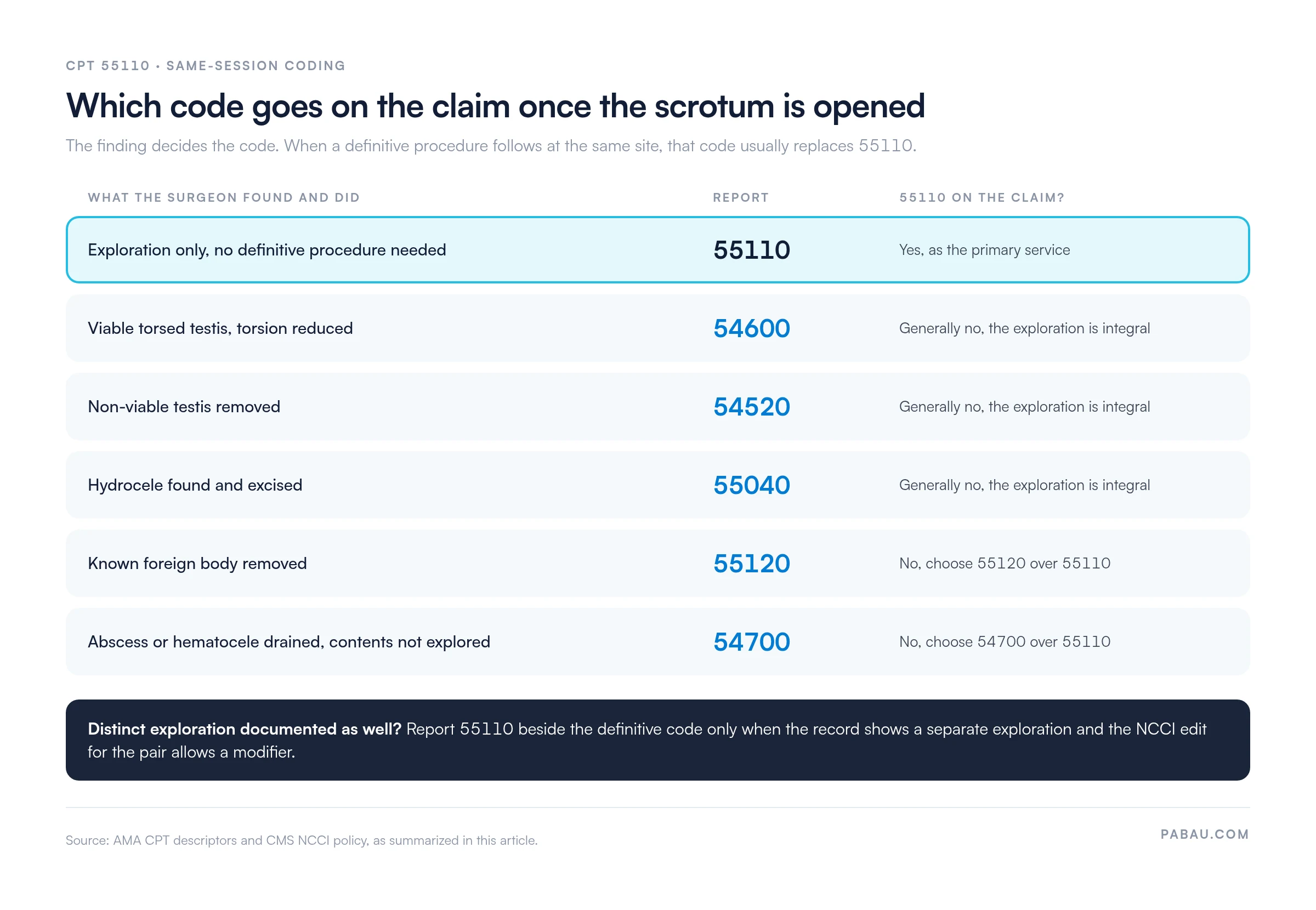
Assignment turns on intent. Use 55110 when exploration is the service. A definitive procedure at the same site, such as torsion reduction (54600) or orchiectomy (54520), generally replaces it under NCCI policy.
Let Pabau's smart automation suggest the right codes, reduce claim denials, and keep your practice compliant—effortlessly.
Automate repetitive tasks and focus on what matters most—your patients.
Reduce coding errors and ensure compliance with the latest regulations.
Clean claims, fewer denials, and faster reimbursements.
Powerful insights and reporting to help your practice thrive.
HIPAA compliant SOC 2 certified GDPR-compliant Trusted by 4,000+ clinics worldwide

CPT 55110 describes surgical scrotal exploration, which differs from a simple incision or drainage procedure.
Testicular torsion (N44.00) and undescended testis are common indications, and the ICD-10 code must match the operative finding.
A definitive same-site procedure, such as torsion reduction (54600) or orchiectomy (54520), usually replaces 55110 on the claim.
Missing or vague operative notes are a leading cause of medical necessity denials for this code.
Pabau, a practice management platform, submits CPT 55110 claims through Claim.MD and runs real-time eligibility checks before the procedure date.
CPT Code 55110 is the billable procedure code the AMA describes as “Scrotal exploration.” AAPC’s CPT code listing places it under Incision Procedures on the Scrotum, the 55100-55120 range. That range sits within the 55100-55180 scrotum subsection of the Male Genital System. The descriptor covers opening the scrotal sac and examining the testicle, epididymis, and spermatic cord.
The key distinction from adjacent codes is intent and scope. CPT 55110 is an exploratory procedure, where the surgeon’s primary objective is surgical investigation rather than a targeted repair or removal. When the exploration leads to a definitive procedure at the same site, report that procedure instead. That is because NCCI policy treats the exploration as integral to it.
CPT 55110 applies when a surgeon performs an operative exploration to diagnose or treat scrotal disease that needs direct visualization. Payers expect the medical record to show why imaging or conservative care fell short before the surgery.
Common clinical indications include:
Medical necessity documentation must connect the clinical indication directly to the operative decision. For example, a note stating “scrotal pain” is insufficient. Instead, the record should state the duration, prior workup results, and the clinical reasoning that made surgery the right next step.
Knowing the surgical steps helps coders see what the operative note must contain. A complete operative note for CPT 55110 follows this progression:
If the operative note omits the exploration findings and jumps straight to the intervention, payers may recode the claim to the more specific procedure. As a result, they can lower payment or deny CPT 55110 as a component of the definitive procedure.
For surgical codes, the operative report has to do more than confirm that a procedure took place. In practice, payers and auditors look for:
Billers should request the operative report before submitting, rather than after a denial arrives. Also, a quick pre-submission review against this checklist helps catch rejections caused by missing records.
The ICD-10-CM code on the claim must match the clinical case in the operative note. A vague or mismatched code often triggers a denial. For that reason, verify all codes against the current-year tabular list, because ICD-10-CM updates every October 1.
Several codes in the 54700-55180 range cover overlapping anatomical territory. Because of that overlap, picking the wrong one is a common coding error that payers flag in urology audits.
When a scrotal exploration (CPT 55110) leads to an orchiectomy or a torsion reduction in the same session, report the definitive procedure. Under NCCI policy the exploration is generally integral to it. Add 55110 only when the record documents a distinct exploration, and confirm current NCCI edits first, because the tables update quarterly.
Medicare calculates reimbursement for CPT 55110 using Relative Value Units (RVUs) from the CMS Medicare Physician Fee Schedule (MPFS). Payment rates update annually and vary by geographic practice cost index.
Billing teams should check current figures in the MPFS lookup tool rather than rely on static published amounts. In addition, for current Work RVU values, the FastRVU 2026 RVU lookup tool provides calculations with geographic adjustment.
Key reimbursement reference points for CPT 55110:
A superbill for CPT 55110 should capture the procedure code, the modifiers, the place of service, and the linked ICD-10 code. Capturing them at the time of service therefore avoids transcription errors during claim submission. Claims go out electronically through Claim.MD, Pabau’s US clearinghouse partner, which routes 837P professional claims to thousands of US payers.
Under the CMS global surgical package, the 90-day global period for CPT 55110 bundles three services. They are pre-operative visits on the day of surgery, the intraoperative service, and related post-operative care. However, you may bill unrelated E/M visits during the global period separately with documentation and Modifier 24.
Prior authorization: Medicare does not require prior authorization for CPT 55110, but many commercial and Medicare Advantage plans do. Verify prior authorization requirements with each payer before scheduling elective scrotal exploration. Emergency cases (testicular torsion) are typically exempt. Even so, payers may require post-service notification within 24 to 48 hours.
Local Coverage Determinations: Some Medicare Administrative Contractors publish LCDs governing male genital surgery codes. Check the applicable MAC’s LCD database for active policies that list covered indications, non-covered indications, or documentation requirements for CPT 55110. Good urology billing compliance practice also means reviewing LCDs at the start of each calendar year, when MPFS updates take effect.
Modifier selection for CPT 55110 follows standard surgical modifier logic, and misuse invites payer audits. Use a modifier only when the clinical situation warrants it, and document the justification in the operative or encounter note.
Denials on CPT 55110 cluster around the same documentation failures that affect most surgical codes, plus some urology-specific bundling pitfalls. A proactive denial management workflow catches many of these before submission.
Clean claim submission for CPT 55110 means the biller validates every field before transmitting the electronic claim. That covers the code pair, the modifiers, the POS code, and the linked diagnosis.
Only when the surgeon performs a distinct, documented exploration alongside the other procedure. Under NCCI policy, a diagnostic exploration is integral to a definitive procedure at the same site. Therefore, if the surgeon explores the scrotum and then performs one, report the definitive code alone. Where the record documents a separate exploration, check the current NCCI edits before adding it.
The finding at exploration decides which code reaches the claim, as the table below shows.
Definitive procedures that usually replace 55110 on the claim:
Services included in CPT 55110 (not separately reportable):
Detorsion is not part of 55110. When the surgeon reduces a torsion, report 54600, with or without fixation of the contralateral testis.
Orchiopexy 54640 describes the repair of an undescended testis, so it does not fit fixation after torsion. However, a distinct exploration documented beside a definitive procedure may justify Modifier 51 or 59. That holds only where the NCCI edit allows it and the record supports a separate service.
Before billing CPT 55110 alongside any same-session procedure, run the code pair through the current NCCI edit tables. The AAPC Codify tool and the CMS NCCI web tool both provide edit lookup. Also, document separate indications and distinct operative steps for each billed code. One narrative covering both will not satisfy a payer that requires separately documented services.
Most of the work on a 55110 claim happens before submission. The biller reads the operative note, confirms eligibility and any prior authorization, and decides whether the exploration stands alone or belongs to a definitive procedure.
Pabau’s claims management software runs real-time eligibility checks through Claim.MD before the procedure date. It also tracks the prior-authorization code on the patient’s case and warns the team when one is missing.
When the claim is ready, the Claim.MD clearinghouse integration submits it as an 837P claim to thousands of US payers. ERA remittances come back into the same billing workflow, so a denied 55110 line shows up where the biller already works.

Pabau submits CPT 55110 claims electronically through Claim.MD, verifies patient eligibility in real time, and tracks prior-authorization codes on each case. Remittances return to the same workflow, so denials surface quickly.

CPT 55110 pays only when the exploration is the service. Once the surgeon reduces a torsion, removes a testis, or excises a hydrocele, the definitive code takes the claim. 55110 stays on it only when the record documents a distinct exploration and the NCCI edit allows it.
So settle the code from the operative note before submission, rather than from the denial afterward. A note that names the structures explored, the findings, and each separate act answers the code choice and the modifier question together.
Book a demo to see how Pabau keeps eligibility checks, prior-authorization codes, and 837P submissions for urology claims on one patient record.

Billing a torsion reduction instead? CPT 54600 covers the code that usually replaces 55110 when a viable testis is detorsed.
Need to understand how clearinghouse submission works for surgical codes? Medical claims clearinghouse guide explains how 837P electronic claims are routed, validated, and adjudicated by payers.
Seeing recurring CARC denial codes on urology claims? Electronic remittance advice (ERA) explained covers how to read 835 remittance files and act on CARC denial reason codes.
Want to reduce claim rework across your urology practice? Revenue cycle management overview outlines the end-to-end billing workflow from eligibility through payment posting.
CPT Code 55110 is the AMA procedure code for surgical exploration of the scrotum. The surgeon opens the scrotal sac to examine and address pathology of the testicle, epididymis, or spermatic cord. It falls within the 55100-55120 incision procedures in the 55100-55180 scrotum subsection and carries a 90-day global surgical package.
Four reasons recur. The operative note does not explain why surgery was required, or the ICD-10 code does not match the finding. 55110 is billed beside a same-session procedure it is integral to, or a required prior authorization is missing. A pre-submission eligibility and NCCI edit check catches many of these before the claim transmits.
Medicare does not require prior authorization for CPT 55110, but many commercial and Medicare Advantage plans do for elective scrotal exploration. Emergency procedures for testicular torsion are typically exempt, though post-service notification within 24 to 48 hours may be required. Always verify prior authorization requirements with the specific payer before scheduling non-emergency procedures.
Commonly paired ICD-10-CM codes include N44.00 (torsion of testis, unspecified) and N44.01-N44.02 (specific torsion types). N43.3 (hydrocele, unspecified), N45.1 (epididymitis), and S31.31XA (laceration without foreign body of scrotum and testes, initial encounter) also apply. The code must match the indication documented in the operative note, and every code should be checked against the current-year tabular list.




