CPT Code 28005: Incision of bone cortex, foot
CPT Code 28005: Definition and clinical scope CPT Code 28005 is the Current Proc...

Last Updated: Oct 22, 2026
41112 is the CPT code for excision of lesion of tongue with closure; anterior two-thirds. It covers removing a discrete lesion from the oral tongue and closing the wound in the same session.
The code sits in the 41100-41155 range for excision on the tongue and floor of mouth. Assignment turns on two documented facts. Without closure, 41110 applies, and a lesion in the posterior one-third takes 41113.
Let Pabau's smart automation suggest the right codes, reduce claim denials, and keep your practice compliant—effortlessly.
Automate repetitive tasks and focus on what matters most—your patients.
Reduce coding errors and ensure compliance with the latest regulations.
Clean claims, fewer denials, and faster reimbursements.
Powerful insights and reporting to help your practice thrive.
HIPAA compliant SOC 2 certified GDPR-compliant Trusted by 4,000+ clinics worldwide

CPT code 41112 needs a lesion in the front two-thirds of the tongue and a closed wound. If either is missing, a different code applies.
The 2.76 work RVU sets 41112 apart from 41110 (excision without closure), which carries a lower wRVU, so check the code before you bill.
CPT 41112 carries a 90-day global period, so related follow-up visits for three months after surgery are not billed on their own.
Modifier -59 is needed when you bill 41112 with a same-session biopsy, because otherwise NCCI bundles the two lines.
Pabau, the practice management platform we build, also helps teams build and submit clean claims, track claim status and manage denials through the Claim.MD clearinghouse.
The American Medical Association’s CPT code set defines CPT code 41112 as Excision of lesion of tongue with closure; anterior two-thirds. Two facts decide the code. First, the lesion sits in the front two-thirds of the tongue, the part you can see on a routine exam. Second, the surgeon closes the wound instead of letting it heal on its own.
The code falls within the 41100-41155 range for tongue and floor-of-mouth excisions. Closure is part of the procedure, so billing a separate wound repair code in the same session is wrong. It also triggers National Correct Coding Initiative (NCCI) edits.
The 41112 bundle includes lesion excision, bleeding control during surgery, and primary closure of the wound. Any step beyond these is billable on its own only with a supporting modifier.
Included in 41112:
Excluded from 41112 (these require separate codes or cannot be billed together):
Four codes sit close to 41112, and they differ by closure status, lesion site, and extent of resection. Choosing the wrong one is the main cause of downcoding on tongue procedure claims.
Most billing errors start with the 41110-versus-41112 choice. If the surgeon closed the wound, even with a simple two-stitch closure, 41110 understates the procedure. So the procedure note must state that closure was done, or 41112 may not survive an audit.
Check closure before the site, because 41110 applies to an unclosed excision anywhere on the tongue. Then the three questions below settle the code in that order.
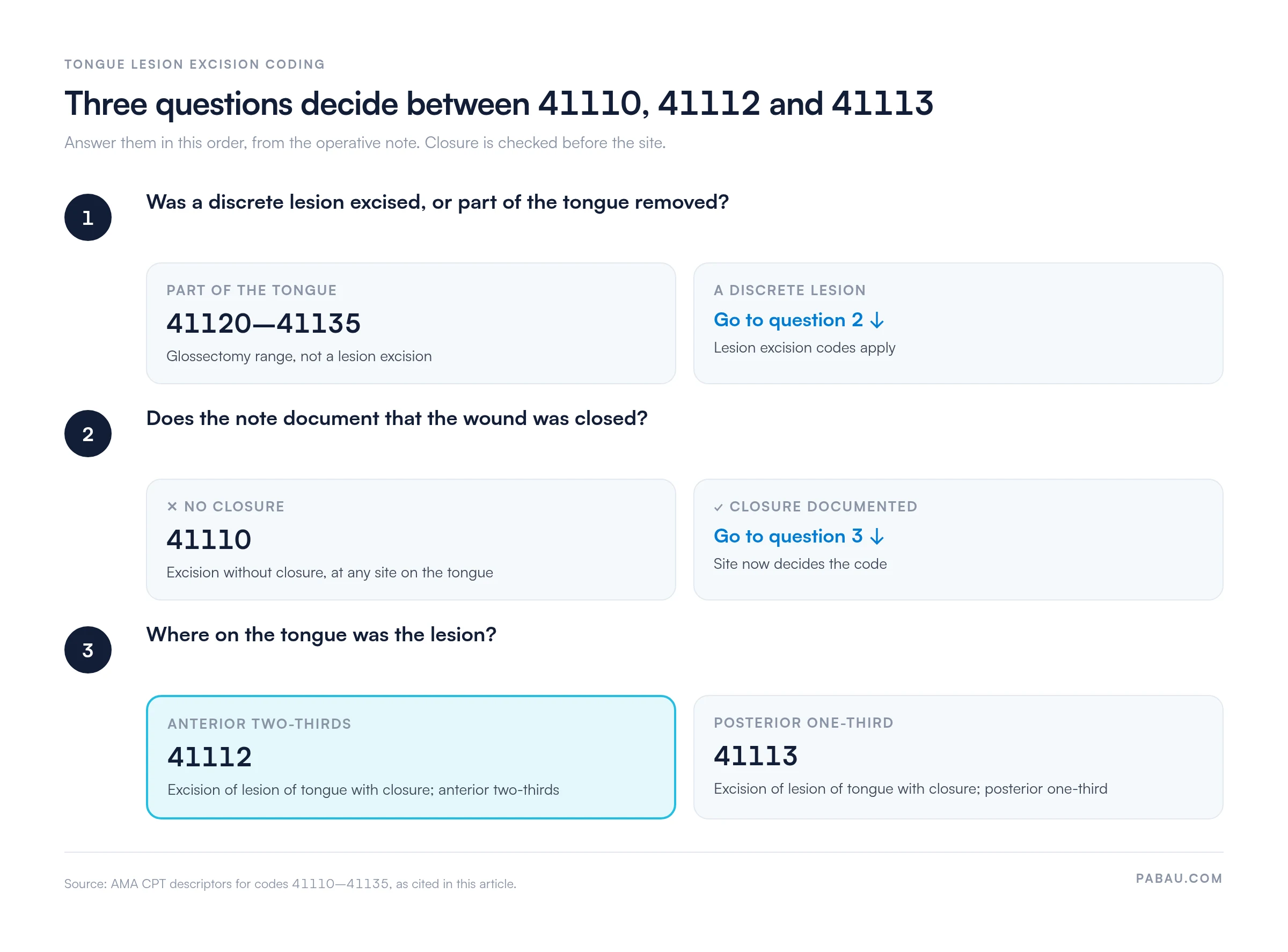
Glossectomy and floor-of-mouth codes sit in the same surgery chapter. To check one of those neighbors before you bill, start from our searchable CPT code library.
Payers audit tongue excision claims because the front-versus-back distinction and the closure rule are easy to misapply. The procedure note must cover all of the following, or the claim risks a medical necessity denial.
A sound billing workflow captures these elements at the point of care, while the surgeon still remembers the case:
The diagnosis code must justify surgical excision. These codes are often paired with 41112:
Flag leukoplakia and erythroplakia diagnoses for prior authorization before you schedule. Many MACs ask for approval first when the diagnosis raises suspicion of cancer, even if the excision is meant only to reach a diagnosis.
Modifier choice for CPT code 41112 follows standard surgical-code logic. Three modifiers apply in routine practice, while two cover services during the recovery period after surgery.
Modifier -59 is the one you will need most often. For example, a surgeon may biopsy one tongue lesion and excise a separate one in the same session. If you bill the pair without -59, NCCI bundles them and the biopsy line is denied.
CPT code 41112 carries a work RVU of 2.76, according to FastRVU’s 2026 RVU lookup tool. The total RVU adds up the work component, practice expense (both facility and non-facility), and malpractice expense.
Medicare multiplies the total RVUs by the conversion factor (CF) to set the payment rate. The CF changes every year, so check the current rates in the CMS Physician Fee Schedule Look-Up Tool before you quote expected payment. Private payer rates often run at 110-150% of Medicare, but this varies a lot by payer contract and location.
CPT code 41112 carries a 90-day global surgical period (global indicator 090) under the Medicare Physician Fee Schedule, the package CMS applies to major surgery. The package also covers the day before surgery, so related visits that day are bundled too. Coders should check the global period for the current year in the CMS PFS Look-Up Tool, since assignments can change.
During the 90-day global period, these services are bundled and cannot be billed on their own:
Some services can still be billed during the global period when the right modifier backs them up:
Ninety days is long enough for a routine suture check to be billed by mistake months after surgery. Strong revenue cycle management tracks each global period’s start and end dates, so bundled follow-up visits never reach a claim and trigger recoupment.
Tongue excision claims share a small set of denial triggers. Most are easy to prevent if you run a checklist on every claim before it reaches the clearinghouse.
Putting denial management workflows in place at the practice level catches these patterns before they reach the payer. Also, a clean claim submission for 41112 needs three elements in the procedure note:
Prior authorization rules for CPT code 41112 vary a lot by payer, plan type, and the diagnosis paired with the procedure. Most commercial payers do not require prior authorization for routine benign lesion excisions. However, cases with suspected cancer are a different matter.
Payers are more likely to require prior authorization when:
To confirm prior authorization rules, check the Local Coverage Determination (LCD) for the right Medicare Administrative Contractor (MAC) region. For a commercial plan, check its clinical policy bulletins instead. For Medicare patients, anyone can search LCDs in the CMS Coverage Database.
For commercial plans, call the provider relations line or use the payer portal before you schedule. Applying billing compliance practices at scheduling, before any claim exists, is the fastest way to avoid authorization denials.
When a prior authorization request is required, include these items:
Some payers also accept the AAPC Codify CPT lookup code descriptor as part of the supporting records.
Check the MAC LCD before you schedule any tongue excision where the diagnosis involves leukoplakia, erythroplakia, or any dysplastic lesion. CGS, Novitas, and WPS each publish LCD policies that can add record-keeping or prior authorization steps beyond the national Medicare policy.
Without a claims workflow, the biller rereads each procedure note for site, closure and modifier details after the surgeon signs it. Errors then surface weeks later as denials. Plus, a 90-day global period adds three months of follow-up visits to watch.
Pabau, the practice management platform we build, includes simpler claims management for US practices. Teams build and submit clean claims, track claim status and manage denials through the Claim.MD clearinghouse. The claim also sits in the same system as the patient’s appointments and records.
A well-built superbill generation workflow records the code, modifier and diagnosis together at the point of care. As a result, fewer 41112 claims come back for rework, and the team can see and work through the denial queue.

Pabau helps oral and facial surgery teams build and submit clean claims, track claim status and manage denials through the Claim.MD clearinghouse, so fewer 41112 claims come back for rework.

Code 41112 only when the procedure note proves two facts. The lesion sat in the front two-thirds of the tongue, and the surgeon closed the wound. If either is missing, the claim belongs to 41110 or 41113, and an auditor will downcode it.
The 90-day global period is the trade-off to remember. Related follow-up care for three months is already paid for, so bill only what modifiers -24, -78 or -79 support.
Build the site and closure fields into your procedure note template, and then each claim that follows starts clean. Book a demo to see how Pabau helps your team submit 41112 claims and work denials through Claim.MD.

Need to understand how claims reach payers electronically? 837 file submission guide explains the electronic claim format used for CPT code submission to US payers.
Dealing with CARC denial codes after a rejected 41112 claim? Denial codes in medical billing maps common CARC codes to root causes and resolution steps.
Billing the pathology read on the excised specimen? CPT code 88305 covers the surgical pathology code the laboratory reports for the tissue.
Choosing billing software for a surgical practice? Best medical billing software for US practices compares tools that handle clearinghouse submission and denial tracking.
CPT code 41112 covers surgical excision of a lesion from the anterior, or front, two-thirds of the tongue with closure. The bundle includes lesion removal, bleeding control during surgery, and wound closure, so no separate closure code may be added to the claim.
CPT 41110 is excision of a tongue lesion without wound closure, at any site on the tongue. CPT 41112 is excision with closure in the front two-thirds. If the surgeon closed a wound in that area, 41112 is correct, and billing 41110 results in underpayment.
The most common is -59, which you need when you bill a biopsy of a separate lesion at the same session. Others are -22 for a very difficult excision and -51 for multiple procedures. Also, -24, -78 and -79 apply during the global period.
CPT 41113 covers excision of a lesion from the posterior, or back, one-third of the tongue with closure. Because this base-of-tongue area is distinct from the front two-thirds, using 41112 for a back-of-tongue lesion is the wrong code.
CPT 41112 has a 90-day global period (indicator 090) on the Medicare Physician Fee Schedule, plus a one-day window before surgery. Because of this, related follow-up visits in that time are bundled into the surgical payment.