CPT code 21011: Excision of soft tissue tumor of the face
CPT code 21011: Official descriptor and procedure overview CPT code 21011, as pu...

Last Updated: Oct 8, 2026
36821 is the CPT code for arteriovenous anastomosis, open; direct, any site (eg, Cimino type) (separate procedure). The surgeon joins the patient's own artery directly to a nearby vein, most often at the wrist or elbow, to create hemodialysis access.
The code sits in the 36818-36830 hemodialysis access family. What sets 36821 apart from its neighbors is technique: a direct join, with no vein transposition and no graft.
Let Pabau's smart automation suggest the right codes, reduce claim denials, and keep your practice compliant—effortlessly.
Automate repetitive tasks and focus on what matters most—your patients.
Reduce coding errors and ensure compliance with the latest regulations.
Clean claims, fewer denials, and faster reimbursements.
Powerful insights and reporting to help your practice thrive.
HIPAA compliant SOC 2 certified GDPR-compliant Trusted by 4,000+ clinics worldwide

CPT code 36821 describes an open, direct arteriovenous anastomosis at any site using the patient’s own artery and vein, billed as a separate procedure.
It covers direct autogenous fistulas such as the Cimino radiocephalic fistula, not vein transpositions (36818), autogenous vein grafts (36825) or nonautogenous grafts (36830).
Medicare assigns a 90-day global surgery period, so related post-op visits in that window are bundled unless a qualifying modifier applies.
The CY2026 Medicare Physician Fee Schedule lists 11.60 work RVUs and 17.99 total RVUs for 36821, or roughly $601 to $604 nationally.
Practice management software like Pabau lets billing teams set configurable claim checks, such as a required LT or RT modifier, before submission.
CPT code 36821 reports an open, direct arteriovenous anastomosis that creates hemodialysis access from the patient’s own artery and vein, at any site. The table below collects the facts coders confirm before they open the operative note.
CPT code 36821 covers an open, surgically created connection between an artery and a vein, using the patient’s own (autogenous) vessels. It applies at any anatomical site and is billed as a separate procedure. The “Cimino type” in the descriptor is the most common variant. It is a radiocephalic fistula at the wrist, where the radial artery is joined to the cephalic vein.
The primary clinical indication is ESRD or CKD stage 5. Surgeons create the AV fistula weeks to months before hemodialysis begins, allowing the fistula to mature and the vein to arterialize. The AMA’s CPT code set classifies 36821 under “Hemodialysis Access, Intervascular” within the Surgery section.
Three elements must all be true for 36821 to apply:
Common anatomical sites include the radiocephalic fistula at the wrist and the brachiocephalic fistula at the antecubital fossa. Both bill as 36821 when performed via open direct anastomosis.
Incomplete operative notes are a common cause of 36821 medical necessity denials. The claim must be supported by documentation that confirms each element of the code descriptor. Coders should verify these items in the operative report before submission.
Every 36821 claim needs a diagnosis code that establishes medical necessity. The ICD-10-CM codes below are the most commonly used pairings. Confirm the correct code against the patient’s record before submission. These examples reflect typical pairings, not prescriptive assignments.
Use CrossCoder’s procedure-to-diagnosis crosswalk to verify the current pairing rules and any LCD (local coverage determination) requirements that apply to your Medicare Administrative Contractor.
Hemodialysis access creation spans four closely related CPT codes. Choosing among them means matching the operative report’s description of the conduit and the technique, and site alone rarely decides it. Two questions settle the choice, as the diagram below shows.
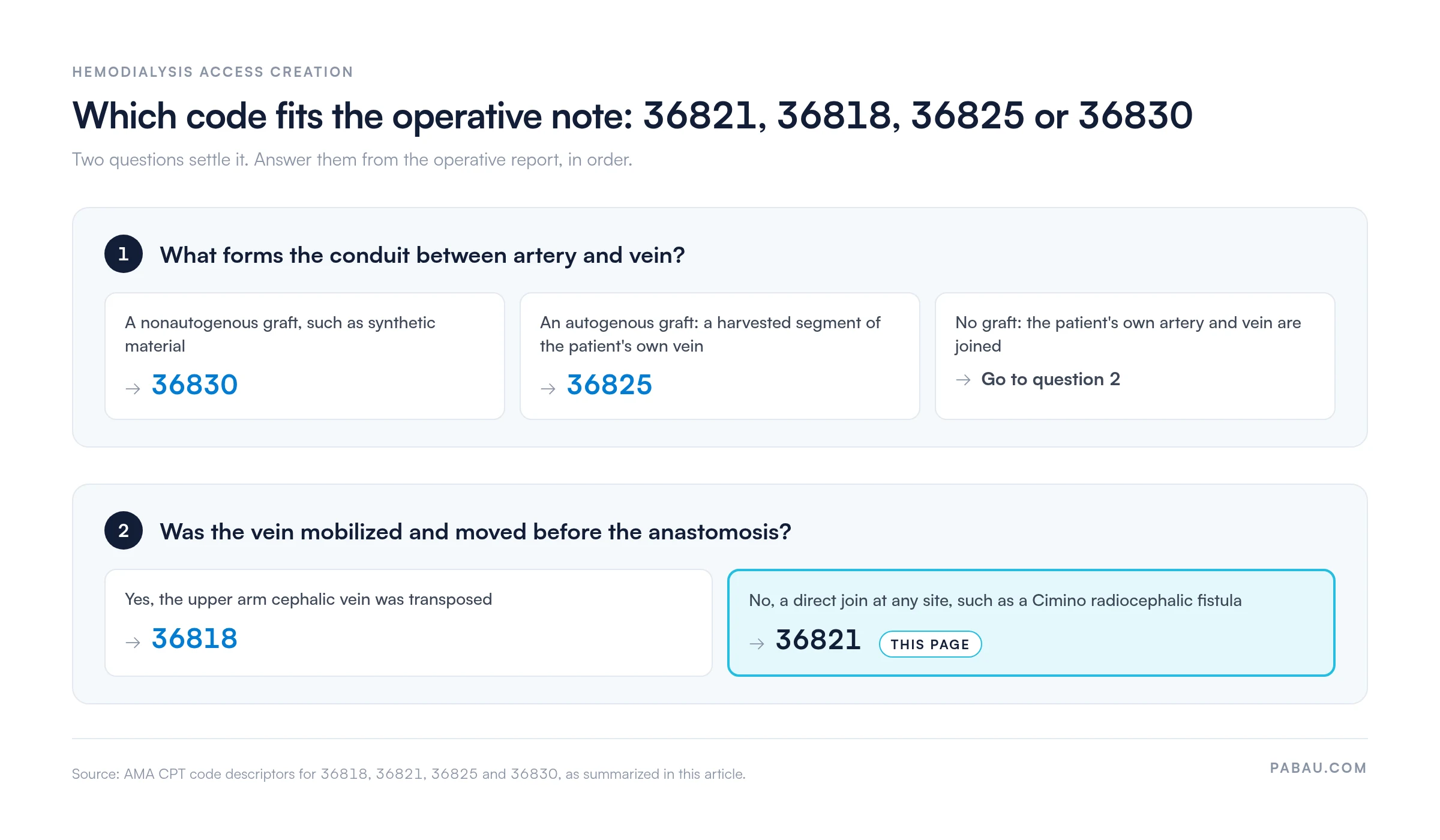
Decision rule for 36818 vs 36821: if the operative note describes the upper arm cephalic vein being mobilized and repositioned before anastomosis, bill 36818. If the note describes a direct artery-to-vein connection at the wrist or antecubital fossa using vessels that were not transposed, 36821 applies.
Modifier selection for CPT code 36821 affects both payment and audit risk. The table below covers the modifiers billers meet most often on AV fistula creation claims.
Because ESRD qualifies virtually all patients for Medicare regardless of age, CPT code 36821 is billed to Medicare more often than to any commercial payer. The CMS Physician Fee Schedule lookup tool provides current locality-adjusted rates.
The figures below come from the CY2026 national payment file. Verify current-year values before using them for contract analysis or compliance work, and reconcile your remittance advice against the expected allowable.
Use the FastRVU 2026 RVU lookup for current work RVU, practice expense, and malpractice values with locality multipliers applied. Geography drives meaningful payment variation: the same procedure yields different allowables in San Francisco versus rural Mississippi.
Run a quarterly comparison of your posted Medicare payments for 36821 against the current MPFS allowable for your locality. A consistent shortfall often indicates a missing laterality modifier (LT/RT) rather than a payer error. The claim may be processing at a reduced rate rather than denying outright.
CPT code 36821 carries a 90-day global surgery period under the Medicare Physician Fee Schedule. This means certain services provided before and after the procedure are considered bundled into the 36821 payment and cannot be billed separately.
What is bundled in the 90-day global period:
What can be billed separately during the global period:
Make sure every post-op encounter note states whether the visit relates to the 36821 surgery, so the correct modifier gets applied at billing.
Medicare does not require prior authorization for CPT 36821 as of 2025. AV fistula creation is not on the CMS list of outpatient hospital services that need prior authorization. CMS reviews that list every year, so confirm it for the current year. Verifying coverage before surgery still matters, even when prior auth is not formally required.
Commercial payers and Medicaid managed care plans are a different matter. Many require prior authorization for elective AV fistula creation. The typical documentation package for a commercial payer prior authorization includes:
Verify authorization requirements directly via each payer’s provider portal before scheduling. An eligibility check at scheduling should show whether the patient’s plan requires prior auth for surgery. Catching it before the procedure date avoids a post-service denial that is hard to reverse. A standard prior authorization form keeps the fistula documentation package together for each request.
Denials on CPT code 36821 cluster around a predictable set of errors, and each one has a fix.
Our guide to common denial codes explains CO-4 (modifier inconsistent or missing) and CO-97 (bundled service), which appear often on 36821 denials. Tag each denial by root cause, and you can see at a glance whether a spike is a laterality, bundling or prior auth problem.
The National Correct Coding Initiative (NCCI) edits govern which codes can and cannot appear on the same claim as CPT code 36821. A bundled code sent without a valid modifier is one of the easier errors to prevent. The NCCI lookup shows the edit before you submit.
Companion codes frequently appearing on the same claim date as 36821:
Verify current NCCI edit pairs via the CMS NCCI edit lookup tool before adding companion codes to a 36821 claim. Edits are updated quarterly, so a pairing that was allowed last year may be bundled today. Clearinghouse edits on the electronic claim add a final check before it reaches the payer. Review the AAPC Codify CPT lookup for companion code guidance and the broader hemodialysis access code range context.
The preventable 36821 denials above share one trait. Each one is a claim field someone could have checked before submission. Think of a missing LT or RT modifier, or a post-op visit billed inside the 90-day window.
Pabau’s claims management software lets your billing team set configurable rule checks for those fields. Before a 36821 claim goes out, a rule can flag a missing laterality modifier or diagnosis code. Your team fixes it in the practice instead of after a denial.
US claims then go out through Claim.MD, a clearinghouse, and Pabau tracks their status so rejections surface quickly. The rules check claim data, and your coder still reads the operative note and picks the code.
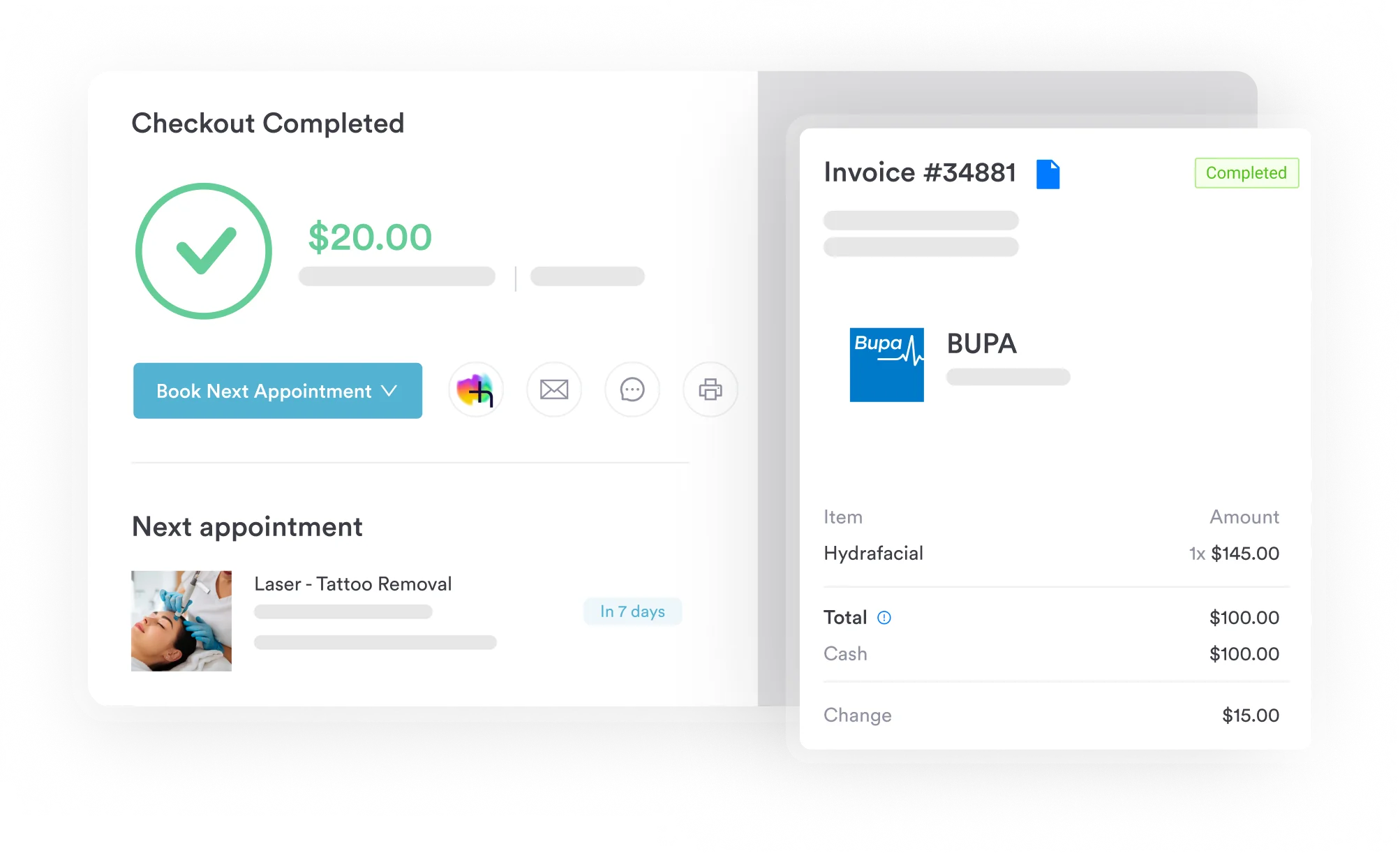

Pabau’s claims management software lets you set configurable checks for modifiers and diagnosis codes, then submits and tracks US claims through Claim.MD. See how it works for vascular surgery billing teams.

CPT code 36821 is simple to code once the operative note confirms an open approach, a direct join, and the patient’s own vessels. If the note leaves any of the three unclear, query the surgeon before you reach for a neighboring code.
At roughly $600 per claim in CY2026, each preventable denial is expensive, and laterality, bundling and global-period errors are all preventable. Build those checks into charge entry, where they cost minutes, instead of the appeals queue, where they cost weeks.
Book a demo to see how configurable claim checks catch those errors on hemodialysis access claims before submission.

Need a faster way to verify claim submission errors? How a medical claims clearinghouse works explains the validation layer between your practice management system and payers.
Tracking which denials cost the most? Revenue cycle management fundamentals covers how to structure a denial tracking workflow by root cause.
Want to stop repeat denials on the same code? Denial management in healthcare shows how to tag, appeal and prevent denials in one workflow.
Chasing a higher first-pass payment rate? What makes a clean claim breaks down the claim fields payers check before they pay.
Scheduling a commercial fistula case? The prior authorization process walks through each step from request to approval.
CPT code 36821 covers an open, direct arteriovenous anastomosis that uses the patient’s own artery and vein to create hemodialysis access. It applies at any site and is billed as a separate procedure. The Cimino-type radiocephalic fistula at the wrist is the most common example. A brachiocephalic fistula at the elbow also qualifies when the surgeon joins the vessels directly, without vein transposition.
LT (left) or RT (right) is required by Medicare on virtually every 36821 claim because the procedure is unilateral. Modifier 59 applies when 36821 is billed on the same date as a code that would otherwise be bundled under NCCI edits. Modifier 79 is used for unrelated procedures performed during the 90-day global period, and modifier 24 covers unrelated E&M visits within that window.
Under the CY2026 Medicare Physician Fee Schedule, CPT 36821 carries 11.60 work RVUs and 17.99 total RVUs, with no facility or non-facility split. That puts the national allowable at roughly $601 to $604, depending on which conversion factor applies. The CY2025 figure was about $628. Rates vary by GPCI locality, so verify yours with the CMS Physician Fee Schedule lookup tool.
Yes, but only with careful attention to NCCI bundling edits. Duplex vein mapping (93971) performed at a prior encounter is separately billable. Companion codes performed at the same surgical session may require modifier 59 to override a bundling edit. Verify current NCCI edit pairs via the CMS NCCI lookup tool before adding any companion code, as edits are updated quarterly.