CCSD code XR650: Percutaneous pyelolysis billing guide
CCSD code XR650 is the UK private billing code for percutaneous pyelolysis, a ki...

Last Updated: Nov 27, 2026
36227 is the CPT code for selective catheter placement in the external carotid artery on one side. It includes angiography of the ipsilateral external carotid circulation, plus all radiological supervision and interpretation.
The fact that decides payment is simple: +36227 is an add-on reported only with 36222, 36223 or 36224 for the same side. Coders often confuse it with 36224, which targets the internal carotid. A missing or ineligible primary code is a frequent reason claims for this code are denied. Below are the pairing rules, bilateral reporting, 2026 RVUs and a pre-submission checklist.
Let Pabau's smart automation suggest the right codes, reduce claim denials, and keep your practice compliant—effortlessly.
Automate repetitive tasks and focus on what matters most—your patients.
Reduce coding errors and ensure compliance with the latest regulations.
Clean claims, fewer denials, and faster reimbursements.
Powerful insights and reporting to help your practice thrive.
HIPAA compliant SOC 2 certified GDPR-compliant Trusted by 4,000+ clinics worldwide

CPT code 36227 covers selective catheterization of one external carotid artery and is not interchangeable with 36224, which targets the internal carotid.
36227 is an add-on code with a ZZZ global period, reported only with 36222, 36223 or 36224 for the same side.
Medicare gives 36227 bilateral indicator 1, so a two-sided study goes on one line with modifier 50, while commercial payers set their own rules.
The 2026 Medicare fee schedule assigns 36227 a work RVU of 2.04, paid on top of the primary code with no multiple-procedure reduction.
Most denials trace back to a missing or ineligible primary, a non-covered diagnosis or a report that never names the external carotid.
CPT code 36227 reports selective catheter placement in one external carotid artery, with angiography of that side’s external carotid circulation. CMS’s 2026 relative value file lists it with a ZZZ global period, the marker for an add-on that is never paid alone.
The official American Medical Association (AMA) descriptor is below. The + prefix in the code book marks its add-on status.
Selective catheter placement, external carotid artery, unilateral, with angiography of the ipsilateral external carotid circulation and all associated radiological supervision and interpretation (List separately in addition to code for primary procedure)
Three attributes shape how 36227 behaves on a claim.
Radiological supervision and interpretation are bundled into 36227. Don’t add a separate supervision code for the external carotid run.
The study starts with arterial access, usually through the common femoral artery. The interventionalist then steers the catheter into the external carotid artery (ECA) and injects contrast under fluoroscopy.
Coders should look for one word: selective. The catheter must pass the carotid bifurcation and sit in the ECA itself. A common carotid injection that happens to fill the ECA does not support 36227.
Going deeper into a branch changes nothing. A facial or internal maxillary run on the same side stays inside 36227, according to the AMA’s CPT Assistant.
The AAPC Codify CPT lookup lists the full 36221-36228 cervicocerebral angiography family. Six codes are primaries, and 36227 is one of two add-ons.
The primaries form the base layer, but each add-on has its own partners. 36227 attaches only to 36222, 36223 or 36224, while 36228 pairs with 36223-36226. No modifier is needed to link an add-on to its primary.
Both arteries leave the same carotid bifurcation, so the codes get mixed up. 36224 targets the internal carotid artery (ICA), while 36227 targets the external carotid. When a report documents both vessels, both codes can go on the claim.
Both codes on one side need two documented tip positions. One sentence about “carotid angiography” supports neither code well.
CPT reports +36227 with one of three primaries, on the same side as the external carotid study.
A study run from the common carotid with intracranial views uses 36223 as the host. The chart below shows which codes can carry the add-on, and which can’t.
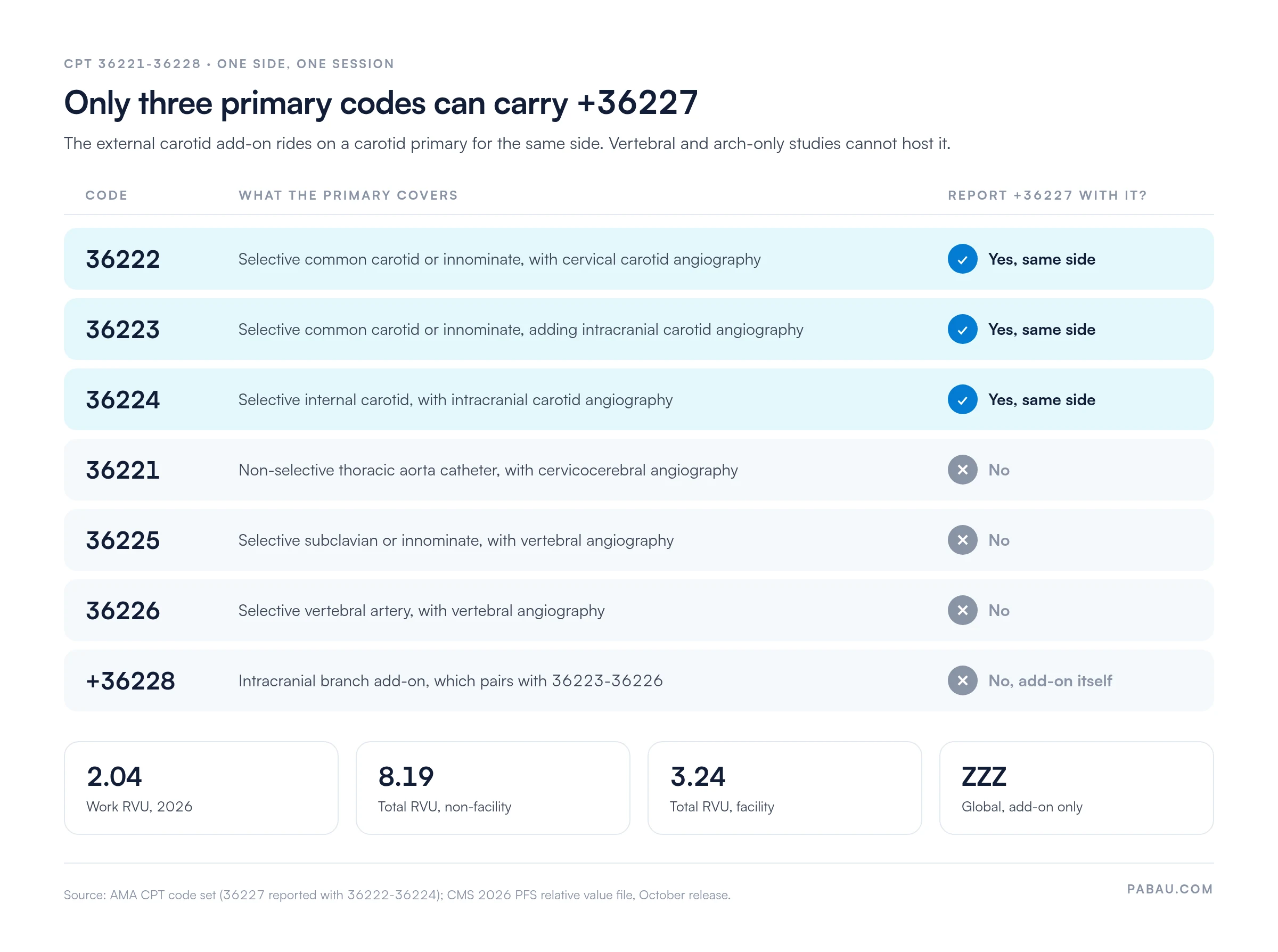
A 36227 line without one of these primaries is denied automatically. Its ZZZ global period means it inherits the primary’s global period instead of starting one.
Before submitting, check that every 36227 line has 36222, 36223 or 36224 on the same claim, for the same side. Audit any encounter with three or more cervicocerebral codes, because multi-vessel studies cause most missing-primary denials.
Take a bilateral study for recurrent epistaxis. On the right, the physician enters the internal carotid for intracranial views, then the external carotid. On the left, the catheter goes from the common carotid into the external carotid, with neck views only.
A commercial payer that rejects modifier 50 would instead take 36227-RT and 36227-LT on two lines. Each side still has a valid primary, so the add-on stands.
36227 is a unilateral code, so a study of both external carotids needs both sides reported. The method varies by payer.
Modifier 59 is not a laterality modifier. It marks distinct procedures on the same date, so using it for a bilateral 36227 is a common audit flag.
Local Coverage Determinations from Medicare Administrative Contractors (MACs) set the documentation floor. A clean claim for 36227 rests on five elements.
The table below comes from the CMS 2026 relative value file, October release. Check the CMS Medicare Physician Fee Schedule (MPFS) lookup tool before quoting a rate, because values change with each update. Your locality’s Geographic Practice Cost Index (GPCI) adjusts the final payment.
Use the FastRVU 2026 RVU lookup tool to work out your local figure. 36227 is paid on top of the primary code, and its multiple-procedure indicator of 0 means no reduction applies. Facility rates apply in a hospital or ambulatory surgical center, and non-facility rates in an office.
CPT 76377 covers 3D rendering with interpretation and reporting on an independent workstation. It can join a 36227 encounter when the physician builds and reads a separate 3D reconstruction of the ECA territory.
That work must go beyond the standard 2D DSA review bundled into 36227. Payer acceptance varies, so document medical necessity and check LCD coverage before billing 76377 routinely.
Prior authorization for 36227 is not uniform. Traditional Medicare generally doesn’t require it for covered indications, but Medicare Advantage plans may. Verifying insurance eligibility and authorization first is the surest way to avoid a post-service denial.
The diagnoses on the authorization request must match the ones on the claim. A mismatch between the two is a frequent and preventable denial.
Once the dictation is signed, the claim passes through a few predictable stages.
Denials for 36227 cluster around five triggers, and each has a clear fix. Our guide to medical billing denial codes explains the CARC behind each one.
A steady denial management routine shortens the time from denial to payment. For 36227, the missing-primary denial is the easiest to stop before it starts.
Map CARC codes to denial categories each month. CARC 4 means the procedure code is inconsistent with the modifier, and CARC 97 means payment was bundled into another service. On 36227 claims, both usually point to a pairing or bilateral error.
The diagnoses below are the ones most often linked to external carotid studies. Each must appear on your MAC’s LCD covered list, and that list differs by jurisdiction.
Choose the most specific code available. I65.21 or I65.22 matches the side in the report better than I65.29 (unspecified carotid artery). For a TIA workup, the G45.9 page sets out how that diagnosis is coded.
Angiography claims usually leave the practice as several lines built from a long dictation. When one line slips, the add-on arrives without its partner and the payer denies it.
Pabau, a practice management platform with built-in claims management software, builds the claim from the patient record. The CPT codes on the service land on the charge lines, and CPT and ICD-10 lookup libraries sit beside each field.
Required fields and authorization codes are checked before the claim can be sent. US claims go through Claim.MD, with eligibility checks, claim status and remittances in the same screen.

Pabau pre-fills CMS-1500 claims from the patient record, checks required fields before sending and routes US claims through Claim.MD. You see eligibility, remittances and claim status in one place.

Treat +36227 as a dependent line. Confirm the primary for that side first, then the payer’s bilateral method, then the word “selective” in the report.
Do that in order and the claim either pays cleanly or fails for a reason you can fix the same day. The trade-off is a few extra minutes of abstracting, which costs far less than a corrected claim.
Book a demo to see how Pabau builds angiography claims from the record and tracks each one to payment.

Need to understand how clearinghouse submission works for complex vascular claims? Revenue cycle management explained covers the end-to-end process from encounter to payment posting.
Choosing a clearinghouse for complex procedure claims? Claim.MD vs Office Ally compares clearinghouse options for practices billing high-complexity procedure codes.
Want to know what carries your CPT lines to the payer? 837 file format and submission explains the EDI transaction that carries your CPT claims to the payer.
Coding the internal carotid on the same side? CPT code 36224 covers selective internal carotid catheterization with intracranial angiography.
Adding intracranial views from the common carotid? CPT code 36223 explains when the common carotid study extends inside the skull.
No. 36227 includes every selective catheterization within the external carotid territory on that side. The AMA’s CPT Assistant confirmed in November 2015 that a facial artery run is not reported separately.
No. 36221 is not one of its primaries. Reaching the external carotid means a selective carotid placement too, so code 36222, 36223 or 36224 for that side, then add +36227.
Nationally, about $273.55 in an office and $108.22 in a facility, using the 2026 non-QPP conversion factor of $33.4009. Your locality’s GPCI adjusts both figures.
No. Its multiple-procedure indicator is 0, so Medicare pays 36227 in full alongside 36228 or other same-session codes. Each line still needs its own documented catheter position.