HCPCS code K0879: Group 4 heavy duty power wheelchair guide
HCPCS code K0879 is a Group 4 heavy duty power wheelchair base HCPCS code K0879 ...

Last Updated: Nov 17, 2026
36223 is the CPT code for selective catheter placement in the common carotid or innominate artery, on one side, with intracranial carotid angiography. The code includes all radiological supervision and interpretation, plus extracranial carotid and arch angiography when performed.
Coders most often go wrong in two places. They report lesser codes such as 36222 alongside it, or treat 36224 as its bilateral version. Both 36223 and 36224 are unilateral, so a bilateral study is coded once per side.
Let Pabau's smart automation suggest the right codes, reduce claim denials, and keep your practice compliant—effortlessly.
Automate repetitive tasks and focus on what matters most—your patients.
Reduce coding errors and ensure compliance with the latest regulations.
Clean claims, fewer denials, and faster reimbursements.
Powerful insights and reporting to help your practice thrive.
HIPAA compliant SOC 2 certified GDPR-compliant Trusted by 4,000+ clinics worldwide

CPT code 36223 covers selective catheter placement in the common carotid or innominate artery on one side, with intracranial carotid angiography.
Radiological supervision and interpretation is bundled into 36223, and extracranial carotid and arch imaging are included when performed.
For a bilateral study, report the unilateral code once per side with RT/LT or modifier 50, following payer rules. 36224 is a different unilateral code, not the bilateral version.
Pabau, the practice management platform we build, tracks prior authorization on each case and warns staff when one is missing.
CPT code 36223 reports a unilateral, selective catheter placement in the common carotid or innominate artery. From there, the intracranial carotid circulation on the same side is imaged, as MedLearn’s angiography coding guide explains. The full descriptor reads:
Selective catheter placement, common carotid or innominate artery, unilateral, any approach, with angiography of the ipsilateral intracranial carotid circulation and all associated radiological supervision and interpretation, includes angiography of the extracranial carotid and cervicocerebral arch, when performed.
Two parts of that wording drive correct coding. The catheter sits in the common carotid or innominate artery, not the internal carotid. And the intracranial images are mandatory, while extracranial carotid and arch images are included only “when performed.”
In the CPT code set maintained by the American Medical Association, 36223 belongs to the diagnostic studies of cervicocerebral arteries, 36221 through 36228. Every selective code in that family, 36222 through 36228, describes one side only.
Accurate coding starts with what happens in the angiography suite. The physician gains arterial access, usually through the femoral artery, and advances a catheter into the common carotid or innominate artery on one side. Contrast is injected, and images of the intracranial carotid circulation on that side are acquired and interpreted.
Common indications that support medical necessity include carotid artery stenosis, transient ischemic attack workup, and assessment before carotid endarterectomy. Intracranial vascular disease is another frequent reason.
A TIA workup with no confirmed cause often goes on the claim as G45.9. Whatever the diagnosis, confirm that it maps to a covered indication under the applicable LCD or NCD before submission. When imaging confirms an infarction but the record names no vessel or mechanism yet, the claim carries I63.9 instead.
RS&I is bundled into 36223, so the billing team cannot report the supervision and interpretation separately. The same goes for the catheter placement itself and the lesser imaging codes in the family. National Correct Coding Initiative (NCCI) edits deny those pairs.
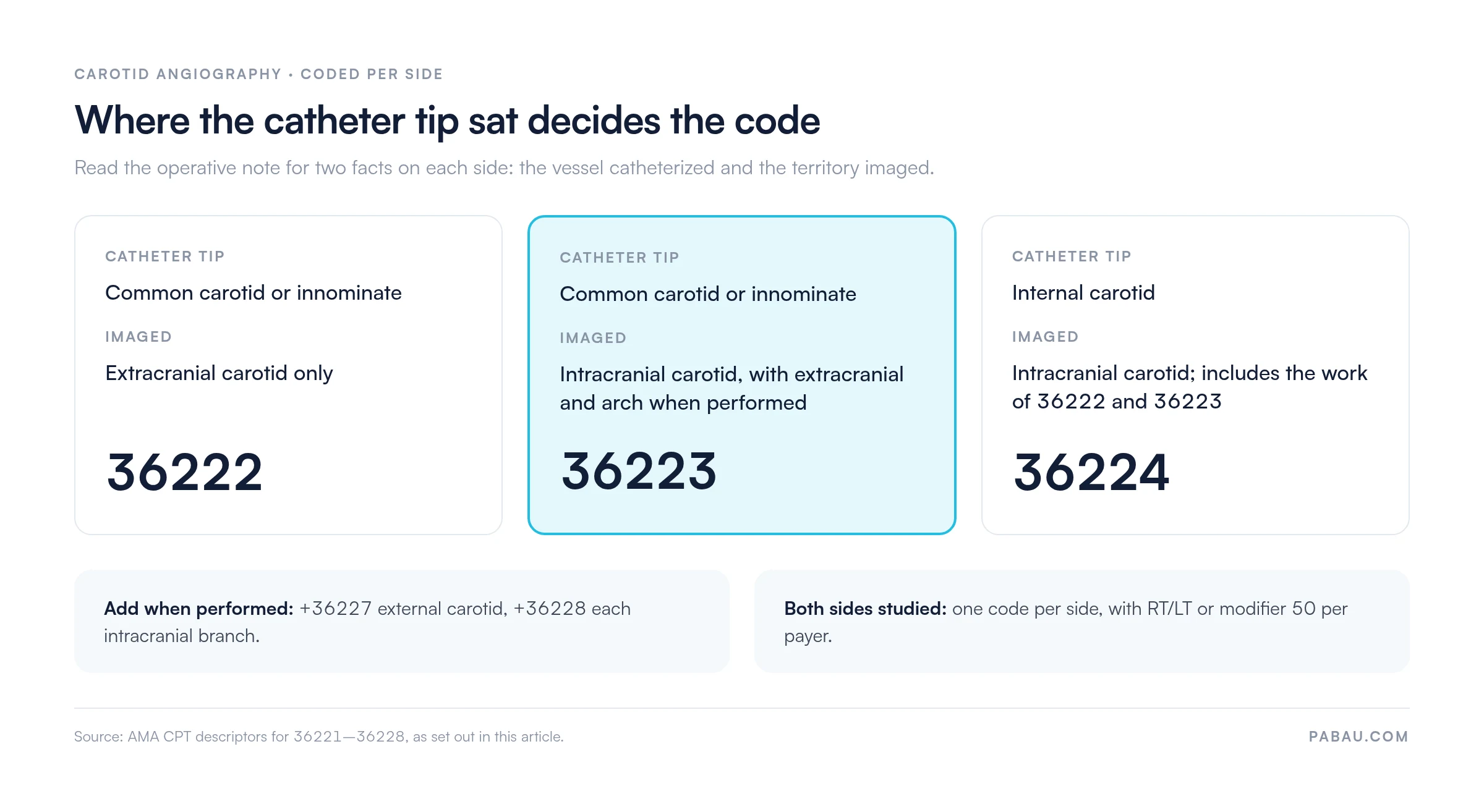
All five codes are unilateral. They differ by the vessel catheterized and the territory imaged, so the operative note decides the code. Check where the catheter tip sat on each side, and which circulation was imaged from there.
The carotid codes build on each other. CPT code 36224 includes the work of 36222 and 36223, so 36221–36223 are not reported with 36224 on the same side. In the same way, 36223 includes 36222 and 36221 on its side. On each side, the choice comes down to two facts in the note, set out below.
Yes, when both sides earn it. If the same service was performed on each side, report 36223 once per side. Depending on the payer, that means 36223-RT and 36223-LT, or one line with modifier 50.
When the two sides differ, code each side on its own with RT and LT. A right internal carotid study with a left common carotid study is 36224-RT plus 36223-LT. Check the NCCI and MUE edits for the pair before the claim goes out.
Before selecting 36223, confirm two things in the operative note. The catheter tip sat in the common carotid or innominate artery on the reported side, and the intracranial carotid circulation was imaged and interpreted. Missing either one means the code is not supported.
Medicare pays 36223 from the Medicare Physician Fee Schedule (MPFS), which CMS updates every January. Because dollar amounts change each year, pull current figures from the CMS MPFS lookup tool rather than a fixed figure in a coding guide.
The table below shows the RVU components that drive payment. Place of service changes the practice expense component, so facility and non-facility rates differ. The FastRVU lookup tool shows current-year wRVU values by place of service. For a bilateral claim, check how the payer applies its bilateral payment adjustment.
For revenue cycle management, 36223 is worth guarding closely. One denial for missing documentation or prior authorization is a meaningful loss, so a clean-claim process for this code pays off quickly.
Prior authorization for CPT code 36223 varies by payer and plan year. Traditional Medicare generally does not require it for diagnostic angiography, but Medicare Advantage plans often do. Many commercial insurers also require it for interventional radiology services, so confirm through each payer’s portal before scheduling.
When prior authorization is required, the supporting documentation typically includes:
Local Coverage Determinations for angiography spell out the covered indications. Maintaining medical billing compliance means checking the ordering diagnosis against a covered indication before submission, not after a denial.
The procedure note and the interpretation report together support the claim. A missing element below is a common cause of audit findings and clean claim submission failures for this code.
Denials for CPT code 36223 cluster around a few root causes, and each has its own fix. Effective denial management in healthcare tracks them by denial code, not just by dollar amount.
Pabau sends US claims as 837P files through Claim.MD, the clearinghouse it connects to. A clearinghouse rejection for a missing field arrives days before a payer denial would. Knowing the denial codes in medical billing behind each root cause also helps staff route appeals correctly.
Run a 90-day pull of all 36223 claims by denial code before changing your process. Bundling denials and prior-auth denials need different fixes, so treating them as one problem wastes appeal time.
Several codes can appear on the same claim as CPT code 36223 when additional work was done. Others look related but are bundled. Pabau’s claims management software supports multi-line claims, so companion codes and modifiers are captured with the primary code.
Before submitting, check the current NCCI procedure-to-procedure edits and MUE values for every code pair on the claim. Payer contracts can also bundle codes differently, so verify against the current year’s data.
Most 36223 denials start before the claim leaves the practice. A side goes undocumented, a lesser code rides along with the primary one, or prior authorization is missed. Catching those errors by hand on every angiography claim is slow work for a billing team.
Pabau keeps the clinical record, scheduling, and claims in one place. US claims go out through Claim.MD as 837P files, with eligibility checks before the study and ERA remittances after it.
Prior authorization codes, dates, and sessions sit on the patient’s case, and staff see a warning when one is missing. That catches the Medicare Advantage authorization before the patient is on the table, not after the denial arrives.

Pabau tracks prior authorization on every case and sends US claims through Claim.MD with eligibility checks built in. See how it works for interventional radiology and vascular practices.

CPT code 36223 rewards precise reading of the descriptor. It means a common carotid or innominate catheter position with intracranial imaging on one side. Internal carotid selection moves you to 36224, and each side of a bilateral study is coded on its own.
Settle catheter position and laterality in the note before anyone picks a code. The bundling and modifier denials in this guide then have far less to catch. To see how Pabau tracks authorizations and sends angiography claims from note to remittance, book a demo.

Billing the internal carotid instead? CPT code 36224 covers selective internal carotid catheterization with intracranial angiography, and how it bundles 36223.
Moving from diagnosis to treatment? CPT code 37215 explains carotid stent billing, modifiers, and the fee schedule.
Unclear on what a clean claim requires? Clean claim submission guide walks through every field that must be complete before a claim transmits.
Want to understand denial codes by CARC category? Denial codes in medical billing maps common CARC and RARC codes to corrective actions for the most frequent rejection types.
CPT code 36223 reports selective catheter placement in the common carotid or innominate artery on one side. It includes angiography of the intracranial carotid circulation on that side. Radiological supervision and interpretation is included. Extracranial carotid and arch angiography are included when performed, but are not required.
CPT 36223 is unilateral. For a bilateral study, report it once per side, using RT and LT or modifier 50 according to the payer’s rules. Check NCCI and MUE edits before submitting.
Both are unilateral intracranial carotid codes. 36223 applies when the catheter sits in the common carotid or innominate artery, while 36224 applies when the internal carotid artery is selectively catheterized. 36224 includes 36222 and 36223, so do not report them together on the same side.
Yes. RS&I is bundled into CPT 36223 and cannot be reported as a separate line. The physician’s written interpretation is still required documentation, but it does not create a separate billable service.
Medicare pays CPT code 36223 from the annual Medicare Physician Fee Schedule, and the rate varies by locality and place of service. CMS updates the figures each January, so check the current rate in the CMS MPFS lookup tool.
Requirements vary by payer. Traditional Medicare generally does not require prior authorization for diagnostic angiography, but Medicare Advantage and many commercial plans do. Expect to send prior imaging results, clinical notes on the indication, and the ICD-10-CM code.
Common triggers are NCCI bundling conflicts, bilateral modifier errors, missing prior authorization, and undocumented laterality. A diagnosis that does not match the covered LCD indications is another. Each needs a different fix, from removing an included code to obtaining an amended procedure note.