CPT code 21011: Excision of soft tissue tumor of the face
CPT code 21011: Official descriptor and procedure overview CPT code 21011, as pu...

Last Updated: Oct 8, 2026
CPT code 36224 covers selective catheter placement in the internal carotid artery, unilateral, with angiography of the ipsilateral intracranial carotid circulation. The descriptor also absorbs all associated radiological supervision and interpretation, plus arch and extracranial carotid imaging when performed.
That one clause settles most 36224 claims. Every vessel the catheter passed through, and every image taken along the route, is already paid for inside the code.
Bill 36224 on its own, attach a laterality modifier, and the claim usually clears. From there, the code family, the payment math, the modifiers and the documentation all follow from the same rule.

CPT code 36224 covers unilateral internal carotid catheterization with intracranial angiography, and radiological supervision and interpretation sits inside the code.
Bill only the highest level the catheter reached, because 36221, 36222 and 36223 are all included in 36224 on the same side.
The NCCI edit pairing 36221 with 36224 carries modifier indicator 0, so no modifier will bypass it.
Add modifier -LT or -RT for laterality, and use -50 when both internal carotid arteries are studied in one session.
Practice management software like Pabau pre-fills the claim from the patient record and submits it through Claim.MD, our US clearinghouse partner.
One code, three pieces of work. Per the American Medical Association’s CPT code set, 36224 describes selective catheter placement in the internal carotid artery (ICA).
The descriptor is unilateral, and it covers angiography of the ipsilateral intracranial carotid circulation. It then adds all associated radiological supervision and interpretation, or RS&I for short. Extracranial carotid and cervicocerebral arch imaging also come along when those runs are performed.
Here is how the procedure runs. The physician gains arterial access, usually femoral or radial. The catheter is then advanced under fluoroscopy into the ipsilateral internal carotid artery. Contrast goes in, and angiographic sequences of the intracranial carotid circulation are captured.
Finally, the interpreting physician reads the images and signs a formal report. Both halves of that work, the technical performance and the professional read, sit inside the same 36224 unit. No separate RS&I line is available for the vessels this code already covers.
Specialties that regularly bill 36224 include:
One more point worth holding on to. The code is unilateral by definition, so a right ICA study and a left ICA study are two pieces of work. Payers split on how they want that reported, which is why the modifier section below matters as much as the code itself.
CPT codes 36221 through 36228 form a hierarchy, and each higher code includes the work of the ones below it. So the level the catheter reached decides the code, and the steps taken to get there are already paid for.
Stacking two codes from this family on one claim is the most common error on cervicocerebral angiography. It is also the quickest route to a rejection instead of a clean claim submission.
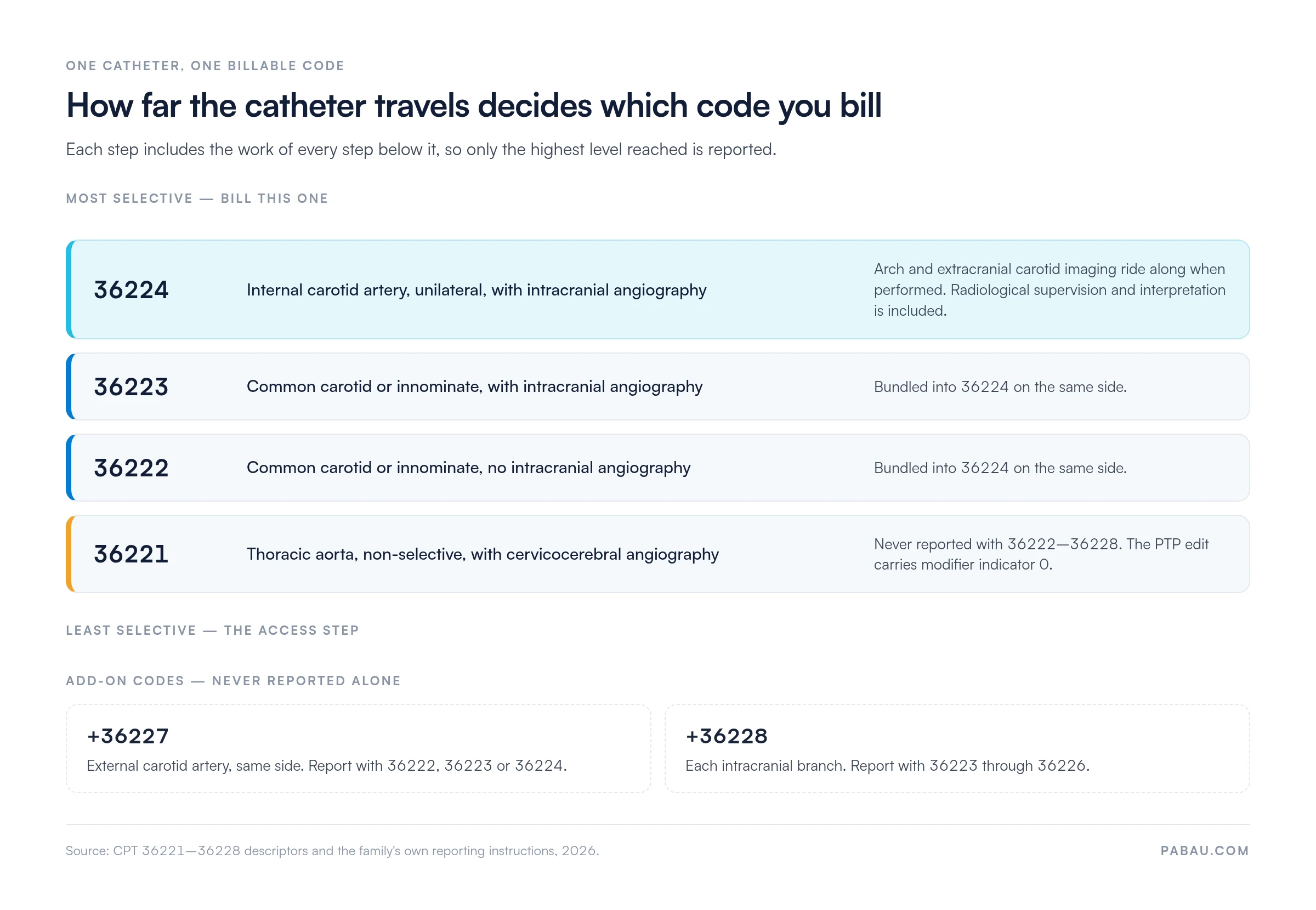
The full family, with the two add-on codes marked, looks like this.
Note the plus signs on the last two rows. Codes 36227 and 36228 are add-on codes, so neither one can ever stand alone on a claim. Report +36227 only alongside 36222, 36223 or 36224, and report +36228 only alongside 36223 through 36226.
A worked example makes the hierarchy concrete. Say the catheter goes in at the right groin and up to the aortic arch. From there it enters the left common carotid artery, then the left internal carotid artery, with intracranial runs.
That is one line item: 36224 with modifier -LT. The arch shot and the left common carotid step are both included, so adding 36221 or 36222 would only invite an edit.
Medicare pays for 36224 from the CMS Physician Fee Schedule, not from a fixed dollar amount. The code carries relative value units, or RVUs, which are then adjusted for where the practice sits.
Rates move every January with the fee schedule update. So the table below sets out the structure, not a figure to quote back to a payer.
Working out the allowed amount takes three steps. Add the three RVU components together, apply the GPCI for your locality, then multiply by the year’s conversion factor.
Commercial payers usually set their rate as a percentage of Medicare, or run a fee schedule of their own. Check the contract rather than assuming parity.
Run a quarterly audit of 36224 remittances against your contracted rates. Underpayments on complex interventional codes often go unchallenged because the remittance posts them as a contractual adjustment rather than a denial. Comparing what landed against your fee schedule, payer by payer, is how a consistent shortfall becomes an appeal.
Because 36224 is unilateral, the modifier is what tells the payer which side you studied. Leave it off and the claim stalls. Pick the wrong one and the payer sees a duplicate the next time the other side is done. The choice itself is quick.
The rest of the modifier set covers who is billing and why. The table below summarizes the ones that show up on interventional radiology claims.
Two habits keep this section out of your denial queue. Confirm each payer’s bilateral preference before the claim goes out, not after it comes back. And read the remittance on bilateral cases, because Medicare applies the 150% reduction itself and the line will not match your charge.
Modifier logic changes shape on supply codes, where the modifier describes the item rather than the service. A replacement defibrillator battery billed under HCPCS code K0607 takes NU when it is new and UE when it was previously used.
Make laterality a required field for 36224 in your billing workflow. Ask the biller to confirm -LT or -RT before the claim can be created. Then flag any 36224 that arrives without a side documented in the note. One checkpoint removes the most common modifier omission on interventional radiology claims.
The National Correct Coding Initiative, or NCCI, lists the code pairs a payer will not pay together. Each pair carries a modifier indicator that says whether a modifier can bypass the edit. Indicator 1 means a modifier can. Indicator 0 means nothing will, so the second code is simply not payable.
Four rules cover almost every 36224 bundling question.
CMS refreshes these edits four times a year, so last quarter’s answer is not always this quarter’s. Check the current pairs in the Medicare NCCI procedure-to-procedure edit files, or run the claim through your clearinghouse scrubber before it goes out.
Every 36224 claim needs a diagnosis code that explains why the study happened. Per AAPC coding guidance, that code has to match the indication written in the ordering physician’s note.
Coverage is then set locally. Each Medicare Administrative Contractor publishes a Local Coverage Determination listing the diagnoses it will pay for. A code Palmetto GBA covers may not clear at Noridian.
Pick the code that matches the documented indication, not the one most likely to be paid. Where the ordering note and the claim disagree, the payer reads the note. Our ICD-10-CM code reference is a quick way to check a descriptor or a sibling code before you commit to it.
The note is the claim’s defense. An auditor comparing 36224 against a thin report wants two pieces of evidence. The catheter reached the internal carotid artery, and a physician read the images. The procedure note and the interpretation together need to cover every element of the descriptor.
Run these five before the claim leaves the practice. Each one maps to a denial reason we have already covered.
In many practices the same facts get typed twice. The note records a left internal carotid angiogram, then someone opens a claim form and enters 36224, the diagnosis and the plan details again. Every retype is another chance to transpose a digit.
Pabau, an all-in-one practice management system, has claims management built in. The CPT code attached to the service lands on the charge line by itself.
ICD-10 slots are seeded from the problem list already on the record. Built-in CPT, HCPCS and ICD-10-CM lookup libraries sit behind a search icon, so a coder can check a descriptor without leaving the claim.
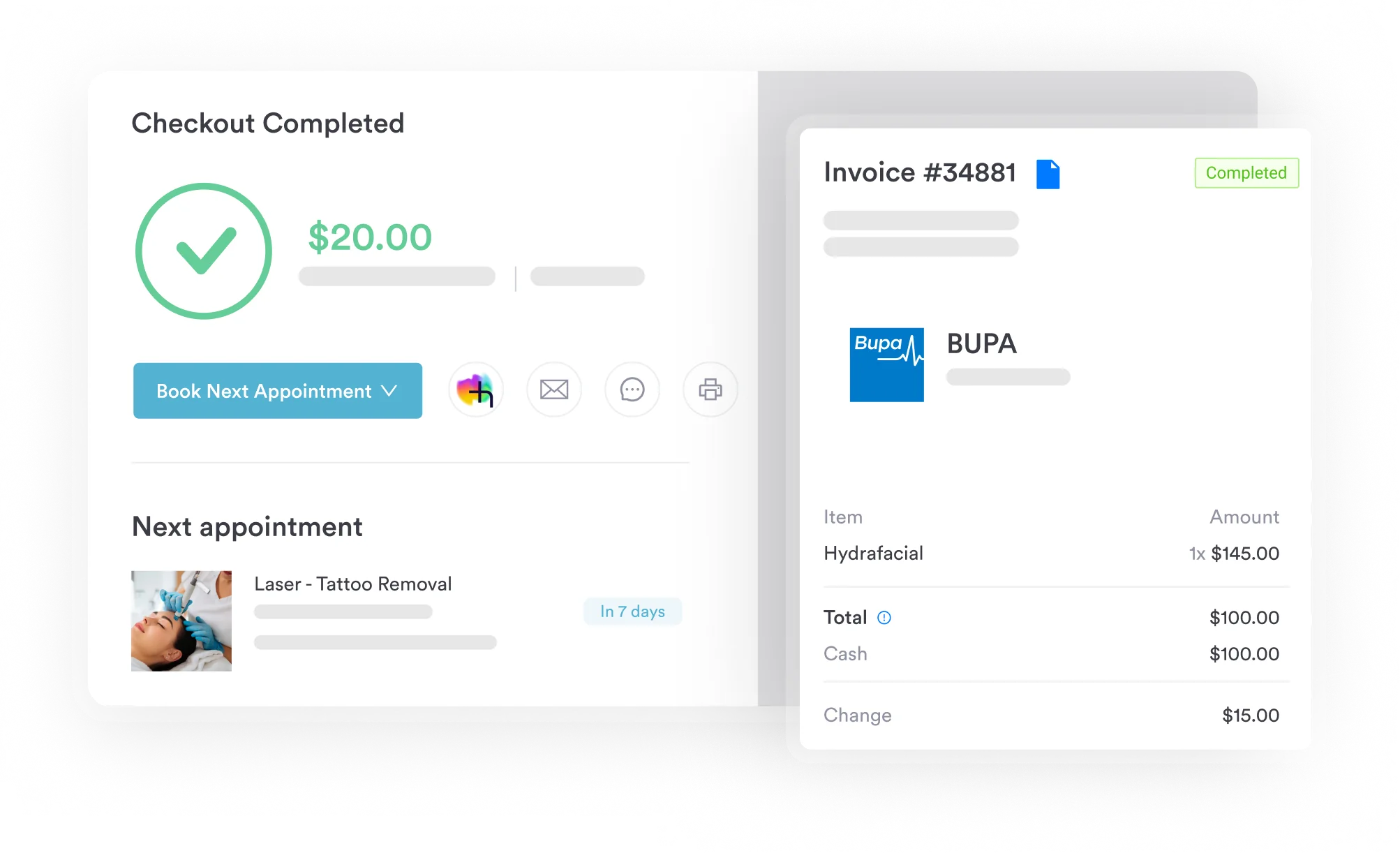
Pabau also checks that the fields a payer needs are complete before the send button unlocks. It will not choose your laterality modifier for you, and it does not scrub NCCI pairs. That judgment stays with your coder, where it belongs.
What it does take off their desk is the submission itself. Claims go out through Claim.MD, our US clearinghouse partner, with real-time eligibility checks and claim-status tracking. Remittances post back against the charge, and denial reporting groups the results by code. If 36224 rejections climb in March, you see it in March.

Pabau pre-fills the claim form from the patient record, checks the required fields, and submits through Claim.MD with eligibility checks and remittance posting. Your coder keeps the code and modifier decisions.

Almost every avoidable 36224 denial comes from billing the route as well as the destination. Choose the highest level the catheter reached, attach the side, and leave the rest of the family off the claim. That single habit closes the bundling edits, and the signed interpretation closes the audit risk.
Holding that discipline on a full schedule is the harder part. A quarterly remittance audit catches the slow leaks, and a laterality prompt in the claim workflow catches the fast ones. Neither takes long once someone owns it.
Retyping the same procedure details into claim forms is where a billing team loses its afternoons. Book a demo to see how Pabau builds the claim from the record instead.

Want fewer claims coming back at all? Clean claim submission sets out what makes a claim payable on the first pass.
Tracking denials by code? Denial management in healthcare shows how to group, measure and reduce rejections across your code mix.
Not sure what a remittance code means? Denial codes in medical billing translates the common rejection reasons into next actions.
Curious how your claim reaches the payer? The 837 electronic claim file breaks down each segment and where mapping errors delay payment.
Building a charge sheet for procedural work? What a superbill includes maps procedure codes to the documentation each one needs.
Not on the same side. The carotid stent codes already include catheter placement and the diagnostic angiogram of the artery being treated. Report 36224 separately only when the diagnostic study covers a different vessel, and document why that study was needed. Payer policies differ on the contralateral side, so check before you submit.
Different vessels. Code 36224 covers the internal carotid artery, which feeds the anterior circulation. Code 36226 covers the vertebral artery and the posterior circulation. A four-vessel study often involves both, each reported once per side. The vessel you catheterized picks the code, and the side picks the modifier.
Often yes, for an elective study under a commercial plan. Traditional Medicare does not require prior authorization for this physician service, but Medicare Advantage plans frequently do. Check the plan’s radiology policy at scheduling rather than on the day. An authorization obtained after the procedure rarely rescues the claim.
Read the remittance first to see which line was denied and which one paid. If the payer bundled a legitimate contralateral study, resubmit with laterality modifiers and the note showing two separate vessels. If the edit was applied correctly, an appeal will not move it. Rebill the single highest-level code instead.