CCSD code H4430: Examination of rectum under anaesthetic
CCSD code H4430 pays for the examination alone CCSD code H4430 is the UK private...

Last Updated: Oct 20, 2026
33405 is the CPT code for replacement, aortic valve, open, with cardiopulmonary bypass; with prosthetic valve other than homograft or stentless valve.
It covers surgical aortic valve replacement (SAVR) through a sternotomy, with the patient on bypass, using a mechanical or stented bioprosthetic valve. A homograft bills under 33406, a stentless tissue valve under 33410, and a transcatheter replacement under 33361-33366. The valve type named in the operative report decides which code applies.
Let Pabau's smart automation suggest the right codes, reduce claim denials, and keep your practice compliant—effortlessly.
Automate repetitive tasks and focus on what matters most—your patients.
Reduce coding errors and ensure compliance with the latest regulations.
Clean claims, fewer denials, and faster reimbursements.
Powerful insights and reporting to help your practice thrive.
HIPAA compliant SOC 2 certified GDPR-compliant Trusted by 4,000+ clinics worldwide

CPT code 33405 covers open aortic valve replacement on cardiopulmonary bypass (CPB) with a mechanical or bioprosthetic valve, not a homograft or stentless valve.
Cardiopulmonary bypass is bundled into 33405 and cannot be billed separately under any circumstance.
Homograft valves bill under 33406, stentless tissue valves under 33410, and transcatheter approaches under 33361-33366.
33405 carries a 90-day global period, and the hospital’s MS-DRG depends on whether cardiac catheterization was also performed.
Pabau’s claims management software connects to Claim.MD to submit, track, and reconcile cardiac surgery claims.
CPT code 33405 is the code for open aortic valve replacement on cardiopulmonary bypass using a mechanical or stented bioprosthetic valve. The American Medical Association defines it as “Replacement, aortic valve, open, with cardiopulmonary bypass; with prosthetic valve other than homograft or stentless valve.”
Every word in that descriptor carries billing weight. “Open” excludes transcatheter approaches. “Cardiopulmonary bypass” means CPB is required and bundled. “Prosthetic valve other than homograft or stentless” is the decisive differentiator from adjacent codes 33406 and 33410.
RVU values are updated annually in the CMS Physician Fee Schedule. Verify figures using the CMS PFS lookup tool or a current-year RVU calculator before using them in compensation benchmarking or claim submission.
Coders assign CPT code 33405 based on what the operative report confirms, not on the diagnosis alone. A 33405 claim without an operative note that names each required element is likely to be denied on documentation grounds.
The procedure follows a defined surgical sequence. Each step below corresponds to a documentation requirement the coder must locate before assigning the code.
Preoperative documentation matters too. Prior authorization reviews and medical necessity audits typically ask for three records:
CPB is the most frequently unbundled service on 33405 claims. CMS NCCI edits prohibit separate billing of the bypass pump when it is performed as part of the valve replacement. The table below shows which related services are bundled and which can be billed on their own.
Concurrent CABG is the most common legitimate add-on for 33405. When valve replacement and bypass grafting happen in the same session, bill the CABG code (such as 33533 for an arterial graft) alongside 33405. Each code is reported separately, and modifier 51 may apply depending on payer rules.
NCCI edits are updated quarterly, so confirm current bundling rules before billing add-on procedures. Building that quarterly check into your medical billing compliance routine keeps unbundling errors off high-value claims.
Choosing between the aortic valve codes hinges on two factors: the approach (open vs transcatheter) and the valve type implanted. The diagram below maps that decision, and the table after it adds the bypass requirement for each code.
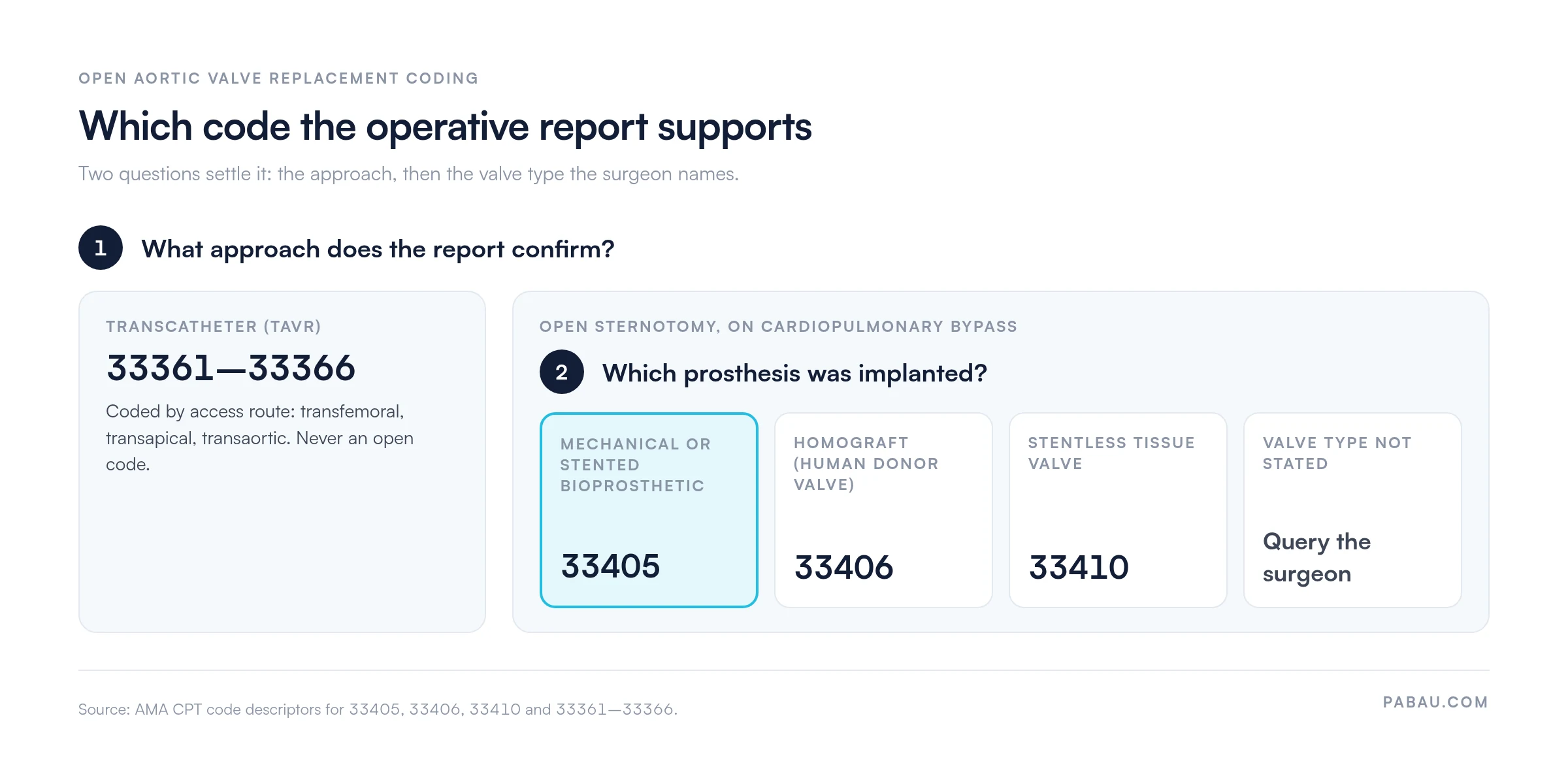
The TAVR family (33361-33366) is coded by access approach (transfemoral, transapical, transaortic, etc.), not by valve type. A patient who had a transcatheter procedure but whose report is ambiguous about approach should not be coded as 33405. Query the operative note or contact the surgeon before assigning any open code to a minimally invasive procedure.
Each access route in that range carries its own code. Percutaneous femoral artery access bills under CPT 33361.
If the operative report says ‘aortic valve replacement’ without specifying valve type, do not default to 33405. Homograft and stentless valves are implanted in a meaningful minority of SAVR cases. Flag the note for surgeon query before billing. An incorrect code selection on a high-value cardiac surgery claim draws payer scrutiny well beyond the single claim.
CPT code 33405 accepts several modifiers, each applying in a distinct surgical team or procedural scenario. Using the wrong modifier, or omitting one when it is required, is a direct path to claim denial.
Modifier 62 is the most scrutinized modifier on cardiac surgery claims. Both surgeons must bill 33405-62, and each must document their distinct contribution in a separate or co-signed operative note. A single note signed by one surgeon does not support the co-surgery modifier for the second.
CPT code 33405 carries one of the highest work RVU values in cardiac surgery, which reflects the complexity and time of open valve replacement. The professional fee component (what the surgeon bills) is separate from the facility fee the hospital receives through the DRG system.
Professional component (surgeon’s bill): The 2026 work RVU is 40.29. Combined with the practice expense and malpractice RVUs, it gives a total facility RVU of 63.65. To estimate the Medicare allowable, multiply that total by the CMS conversion factor and adjust for your locality’s geographic practice cost index (GPCI). The FastRVU lookup tool or the CMS PFS search pulls current-year figures by locality.
Hospital reimbursement via DRG: Most 33405 cases are billed as inpatient admissions, so the hospital is paid through the Medicare Inpatient Prospective Payment System. When cardiac catheterization is performed in the same admission, the case groups to MS-DRG 216, 217, or 218. Without catheterization, it groups to MS-DRG 219, 220, or 221.
Within each set of three, the DRG depends on whether a major complication or comorbidity (MCC) or a complication or comorbidity (CC) is documented. DRG payment is a bundled facility rate, separate from what the operating surgeon bills under the physician fee schedule.
Because 33405 is a facility-only code, the non-facility practice expense RVU does not apply. The procedure is always performed in an inpatient or outpatient hospital setting. Billing it with a non-facility place of service triggers an automatic denial.
Every 33405 claim requires a supporting ICD-10-CM diagnosis code that establishes medical necessity. The primary diagnosis must reflect the valvular pathology that drove the decision to operate. When the record points to a less common etiology, search the full ICD-10-CM code library for the most specific match.
Payers expect the documented diagnosis to match what the echocardiogram confirmed. A claim listing I35.0 with no echo in the record showing severe stenosis will likely be denied for medical necessity. Check insurance eligibility and coverage criteria for the diagnosis before submitting, particularly for Medicare Advantage plans.
Three distinct compliance layers govern every 33405 claim: prior authorization (before the procedure), documentation (during and after), and global period rules (for 90 days post-surgery).
Prior authorization: Traditional Medicare fee-for-service does not require prior authorization for inpatient procedures. Medicare Advantage plans and most commercial payers do.
Standard requirements include an echocardiogram confirming severe aortic stenosis or regurgitation, a heart team evaluation note, and documentation that catheter-based alternatives were considered. Check individual payer policies, as requirements change annually.
Documentation checklist for the operative record:
Global period: CPT code 33405 carries a 90-day global period. Routine post-operative office visits within those 90 days are included in the global package and cannot be billed separately. Separate billing is permitted in four situations:
The global period starts the day after surgery, not the day of. Confirm that your billing system applies the correct start-date logic before auto-generating post-op visit claims. A structured superbill with the global-period end date captured reduces inadvertent post-op billing errors.
Denials on 33405 claims are disproportionately expensive relative to typical outpatient codes because the professional fee and associated claims represent high-dollar reimbursement. Identifying the most common denial patterns before submission is far more efficient than working rejections after the fact.
Tracking denial patterns across 33405 claims shows billing teams whether errors are coder-driven (wrong code) or documentation-driven (missing records).
Pabau, the practice management platform we build, receives electronic remittance advice (ERA) through its Claim.MD integration. Its denial management workflow flags the claim adjustment reason code (CARC) on each ERA, so teams can fix root causes. Our clean claim guide covers how submissions pass clearinghouse edits on the first attempt.
Run a monthly audit of 33405 claims grouped by denial reason code. If modifier-related denials cluster around specific surgeons, the issue is documentation rather than coding. Bring a one-page modifier guide into the post-op dictation workflow, then compare the next month’s denials against that baseline.
Cardiac surgery billing teams often check eligibility in a payer portal, submit through a separate clearinghouse, and reconcile remittances in a spreadsheet. On a 33405 claim, each handoff lets a wrong valve code, a missing auth number, or an unbundled bypass line slip through.
Pabau connects to Claim.MD, so real-time eligibility checks, claim submission, and electronic remittance reconciliation happen in one workflow. Through its single-workflow claims management, Pabau submits CMS-1500 and 837P claims to thousands of US payers.
Denials come back with their reason codes attached to the claim. That lets your team tell a coding error from a documentation miss and fix the surgeon’s dictation habit, not just the one claim.

Pabau connects to Claim.MD to submit, track, and reconcile high-value claims like 33405. Eligibility checks, remittances, and denial tracking sit in one platform.

On a 33405 claim, the operative note decides the payment. If it names the open approach, the bypass, and the prosthesis type, the code will hold up in review. If any of the three is missing, query the surgeon before the claim goes out.
That pre-bill check slows submission slightly on every open valve case. It still costs far less than appealing a denied cardiac surgery claim, and it teaches surgeons which details their dictation must carry.
Book a demo to see how Pabau keeps 33405 claims, eligibility checks, and remittances in one traceable workflow.

Need to understand how claim denials are categorized? Denial codes in medical billing explains CARC and RARC codes returned on remittances for high-value surgical claims.
Preparing a clean submission for a complex cardiac surgery claim? How the 837P file works walks through the electronic transaction format used to submit professional claims like 33405 to payers.
Looking for a broader overview of surgical billing compliance? What is medical billing covers the end-to-end workflow from code selection through payment posting.
CPT code 33405 covers open aortic valve replacement performed with cardiopulmonary bypass, using a mechanical or bioprosthetic valve (not a homograft or stentless valve). The code includes the bypass pump, native valve excision, and prosthesis implantation as a global package. Services such as concurrent CABG or septal myectomy are billed separately.
CPT 33405 requires an open sternotomy with cardiopulmonary bypass. TAVR codes (33361-33366) apply to transcatheter aortic valve replacement, performed through a catheter without open-chest surgery. The TAVR codes are differentiated by access approach (transfemoral, transapical, transaortic) rather than by valve type.
The most common modifiers for 33405 are 62 (co-surgery) and 80 or 82 (assistant surgeon). AS covers a physician assistant as assistant, and 22 covers increased complexity such as a redo sternotomy. Modifier 51 may apply to secondary procedures billed in the same session, depending on payer rules.
CPT 33405 is used when a mechanical or bioprosthetic (non-homograft, non-stentless) valve is implanted. CPT 33406 is used when a homograft (cadaveric human) valve is implanted. Both require open sternotomy and cardiopulmonary bypass, and the operative report must name the valve type to support either code.
CPT code 33405 carries a 90-day global period beginning the day after surgery. Routine post-operative visits within those 90 days are included in the global package. Separate billing requires modifier 24 (unrelated E/M), 78 (return to OR for complication), or 58 (staged procedure). Modifier 79 covers an unrelated procedure or service by the same physician during the postoperative period.
The most common reason is a wrong code, such as a homograft billed as 33405 instead of 33406. Missing prior authorization for commercial or Medicare Advantage plans is close behind. Others include no echocardiogram on file to establish medical necessity, unbundled cardiopulmonary bypass, and an incorrect place of service code. Reviewing the operative note and payer policy before submission prevents most of these denials.
Yes. Cardiopulmonary bypass is bundled into CPT code 33405 under CMS NCCI edits and cannot be billed separately. Submitting a separate CPB charge alongside 33405 is an unbundling error that will be denied and, if repeated, can be treated as a compliance issue.
Surgical aortic valve replacement (SAVR) via open sternotomy uses 33405, 33406, or 33410, depending on valve type. Transcatheter aortic valve replacement (TAVR) uses 33361-33366, depending on access approach. ACC/AHA valve guidelines govern the clinical choice between SAVR and TAVR. Coders assign the code for the procedure documented in the operative report.