CPT Code 62284: Injection procedure for myelography
CPT Code 62284: official descriptor and procedure overview The American Medical ...

Last Updated: Oct 19, 2026
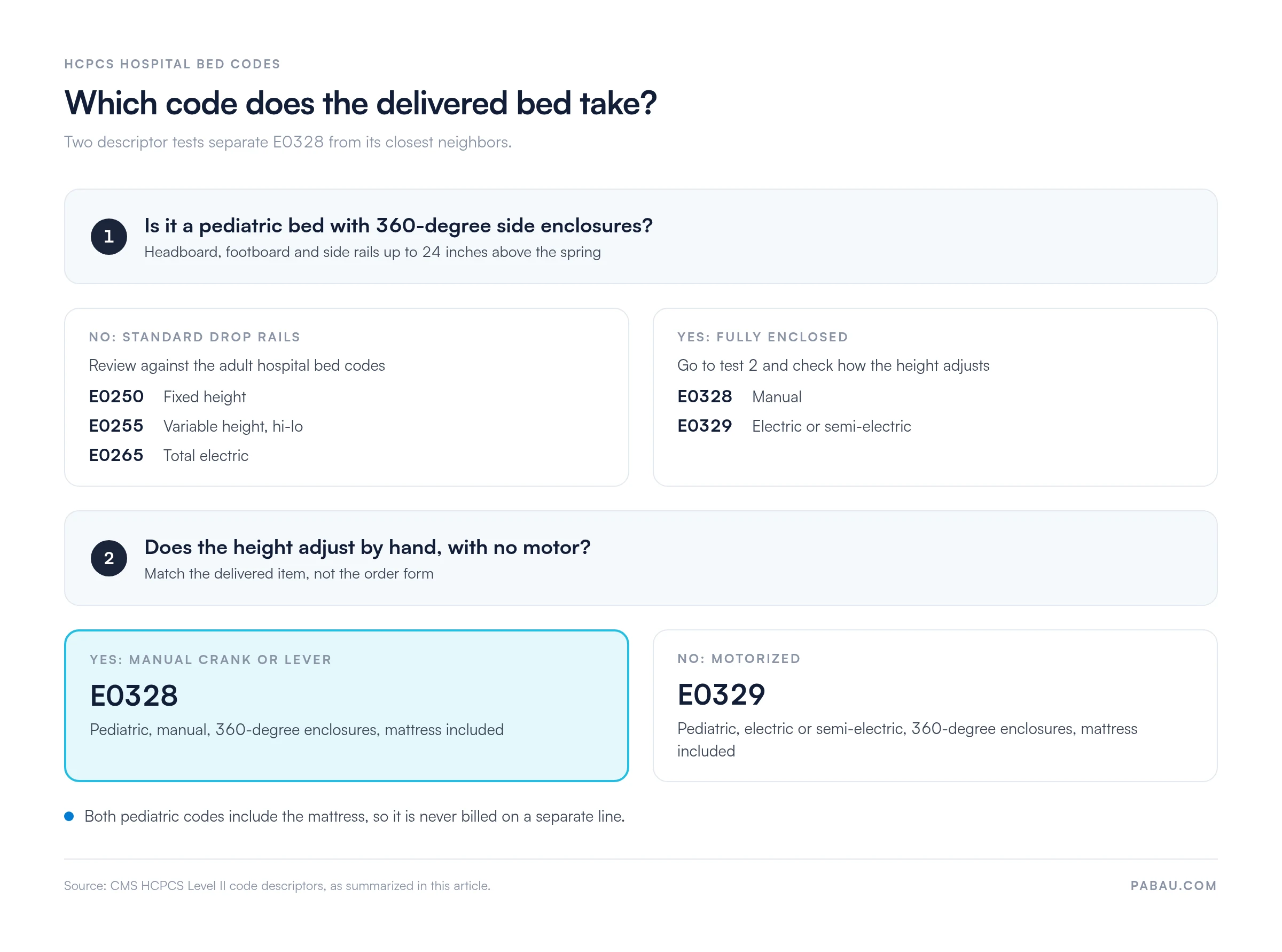
E0328 is the HCPCS Level II code for a manual pediatric hospital bed with 360-degree side enclosures and an included mattress. Its headboard, footboard and side rails reach up to 24 inches above the spring.
DME suppliers bill it when a child needs a fully enclosed bed at home because a standard bed with drop rails can't keep them safe. The electric or semi-electric version of the same bed is E0329.
Let Pabau's smart automation suggest the right codes, reduce claim denials, and keep your practice compliant—effortlessly.
Automate repetitive tasks and focus on what matters most—your patients.
Reduce coding errors and ensure compliance with the latest regulations.
Clean claims, fewer denials, and faster reimbursements.
Powerful insights and reporting to help your practice thrive.
HIPAA compliant SOC 2 certified GDPR-compliant Trusted by 4,000+ clinics worldwide

HCPCS Code E0328 covers a manually operated pediatric enclosure bed with 360-degree side rails and an included mattress, not just any pediatric or hospital bed.
A signed Certificate of Medical Necessity from the ordering physician has to be in place before an E0328 claim goes out. Missing or incomplete CMNs are the leading denial cause.
E0328 is manual only. The electric or semi-electric pediatric version is E0329, and billing the wrong one triggers an automatic denial.
Pabau’s claims management software keeps E0328 documentation, CMN tracking, and claim submission in one workflow, reducing rework on denials.
HCPCS Code E0328 is the Level II code for a manual pediatric hospital bed with 360-degree side enclosures and an included mattress.
It sits in the E-series of the HCPCS Level II system. The Centers for Medicare and Medicaid Services (CMS) updates that system each year for durable medical equipment, prosthetics, orthotics, and supplies (DMEPOS). The official CMS descriptor reads:
E0328: Hospital bed, pediatric, manual, 360 degree side enclosures, top of headboard, footboard and side rails up to 24 inches above the spring, includes mattress.
Every word in that descriptor is a coverage requirement. “Manual” means the height adjustment is not motorized. “360 degree side enclosures” means the bed is fully enclosed on all four sides, not just fitted with standard drop rails. “Includes mattress” means the mattress is part of the billable item and cannot be billed separately under another code.
E0328 covers the manual version of the pediatric enclosure bed, and E0329 covers the electric or semi-electric version. Payers treat them as mutually exclusive, so submitting the wrong one produces an immediate denial based on code-to-descriptor mismatch rather than a medical necessity review.
The clinical distinction matters: use E0328 when the physician’s order specifies a manual bed and there is no documented medical reason for motorized height adjustment. Bill E0329 only when the patient’s condition requires electric repositioning and the CMN documents that need.
E0328 is one of the hospital bed codes in the E0250-E0373 range of HCPCS Level II codes. Knowing the neighboring codes helps confirm that E0328 is the correct choice for a pediatric enclosure bed rather than an adult or variable-height equivalent.
Adult bed codes such as E0250 carry no enclosure requirement. A bed for a pediatric patient with standard drop rails doesn’t meet the E0328 descriptor. Review it against the adult codes instead, with a note on the patient’s size and clinical need. The two tests below decide which code a delivered bed takes.
Medicare Part B covers HCPCS Code E0328 as a DMEPOS benefit when the bed is medically necessary and ordered by a physician. The supplier also has to hold DMEPOS accreditation. Coverage isn’t automatic. The DME Medicare Administrative Contractor (DME MAC) for the supplier’s region applies its Local Coverage Determination (LCD) to decide whether the claim meets necessity criteria.
Medical necessity for a pediatric enclosure bed usually rests on a condition that makes sleep or rest unsafe. The documentation has to show that a standard hospital bed with drop rails can’t manage that risk. Conditions commonly cited include severe epilepsy, cerebral palsy, neurodevelopmental disorders with self-injurious behavior, and musculoskeletal conditions preventing safe repositioning.
Verifying patient eligibility and coverage before ordering equipment prevents downstream denials. Running insurance eligibility verification when the order comes in confirms the patient’s active Part B coverage and any supplemental plan obligations. It also shows whether prior authorization is on record.
CMS has expanded its DMEPOS prior authorization program over successive rulemaking cycles. Suppliers should check the current CMS prior authorization list before delivering equipment. An item that needs prior authorization and ships without it is non-covered, whatever the medical necessity documentation says. The requirement is judged on the delivery date, so recheck it if an order waits before delivery.
Commercial payers such as Aetna maintain their own clinical policy bulletins covering hospital beds and accessories. These policies may adopt the CMS descriptor for E0328 but apply their own medical necessity criteria. Some also require different CMN language or shorter authorization windows than Medicare.
State Medicaid programs vary significantly: some cover pediatric enclosure beds under DME with criteria mirroring Medicare, while others require a separate pediatric equipment benefit category. Verify payer-specific criteria before submitting a claim rather than assuming Medicare rules apply universally.
Request the payer’s specific clinical policy for hospital beds and accessories before obtaining the physician order. If you know whether the payer follows Medicare’s LCD or its own criteria, you can draft the CMN language right the first time.
Clean E0328 claims rest on a complete documentation package assembled before submission. Each element below has a corresponding denial reason when it is missing.
The following ICD-10-CM code groupings are commonly cited in support of medical necessity for a pediatric enclosure bed. Coverage depends on the applicable LCD, and not every payer accepts every diagnosis.
The ICD-10 code alone does not establish medical necessity. The physician’s CMN and clinical notes must connect the diagnosis to the functional limitation that makes the enclosure bed medically necessary. A diagnosis of autism spectrum disorder without documented unsafe behavior during sleep is unlikely to satisfy a DME MAC reviewer.
Medicare reimburses E0328 under the CMS DMEPOS fee schedule, which sets allowed amounts by HCPCS code and geographic locality. Rates are updated annually and published in the CMS DMEPOS fee schedule files. Because rates vary by locality, the figures below reflect general ranges rather than specific amounts.
To find the current allowed amount for E0328 in your locality, download the CMS DMEPOS fee schedule file from cms.gov. The AAPC HCPCS Level II lookup tool is a quicker reference for the code and its neighbors. Commercial payer rates for E0328 are negotiated separately and may be higher or lower than Medicare’s allowed amount.
E0328 is billed by DMEPOS-accredited suppliers on the CMS-1500 claim form (or the 837P electronic transaction for Medicare). The supplier must hold active DMEPOS accreditation from a CMS-approved accrediting organization on the delivery date. Without it, the claim is non-covered regardless of documentation quality.
E0328 denials cluster around six predictable failure points. Each one is preventable with a documentation check before submission. Understanding these patterns is the core of denial management in healthcare for DME suppliers.
Appealing a denied E0328 claim is possible when the denial is based on a documentation deficiency rather than a non-covered benefit. Building a clean claim from the start is faster than reconstructing the record for an appeal. The PGM Billing HCPCS lookup tool lets billers verify the code descriptor against what was delivered before submitting.
Run a pre-submission audit on every E0328 claim before it leaves your system. Confirm the code, modifier, CMN completeness, ICD-10 code against the LCD, and prior authorization status. A five-minute check prevents a 30-to-60-day denial cycle.
An E0328 claim is often assembled from several places. The physician order arrives by fax, the CMN sits in a shared drive, and the signed delivery receipt comes back with the driver. One missing page sends the claim back.
Pabau’s claims management software supports CMS-1500 and 837P workflows. It keeps the CMN, delivery documentation, and prior authorization number attached to the claim before submission.
The outcome is fewer claims returned for missing paperwork. When a denial does come in, your billing team works it from the same record instead of rebuilding the file.

Pabau’s claims management software keeps CMN tracking, claim submission and denial follow-up in one workflow. Your billing team spends less time chasing paperwork and more time collecting.

Treat the E0328 descriptor as a delivery checklist. If the bed that arrives isn’t manual, fully enclosed and shipped with its mattress, the code is wrong before anyone reads the paperwork.
The trade-off is time up front. Checking the payer’s policy, prior authorization and diagnosis support before delivery takes minutes. An appeal takes weeks and still depends on the same documents.
Book a demo to see how Pabau keeps every E0328 claim’s documentation together from order to payment.

Need guidance on reducing claim rejections across DME codes? Denial management in healthcare covers the root causes and recovery workflows for common DME denials.
Want to understand the full medical billing cycle for DMEPOS suppliers? What is medical billing explains the end-to-end process from order to payment posting.
Looking for a compliance framework for your billing team? Medical billing compliance outlines the documentation and audit standards that apply to DME claims.
HCPCS Code E0328 is the Level II DME code for a manually operated pediatric hospital bed with 360-degree side enclosures and an included mattress. Its headboard, footboard and side rails reach up to 24 inches above the spring. It is used by DMEPOS-accredited suppliers billing Medicare Part B and commercial payers for pediatric enclosure beds delivered in the home setting.
E0328 covers a manual pediatric enclosure bed, while E0329 covers the electric or semi-electric version. The key distinction is the height adjustment mechanism: E0328 requires manual operation, while E0329 uses a motor. Using E0329 for a manually adjusted bed is an automatic denial trigger.
A complete E0328 claim needs a signed physician order and a Certificate of Medical Necessity with the patient’s diagnosis and weight. Add a detailed product description confirming the bed meets the descriptor, a signed delivery receipt, and prior authorization where the payer requires it. Missing any of these is the leading cause of E0328 denials.
Yes, Medicare Part B covers E0328 as a DMEPOS benefit when the bed is medically necessary and ordered by a physician. An accredited DMEPOS supplier has to provide it. Coverage is subject to the applicable DME MAC’s Local Coverage Determination and any applicable prior authorization requirements.
Commonly accepted ICD-10-CM codes include G80.x (cerebral palsy), G40.x (epilepsy), F84.0 (autistic disorder), Q05.x (spina bifida), and G71.0 (muscular dystrophy). Coverage depends on the applicable LCD. The diagnosis alone doesn’t establish necessity without clinical notes linking the condition to a safety need that only an enclosure bed addresses.
Medicare fee schedule rates for E0328 vary by geographic locality and are updated annually in the CMS DMEPOS fee schedule files. Use the CMS DMEPOS fee schedule lookup tool or the AAPC HCPCS code reference to retrieve the current allowed amount for your specific locality. Commercial payer rates are negotiated separately and may differ from Medicare’s allowed amount.
The most frequent denial is a missing or incomplete CMN, especially one without the patient’s weight. Others follow from billing E0329 for a manual bed or delivering without required prior authorization. A bed without 360-degree enclosures, a separately billed mattress, or an unsupported ICD-10 code also triggers denial. Each of these is preventable with a pre-submission documentation audit.