CCSD code H4430: Examination of rectum under anaesthetic
CCSD code H4430 pays for the examination alone CCSD code H4430 is the UK private...

Last Updated: Oct 20, 2026
22899 is the CPT code for unlisted procedure, spine. It applies only when no specific code in the Spine (Vertebral Column) subsection accurately describes the spinal procedure performed.
It has no fixed fee, so payers price each claim against the closest specific code. Coders use it most often for novel fusion constructs, hybrid instrumentation builds, and techniques that outpace the CPT update cycle. Most payers expect prior authorization and a complete documentation package.
Let Pabau's smart automation suggest the right codes, reduce claim denials, and keep your practice compliant—effortlessly.
Automate repetitive tasks and focus on what matters most—your patients.
Reduce coding errors and ensure compliance with the latest regulations.
Clean claims, fewer denials, and faster reimbursements.
Powerful insights and reporting to help your practice thrive.
HIPAA compliant SOC 2 certified GDPR-compliant Trusted by 4,000+ clinics worldwide

CPT Code 22899 covers unlisted spinal procedures only when no specific CPT code in the 22010-22855 range accurately describes the work performed.
Every 22899 claim requires a complete operative report and a medical necessity letter comparing the procedure to the closest analogous specific code.
Reimbursement is set case by case, with Medicare contractors pricing it individually and commercial payers comparing it with an analogous specific code.
Pabau, the practice management platform we build, tracks each unlisted spine claim through five status stages, from pending to paid.
CPT Code 22899 is defined by the American Medical Association as “Unlisted procedure, spine.” It is the last code in the Spine (Vertebral Column) subsection of the CPT manual’s musculoskeletal surgery section, which spans codes 22010 through 22899.
The spine subsection covers procedures on the vertebral column including excision, repair, reconstruction, and instrumentation. CPT 22899 acts as the catch-all for any procedure in that clinical domain that does not map to an existing specific code.
Three things are always true of an unlisted code:
Knowing the medical billing fundamentals behind unlisted codes helps coders predict how a payer will react before the claim goes out.
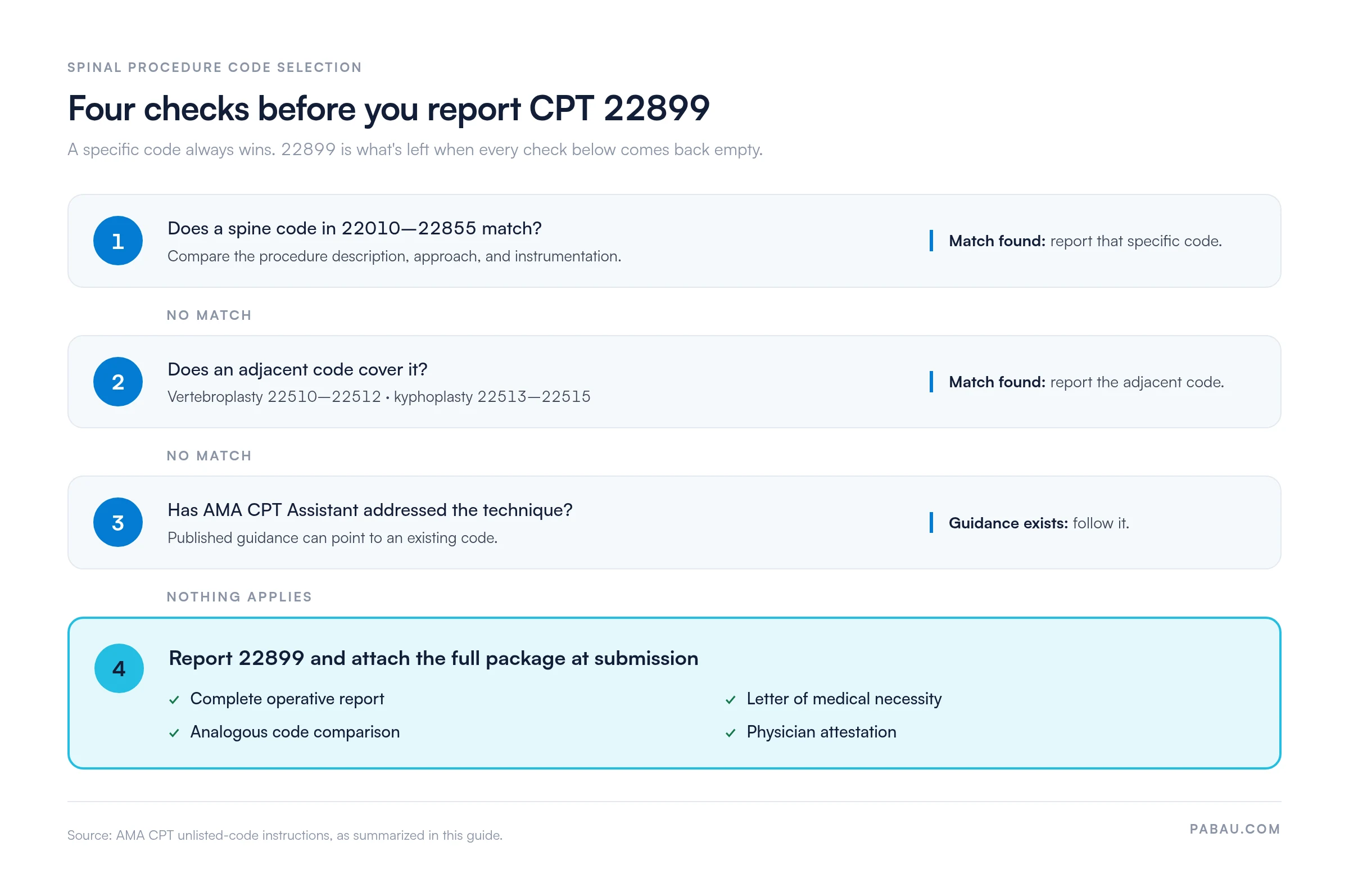
CPT 22899 applies only after ruling out every specific code in the spine subsection. Under the AMA’s general instruction, a specific code takes precedence over an unlisted code whenever it accurately describes the procedure performed.
The decision logic follows four steps:
Using 22899 when a specific code exists constitutes upcoding and triggers compliance exposure. The claim documentation must show why each close specific code falls short, because a bare “no code applies” won’t satisfy a reviewer. The flow below maps each check to the code it leads to.
Certain procedure categories routinely land on 22899 because the CPT code set has not yet assigned them a specific home. Others vary enough from existing codes that a direct match cannot be made.
Note that experimental or investigational procedures coded under 22899 face heightened payer scrutiny. Both Medicare and most commercial payers may exclude coverage for investigational spinal techniques regardless of how well the claim is documented.
Before selecting 22899, coders should verify these neighboring codes have been ruled out. Each has a defined descriptor that covers common spine procedures.
For ACDF specifically: the AAPC CPT code lookup confirms that standard anterior cervical discectomy and fusion has dedicated codes. CPT 22899 is appropriate for ACDF only when the specific construct or technique falls outside the standard descriptor, which requires clear documentation of the deviation.
Run a code comparison check before every 22899 submission. List the three most similar specific spine codes and write a single sentence for each explaining why it does not accurately describe the procedure. This comparison narrative becomes the core of your medical necessity letter and pre-empts the most common denial reason.
Incomplete documentation is the leading reason 22899 claims are denied. Every submission requires a complete package attached at the time of filing, not provided on request after a denial.
The mandatory documentation set includes:
The AMA recommends consulting AMA CPT Assistant guidance when constructing the medical necessity narrative. If CPT Assistant has addressed the procedure type, citing that guidance in the letter strengthens the analogous code argument.
Maintaining medical billing compliance for unlisted codes means keeping this documentation package in the patient record, whatever the claim outcome. Payers may request it during audits.
Most payers require prior authorization for unlisted procedure codes before the procedure is performed. Retroactive authorization requests are rarely approved and are often contractually prohibited.
Cigna manages CPT 22899 through its eviCore-administered spine surgery precertification program. The eviCore spine surgery protocol requires clinical submission of imaging, conservative treatment history, and the procedural rationale before authorization is granted.
The prior authorization process for 22899 typically follows these steps:
Medicare does not have a universal prior authorization requirement for 22899 under traditional fee-for-service. Medicare Advantage plans, however, frequently impose their own PA requirements. Verify plan-specific requirements before scheduling any procedure anticipated to be billed under this code.
CPT 22899 carries no fixed RVU value. The CMS Physician Fee Schedule designates unlisted procedure codes as contractor-priced. Each Medicare Administrative Contractor (MAC) prices the code individually, based on the submitted documentation and the analogous specific code identified.
For commercial payers, reimbursement methodology varies:
Submitting a suggested reimbursement amount with supporting rationale is permitted and can anchor the payer’s pricing decision. The suggested fee should correspond to the analogous specific code fee schedule amount, adjusted for any procedural differences.
The FastRVU 2026 lookup tool shows the current Medicare RVU value for the analogous code, which gives the suggested fee an objective baseline.
Medicare coverage for 22899 is not automatic or guaranteed. The applicable MAC reviews each claim against two criteria. The first is medical necessity under any relevant Local Coverage Determination (LCD), and the second is the adequacy of the submitted documentation.
Key Medicare-specific considerations:
Consulting the relevant MAC’s coverage determinations before billing 22899 under Medicare is the most reliable way to assess reimbursement probability.
CPT 22899 claims are denied more frequently than specific spine codes because the documentation burden is higher and the payer review process is more subjective. Each denial reason below has its own fix, and most can be prevented at first submission.
Tracking patterns in your denial management workflow shows whether 22899 denials cluster around missing documentation, authorization failures, or coverage determinations. Each of those needs a different operational response.
A denied 22899 claim is not automatically a write-off. Most payers have a formal appeals process, with a window that typically runs 180 days from the denial date. Check the plan-specific timeline on the Explanation of Benefits.
The appeal process follows this sequence:
Submit 22899 appeals with the electronic remittance advice from the original denial attached. The reviewer then sees the denial basis without requesting more records.
Billing CPT Code 22899 correctly requires preparation before the claim is submitted, not after. Each step builds the documentation foundation that payer reviewers require.
Spine surgery practices billing CPT Code 22899 often follow each unlisted claim by hand, across payer portals, spreadsheets, and email. A claim sitting in manual review is easy to lose that way.
Pabau’s medical claims management tools keep every claim in one dashboard, marked pending, submitted, processing, paid, or error. US practices submit through the Claim.MD clearinghouse, which also runs real-time eligibility checks.
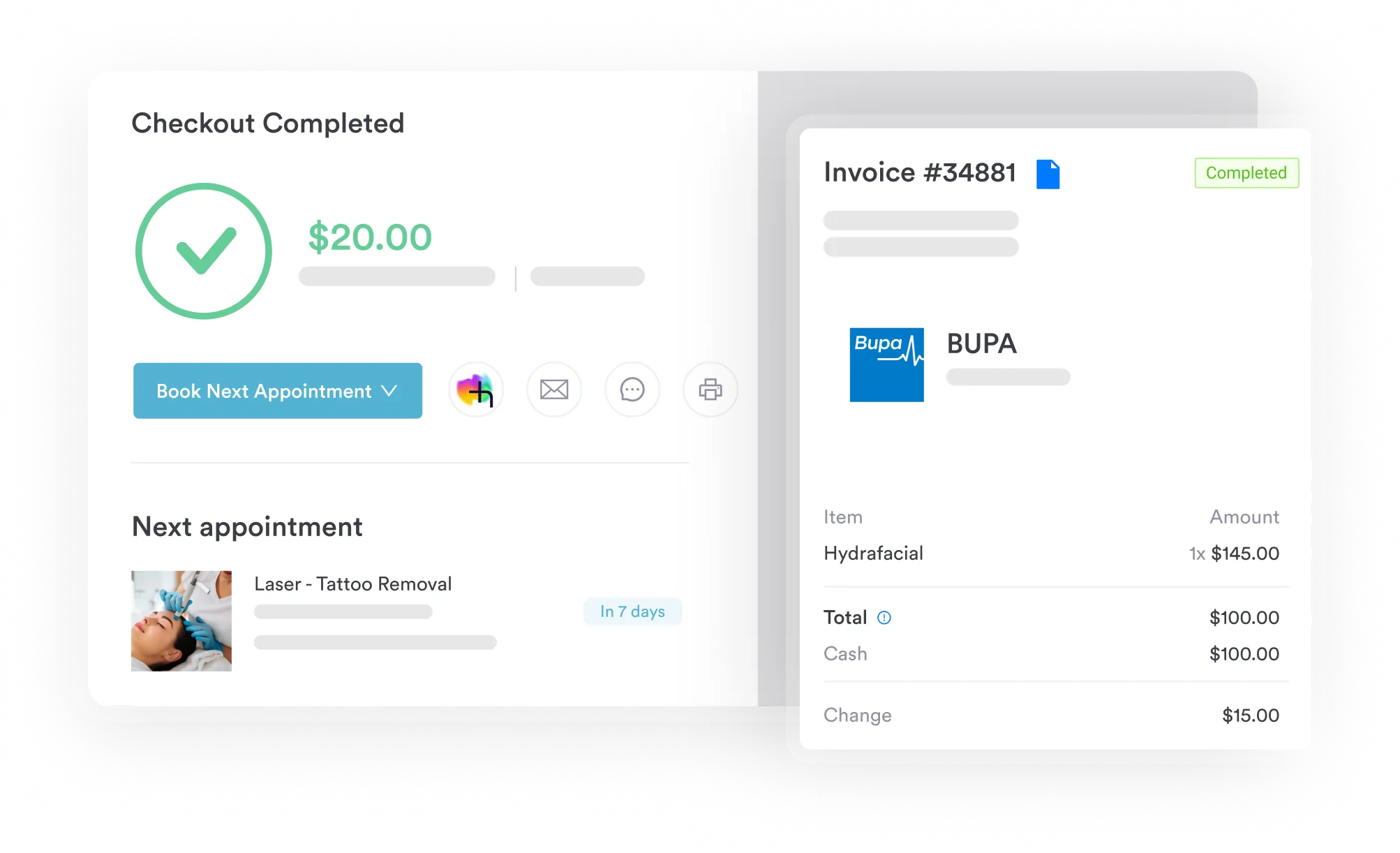
Before a claim goes out, background validation checks confirm required details such as authorization codes are present. That matters on 22899, where a missing prior authorization reference is one of the most common denial reasons.
When the payer settles, your team posts the ERA remittance and records the payment against the right invoice, so billing and claims stay in sync. Claims management is included in every Pabau subscription.

Pabau tracks every unlisted spine claim from pending to paid, submits US claims through Claim.MD, and records each payment against the right invoice.

Treat 22899 as a last resort that earns its place only after the four code checks come back empty. When it does apply, the claim is usually won or lost before it is submitted.
Build the documentation package while the operative details are fresh, and secure prior authorization before the surgery date is booked. Doing both turns a slow, subjective review into a predictable one.
The trade-off is an hour of preparation now against months of appeals later. Book a demo to see how Pabau keeps every unlisted spine claim visible from submission to payment.

Billing a musculoskeletal procedure outside the spine? CPT Code 20999 covers the general unlisted musculoskeletal code and the documentation payers expect with it.
CPT Code 22899 is the unlisted procedure code for the spine. Coders use it when no specific CPT code in the 22010-22855 range accurately describes the spinal procedure performed. It is assigned no fixed RVU and is priced individually by payers based on the most analogous specific code identified in the claim package.
Use CPT Code 22899 only after ruling out all specific spine CPT codes. Submit it with a complete operative report and any applicable prior authorization documentation. Add a medical necessity letter that names the most analogous specific code and explains why existing codes do not apply.
Medicare does not guarantee coverage for CPT 22899. Each Medicare Administrative Contractor prices and reviews the code individually based on local coverage determinations and the documentation submitted. Investigational or experimental procedures coded as 22899 are typically excluded from Medicare coverage regardless of documentation quality.
Most commercial payers require prior authorization for CPT 22899 before the procedure is performed. Cigna manages 22899 through its eviCore-administered spine surgery precertification program. Traditional Medicare does not universally require prior authorization, but Medicare Advantage plans often do. Verify requirements with each payer before scheduling.
The most common reason is that a specific spine CPT code already describes the procedure. Others include a missing or vague operative report, no prior authorization, and a procedure classified as investigational. Each denial reason requires a different corrective action before resubmission or appeal.
There is no fixed reimbursement rate for CPT 22899. Medicare contractors price it individually. Commercial payers typically price it by comparison to the analogous specific CPT code identified in the claim. Practices can include a suggested fee based on the analogous code’s fee schedule rate, with supporting rationale, to anchor the payer’s pricing decision.
Yes, CPT 22899 can be billed alongside other spine CPT codes when additional separately identifiable procedures are performed. Each procedure must be independently documented and coded. Payers may apply NCCI edits or bundling rules, so verify for any code combination before submitting.