CPT Code 62284: Injection procedure for myelography
CPT Code 62284: official descriptor and procedure overview The American Medical ...

Last Updated: Oct 19, 2026
S0021 is the HCPCS Level II code for injection, cefoperazone sodium, 1 gram. It bills the supply of this third-generation cephalosporin antibiotic, given by IV or IM injection, at one unit per gram. Medicare doesn't pay it, because it's a temporary S-code, so only some commercial and Medicaid plans accept it.
Cefoperazone is also no longer marketed in the United States, which makes a valid NDC harder to supply. The dose is already given by the time the claim goes out. A rejected line leaves the practice chasing payment for stock it has used. Four checks decide whether it pays: payer acceptance, the NDC, the diagnosis pairing and the chart.
Let Pabau's smart automation suggest the right codes, reduce claim denials, and keep your practice compliant—effortlessly.
Automate repetitive tasks and focus on what matters most—your patients.
Reduce coding errors and ensure compliance with the latest regulations.
Clean claims, fewer denials, and faster reimbursements.
Powerful insights and reporting to help your practice thrive.
HIPAA compliant SOC 2 certified GDPR-compliant Trusted by 4,000+ clinics worldwide

HCPCS code S0021 reports the supply of injectable cefoperazone sodium, a cephalosporin antibiotic, at one unit per gram.
It is a temporary S-code, so Medicare does not pay it and each commercial or Medicaid plan decides whether to accept it.
Cefoperazone is no longer marketed in the United States, so check the NDC before the dose is given, not after the denial.
Pair S0021 with the ICD-10-CM code for the infection being treated, plus an organism code where the record names one.
Bill the injection or infusion service separately, because S0021 bills only the drug.
HCPCS code S0021 is the Level II code for injection, cefoperazone sodium, 1 gram. It reports the antibiotic itself when a clinician gives it by IV or IM injection. The administration service goes on its own claim line with a CPT code.
Cefoperazone is a third-generation cephalosporin. It was sold in the US as Cefobid and is one of the few cephalosporins with activity against Pseudomonas. S0021 took effect on January 1, 2000, and no HCPCS changes to it are scheduled.
Here’s the code at a glance.
Report one unit of S0021 for every gram you give. A 2-gram dose is two units. Payers differ on partial grams. Check whether a 1.5-gram dose rounds up to two units or goes on the claim as an exact NDC quantity.
Here’s how a single visit looks on the claim. A patient receives 2 grams of cefoperazone as an IV push. The claim carries two lines:
S0021 doesn’t cover the diluent, the IV supplies or the clinician’s time. Those either bundle into the administration code or bill under their own codes, depending on the payer. The layout below puts both lines side by side, field by field.
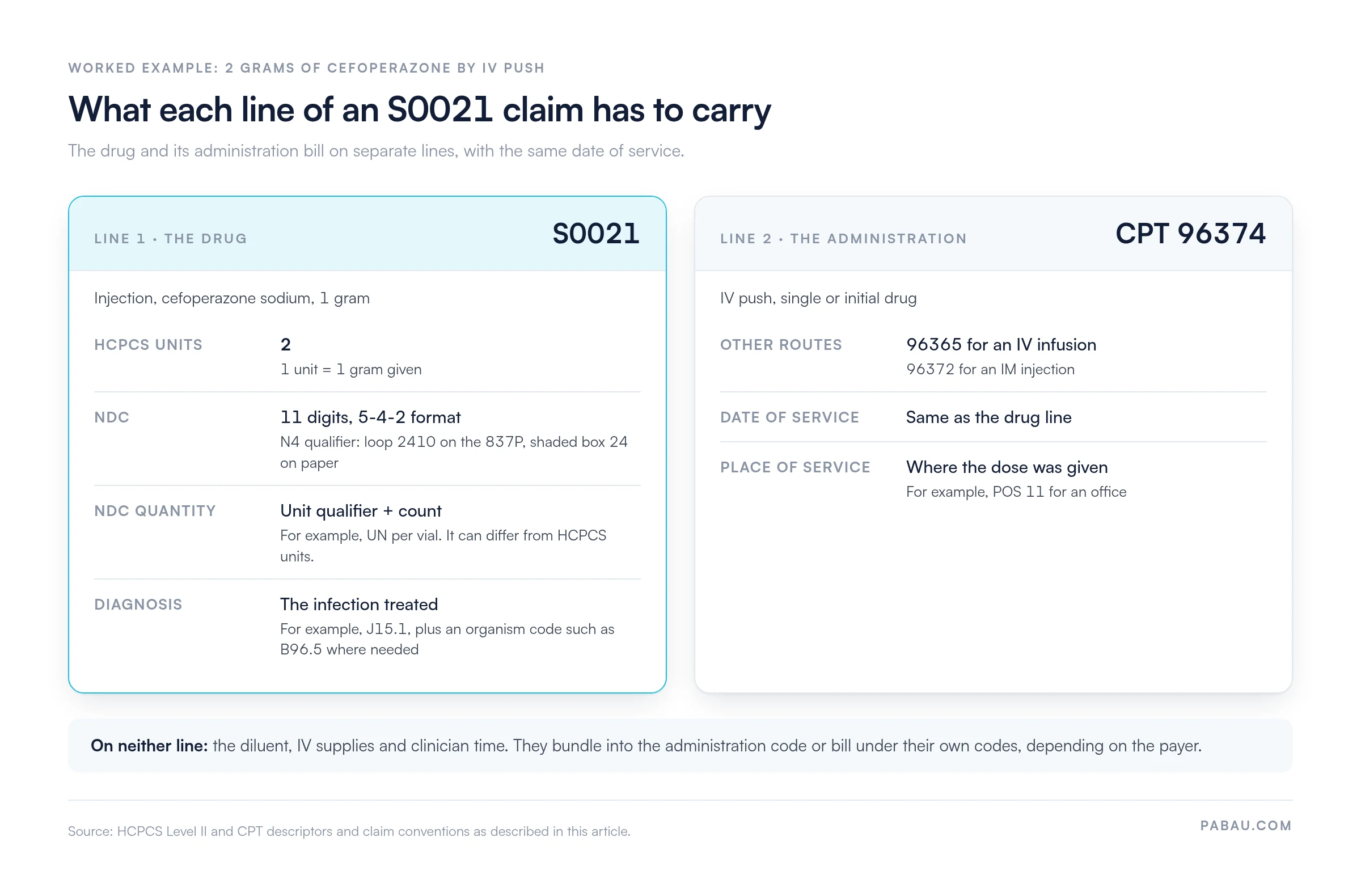
Only payers that have chosen to recognize S-codes will pay S0021. Blue Cross Blue Shield plans and other commercial insurers created the S-series for their own use. Medicare never adopted it, and Medicaid programs decide state by state.
Reimbursement varies just as much as acceptance. Because Medicare publishes no rate, each commercial plan sets its own allowable, often as a percentage of average wholesale price. Get the rate in writing if you give this drug often.
Most payers that accept S0021 also want the National Drug Code for the vial you used. That creates a specific problem with cefoperazone. The drug is no longer marketed in the United States, so an older NDC may be inactive in the FDA directory.
If your stock is imported, compounded or left over from an old supply, confirm the NDC with the payer before the dose. A claim with an inactive or foreign product number usually rejects at the clearinghouse.
When the NDC is valid, report it in the standard format:
HCPCS units and NDC units often differ. Two units of S0021 might equal two 1-gram vials, or one 2-gram vial reported as a single NDC unit. Mismatched quantities are a common reason for an edit.
The diagnosis on an S0021 line should name the infection the antibiotic treats. Cefoperazone was labeled for respiratory, intra-abdominal, skin, urinary and gynecologic infections, plus bacterial septicemia. Code the condition first, then add the organism where the record identifies one.
Use the most specific code the documentation supports. Check each code against the current fiscal year in the CDC ICD-10-CM browser tool before you submit.
A payer that questions an S0021 claim will ask for the medication record. It should answer five questions without anyone having to phone the clinician:
Keep the physician order on file as well. Without a signed order, the drug line is hard to defend on audit even when the rest of the claim is clean.
Most S0021 problems can be caught at the front desk or the billing queue. Work through these checks in order:
For a wider view of what payers check before they adjudicate, see our guide to the clean claim. Building the drug fields into your superbill also saves the biller from retyping them.
Two kinds of mix-up cause trouble here. One is a keying error with the neighboring S-codes. The other is reaching for a similar-sounding cephalosporin code.
If the order says cefoxitin or ceftazidime, bill that drug’s J-code. S0021 is correct only when cefoperazone itself was given.
A keying slip causes the same problem. A claim sent with S0020 reports bupivacaine, a local anesthetic. CMS deleted that code effective June 30, 2023.
Most denials on this code trace back to one of four causes, and each has a quick fix. The remittance flags every one with a claim adjustment reason code, or CARC. Our rundown of the top 20 CARC codes covers the ones not listed here.
Track which cause you see most. A pattern tied to one payer usually points to a setup issue, not a coding error. Our guide to denial management in healthcare covers how to work those patterns.
Drug claims fail on small details. A missing NDC, a unit count that doesn’t match the dose, or a diagnosis left off the line can each send S0021 back. Retyping the same fields for every visit is where those slips creep in.
Pabau, the practice management and billing platform we build, fills the CMS-1500 from the patient record. The HCPCS code attached to the service lands on the charge line, and diagnosis slots draw from the recorded problem list. A built-in code library lets billers look up S0021 and its neighbors without leaving the claim.
Pabau also checks that required claim fields are complete before the claim can be sent. For US practices, Pabau’s claims management software submits through Claim.MD, runs eligibility checks and posts remittances when they arrive. When a payer rejects an S0021 line, your team sees it on the remittance and can fix the NDC or code before resubmitting.

Pabau pre-fills claims from the patient record and checks required fields before submission, so S0021 lines go out with the details payers ask for.

S0021 is a rare code, and that is its main risk. Few billers see it often enough to remember which payers accept it. Because the drug is no longer marketed in the US, the NDC step can stop a claim before any payer reviews it.
Treat every S0021 dose as a claim to plan before the injection, not after. Confirm the payer’s code, check the NDC and write the dose in grams. If a payer won’t take S0021, bill the code it names, and keep your billing compliance records consistent.
Book a demo to see how Pabau helps your team send complete drug claims and track them to payment.

Want fewer rejections at the clearinghouse? Clean claim submission explains what payers check before a claim reaches adjudication.
Chasing the same denial every month? Denial management in healthcare shows how to track, appeal and prevent repeat denials.
Retyping drug codes on every visit? Superbill documentation covers how to capture HCPCS codes, NDCs and diagnoses in one step.
Billing Medicare for a drug with no J-code? HCPCS code J3490 explains how the unclassified drug code works.
Not sure the plan needs approval first? Prior authorization process walks through when payers ask for approval and how to request it before the dose.
S0021 is the HCPCS Level II code for injection, cefoperazone sodium, 1 gram. It reports the drug supply for this cephalosporin antibiotic, at one unit per gram.
No. S0021 is a temporary S-code that is not payable by Medicare. Ask your Medicare contractor how it wants the drug reported, which is commonly J3490 with the NDC.
Bill two units, because one unit equals 1 gram. Report the administration separately, for example with CPT 96374 for an IV push.
Most payers that accept S0021 require one. Cefoperazone is no longer marketed in the US, so confirm the NDC is active before the dose is given.
Use the code for the infection being treated, such as J15.1 for Pseudomonas pneumonia. Add an organism code like B96.5 where the condition code calls for it.