CCSD code H4430: Examination of rectum under anaesthetic
CCSD code H4430 pays for the examination alone CCSD code H4430 is the UK private...

Last Updated: Oct 20, 2026
25447 is the CPT code for arthroplasty, intercarpal or carpometacarpal joints; interposition (eg, tendon). It covers resecting an arthritic CMC or intercarpal joint, most often at the thumb base, and placing tissue such as tendon in the gap.
Since 2025, a suspension of the same joints using a transferred or transplanted tendon is reported with CPT 25448 instead. The two codes are never reported together, so the operative note decides which one applies.
Let Pabau's smart automation suggest the right codes, reduce claim denials, and keep your practice compliant—effortlessly.
Automate repetitive tasks and focus on what matters most—your patients.
Reduce coding errors and ensure compliance with the latest regulations.
Clean claims, fewer denials, and faster reimbursements.
Powerful insights and reporting to help your practice thrive.
HIPAA compliant SOC 2 certified GDPR-compliant Trusted by 4,000+ clinics worldwide

CPT Code 25447 covers intercarpal or carpometacarpal (CMC) joint arthroplasty with interposition, such as a tendon graft, and no suspension.
Since 2025, suspension arthroplasty of the same joints, with tendon transfer or transplant, is reported with CPT 25448 and never alongside 25447.
The RUC recommended a work RVU of 11.14 for 25447 and 13.90 for 25448. Confirm current payment in the CMS fee schedule lookup.
Modifier -LT or -RT is required for laterality. Modifier -47 (anesthesia by surgeon) is payer-dependent, so confirm it before appending.
Pabau, the practice management and billing platform we build, submits 25447 claims electronically through its Claim.MD clearinghouse integration.
CPT Code 25447 is the code for arthroplasty, intercarpal or carpometacarpal joints; interposition (eg, tendon). The American Medical Association maintains it in the Musculoskeletal System section of the CPT code set, among the forearm and wrist repair codes.
The surgeon removes the arthritic joint surface, most often by excising the trapezium at the base of the thumb. Tissue such as a rolled tendon graft then fills the gap to keep the bones apart. The code was revised for CPT 2025 to make clear that it covers interposition only, not suspension.
The 90-day global period means that routine follow-up visits within 90 days of the surgery are bundled into the procedure payment. Payers will reject separately billed E/M visits during that window unless a significant separate service is documented and a modifier appended.
CPT Code 25447 covers arthroplasty at an intercarpal or CMC joint when the surgeon places interposition material in the joint space without a suspension. The most common clinical scenario is thumb basal joint arthritis. Destruction of the first CMC joint leaves the patient with chronic pain and grip weakness that conservative care has not relieved.
Procedures billed under 25447 include:
Several nearby procedures fall outside 25447:
The operative report must name the joint and describe what was placed in the joint space. If a tendon was transferred or used to suspend the metacarpal, the case belongs under 25448. The chart below matches each description in the note to the code it supports.
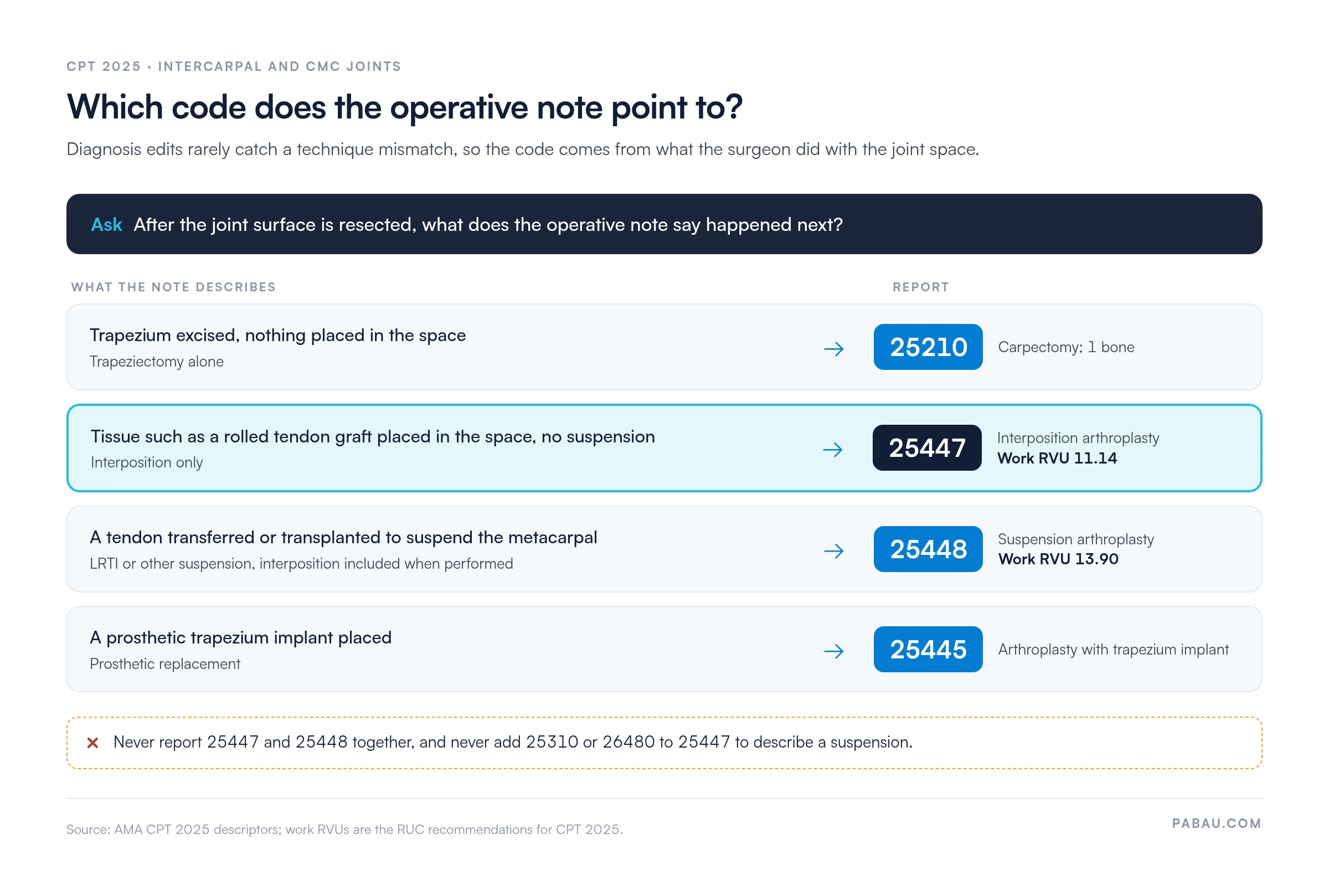
CPT 25447 and CPT 25448 cover the same intercarpal and carpometacarpal joints. They differ only by surgical technique. CPT 25447 is interposition alone, while 25448 adds a suspension using a transferred or transplanted tendon.
CPT 25448 is new for 2025. The CPT Editorial Panel created it after a RUC screen found a pattern. About 80% of the time, 25447 was reported with a tendon transfer code such as 25310 or 26480. Surgeons were billing suspension work as two codes, and the new code bundles it into one.
Pick the code from the operative note, not the diagnosis. Both codes pair with the same ICD-10 codes, so diagnosis edits rarely catch a technique mismatch. A records review will. If the note describes a tendon slip used to suspend the metacarpal, the claim is 25448.
Several adjacent codes appear in the same hand surgery billing context as CPT Code 25447. Some are billed instead of 25447, some alongside it with a modifier, and some are bundled into it under CMS’s National Correct Coding Initiative edits.
Carpal tunnel release (64721) is the most common separately payable procedure in the same session as thumb CMC arthroplasty. The operative report must document each procedure as a distinct service. Append modifier -59, or XS where the payer requires it, when an NCCI edit pairs the two codes.
Modifiers for CPT Code 25447 govern laterality, multiple procedures, distinct services, and the unusual situation where the operating surgeon also administers anesthesia. Applying the wrong modifier, or omitting a required one, is a frequent reason this code is denied.
Modifier -47 deserves particular caution. Medicare does not pay for anesthesia provided by the operating surgeon, so the surgeon cannot bill it separately under Medicare rules. Commercial payer acceptance varies. Confirm each payer’s policy individually before appending -47 to CPT Code 25447 claims.
The CMS Medicare Physician Fee Schedule sets the national reimbursement benchmarks for CPT Code 25447. Rates are adjusted annually and vary by locality through CMS’s Geographic Practice Cost Index (GPCI). Always verify the current year’s rate through the CMS lookup tool before billing.
The work RVUs below come from the RUC’s review of the CMC arthroplasty family for CPT 2025. Most cases take place in a hospital outpatient department or an ambulatory surgery center, so the facility rate usually applies.
The two codes sit 2.76 work RVUs apart, so the technique recorded in the note moves the payment. Billing 25447 for a suspension case underpays the surgeon. Billing 25448 for an interposition-only case overstates the work and invites recoupment.
Use the FastRVU lookup tool to retrieve current work, practice expense, and malpractice RVUs for CPT Code 25447 by locality. The AMA/Specialty Society Relative Value Scale Update Committee (RUC) sets its work RVU recommendation from physician time and work intensity. Practice managers use the figure to model revenue per surgical case.
Most 25447 cases take place in an ASC or a hospital outpatient department, where Medicare pays the surgeon the facility rate. Pull the locality-adjusted facility rate from the CMS lookup tool, and build revenue projections on it rather than on the non-facility figure.
Most commercial payers require prior authorization before approving CPT Code 25447 claims. Following the payer’s prior authorization process for surgery matters, because a missing authorization number is an automatic denial however well the claim is coded.
Medicare does not routinely require prior authorization for 25447, but commercial payers including UnitedHealthcare, Aetna, and BCBS plans typically do. Requirements vary by plan and region. Below are the documentation elements most payers request:
Request authorization for the technique the surgeon plans to use. An approval for 25447 does not cover a 25448 suspension, so confirm the plan before submitting the request. If the surgeon changes technique in the operating room, contact the payer about updating the authorization.
State Medicaid programs have their own coverage policies for CPT Code 25447, which vary significantly. Some require extra pre-authorization steps. Verify coverage against the state Medicaid fee schedule before scheduling a Medicaid patient for CMC arthroplasty.
Selecting the correct ICD-10-CM diagnosis code is critical for establishing medical necessity and passing clean-claim edits. For CPT Code 25447, the ICD-10 code must specify the affected joint and laterality. The M18 category covers osteoarthritis of the first CMC joint and accounts for most 25447 claims.
Always code to the highest specificity available. Unspecified codes such as M18.9 will trigger medical necessity flags with most payers. The operative report and pre-operative notes must reflect the same laterality as the diagnosis code on the claim.
The operative report is the single most important document for CPT Code 25447 claims. It must show that the procedure performed matches the code billed, with enough detail for a payer reviewer to confirm medical necessity. Practices focused on medical billing compliance treat the op report as the claim’s primary defense.
Required elements for the operative report include:
For submitting clean claims, keep the pre-operative documentation package with the claim when prior authorization was obtained. Payers may request the approval letter, the supporting clinical notes, and post-operative notes during an appeal.
Denials on CPT Code 25447 cluster around four root causes: wrong code selection, prior authorization failures, thin operative notes, and modifier errors. Effective denial management workflows address each root cause separately rather than treating every denial as one problem.
Common medical billing denial codes on 25447 claims include CO-4 (inconsistent modifier), CO-197 (authorization absent), and CO-50 (not medically necessary). Each requires a distinct appeal. CO-197 appeals need the authorization approval, and CO-50 appeals need a necessity letter from the surgeon.
Build a CPT 25447 denial tracking log in your billing system. Capture denial code, payer, rejection date, and resolution time for every claim. After 30 claims, patterns start to show. When most 25447 denials from one payer cite CO-197, the authorization step for that payer is breaking down. Repairing that step prevents the next denial.
In many hand surgery practices, a coder rebuilds each 25447 claim from the operative note by hand. Someone then checks its status in a payer portal and logs the result in a spreadsheet. Each hand-off is another chance to drop a laterality modifier or miss a technique change.
Pabau removes those hand-offs. Its claims management software pre-fills each claim from the codes, modifiers, and diagnoses already on the patient record. Claims then go to payers through its Claim.MD clearinghouse integration, which also checks eligibility in real time.
Claim status and remittances flow back into the same record. A short-paid or denied 25447 claim shows up while there is still time to correct or appeal it. Choosing between 25447 and 25448 stays with your coders, backed by the documentation habits above.
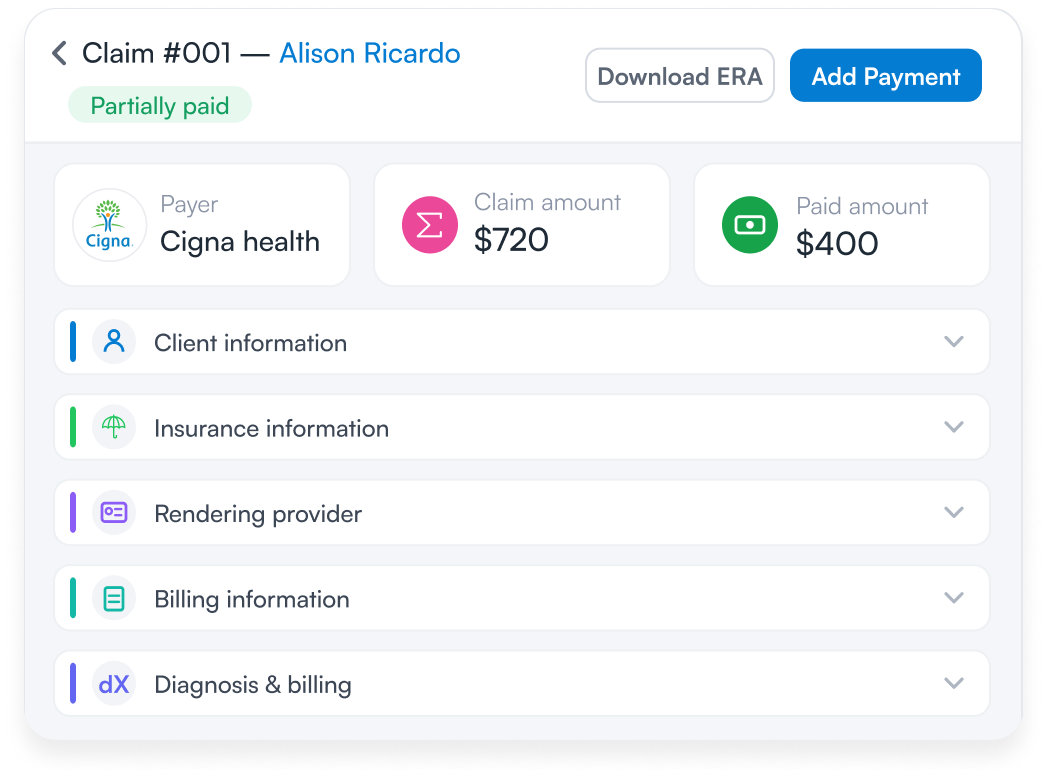

Pabau pre-fills claims from the patient record, submits them through Claim.MD, and tracks status and remittances. Hand surgery practices spot a denied 25447 claim while there is still time to appeal.

CPT 25447 is now an interposition-only code. Read the operative note for a tendon transfer or suspension before coding the case. If one is there, the claim is 25448, billed on its own.
The fix sits upstream of the billing team. An op note template that asks the surgeon to name the interposition material and state whether a suspension was done settles the code early. It also keeps the prior authorization aligned with the surgery performed.
The trade-off is one more line in the dictation in exchange for fewer recoupments on a 90-day global code. Book a demo to see how Pabau tracks hand surgery claims from submission to remittance.

Need to understand how clearinghouse submission works? Medical claims clearinghouse guide explains how electronic claim routing reduces denial rates and speeds up reimbursement for surgical codes.
Want to see the full superbill workflow? Superbill guide covers how to structure a compliant superbill that supports clean-claim submission for procedure codes including CPT 25447.
Looking to verify eligibility before scheduling surgery? Insurance eligibility verification details the real-time eligibility check process that flags prior authorization requirements and coverage limits before the patient reaches the OR.
CPT Code 25447 is the code for arthroplasty, intercarpal or carpometacarpal joints; interposition (eg, tendon). It is most often used for thumb basal joint arthroplasty. The surgeon removes the trapezium and fills the space with a tendon graft, without a suspension.
Both codes cover the same intercarpal and carpometacarpal joints and differ only by technique. CPT 25447 is interposition alone. CPT 25448, new in 2025, adds a suspension using a transferred or transplanted tendon, with interposition when performed. CPT says not to report the two together.
The most common modifiers for CPT 25447 are -LT and -RT for laterality and -51 for multiple procedures in the same session. Use -59 or an X modifier for a distinct service such as carpal tunnel release (64721). Modifier -47 (anesthesia by surgeon) is not paid by Medicare and has variable acceptance among commercial payers.
Medicare pays CPT 25447 through the Physician Fee Schedule, with a 90-day global period. Payment depends on your locality’s GPCI and on the setting, and most cases are done in a facility. Look up the current national and local amounts in the CMS Physician Fee Schedule tool before quoting a figure.
In its review for CPT 2025, the RUC recommended keeping the work RVU for CPT 25447 at 11.14. It valued the new suspension code 25448 at 13.90. Total RVUs add practice expense and malpractice components and vary by setting, so confirm current values in the CMS lookup.
The most common denials for CPT Code 25447 are technique mismatches, missing prior authorization, laterality errors, and thin operative notes. A technique mismatch means billing 25447 for a suspension case, or adding 25310 or 26480 to describe one. Each denial type needs its own correction before resubmission.
Modifier -47 is payer-dependent for CPT 25447. Medicare does not pay for anesthesia provided by the operating surgeon, so it cannot be billed separately under Medicare rules. Commercial payer acceptance varies by plan, so confirm each payer’s policy before appending modifier -47 to any 25447 claim.