



HCPCS code E0198: Water pressure pad billing guide
HCPCS code E0198 is a water pad for a standard mattress HCPCS code E0198 is the ...

Last Updated: Oct 13, 2026

CPT Code 00930 describes anesthesia for orchiopexy (unilateral or bilateral) and open urethral procedures on the male genitalia.
The code carries 4 ASA base units. Reimbursement calculates as (Base Units + Time Units + Modifying Units) times the CMS conversion factor.
Physical status modifiers (P1-P6) and medical direction modifiers (AA, QK, QX, QY, QZ) are required. Incorrect modifier selection is the leading cause of claim denial.
Pabau’s claims management software helps anesthesia billing teams track modifier assignment, time unit entry, and claim submission accuracy in one workflow.
CPT Code 00930 is the anesthesia code anesthesiologists and CRNAs bill for orchiopexy, unilateral or bilateral, and open urethral procedures on male patients. It covers the anesthesia service only, not the surgical procedure itself, and requires the correct physical status modifier, medical direction code, and time units on every claim.
This reference covers everything billers and coders need for CPT Code 00930: the official descriptor, 4-unit base value, the (B+T+M) x CF formula with a worked example, all applicable modifiers, qualifying circumstances, Medicare reimbursement context, related codes in the 00920-00952 range, and common billing errors to avoid.
CPT Code 00930 is an anesthesia code published by the American Medical Association (AMA) under the CPT code set. Its official descriptor reads: Anesthesia for procedures on male genitalia (including open urethral procedures); orchiopexy, unilateral or bilateral. The code falls within the Male Genitalia Anesthesia section of the CPT manual (range 00920-00952).
CPT Code 00930 is used by anesthesiologists and Certified Registered Nurse Anesthetists (CRNAs) billing for anesthesia services during these specific surgical procedures. It captures only the anesthesia component of care. Surgeons billing for orchiopexy itself use separate CPT codes from the urological surgery section.
Orchiopexy corrects cryptorchidism, the condition where one or both testes fail to descend into the scrotum during development. The procedure repositions the undescended testis and secures it surgically. CPT Code 00930 covers the anesthesia for this procedure whether performed on one side (unilateral) or both (bilateral) in the same operative session.
Bilateral orchiopexy does not require a separate anesthesia code or a bilateral modifier. The single CPT Code 00930 descriptor already captures both anatomical sides. Practices running men’s health clinic software handle these cases routinely and should confirm bilateral documentation is in the operative note before submission.
Open urethral procedures on male patients also fall under CPT Code 00930 when general or regional anesthesia is administered. The code applies to the open surgical approach only. Laparoscopic or endoscopic urethral procedures may map to a different anesthesia code, so verify against the specific CPT section guidance and payer policy before billing. When an indwelling catheter is placed as part of the procedure, confirm separately whether the supply is billed under its own HCPCS code, such as A4311. Most avoidable denials on this code trace back to eligibility verification that was never run. If the encounter included an assessment and a plan, the evaluation and management component needs its own documentation.
Good pre-operative medical practice forms that capture surgical approach, laterality, and anesthesia start/stop times are the foundation for accurate CPT Code 00930 claims. Missing this detail downstream creates avoidable denials.
CPT Code 00930 carries 4 ASA base units, as established by the American Society of Anesthesiologists (ASA) Relative Value Guide and confirmed by the Medicare Physician Fee Schedule. Base units reflect the complexity of the anesthesia service for that category of procedure, independent of how long the case runs.
Total reimbursement for anesthesia is not flat. It uses a unit-based formula where time and patient complexity both affect the final payment.
The standard ASA and CMS formula is: (Base Units + Time Units + Modifying Units) x Conversion Factor = Reimbursement
A 7-year-old patient (qualifying for the 99100 extreme age circumstance) undergoes unilateral orchiopexy under general anesthesia. Anesthesia time: 45 minutes. Physical status: P1 (no additional modifying units for P1). Qualifying circumstances: 99100 adds 1 modifying unit.
The CMS anesthesia conversion factor is updated every January. Never apply a prior-year figure without confirming the current rate from FastRVU’s 2026 RVU lookup or your MAC’s fee schedule. Reimbursement also varies by locality: a New York-based anesthesiologist receives a different payment per unit than a practice in rural Mississippi for the same CPT Code 00930 claim.
Anesthesia codes require modifiers that other CPT categories do not. Two modifier families are mandatory: physical status and medical direction. Getting either one wrong is the fastest route to a denial or audit flag on a CPT Code 00930 claim. For broader context on how modifier logic fits into medical practice management, the billing workflow matters as much as the code itself.
Physical status modifiers reflect the patient’s overall health at the time of anesthesia. They are defined by the ASA and must appear on every anesthesia claim. P3 and above add modifying units to the billing total.
Additional unit values per physical status level vary by payer. Confirm current values against your MAC policy before billing, as commercial insurers may differ from Medicare.
Medical direction modifiers tell the payer who administered the anesthesia and in what supervisory capacity. They affect both reimbursement rate and compliance standing.
QK and QX must always be billed as a matched pair: the anesthesiologist submits QK and each directed CRNA submits QX on their own claim. Submitting only one side is an automatic edit failure.

Pabau’s billing and claims management tools help anesthesia teams track modifier assignments, time unit entries, and claim status across every procedure code, including CPT Code 00930.

Qualifying circumstances are add-on codes that capture anesthesia provided under unusually difficult conditions. They are billed alongside CPT Code 00930, not instead of it. Not every payer accepts all qualifying circumstances codes, so verify with the specific payer before reporting. When 99140 applies because the case originated as an emergency, check whether the patient’s emergency department visit, such as one billed under 99284, is documented to support medical necessity.
Code 99100 applies most frequently with CPT Code 00930 because orchiopexy is commonly performed on pediatric patients, and children under age 1 qualify. The operative report must document why the qualifying circumstance was present. Without documentation, the code will be denied on audit.
Medicare pays for anesthesia services using the unit-based formula above, applied to the current anesthesia conversion factor. The conversion factor is published annually by CMS through the Medicare Physician Fee Schedule and differs by locality. Medicare does not reimburse at a flat dollar amount per procedure for anesthesia codes.
For CPT Code 00930, the relevant billing variables under Medicare are:
For current 2026 reimbursement values broken down by RVU component, filter your MAC’s published fee schedule by anesthesia codes. This is more reliable than relying on a static fee schedule published before the annual CMS update.
Before finalizing any CPT Code 00930 claim, pull the current conversion factor from your MAC’s fee schedule, not from a third-party reference table. Conversion factors for anesthesia are updated every January, and using a prior-year figure is one of the most common causes of underpayment on anesthesia claims.
CPT Code 00930 sits within the Male Genitalia Anesthesia section of the CPT manual. Selecting the wrong code from this range is a frequent error when the procedure type or anatomical area is not confirmed before billing. Misapplying codes here creates the same compliance exposure as picking the wrong code family entirely. Compare the full range below before assigning any anesthesia code in this section.
Base unit values listed above are the standard ASA values, and payer-specific reimbursement may differ. CPT 00940 sits in the adjacent gynecologic anesthesia section rather than the male-genitalia range: see 00940 for that code’s own billing detail.
Practices that handle both urology and reproductive care often reference IVF CPT codes and run fertility clinic software alongside general anesthesia billing tools, so every specialty stays in one system.
Most CPT Code 00930 denials trace back to one of four avoidable errors. The same documentation discipline matters across unrelated code families too. Maintaining medical office HIPAA compliance throughout the billing workflow matters just as much, particularly when transmitting claim data electronically.
Anesthesia billing has more moving parts than most CPT coding because the reimbursement amount changes with every case. Time varies. Physical status varies. Qualifying circumstances appear or not depending on the patient. A biller manually tracking all of this across a day’s caseload is exposed to every error listed above.
Practice-level claims management software addresses this by centralizing the modifier-to-code assignment check and flagging incomplete fields before submission. Pabau’s platform links the clinical record (procedure type, patient age, anesthesia start/stop time) directly to the billing workflow, so the variables that determine CPT Code 00930 reimbursement are captured at the point of care, not reconstructed from memory hours later.
Leveraging automated billing workflows reduces the manual handoff steps where modifier errors most often appear.
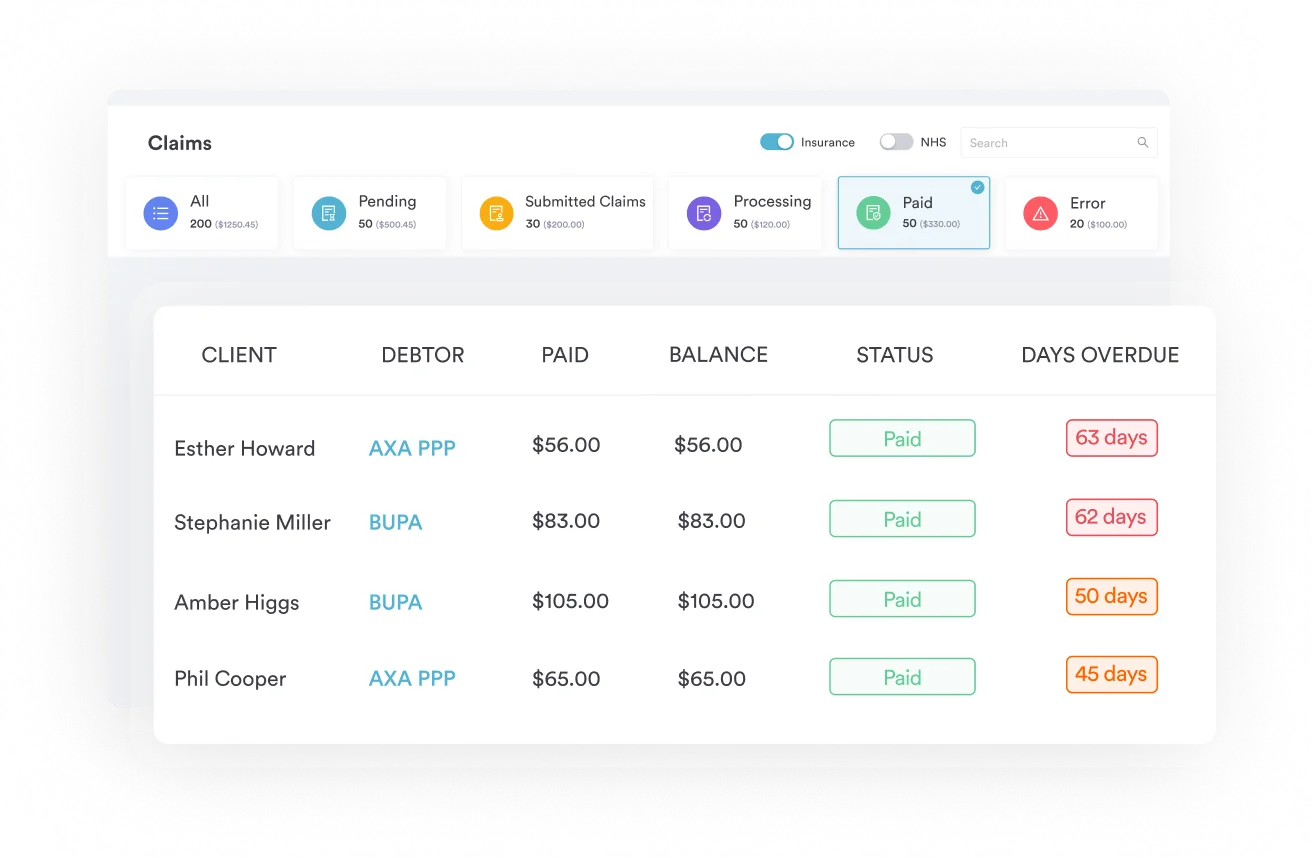
For practices managing multiple anesthesiologists or a CRNA team, the QK/QX pairing requirement becomes a tracking challenge. Software that surfaces concurrent case relationships at the claim-preparation stage eliminates the paired-modifier error before it reaches the payer. For more on how practice management software integrates billing and clinical documentation, the workflow benefits extend well beyond anesthesia coding.
CPT Code 00930 is a straightforward anesthesia code for a specific procedure category, but the billing complexity sits in the modifier layer and the unit calculation. Four base units is the fixed starting point. Time, physical status, qualifying circumstances, and medical direction vary per case, and each one must be documented before the claim is submitted.
Pabau’s claims management software helps anesthesia practices connect clinical documentation to billing data, apply modifiers consistently, and catch errors before they reach the payer. To see how it fits your anesthesia billing workflow, book a demo.

Managing billing for multiple CPT code families? 00936 covers the related amputation code in the same male-genitalia anesthesia section.
Billing a maxillary torus excision? Maxillary torus excision billing guide covers excision of a maxillary torus palatinus, paired with ICD-10 code K10.0 and a documented functional problem.
Billing anesthesia for a transurethral procedure instead? 00910 covers anesthesia for transurethral procedures in the adjacent genitourinary anesthesia range.
CPT Code 00930 is an anesthesia code used for procedures on male genitalia, specifically orchiopexy (unilateral or bilateral) and open urethral procedures. It is billed by anesthesiologists and CRNAs for the anesthesia service during these surgeries, not by the operating surgeon.
CPT Code 00930 has 4 ASA base units. This value is consistent across Medicare and most commercial payers. Base units are the starting point for the anesthesia billing formula: (Base Units + Time Units + Modifying Units) x Conversion Factor.
Yes. The CPT Code 00930 descriptor explicitly states “unilateral or bilateral,” so a single unit of the code covers both sides when orchiopexy is performed bilaterally in the same operative session. Do not append modifier -50. Doing so creates a duplicate billing edit.
The most common is 99100 (extreme age), which applies when the patient is under 1 year old. Orchiopexy is frequently performed on pediatric patients, making 99100 relevant for many CPT Code 00930 claims. Codes 99116, 99135, and 99140 apply in less common clinical scenarios and require payer verification before reporting.
CPT 00920 (3 base units) covers general male genitalia procedures not otherwise specified. CPT Code 00930 (4 base units) specifically covers orchiopexy and open urethral procedures. CPT 00940 (3 base units) is not a male genitalia code. It covers anesthesia for vaginal procedures, with or without biopsy, in the adjacent gynecologic section of the CPT manual. Selecting the wrong code from this range is a common audit trigger.
Reimbursement uses the formula: (4 base units + time units + modifying units) x the current CMS anesthesia conversion factor for your locality. Time units are typically 1 unit per 15 minutes, though some commercial payers use 10-minute intervals. The conversion factor is updated annually by CMS and varies by Medicare Administrative Contractor region.



