


CPT Code 30801: Superficial turbinate ablation billing guide
CPT Code 30801: Official descriptor and procedure overview The American Medical ...

Last Updated: Nov 27, 2026
CCSD code XR510 covers fluoroscopically guided discectomy, including laser discectomy, in the UK private insurance schedule. It’s spinal surgery, even though the “XR” prefix reads like an X-ray. The code sits in Chapter 17 (Spine), sub-chapter 17.8.0, where its closest siblings are CT guided discectomy and two vertebroplasty codes.
Pick the wrong sibling, or pair XR510 with a blocked discectomy or fusion code, and the insurer sends the claim back. Below are the neighboring codes, the operative note insurers expect, a pre-submission checklist and the mistakes that most often stall payment.

CCSD code XR510 is fluoroscopically guided discectomy, including laser, in Chapter 17 (Spine), sub-chapter 17.8.0.
The XR prefix marks image-guided interventional procedures, not plain-film radiography.
Use XR520 when CT guides the discectomy, and XR530 or XR540 for percutaneous vertebroplasty.
V2901 and V2902 are two of several codes the CCSD lists as unacceptable combinations with XR510, so check the full schedule.
Build the claim on the operative note: indication, levels treated, imaging guidance, consultant and pre-authorization reference.
The CCSD descriptor for XR510 reads “Fluoroscopically guided discectomy (including laser)”. The Clinical Coding and Schedule Development Group places it in Chapter 17, Spine, under sub-chapter 17.8.0.
In practice, the consultant removes disc material while live X-ray imaging guides the instruments. Laser discectomy falls under the same code, so it needs no separate one.
The prefix causes most of the confusion. Across the schedule, XR codes cover image-guided interventional procedures rather than plain radiography. XR130, for example, is a plugged liver biopsy. Bupa’s imaging paper lists CCSD code XR260 as angioplasty with insertion of a metallic stent.
The full schedule sits behind a CCSD login. Check the current descriptor there, or in an insurer tool such as the Bupa code search, before you bill. Our CCSD code library covers more codes from the same schedule.
Two questions separate XR510 from its closest siblings in Spine 17.8.0. Which procedure was done, and which imaging guided it? The grid crosses those two answers.
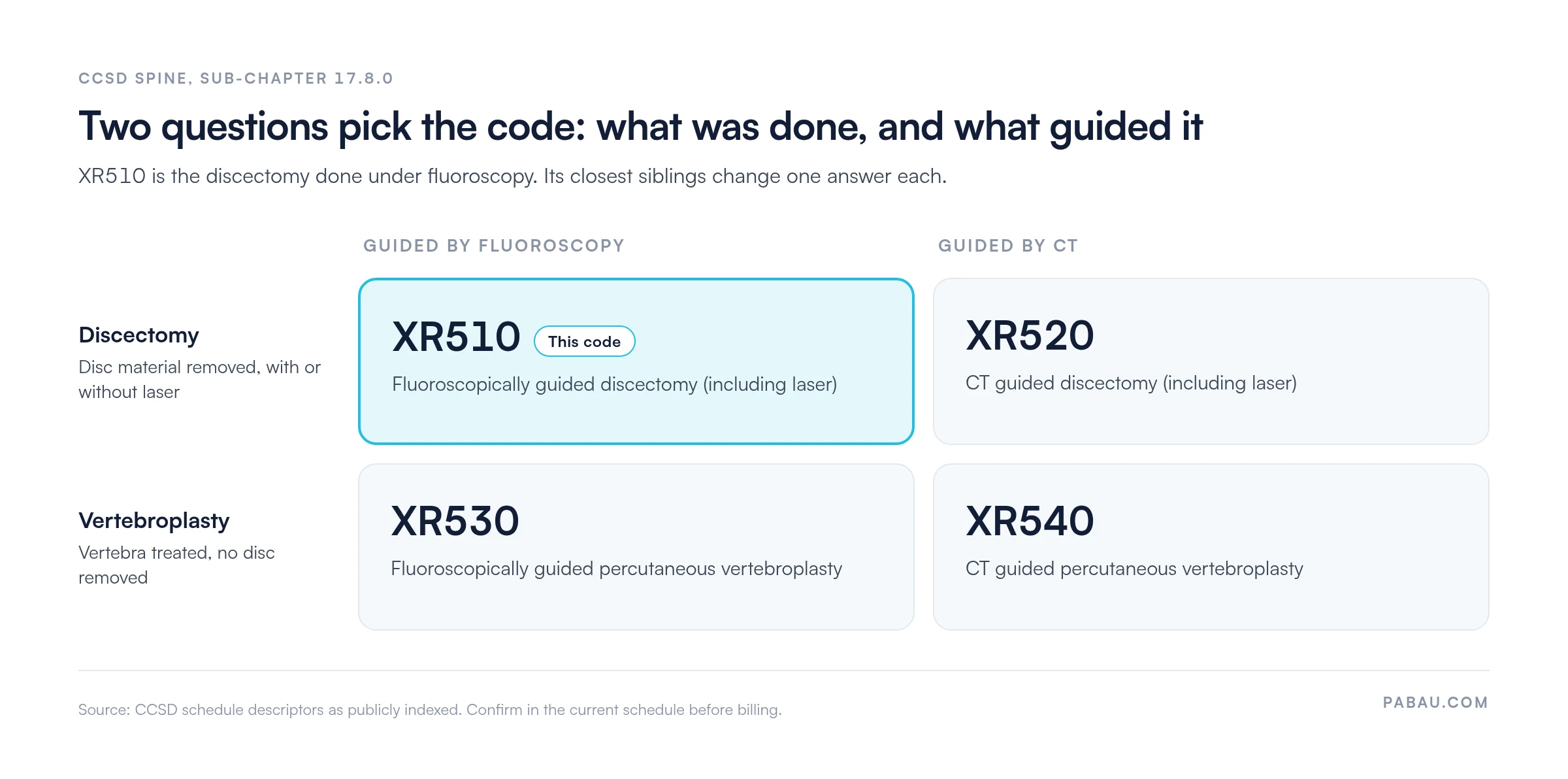
So the operative note has to name the guidance modality. Without it, a reviewer can’t tell XR510 from XR520.
These four aren’t the whole XR5 run. Indexed entries also show XR500 for chemonucleolysis and XR531 for Coblation vertebroplasty. Check the full schedule when a procedure fits none of the boxes above.
The CCSD lists several unacceptable combinations for XR510, and none of them belongs on the same claim. Two cervical examples show the pattern:
Both describe anterior cervical discectomy. Paired with XR510, either one reads as the same disc work billed twice. If the consultant believes both procedures took place, raise it with the insurer before you submit.
V2901 and V2902 are only part of the blocked set. AXA Health’s entry for XR510 also lists V2680, V2900, V2950, V2951, V3100, V3102 and V3140. Check the full schedule for the complete, current list before you bill.
Insurers judge an XR510 claim on the procedure record, so a radiology report alone won’t carry it. Make sure the note shows:
Keep the signed note on file before the claim goes out. A query is far quicker to answer when the record is already complete.
UK private medical insurers generally expect pre-authorization for planned surgical procedures. Ask for it before the date is booked, quoting XR510 and the levels planned.
Then record the reference, the date and the name of whoever approved it. Authorization isn’t a promise of payment, though. The insurer can still decline if the note describes a different procedure, such as a CT guided discectomy.
Fees for XR510 come from each insurer’s schedule and your provider agreement. Check the insurer’s own tool, such as the Vitality fee finder, rather than assuming one rate applies everywhere.
Most UK private claims reach insurers electronically through Healthcode. For XR510, the workflow runs like this:
XR510 claims stall when the operative note, the pre-authorization reference and the claim live in different places. Your billing team then chases paper while the insurer waits.
Pabau, a practice management platform, keeps those records on one patient file. Your team builds the claim from that record in Pabau’s medical billing software and submits it through Healthcode. When a query comes back, the note is a click away.
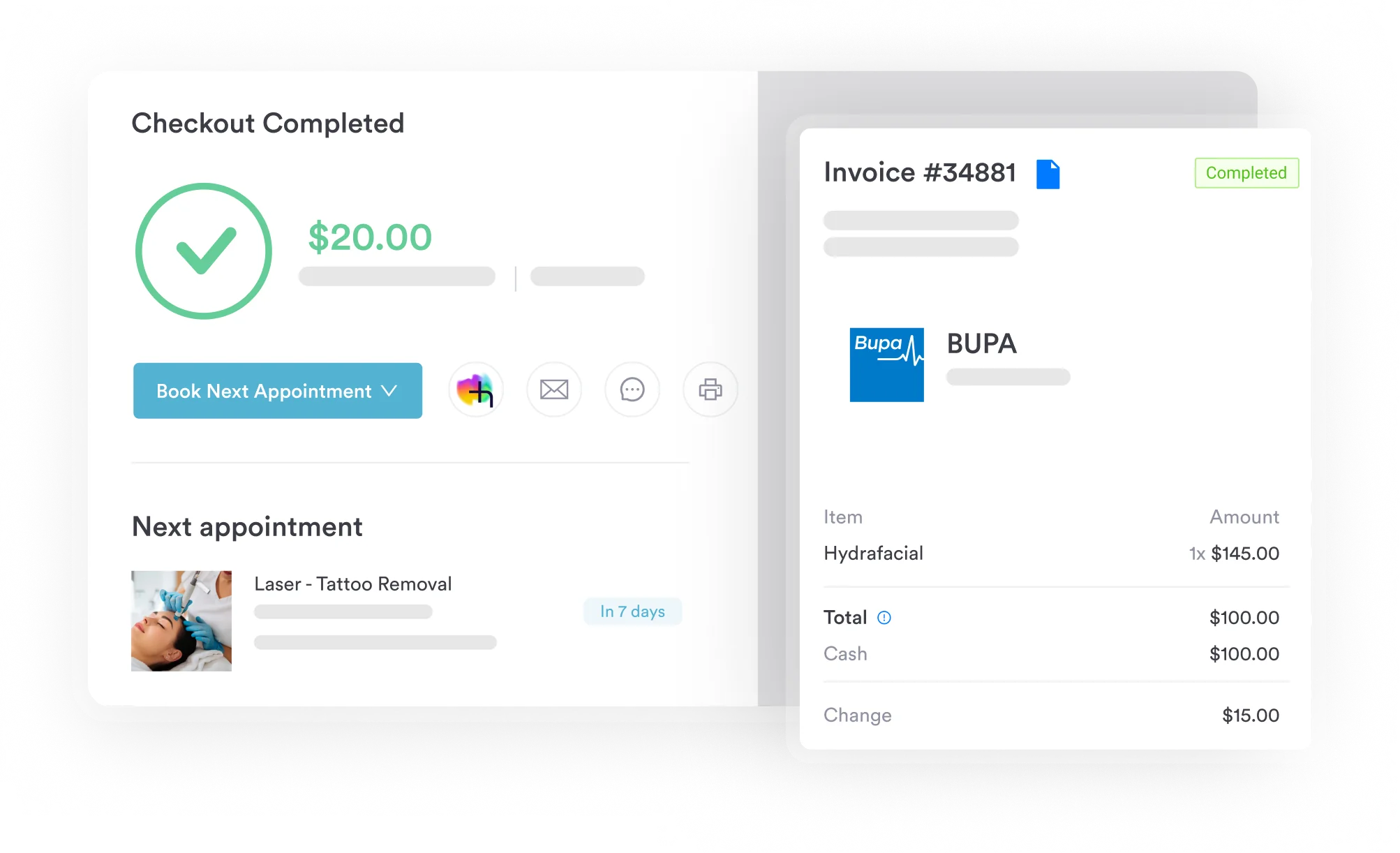

Keep operative notes, pre-authorization references and claims on one patient record, then submit to UK insurers through Healthcode.

XR510 looks like a radiology code, but it pays for spinal surgery. Read it that way and the rest follows. You pick the sibling that matches the procedure and imaging, keep blocked combinations off the claim and build it on the operative note.
When a descriptor or a pairing is in doubt, let the current schedule settle it rather than memory. Book a demo to see operative notes, pre-authorization references and Healthcode claims kept on one patient record.

Billing CCSD procedures for Bupa patients? Bupa CCSD codes billing guide covers how the schedule applies to Bupa-insured patients.
Coding another image-guided intervention? CCSD code XR580 explains percutaneous cholecystostomy billing.
Coding a vertebroplasty instead? CCSD code V2570 covers percutaneous vertebroplasty at one level.
Retrieving a foreign body under imaging? CCSD code XR940 walks through foreign body retrieval claims.
Need a system to track insurer claims? Claims management software shows how claims move from the patient record to the insurer.
Usually the consultant who performs the discectomy, whether that’s a spinal surgeon or an interventional radiologist. The code describes the procedure rather than the specialty. If you’re unsure your insurer recognition covers it, ask the insurer first.
Often, yes. Many UK insurers have the anesthetist claim against the same CCSD procedure code as the operating consultant. Each insurer sets its own anesthetic fees and rules, so check before you bill.
Register for an account on the CCSD website, ccsd.org.uk. Code searches need a login, and the site lists a contact address for help with access.
Contact the insurer before the procedure and agree the fee in writing. Don’t swap in a different code to reach a listed fee, because that misdescribes the procedure.




