CPT code 33234: Pacemaker lead removal billing guide
CPT code 33234: Official descriptor and code placement CPT code 33234 is the cod...

Last Updated: Nov 26, 2026
V2680 is the CCSD code for revision anterior discectomy, decompression and anterior fusion of the lumbar spine, with or without instrumentation. Spinal cord monitoring is included. Surgeons use it when they return through the front to a lumbar level that was operated on before.
The code sits in section 3.1.3, Lumbar Region, of the CCSD schedule used by UK private medical insurers. A first anterior lumbar fusion is billed as V3340 or V3341 instead.
Let Pabau's smart automation suggest the right codes, reduce claim denials, and keep your practice compliant—effortlessly.
Automate repetitive tasks and focus on what matters most—your patients.
Reduce coding errors and ensure compliance with the latest regulations.
Clean claims, fewer denials, and faster reimbursements.
Powerful insights and reporting to help your practice thrive.
HIPAA compliant SOC 2 certified GDPR-compliant Trusted by 4,000+ clinics worldwide

CCSD code V2680 covers revision anterior discectomy, decompression and anterior fusion of the lumbar spine, with or without instrumentation, including spinal cord monitoring.
It is for a return to a previously operated lumbar level. A first anterior lumbar fusion is V3340 for 1 or 2 levels, or V3341 for 3 or more.
UK private medical insurers such as Bupa and AXA Health pay against the CCSD schedule, and each insurer sets its own fee.
The diagnosis on the claim should name the reason for the revision, such as M96.0 for a failed fusion, using WHO ICD-10 codes.
Pabau, a practice management platform, sends insurer claims through Healthcode and to Bupa, with the authorization reference held on the patient’s case.
CCSD code V2680 is the code UK private insurers use for revision anterior discectomy, decompression and anterior fusion of the lumbar spine. Insurer schedules such as National Friendly’s CCSD-based fee schedule list it with that narrative as a Complex Major procedure.
The surgeon goes back in through the front of the abdomen to a lumbar level that was operated on before. The disc space is cleared, the nerves are decompressed and the segment is fused again. Instrumentation is optional in the narrative, and spinal cord monitoring is included in it.
The word “revision” carries the code. If the patient has never had surgery at that level, V2680 is the wrong choice, however difficult the operation was.
Older insurer lists may still print the pre-2020 wording without spinal cord monitoring, so check the edition your insurer works from. Pabau’s index of CCSD codes lists the other procedure codes we cover.
Lumbar fusion codes sit side by side in section 3.1.3 of the CCSD schedule. Three questions settle the choice. Was the approach anterior, posterior or both? Is this a first operation or a revision, and how many levels were treated?
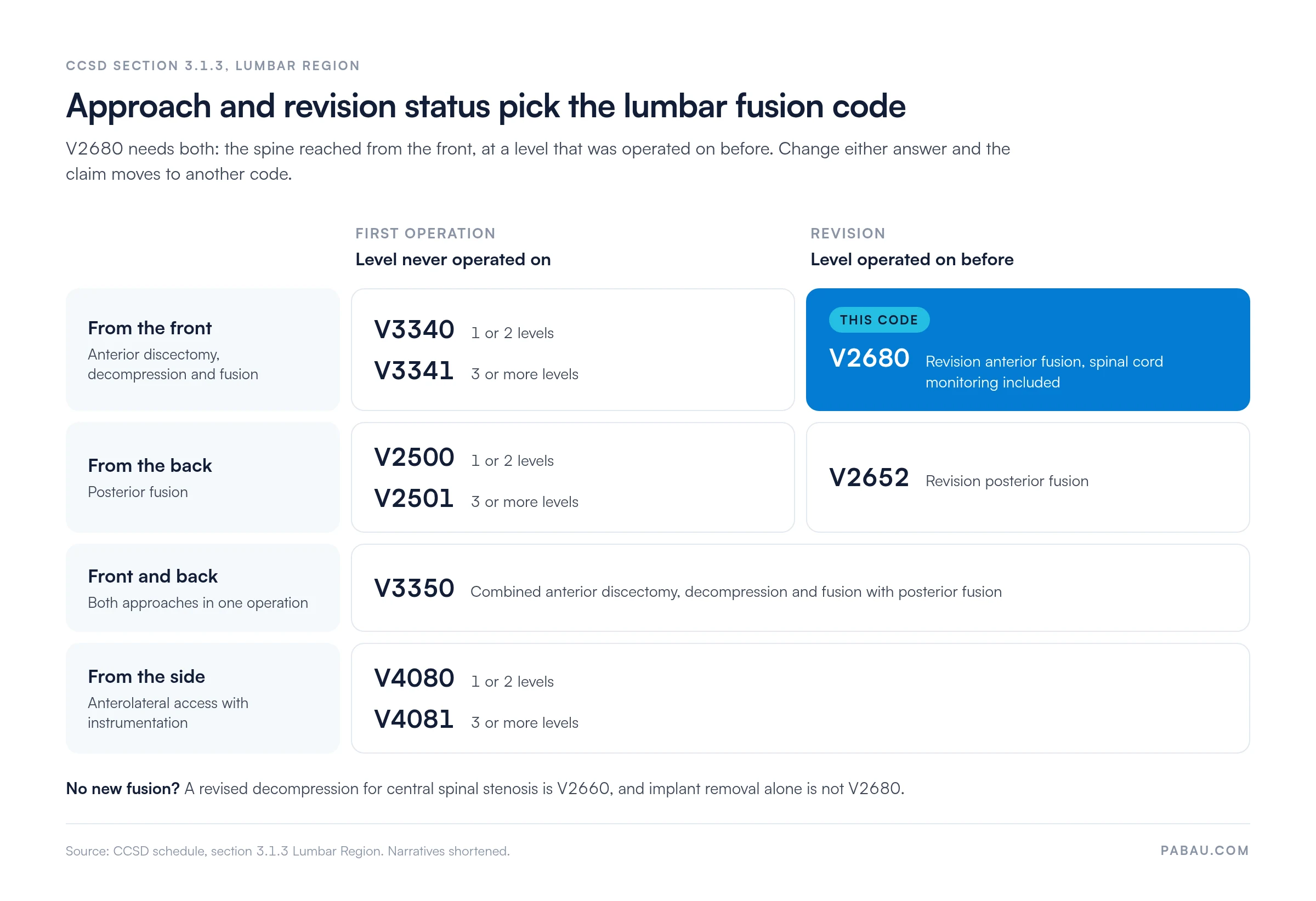
Narratives come from the CCSD schedule and are shortened here. V3340 and V2680 are the easiest pair to confuse, because the operations look alike on the table. A front-and-back fusion goes to CCSD code V3350 instead. Neck operations sit in a separate section, where trans-oral surgery with posterior fixation is billed under the V3730 code. In the neck, a combined anterior and posterior fusion is billed as code V2980. Removing a vertebral body from the front, with decompression and an implant, is billed as CCSD V4300.
CCSD code V2660 covers a different operation, the revision of a decompression for central spinal stenosis. Before two spinal codes go on one claim, check the insurer’s combination rules.
Revision anterior lumbar surgery is harder than the first operation. Scar tissue from the earlier approach covers the large blood vessels in front of the spine. Many surgeons bring in an access surgeon to open and close.
If the note describes implant removal alone, with no new fusion, V2680 doesn’t fit. Code what was done, not what was planned.
V2680 is for a patient whose earlier lumbar surgery has failed or worn out at the same level or the next one. These are the usual reasons, and each one points to a different diagnosis code.
When an insurer asks for a diagnosis, UK claims use the WHO’s ICD-10, fifth edition, not the US ICD-10-CM. Pick the code for the reason this revision is happening, not the condition behind the first operation. Titles below come from the WHO ICD-10 browser.
T84.1 is for fixation devices in the bones of the limbs, so it doesn’t belong on a spinal claim. Use the diagnosis the surgeon documented.
A V2680 claim is only as strong as the operation note behind it. If the note reads like a first operation, the insurer may query the code or pay at the primary rate.
Open every revision operation note with one fixed line: “Revision of [earlier procedure], [date], at [level].” The coder sees the revision status before reading a word of the technique, and the insurer sees it too.
The work starts before admission. UK insurers usually expect planned spinal surgery to be authorized in advance, and the patient’s policy decides what is covered.
The anesthetist and any access surgeon bill their own fees for the same operation. Agree who bills what before the day, so two claims don’t describe the same work.
Most queried revision claims trace back to a few avoidable slips, each with a straightforward fix.
Bupa is one of the UK’s largest private health insurers, and many spinal surgeons hold Bupa recognition. Its rules are worth knowing before the first revision claim goes out.
Our guide to Bupa CCSD codes explains how Bupa’s procedure list and claim process work.
In many spinal practices, the authorization sits in an email and the operation note lives in the hospital system. The claim is then keyed in by hand. Every handoff is a chance to lose the reference number or send the wrong code.
Pabau keeps those steps on the patient record. Its claims management software sends claims electronically through Healthcode and to Bupa. The authorization code, dates and sessions sit on the patient’s case, with a warning when one is missing.
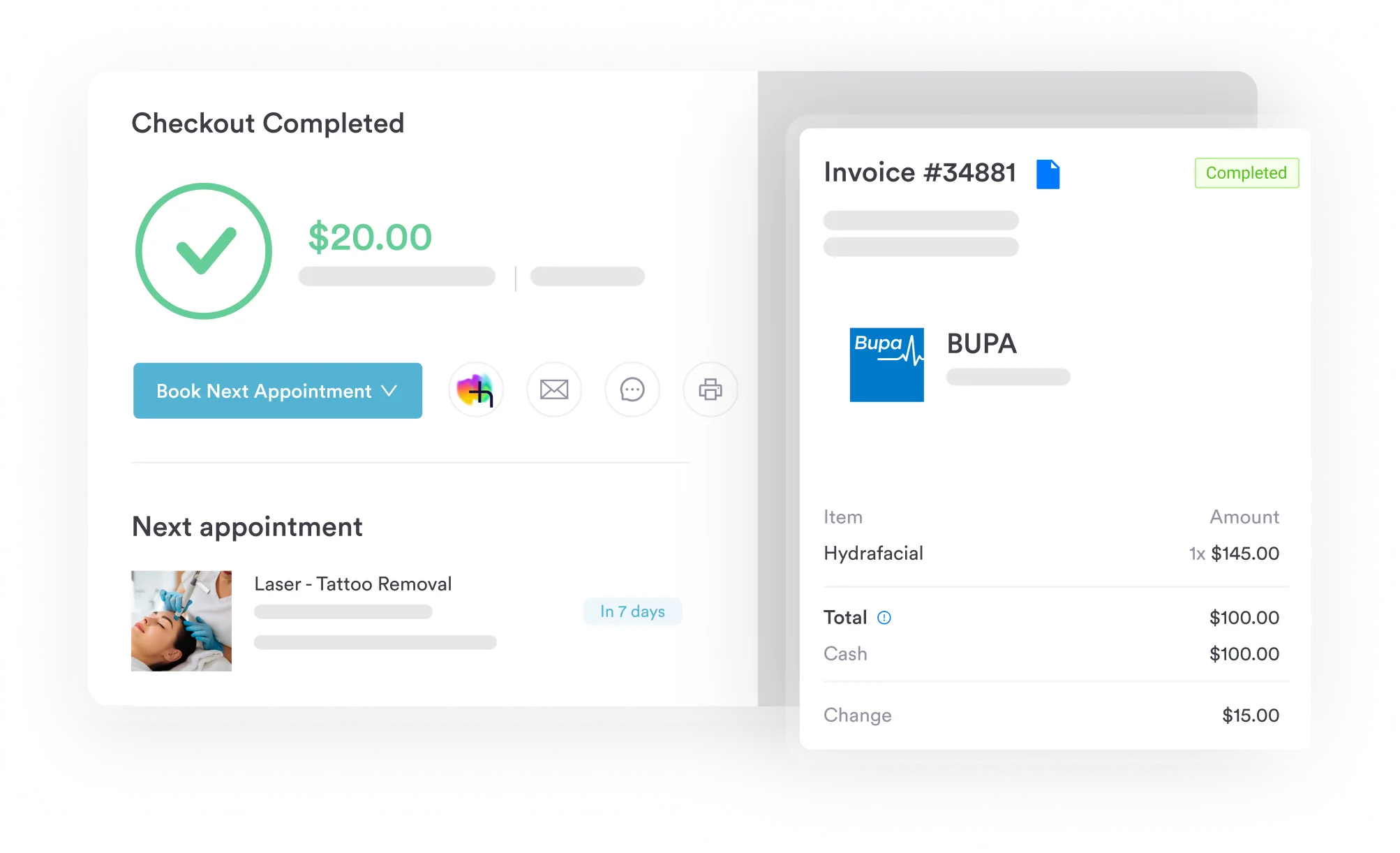
Pabau’s digital forms let you build an operation-note template with a revision line and a level field. The coder then reads the facts V2680 depends on instead of searching a long narrative. The result is fewer queried claims and a clear view of what each insurer still owes.

Pabau tracks authorization codes on the patient’s case and sends claims electronically through Healthcode and to Bupa. You see each claim’s status without phoning the insurer.

V2680 is the right code only when three facts line up. The level was operated on before, the surgeon went in from the front, and a new fusion was done. Miss one, and the claim belongs to V3340, V2652 or V3350 instead.
Put the revision line at the top of every operation note, and check each insurer’s current narrative and fee. Those two habits remove most of the queries that slow revision spine payments. Book a demo to see how Pabau tracks authorizations and sends your Healthcode claims from one patient record.

Fusing from the front and the back? CCSD code V3350 covers combined anterior and posterior lumbar fusion.
Revising a stenosis decompression instead? CCSD code V2660 covers revision of decompression for central spinal stenosis.
Revising a posterior disc excision? CCSD code V2543 covers revision posterior disc excision with facetectomy in the lumbar region.
Need a full Bupa CCSD billing reference? Bupa CCSD codes explains Bupa’s procedure list and how its claims work.
CCSD code V2680 covers revision anterior discectomy, decompression and anterior fusion of the lumbar spine, with or without instrumentation. Spinal cord monitoring is included in the narrative. It applies when the surgeon returns through the front to a level that was operated on before.
CCSD codes come from the UK’s Clinical Coding & Schedule Development group. UK private medical insurers such as Bupa and AXA Health use its schedule, as do the consultants and hospitals that bill them.
A first anterior lumbar discectomy, decompression and fusion is V3340 for 1 or 2 levels, or V3341 for 3 or more levels. V2680 is only for a revision at a previously operated level. V2660 is a different operation, a revision of decompression for central spinal stenosis.
UK claims use WHO ICD-10 codes, not ICD-10-CM. A failed fusion is M96.0, and a failed spinal fixation device is T84.2. Infection around the hardware is T84.6. Use the diagnosis the surgeon documented for this revision.
Check the insurer’s combination rules first. If the surgeon fused the spine from the front and the back in one operation, V3350 may describe the work better than two separate codes.
Yes. The CCSD Group created V2680 in January 2010 and updated its narrative in April 2020 to include spinal cord monitoring. Insurer schedules such as National Friendly’s October 2025 list still carry it.