CCSD Code D1010: Radical mastoidectomy including meatoplasty
CCSD Code D1010: Definition and clinical scope CCSD Code D1010 is the UK private...

Last Updated: Nov 25, 2026
V2570 is the CCSD (Clinical Coding & Schedule Development) code for percutaneous vertebroplasty at one vertebral level. Bone cement is injected into a fractured vertebral body through a needle under image guidance. UK private medical insurers such as Bupa, AXA Health and Allianz use the code to assess consultants' invoices.
Bupa's February 2026 schedule places V2570 in band MAJOR 5. Two or three levels in one session are coded V2572, and four or more are V2571.
Let Pabau's smart automation suggest the right codes, reduce claim denials, and keep your practice compliant—effortlessly.
Automate repetitive tasks and focus on what matters most—your patients.
Reduce coding errors and ensure compliance with the latest regulations.
Clean claims, fewer denials, and faster reimbursements.
Powerful insights and reporting to help your practice thrive.
HIPAA compliant SOC 2 certified GDPR-compliant Trusted by 4,000+ clinics worldwide

CCSD code V2570 covers percutaneous vertebroplasty at one vertebral level: bone cement injected into a fractured vertebral body through a needle.
The level count picks the code. Two or three levels in one session are V2572, and four or more are V2571.
CCSD stands for Clinical Coding & Schedule Development, the UK schedule that private medical insurers such as Bupa, AXA Health and Allianz use.
Bupa’s February 2026 schedule places V2570 in band MAJOR 5 at £650. AXA Health lists it as Xmajor, and each insurer sets its own fee.
Pabau’s claims software sends CCSD-coded claims to UK insurers through Healthcode, with the procedure note and authorisation number in the same patient record.
CCSD code V2570 describes percutaneous vertebroplasty at one vertebral level. AXA Health’s specialist code list prints its descriptor, “Percutaneous vertebroplasty – 1 level”, beside the fees AXA pays.
Bone cement is injected into a fractured vertebral body through a needle in the skin. The code sits in chapter 3 of the CCSD schedule, under 3.1 Spinal column (including intervertebral discs).
CCSD stands for Clinical Coding & Schedule Development. It is the UK schedule of procedure codes that private medical insurers use to assess consultants’ invoices. Bupa, AXA Health, Allianz, Aviva, Vitality and WPA all work from it, and each sets its own fee for V2570.
Our CCSD procedure code reference explains how the schedule and insurer fees fit together. The guides to other codes in the schedule sit in our CCSD billing reference.
A spinal surgeon, neurosurgeon or interventional radiologist usually performs it. The code covers one treated level, including the image guidance used to place the needle. The anaesthetist invoices separately, and the hospital bills the cement kit on its own account.
Percutaneous vertebroplasty involves four steps that coders need to recognise in the operative report before they code the claim.
Each of these steps should appear in the operative or procedure note. If the report leaves out image guidance, cement injection or needle placement, the insurer’s claims assessor will query the code.
Insurers authorise and pay V2570 when the stated indication matches an accepted diagnosis. The usual indications are an osteoporotic vertebral compression fracture and a pathological fracture from metastatic bone disease. A painful acute traumatic fracture that has not settled with conservative care can also qualify. Chronic fractures without imaging evidence of acuity are a frequent query trigger.
UK insurers code diagnoses with WHO ICD-10, not the US ICD-10-CM. The table below lists the codes most often paired with V2570, checked against the WHO ICD-10 browser. Select the most specific code the record supports.
Code to four characters wherever WHO ICD-10 offers them, because a three-character code such as M80 is a category, not a diagnosis. Confirm full descriptions in the WHO ICD-10 browser before submitting.
V2570 covers the vertebroplasty itself: needle placement, image guidance and cement injection at one level. AXA Health’s chapter 3 code list names 15 codes that can’t be billed with V2570. They include the radiology vertebroplasty codes and an image-guided spinal biopsy at the same sitting.
Check the patient’s insurer before adding any second code to a V2570 invoice. Combination rules differ between schedules, and an unacceptable pair is usually cut back to the higher-value code.
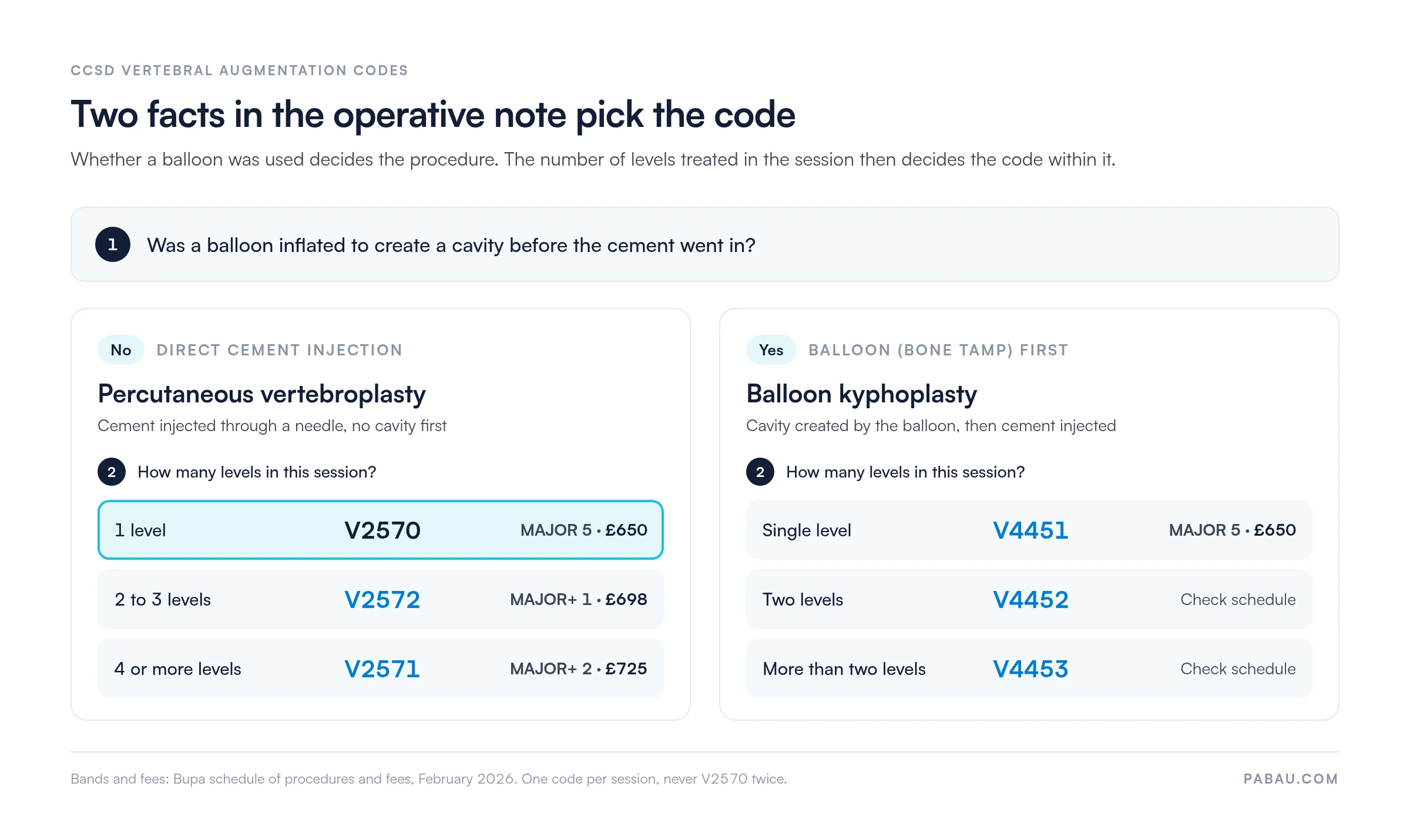
CCSD does not bill vertebroplasty per level. It splits the procedure into three codes by the number of levels treated in one session. Bupa’s February 2026 schedule sets the bands and fees below. Our Bupa fee schedule guide explains how a band maps to a fee.
Before treating more than one level, state the planned number of levels in the authorisation request. An authorisation for V2570 does not cover V2572, and a mismatch is hard to fix once the invoice has gone.
Vertebroplasty and kyphoplasty both treat vertebral compression fractures, but they are distinct procedures with their own CCSD codes. Coding one as the other is a common reason spinal augmentation claims are queried. Open spinal fusion sits in another part of the chapter, and a combined anterior and posterior lumbar fusion is billed under CCSD V3350.
Read the operative report before coding. If it describes a balloon inserted and inflated to create a void before cement injection, the procedure is kyphoplasty. If it describes direct cement injection with no balloon step, it is vertebroplasty and V2570 applies for one level.
The chart below puts both questions in the order a coder meets them: balloon first, then the level count.
A complete V2570 claim rests on a specific set of clinical and administrative documents. A missing one is the most common reason a claim is queried after submission. Structured clinical records software that keeps operative notes, imaging references and consent in one place reduces that risk.
UK private medical insurers expect an authorisation before planned spinal treatment. The patient or consultant contacts the insurer, which checks the policy and issues an authorisation number. Claims software that ties that number to the CCSD code prevents one of the most avoidable rejection types.
An authorisation confirms the insurer expects to cover the treatment under the patient’s policy. It is not a promise of payment, because the invoice still has to match the code, the notes and the policy limits. If treatment has to happen urgently, contact the insurer as soon as you can, since cover is not guaranteed after the fact.
A consultant who charges more than the insurer pays leaves the patient with a shortfall. Tell the patient about it in writing before the procedure.
V2570 rejections cluster around a small number of avoidable errors. Each one has a specific corrective action.
A clean V2570 claim needs three things to line up. They are the level count in the operative note, the authorisation number and the code on the invoice. Each one breaks down when the note, the authorisation and the invoice live in different systems.
Pabau keeps all three in one patient record. Its claims management software sends CCSD-coded claims to UK insurers through Healthcode and tracks each claim on one dashboard. The authorisation code and dates sit on the patient’s case, with a warning when one is missing.

Pabau helps UK private practices keep procedure notes, imaging and authorisation numbers together, then sends CCSD-coded claims to insurers through Healthcode.

V2570 is a narrow code. It pays for one vertebral level treated by direct cement injection. Most queried V2570 claims come down to that boundary: a second level, a balloon, or a radiology code added on top.
So the claim rests on two lines in the operative note: how many levels, and whether a balloon was used. Write them plainly, match the authorisation to them and check the insurer’s own fee.
If you are comparing systems, our guide to UK medical billing software sets out what to look for. Book a demo to see how Pabau sends CCSD claims through Healthcode with the note beside each one.

Coding a repeat lumbar operation? CCSD code V2660 covers revision of decompression for central spinal stenosis, another chapter 3 spinal code.
Billing revision disc surgery? CCSD code V2543 explains revision posterior disc excision with facetectomy in the lumbar region.
CCSD code V2570 covers percutaneous vertebroplasty at one vertebral level. Bone cement is injected into a fractured vertebral body through a needle under image guidance. The anaesthetist invoices separately, and the hospital bills the cement kit on its own account.
Vertebroplasty (V2570, V2572, V2571) injects cement directly, with no cavity created first. Balloon kyphoplasty inflates a bone tamp to create a cavity before the cement goes in, and is billed under V4451, V4452 or V4453. Code from what the operative report describes.
The image guidance used to place the needle is part of the procedure. The radiology vertebroplasty codes XR530 and XR540 are alternatives to V2570, not add-ons. AXA Health lists both among the codes that can’t be billed with V2570.
Bill one code per session based on the number of levels treated. V2570 covers one level, V2572 covers two or three, and V2571 covers four or more. Never bill V2570 more than once for the same session.
Not on the consultant’s invoice. In UK private healthcare the hospital bills the cement and vertebroplasty kit on its own account with the insurer. The consultant’s invoice carries V2570 and the consultant’s fee only.
UK private medical insurers such as Bupa, AXA Health, Allianz, Aviva, Vitality and WPA expect an authorisation before planned treatment. Each sets its own fee for V2570, so check the patient’s policy and the insurer’s schedule before the procedure.
The most frequent reasons are a missing or mismatched authorisation, the wrong level code, and an absent or non-specific ICD-10 code. Missing imaging reports, miscoding as kyphoplasty and unacceptable code pairs follow. A short pre-submission checklist prevents each of them.
Yes. The anaesthetist invoices the insurer separately against the same procedure code, and insurers set a separate anaesthetist fee. AXA Health, for example, lists £499 against V2570 next to the £1,000 surgeon fee.