


CPT Code 30801: Superficial turbinate ablation billing guide
CPT Code 30801: Official descriptor and procedure overview The American Medical ...

Last Updated: Nov 27, 2026
CCSD code XR530 is fluoroscopically guided percutaneous vertebroplasty, a spinal procedure that injects bone cement into a fractured vertebra under live X-ray guidance. The “XR” prefix looks like a plain X-ray code, but the CCSD Technical Guide gives the letter X to its interventional radiology chapter. The CCSD entry for XR530 files it in Chapter 17 (Interventional radiology), section 17.8, Spine.
Bill it as plain radiography and the insurer sends the claim back. Pair it with V2570 or XR531 and it bounces too. Below are the sibling codes, the operative note insurers expect, how the claim moves through Healthcode and the mistakes that stall payment.

CCSD code XR530 is fluoroscopically guided percutaneous vertebroplasty, listed in Chapter 17 (Interventional radiology), section 17.8 Spine, of the CCSD schedule.
The XR prefix marks an image-guided procedure here, not a plain X-ray examination.
Use XR540 when CT guides the vertebroplasty, and XR531 for coblation vertebroplasty.
The CCSD lists V2570 and XR531 as unacceptable combinations with XR530, so never put them on the same claim.
Build the claim on the operative note: indication, levels treated, fluoroscopic guidance and the pre-authorisation reference.
The CCSD descriptor for XR530 reads “Fluoroscopically guided percutaneous vertebroplasty.” The Clinical Coding and Schedule Development Group maintains that schedule and files XR530 under interventional radiology, in its spine section.
In practice, the consultant passes a needle through the skin into the fractured vertebral body. Fluoroscopy shows the needle position in real time. Bone cement then goes in to stabilise the fracture and ease pain.
That makes XR530 a procedure claim, not an imaging claim. A radiology report on its own won’t support it. Insurers expect a procedure record, just as they would for CCSD code XR510, its fluoroscopically guided discectomy neighbour.
The full schedule sits behind a CCSD login, so check the current entry before you bill. The CCSD also states that it doesn’t set fees, which come from each insurer. Our CCSD code library covers more codes from the same schedule.
Two questions separate XR530 from its neighbours. Which imaging guided the needle, and which technique treated the vertebra? Get either wrong and you’ve billed a different procedure.
So the operative note has to name both the guidance and the technique. Without them, a reviewer can’t tell XR530 from XR540 or XR531. One check comes first, though: whether cement went in at all, since XR510 covers disc removal. The chart below runs the three questions in order.
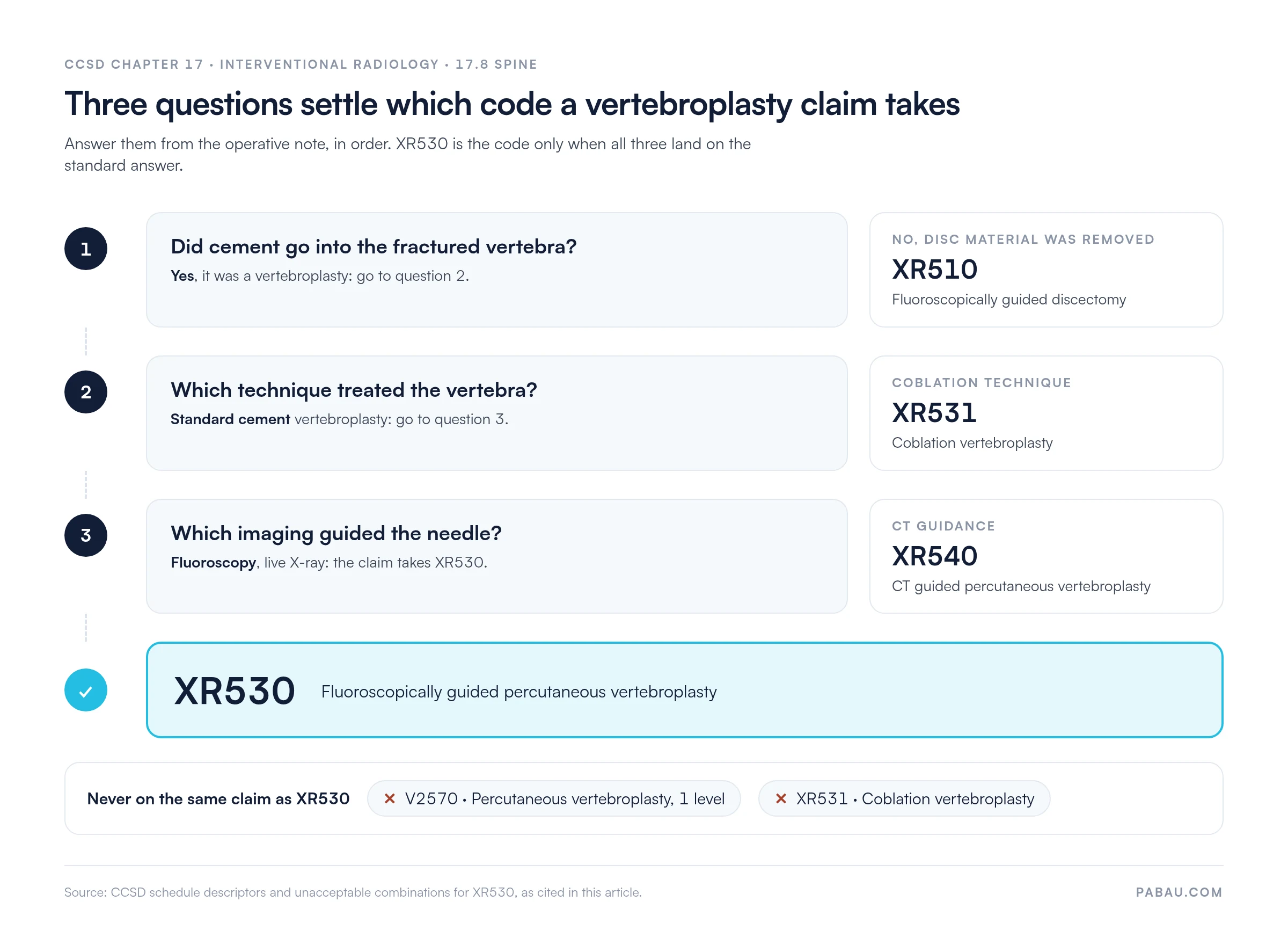
The indexed CCSD entry lists two unacceptable combinations for XR530:
Both describe vertebroplasty. Paired with XR530, either one reads as the same vertebra billed twice. Pick the one code that matches what was done and keep the other off the claim.
Don’t treat this pair as the whole list, though. The full entry may carry more, and the CCSD can add combinations over time. Check the current schedule before you submit.
Insurers judge an XR530 claim on the procedure record. Make sure the note shows:
The fracture confirmation matters more than it looks. NICE technology appraisal TA279 recommends vertebroplasty for osteoporotic fractures only in specific cases. The pain must be severe and ongoing after a recent, unhealed fracture, despite optimal pain management. Imaging and examination must also confirm it sits at the fracture level. A note that records both answers the most likely query before it comes.
UK private medical insurers generally expect pre-authorisation for planned procedures. Ask before the date is booked, quoting XR530 and the levels planned.
Then record the reference, the date and who approved it. Authorisation isn’t a promise of payment. The insurer can still decline if the note describes a different procedure, such as a CT guided vertebroplasty.
Fees differ by insurer and by your provider agreement. Check each insurer’s own tool rather than assuming one rate applies everywhere.
Most UK private claims reach insurers electronically through Healthcode. For XR530, the workflow runs like this:
A query isn’t a rejection. Most can be cleared by sending the operative note or the authorisation details the insurer asked for.
Most XR530 rejections follow a few patterns, and each one has a fix you can apply before submission.
XR530 claims stall when the operative note, the imaging and the pre-authorisation reference live in different places. Your billing team then chases paper while the insurer waits.
Pabau, a practice management system with built-in claims, keeps those records on one patient file. Your team builds the claim from that file in Pabau’s claims management software and submits it through Healthcode. When a query comes back, the note is already on the record.

Keep operative notes, pre-authorisation references and claims on one patient record, then submit to UK insurers through Healthcode.

XR530 looks like an imaging code, but it pays for a spinal procedure. Read it that way and the rest follows. You match the guidance and technique, keep V2570 and XR531 off the claim and build it on the operative note.
When a descriptor or pairing is in doubt, let the current schedule settle it rather than memory. Book a demo to see operative notes, pre-authorisation references and Healthcode claims kept on one patient record.

Coding a single-level vertebroplasty instead? CCSD code V2570 covers percutaneous vertebroplasty at one level.
Was a disc removed rather than a vertebra treated? CCSD code XR510 explains fluoroscopically guided discectomy billing.
Billing another image-guided intervention? CCSD code XR565 walks through biliary stricture dilatation claims.
Billing CCSD procedures for Bupa patients? Bupa CCSD codes billing guide covers how the schedule applies to Bupa-insured patients.
Need a system to track insurer claims? Claims management software shows how claims move from the patient record to the insurer.
No. Vertebroplasty injects cement straight into the fractured vertebra. Balloon kyphoplasty first inflates a balloon to create a cavity, then fills it. They’re separate procedures, so never code a kyphoplasty as XR530.
Usually the consultant who performs the procedure, often an interventional radiologist or a spinal surgeon. The code describes the procedure, not the specialty. Confirm your insurer recognition covers it before you book.
The publicly indexed entry doesn’t say how multiple levels are billed. Check the full CCSD entry and ask the insurer before the procedure. Either way, record every level in the operative note.
Register for an account on the CCSD website, ccsd.org.uk. Code searches need a login, and the site lists a contact address for help with access.
Contact the insurer before the procedure and agree the fee in writing. Don’t swap in a different code to reach a listed fee, because that misdescribes the procedure.




