CPT code 33234: Pacemaker lead removal billing guide
CPT code 33234: Official descriptor and code placement CPT code 33234 is the cod...

Last Updated: Nov 26, 2026
W1080 is the CCSD code for osteotomy of long bone, with or without fixation, including graft. It covers a planned corrective cut through the femur, tibia, fibula, humerus, radius or ulna. Any plates, screws, nail or bone graft placed at that site are bundled into the same code.
UK private medical insurers pay against it for realignment surgery such as high tibial osteotomy. On Bupa's February 2026 schedule, W1080 sits in fee band MAJOR 4, with a listed fee of £618.
Let Pabau's smart automation suggest the right codes, reduce claim denials, and keep your practice compliant—effortlessly.
Automate repetitive tasks and focus on what matters most—your patients.
Reduce coding errors and ensure compliance with the latest regulations.
Clean claims, fewer denials, and faster reimbursements.
Powerful insights and reporting to help your practice thrive.
HIPAA compliant SOC 2 certified GDPR-compliant Trusted by 4,000+ clinics worldwide

CCSD Code W1080 covers osteotomy of any long bone, with or without fixation, including bone graft placed at the operative site.
Internal fixation and bone graft at the same site are included in W1080, so neither is billed under a second procedure code.
On Bupa’s February 2026 schedule, W1080 sits in fee band MAJOR 4, with a listed fee of £618.
Insurers expect pre-authorisation before elective W1080 surgery, and a claim without the authorisation reference is usually returned unpaid.
Pabau’s billing software records the CCSD code and the authorisation on the patient’s case, then submits UK claims through Healthcode and Bupa.
CCSD Code W1080 is the procedure code for osteotomy of long bone, with or without fixation, including graft. It belongs to the CCSD Schedule, the shared standard of procedure codes for UK independent healthcare.
The Clinical Coding and Schedule Development (CCSD) group publishes it, and Bupa, AXA Health, Vitality and Aviva sit on that group.
The code has two key structural features. First, the with/without qualifier means W1080 applies whether or not the surgeon stabilises the osteotomy site with hardware. Second, the phrase “including graft” means any bone graft placed at the operative long-bone site is bundled into the code, not billed separately.
W1080 sits in the W-series, which covers musculoskeletal and orthopaedic surgery in the CCSD codes reference. On Bupa’s February 2026 schedule it falls in fee band MAJOR 4, with a listed fee of £618. The Bupa procedure fee schedule lists the band and fee for every other code.
Other UK private medical insurers accept CCSD codes too, but each pays against its own fee schedule. NHS trusts code procedures in OPCS-4 instead, so W1080 applies to private practice only.
An osteotomy is a surgical procedure in which the surgeon deliberately cuts a bone to change its alignment. Knowing the steps helps the coder and the practice manager confirm that the operative note supports a W1080 claim.
The long bones covered by W1080 are the six main bones of the limbs:
A typical W1080 procedure follows this sequence. The surgeon exposes the target bone, then cuts through the cortex at the planned correction level with an oscillating saw or osteotome. The bone ends are repositioned to the corrected alignment.
If internal fixation is used, the plates, screws or intramedullary nail are seated and checked under fluoroscopy. Where bone graft is needed to fill the opening or promote healing, autograft or allograft is packed at the osteotomy site before closure. Autograft usually comes from the iliac crest or a local site.
W1080 applies when surgery is clinically justified by a specific pathological finding. The most common indications are:
The operative note must state which of these indications applies. Insurers use the stated indication to assess medical necessity. A note that records the technical steps without naming a diagnosis is a common denial trigger.
The with/without fixation and including graft language in the W1080 descriptor defines the bundling logic. Per the CCSD Technical Guide, procedures integral to the primary surgical episode at the same site are bundled into the principal code. They are not billed separately.
The W-series covers the breadth of orthopaedic bone surgery, and several neighbouring codes describe similar work. Picking the wrong one gets a W1080 claim queried or re-coded at audit.
The most consequential distinction is W1080 versus W1920, the open reduction code for a long bone. If the operative note describes repair of an acute fracture, W1920 applies. The word “osteotomy” in the operative title does not justify W1080 on its own. The indication and the procedure description must confirm a planned corrective cut.
The bone matters as much as the job. A corrective cut in a metacarpal or phalanx is W1641, not W1080, and a realignment of the pelvis is billed as W1640. The chart below matches each operative description to its code and Bupa fee band.
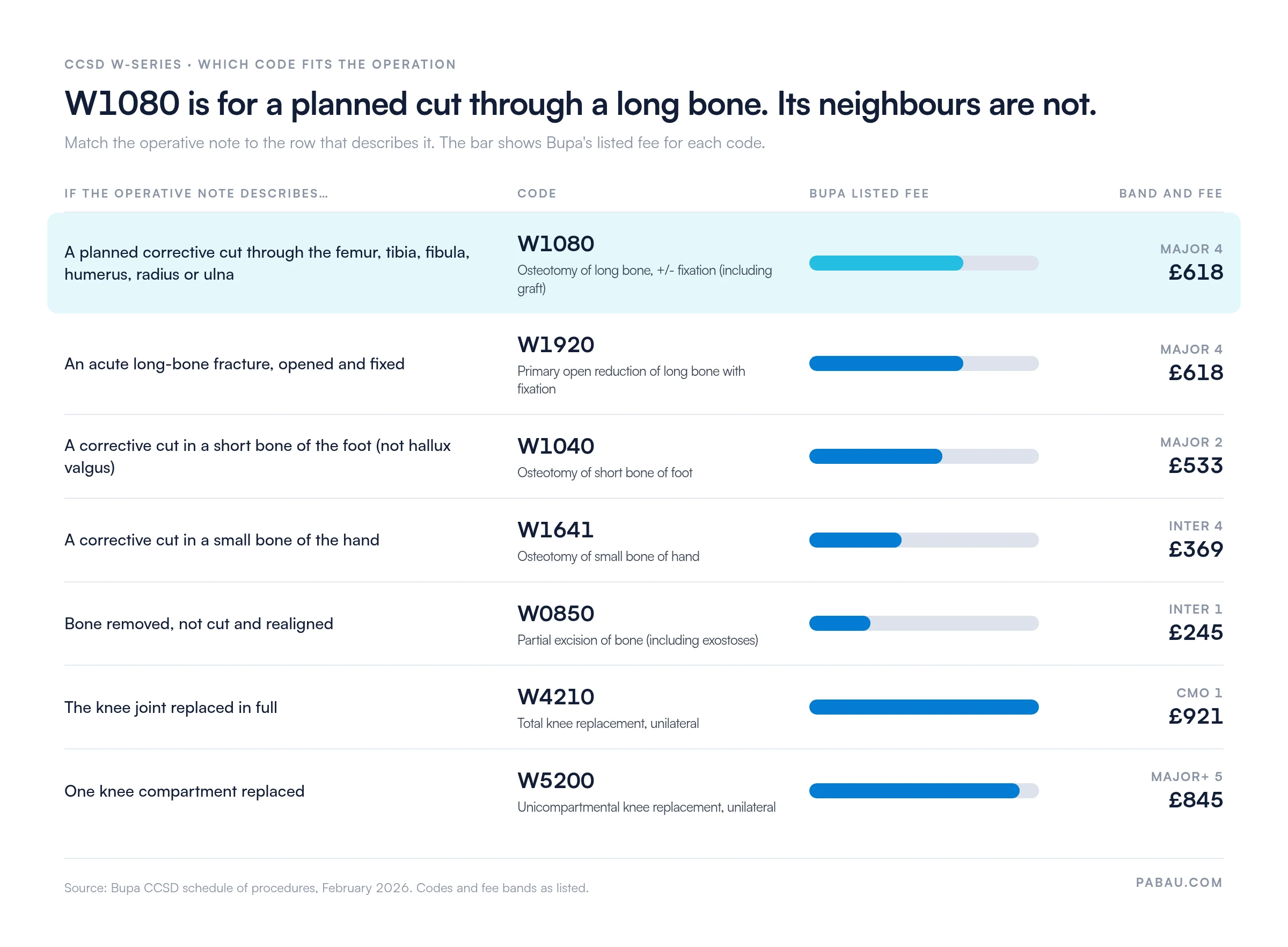
Knee replacement sits further away. W4210 and W5200 replace the joint, while a high tibial osteotomy under W1080 keeps it.
Several codes appear on the same claim episode as W1080. Each is separately billable but subject to individual insurer recognition rules.
An operative note that is complete on the day of surgery saves time when an insurer asks for clinical records. To support a W1080 claim, the note must contain each of the following:
Notes that skip the specific bone, the correction angle or the graft source tend to draw a request for clarification from the insurer. Payment then waits until the practice answers it.
Draft a W1080 operative note template that includes every mandatory field as a structured prompt. When the scrub nurse or surgical coordinator builds the note intraoperatively, the prompts ensure nothing is omitted before the surgeon signs. Review the template against your highest-volume insurer’s current clinical record requirements at the start of each financial year.
Elective orthopaedic surgery, W1080 osteotomy included, needs pre-authorisation from the patient’s private medical insurer before it takes place. A W1080 claim without a valid authorisation reference is usually rejected outright rather than queried. Use the Bupa CCSD codes guide alongside insurer portals for code-level pre-authorisation rules.
Pre-auth policies change annually. Always confirm the current requirements with each insurer’s provider portal rather than relying on prior-year experience. The authorisation reference number must appear on the claim invoice exactly as the insurer issued it.
A denied W1080 claim usually traces back to one of five causes. Checking each before submission saves a resubmission later.
If a W1080 claim is denied after a correct submission, a structured appeal gives the insurer’s medical assessor what they need to reverse it.
In many private orthopaedic practices, the authorisation reference lives in a spreadsheet and the CCSD code is typed into an insurer portal. The operative note sits in a separate folder. Each hand-off is a chance to lose the reference number or pick the wrong neighbouring code.
Pabau’s billing software keeps those steps on the patient record. The practice enters W1080 against the episode and records the authorisation code, dates and sessions on the case. A warning appears when the authorisation is missing, and claims go to UK insurers through Healthcode and Bupa.
When an insurer queries the claim, the billing team opens the operative note from the same record and sends it. Fewer W1080 claims stall waiting for paperwork, so the surgeon gets paid sooner.

Pabau records the CCSD code and pre-authorisation on the patient’s case and submits UK claims through Healthcode and Bupa. See how it handles a W1080 claim from referral to payment.

A W1080 claim rarely fails on the code itself. It fails when the insurer never authorised the surgery, or when the note can’t show what the surgeon did. Get the authorisation reference before theatre. Then write the note on the day, naming the bone, the correction, the fixation and the graft.
The one judgement call is the neighbouring code. If the note describes a fracture, or a bone of the hand or foot, W1080 is the wrong code, however the procedure was titled. Book a demo to see how Pabau keeps the authorisation, the operative note and the CCSD claim on one patient record.

Fixing a fracture of a small bone? CCSD code W1940 covers primary open reduction of a short bone with fixation.
CCSD Code W1080 covers osteotomy of a long bone, with or without internal fixation, including any bone graft at the operative site. It applies to planned corrective bone cuts on the femur, tibia, fibula, humerus, radius or ulna in UK private healthcare.
Yes. When internal fixation and bone graft are performed at the same long-bone site during the osteotomy, both are bundled into W1080. A separate fixation code for the same site is a bundling error and usually gets the claim rejected.
The note must name the long bone, describe the type and level of the osteotomy, and give the correction achieved. It must also state whether fixation was used, name the implant, and record the graft type and harvest site. Finally, it should cite the pre-operative imaging and the clinical diagnosis.
Bupa, AXA Health, Vitality and Aviva typically require pre-authorisation before elective orthopaedic surgery, W1080 included. Requirements vary by insurer and can change each year. Confirm them on the insurer’s provider portal before the procedure.
The usual causes are a missing or mistyped pre-authorisation reference and an operative note that omits the bone or the correction. Others are a wrong neighbouring code, such as W1641 or W1920, or a separate fixation code billed alongside W1080. An implant charge sent without the supplier invoice is another.
Short bones have their own codes: W1641 for a small bone of the hand, and W1040 for a short bone of the foot. W1080 applies only to the six long bones of the limbs. Using W1080 for a metatarsal osteotomy would be a code selection error.