

CPT Code 30801: Superficial turbinate ablation billing guide
CPT Code 30801: Official descriptor and procedure overview The American Medical ...

Last Updated: Nov 27, 2026
W0850 is the CCSD code for partial excision of bone (including exostoses). It covers removing a bony spur, osteophyte or exostosis, such as a heel spur, while the rest of the bone stays in place. Removing a whole bone, clearing dead bone and soft tissue-only surgery take other codes.
Insurer schedules can word the code differently. AXA Health's podiatry procedure list prints W0850 as excluding exostoses, so check the insurer's own list before billing an exostosis removal.
Let Pabau's smart automation suggest the right codes, reduce claim denials, and keep your practice compliant—effortlessly.
Automate repetitive tasks and focus on what matters most—your patients.
Reduce coding errors and ensure compliance with the latest regulations.
Clean claims, fewer denials, and faster reimbursements.
Powerful insights and reporting to help your practice thrive.
HIPAA compliant SOC 2 certified GDPR-compliant Trusted by 4,000+ clinics worldwide

CCSD code W0850 covers partial excision of bone, including exostoses, where a spur or bony growth is removed and the rest of the bone stays.
Neighboring CCSD codes take the cases W0850 does not, such as W0640 for a whole sesamoid bone and W1800 for clearing dead bone.
Insurer schedules can word W0850 differently, and AXA Health’s podiatry list prints it as excluding exostoses.
Claims are most often queried for missing pre-authorization or an operative note that does not name the bone excised.
Practice software such as Pabau keeps the operative note, the CCSD code and the insurer claim in one patient record.
CCSD code W0850 covers partial excision of bone, including exostoses. The surgeon removes a spur, osteophyte or bony growth and leaves the underlying bone in place. The CCSD schedule files it under 16.2.0 Bone (Non-Specific), with the reference Fp.024. CCSD is the Clinical Coding and Schedule Development Group, which keeps the standard procedure codes for UK private healthcare.
W0850 sits in CCSD chapter 16.0.0, Bones, Joints & Connective Tissue/Tendon Muscle. The CCSD codes reference collects the neighboring code pages, and Bupa CCSD codes explains how Bupa’s own lookup tool handles the same codes.
“Partial” is the word that decides the code. Only the abnormal bony growth comes off, and the bone it grew from stays. Complete bone excision, sequestrectomy and joint arthroplasty all remove or rebuild far more, so they take other codes. Ectopic bone cut away from around a total hip replacement has its own code too, W0702.
Insurer schedules can word the code differently. AXA Health’s podiatry procedure list prints W0850 as “Partial excision of bone (excluding exostoses)”, the opposite of the CCSD wording. Check the insurer’s own list before billing an exostosis removal under W0850.
CCSD does not publish a suggested rate of remuneration for W0850. Each insurer sets the fee, so check that insurer’s fee schedule rather than applying a standard figure.
The descriptor “partial excision of bone (including exostoses)” maps to a defined set of clinical scenarios. Billing W0850 for a procedure that goes further is a common route to a rejected claim.
The clinical record must make clear that bone was partially excised. If the operative note describes only soft tissue clearance or bursa removal, insurers have grounds to query or reject the W0850 claim.
W0850 is used across a range of anatomical sites. The table below maps the most common sites to their typical pathology and the specialty most likely to bill the code. Use it to check that the right consultant has billed the right code.
The operative steps vary by site, but the core sequence for a partial bone excision or exostosis removal follows a consistent pattern. Coders and billing teams need it to check that the operative note describes a procedure that qualifies for W0850.
The operative note must describe each of these stages and name the bone the exostosis was excised from. A note that records only “bony prominence removed” without naming the bone will be queried by most insurers.
Documentation is where most W0850 claims succeed or fail. A structured operative note template lowers the risk of leaving out a required element. These fields must appear in the operative note and the claim submission.
Before you submit a W0850 claim, check it against this list. The two fastest fixes are simple. Name the bone in the body of the operative note, not just the procedure title, and put the pre-authorization reference on the invoice.
Most UK private medical insurers require pre-authorization before elective bone excision. The requirements vary by insurer, so always confirm them with the payer. These are the typical requirements across the main insurers.
For teams working across NHS and private practice, pre-authorization status is easier to track next to the operative note than in a separate spreadsheet. Aviva’s invoicing and procedure guidelines give current guidance for that insurer.
For fee amounts and bundling rules by insurer, check the Healix CCSD fee schedule and Bupa’s code search tool before you submit.
W0850 sits in a family of CCSD bone codes, and most coding errors come from picking a broader or narrower code than the procedure warrants. Work through the questions below in order, and the first yes gives the code.
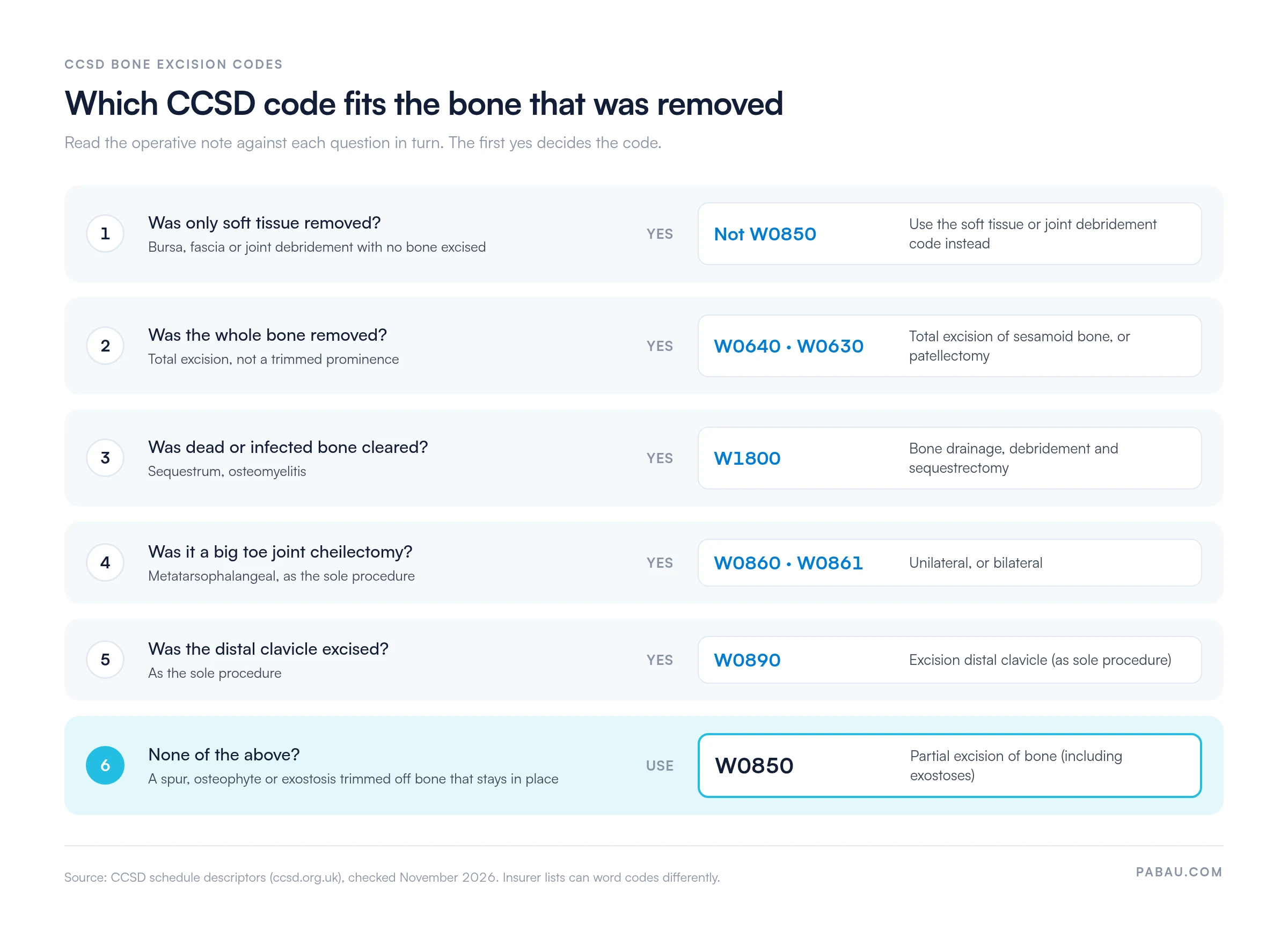
Two neighbors matter most for foot and shoulder work. A big toe cheilectomy done on its own has its own codes, W0860 and W0861, so it shouldn’t go through as W0850. The same goes for a distal clavicle excision billed alone, which is W0890.
At the other end of the scale, clearing infected or dead bone is W1800, and removing the whole kneecap is W0630. Either one on a W0850 claim invites a query, because the operative note will describe more than a trimmed spur. Cutting through a bone to realign it is an osteotomy rather than an excision, so a tibial osteotomy at the knee goes through as W1660.
When a bursa excision and an exostosis removal happen at the same site, the operative note must document both. Depending on the insurer’s bundling rules, the bursa code may or may not be billed alongside W0850, so check with the payer before you submit.
CCSD and OPCS-4, the classification used to code NHS procedures, are parallel systems with no one-to-one mapping. The closest OPCS-4 matches for W0850 sit in category W08, Other excision of bone, in Chapter W (other bones and joints). You can check each one in the OPCS-4.11 tabular list.
Chapter V of OPCS-4 covers the bones and joints of the skull and spine, so its codes are not equivalents for W0850. Use this table as a crosswalk guide only. NHS coders assign OPCS-4 from the NHS record, while private billing uses W0850 from the same operative note. Never put one in place of the other on a claim.
W0850 rejections follow predictable patterns. The table below lists the most common reasons and the fix or resubmission step for each.
Podiatric surgeons bill W0850 often, mainly for heel spur excision and foot exostosis removal. These are the common podiatry uses.
Whether a podiatric surgeon can bill W0850 under a patient’s policy depends on that insurer’s recognition terms for podiatric surgery. Some insurers recognize podiatric surgeons for musculoskeletal procedures only under specific contract terms. Check the surgeon’s recognition status with each insurer before submitting a W0850 claim, and check how that insurer words the code.
In many private orthopedic and podiatry practices, the operative note sits in one system and the insurer invoice in another. Someone at the billing desk reads the note, picks the CCSD code and retypes the bone, side and authorization number. Each retyped field is one more thing an insurer can query.
Pabau, a practice management platform with UK insurer billing, keeps the note, the code and the claim in the same patient record. Surgeons write the operative note from a template the practice builds to ask for the named bone, the side and the extent of excision.
Pabau’s medical billing software then sends the claim to UK insurers through Healthcode, with W0850 on the invoice.
The insurer receives a W0850 claim that matches the note it came from. Your team stops rebuilding surgical detail weeks later, when an insurer asks why the claim says what it says.

Pabau keeps the operative note, the CCSD code and the insurer claim in one patient record. Claims go to UK insurers through Healthcode, so the code on the invoice is the one the surgeon documented.

Treat W0850 as the code that’s left once its neighbors are ruled out. If the whole bone came out or the bone was dead, another CCSD code fits better. The same goes for a sole cheilectomy or distal clavicle excision. What remains is a spur or exostosis trimmed from bone the surgeon kept.
Most queried W0850 claims trace back to the note, not the code. The bone isn’t named, the side is missing, or no pre-authorization number reached the invoice. Fix those three where the surgeon writes the note, and check the insurer’s own wording before you bill an exostosis removal.
To see a W0850 claim carry the named bone and the authorization number straight from the operative note, book a demo with the Pabau team.

Need a full reference for Bupa CCSD codes? Pabau’s Bupa CCSD code guide covers the schedule with Bupa-specific billing guidance.
Billing big toe joint surgery as well? CCSD code W0390 covers resurfacing arthroplasty of the first metatarsophalangeal joint.
Need an example of a total excision code? CCSD code W0283 covers total excision of the trapezium with a spacer.
Want fewer insurer queries across your practice? Pabau’s private practice billing software connects operative notes, CCSD codes and insurer invoices in one workflow.
CCSD code W0850 covers partial excision of bone, including exostoses. The surgeon removes an abnormal bony prominence, such as a heel spur or an osteophyte, and keeps the underlying bone. Complete bone removal and joint replacement take other codes.
Partial bone excision (W0850) removes only the abnormal bony growth and keeps the underlying bone. Complete excision removes a whole bone or bone segment and takes a different CCSD code. Examples are W0640 for a sesamoid bone and W0630 for a patellectomy. The operative note must say which one was done, or insurers will query the claim.
W0850 is part of the CCSD schedule used by UK private medical insurers. They include Bupa, AXA Health, Aviva, Vitality, WPA, Healix, Allianz Care and Cigna UK. Each insurer sets its own fee and pre-authorization rules. Insurer schedules can also word the code differently. AXA Health’s podiatry list prints W0850 as excluding exostoses, so check the insurer’s own list before billing an exostosis removal.
Yes, podiatric surgeons can bill W0850 for exostosis removal, such as calcaneal spur excision or dorsal bunion excision. The insurer must recognize the podiatric surgeon for musculoskeletal procedures under its contract terms. Recognition isn’t universal, so check the surgeon’s status with each insurer before submitting a claim.
The operative note must name the bone excised, record the extent of excision (partial) and state the side. It should also include the anesthetic type and the operative duration. The claim pack needs the pre-authorization reference number too. Missing any of these is a common cause of rejection.
The most common reasons are missing pre-authorization and an operative note that doesn’t name the bone excised. Insurers also reject claims for suspected upcoding to a complete excision code. Others fail because the insurer doesn’t recognize the consultant for musculoskeletal procedures, or because a bundled bursa excision was billed alongside W0850.
The closest OPCS-4 matches sit in category W08, Other excision of bone, in Chapter W, which covers other bones and joints. The nearest general code is W08.5, partial excision of bone NEC, and W08.2 covers excision of overgrowth of bone. CCSD and OPCS-4 are independent systems with no one-to-one mapping. Use the crosswalk as a guide only, and never put an OPCS-4 code on a private insurer claim in place of W0850.




