CCSD code XR940: Radiology billing guide for UK private practice
CCSD code XR940 is a UK private healthcare radiology procedure code used to bill...

Last Updated: Nov 26, 2026
W0283 is the CCSD code for total excision of trapezium with spacer. It covers removal of the whole trapezium at the base of the thumb, with a spacer placed where the bone was. The spacer is usually a rolled tendon or a synthetic implant.
It sits in the Hand incision and excision section of the CCSD bones and joints chapter. Excision without a spacer is W0282, and excision with ligament reconstruction is W0284.
Let Pabau's smart automation suggest the right codes, reduce claim denials, and keep your practice compliant—effortlessly.
Automate repetitive tasks and focus on what matters most—your patients.
Reduce coding errors and ensure compliance with the latest regulations.
Clean claims, fewer denials, and faster reimbursements.
Powerful insights and reporting to help your practice thrive.
HIPAA compliant SOC 2 certified GDPR-compliant Trusted by 4,000+ clinics worldwide

W0283 covers total (not partial) excision of the trapezium combined with spacer insertion, whether a tendon-roll spacer or a synthetic implant.
Excision without a spacer is W0282, and excision with ligament reconstruction, including LRTI, is W0284.
Pre-authorisation is required by all major UK private medical insurers before elective trapeziectomy under W0283.
The operative note must confirm total excision, spacer type and material, implant lot number, laterality, and primary diagnosis to support a valid claim.
Pabau’s claims management software sends UK insurer claims through Healthcode and tracks each pre-authorisation code on the patient’s case.
CCSD Code W0283 is the UK private healthcare code for total excision of the trapezium with a spacer placed where the bone was. AXA Health’s procedure schedule lists W0283 under the descriptor “Total excision of trapezium with spacer” in its bones and joints chapter.
The code set is maintained by the Clinical Coding and Schedule Development (CCSD) Group. UK private insurers use it to identify procedures on a bill.
Three elements of the descriptor matter for billing accuracy.
CCSD codes are used only in UK private healthcare billing and reach insurers through platforms such as Healthcode. They do not map directly to NHS OPCS-4 codes, so coders in practices that treat both NHS and private patients keep separate coding workflows.
Total excision of the trapezium removes the entire bone at the base of the thumb, eliminating the arthritic joint surface. The surgeon then fills the resulting void with a spacer to maintain thumb length, preserve pinch strength, and prevent metacarpal proximal migration.
The procedure follows a consistent sequence.
The operative note must clearly record each of these steps. Any ambiguity about whether excision was total or whether a spacer was placed gives insurers grounds to query the code or downgrade the claim.
W0283 is appropriate when a confirmed clinical indication for trapeziectomy with spacer exists and conservative treatment has failed. Payers expect evidence of both conditions before approving pre-authorisation.
Coders should confirm the documented indication matches one of these categories before submitting W0283. An operative note that records only “thumb pain” without radiographic grading or conservative treatment history increases denial risk.
The trapezium and trapezoid are adjacent carpal bones that are frequently confused in coding. W0283 covers only the trapezium. Submitting W0283 for a procedure performed on the trapezoid is a miscoding error that creates clinical documentation inconsistency and may trigger an insurer audit.
Several CCSD W-series codes cover related thumb base procedures, and picking the wrong one is a frequent billing error for this procedure family. The table below summarises the key distinctions. For Bupa CCSD procedure codes specifically, Bupa’s own code search portal provides the current descriptor and fee benchmark for each.
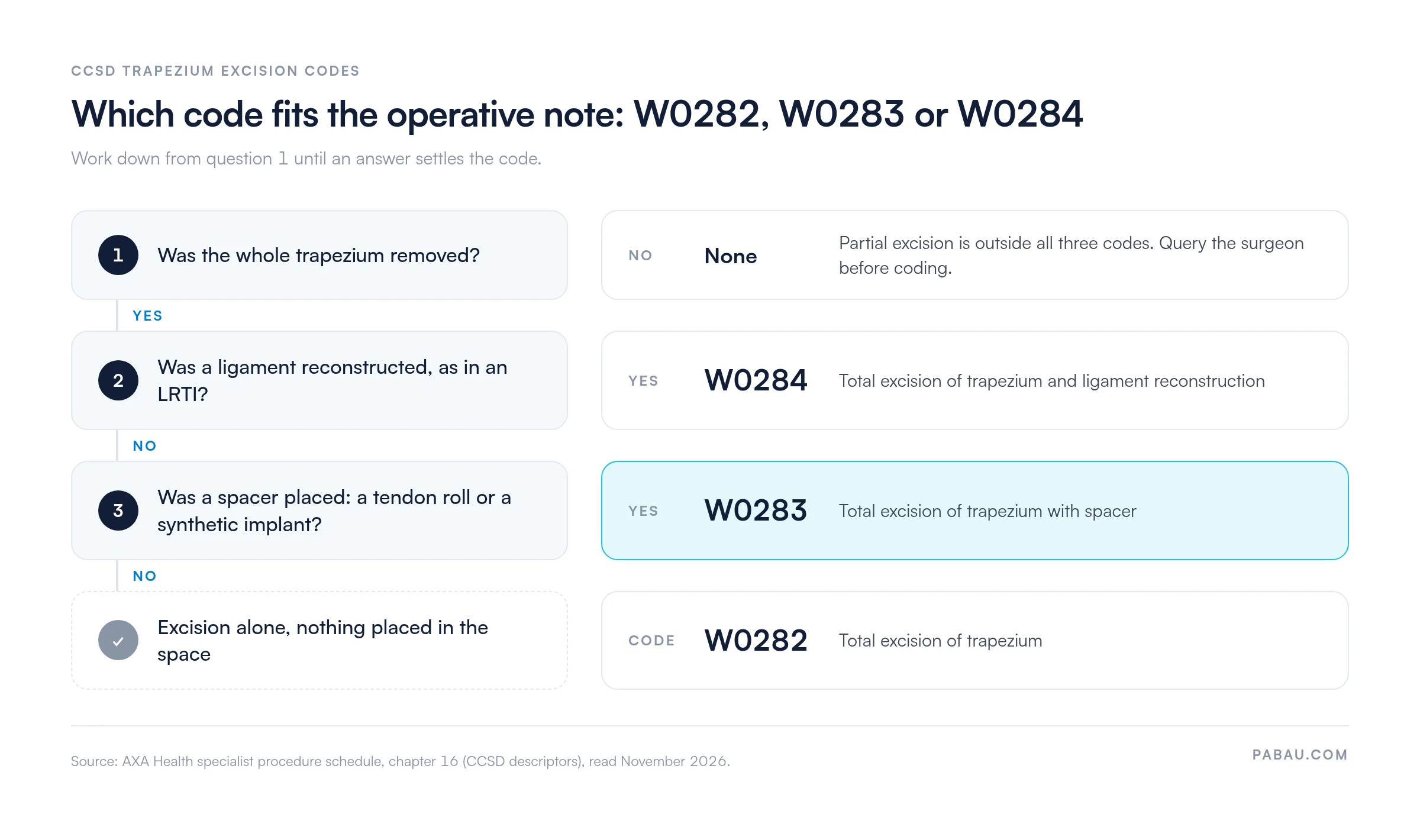
Practical rule: If the operative note records total excision with nothing placed in the space, the correct code is W0282. If the surgeon also reconstructed a ligament, as in an LRTI, the claim belongs under W0284. A note that records only partial excision fits none of the three, so query the operating surgeon before submitting.
The three excision codes split on two questions about the operative note. The chart below sets them out in the order a coder should ask them.
The “with spacer” component of W0283 encompasses two distinct surgical approaches, and the billing implications differ between them.
Whether a synthetic implant cost is separately recoverable varies by insurer and policy year. Some insurers bundle implant costs into the surgical fee; others permit a separately coded prosthesis line on the claim.
Always verify the specific insurer’s current schedule before billing an implant passthrough. The operative note must record the spacer type, product name, and implant lot number regardless of whether a separate line is submitted.
Before billing a synthetic spacer as a separate passthrough item, get written confirmation that the insurer covers that product outside the W0283 surgical fee. The insurer’s current online fee schedule can also settle it. Assumptions about bundling are a leading cause of overpayment recovery requests on hand surgery claims.
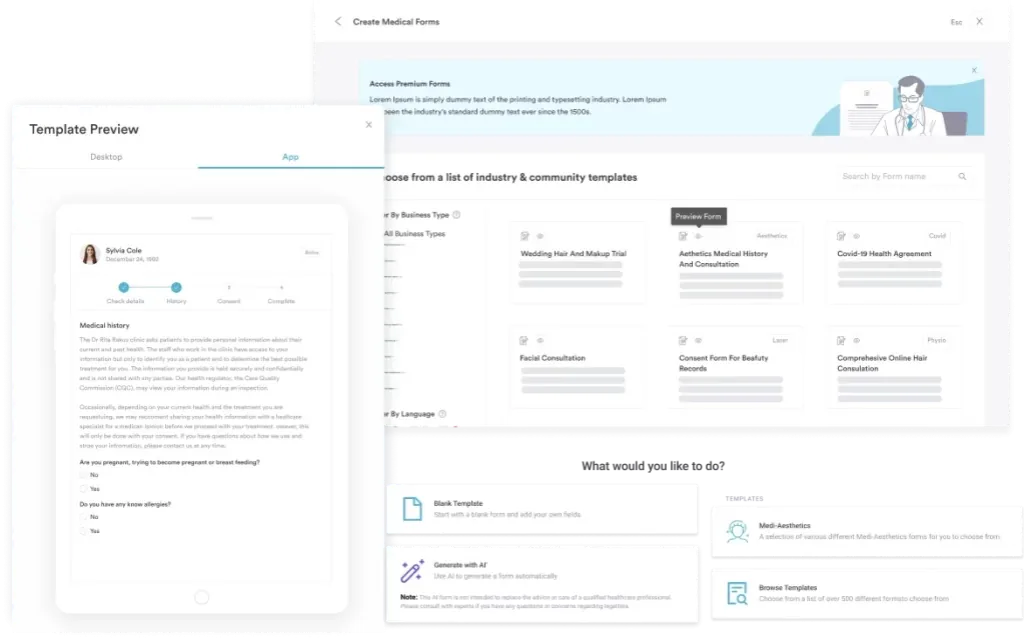
A valid W0283 claim stands on the operative note. Insurers reviewing hand surgery claims look for specific elements, and an incomplete note is the fastest route to a query or denial. Digital clinical forms that capture structured surgical documentation at the time of dictation reduce the risk of missing these elements.
The operative note must include each of the following.
Pre-authorisation is required by all major UK private medical insurers for elective trapeziectomy under W0283. This is not optional and should be obtained before the patient is listed for surgery. Surgeons new to private practice often underestimate how structured insurer pre-auth pathways are for elective joint procedures.
Pre-auth reference numbers expire. The authorisation window is typically 3–6 months, depending on the insurer. If surgery slips beyond it, a fresh authorisation must be obtained before the patient attends. Submitting a claim against an expired authorisation is a preventable denial.
W0283 claims fail more often than simpler outpatient codes. Several documentation elements must all match what the insurer holds on file. The most common denial reasons, and how to avoid each, are listed below.
W0283 covers the surgeon’s procedure fee only. A complete private healthcare claim for trapeziectomy with spacer typically includes additional codes on separate claim lines.
Using claims management software that supports multi-line CCSD submissions reduces the risk of omitting these companion codes. Additional fee information by insurer is available via the Healix fee schedule, which publishes CCSD-based fee benchmarks for surgical procedures.
W0283 is predominantly performed as a day case. Admission sometimes extends to an inpatient stay, for example because of comorbidity or post-operative pain management needs. The facility must then update the claim to the correct admission type, because it affects the insurer’s benefit calculation.
Run a pre-submission checklist before sending any W0283 claim. Confirm the CCSD code, laterality, pre-auth reference number and the spacer type in the operative note. Then check the companion codes for the anaesthetic, any implant passthrough and concurrent procedures. A five-minute pre-submission review catches the majority of denials before they happen.
A W0283 claim depends on details held in three places: the operative note, the pre-authorisation and the claim form. When each sits in a different system, the billing team checks laterality, spacer type and authorisation references by hand before every submission.
Pabau, a practice management platform with built-in insurance billing, keeps those details on one patient record. The pre-authorisation code, its dates and approved sessions sit on the patient’s case, and Pabau warns the team when one is missing. Claims to UK insurers then go out through Healthcode and Bupa from that same record.
Digital forms capture laterality, Eaton-Littler grade and conservative treatment history at consultation, ready for the pre-auth letter. Stock records log a synthetic spacer’s batch number against the patient and the appointment. The lot number is then on file when an insurer asks.

Pabau keeps operative documentation, pre-authorisation codes and Healthcode claim submission on one patient record. Your billing team spends less time cross-checking each W0283 claim.

W0283 is one of three trapezium excision codes, and the operative note decides which one applies. Code it only when the note confirms total excision and names a tendon-roll or synthetic spacer. A reconstructed ligament moves the claim to W0284, and an empty space moves it to W0282.
Most of the denial reasons above can be caught before the claim leaves. Check the authorisation window against the theatre date, and record the implant lot number while the patient is still in theatre. Book a demo to see how Pabau keeps pre-authorisation codes, operative notes and Healthcode claims on one patient record.

Coding the diagnosis behind a trapeziectomy? ICD-10 code M18.9 covers osteoarthritis of the first carpometacarpal joint, the main indication for W0283.
Need evidence of functional limitation for pre-authorisation? Our hand profile template lets patients score how their wrist or hand affects daily life before surgery.
Billing another hand procedure for the same patient? CCSD code A6530 covers endoscopic carpal tunnel release, with its own pre-authorisation and claim rules.
Want W0283 claims to reach insurers faster? Pabau’s Healthcode integration sends private healthcare claims from the patient record to UK insurers.
CCSD Code W0283 covers total excision of the trapezium, the carpal bone at the base of the thumb. The surgeon then inserts a spacer, either a tendon roll or a synthetic implant. It is used in UK private healthcare billing for procedures performed primarily for end-stage basal thumb osteoarthritis.
W0282 covers total excision of the trapezium without a spacer. W0283 requires both total excision and spacer placement. If the operative note does not confirm a spacer was inserted, W0282 is the correct code, not W0283.
Yes. All major UK private medical insurers, including Bupa, AXA Health, Vitality, and Aviva, typically require pre-authorisation before elective trapeziectomy under W0283. Surgery performed without a valid pre-auth reference is almost always denied.
Only for synthetic spacer implants, and only where the specific insurer’s current schedule permits a prosthesis passthrough. Biological tendon-roll spacers are bundled into the W0283 surgical fee and cannot be separately billed. Verify the insurer’s current implant policy before submitting a passthrough line.
No. Ligament reconstruction tendon interposition (LRTI) is coded W0284, total excision of trapezium and ligament reconstruction. W0283 covers excision with a plain spacer and no ligament reconstruction.
The surgeon submits W0283 for the procedural fee. The anaesthetist submits separately under the applicable CCSD anaesthetic code. Theatre and facility fees are submitted by the hospital or day surgery unit. Each claim line is submitted independently through Healthcode. Confirm with each insurer whether an assistant surgeon fee is reimbursable for this specific procedure.