

CPT Code 30801: Superficial turbinate ablation billing guide
CPT Code 30801: Official descriptor and procedure overview The American Medical ...

Last Updated: Nov 27, 2026
W0390 is the CCSD code for interarticular resurfacing arthroplasty with implant of the metatarsophalangeal joint. It sits in the hallux sub-chapter, so it covers the first MTP joint at the base of the big toe.
The surgeon resurfaces the worn joint with an implant, such as a synthetic cartilage or PVA hydrogel device, and the joint keeps moving. Fusion and Keller-type excision arthroplasty have their own codes, and CCSD lists W0380 bilateral fusion as an unacceptable combination.
Let Pabau's smart automation suggest the right codes, reduce claim denials, and keep your practice compliant—effortlessly.
Automate repetitive tasks and focus on what matters most—your patients.
Reduce coding errors and ensure compliance with the latest regulations.
Clean claims, fewer denials, and faster reimbursements.
Powerful insights and reporting to help your practice thrive.
HIPAA compliant SOC 2 certified GDPR-compliant Trusted by 4,000+ clinics worldwide

CCSD Code W0390 covers interarticular resurfacing arthroplasty with implant of the first metatarsophalangeal joint, an operation that keeps the big toe joint moving.
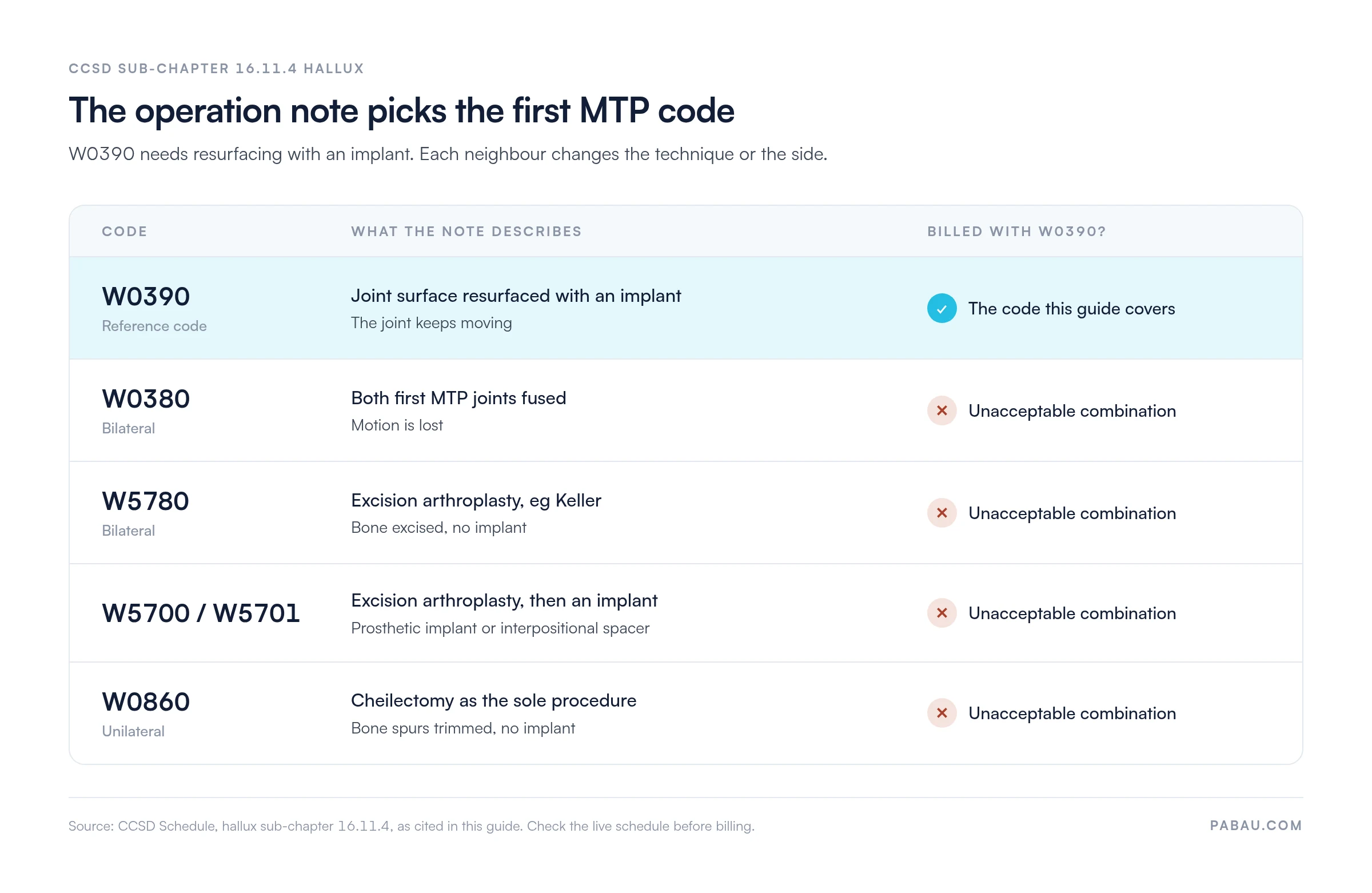
W0380 is bilateral fusion of the first MTP joint, not excision arthroplasty, and CCSD lists it as an unacceptable combination with W0390.
Keller-type excision arthroplasty sits in the W57xx family, including W5780 for both sides and W5700 or W5701 when an implant or spacer is used.
The descriptor names no device brand, so record the implant type, size and lot number in the operation note.
Hallux rigidus, WHO ICD-10 M20.2, is the usual supporting diagnosis, with failed conservative care documented before pre-authorisation.
CCSD Code W0390 is the UK private billing code for interarticular resurfacing arthroplasty with implant of the metatarsophalangeal joint. The code belongs to the CCSD Schedule, which holds the standard procedure codes for the UK private healthcare sector. W0390 sits in sub-chapter 16.11.4 Hallux, so the joint is the first MTP joint at the base of the big toe.
CCSD stands for Clinical Coding and Schedule Development. Bupa, AXA Health, Aviva, Vitality and WPA all key their fees to its codes. The schedule maps closely to OPCS-4, so coders who work across NHS and private settings will find the structure familiar.
The descriptor sets out three facts the claim has to prove. The joint is the first MTP joint, the technique is resurfacing rather than excision or fusion, and an implant is placed. Each neighbouring code in the hallux sub-chapter changes at least one of those facts.
The CCSD schedule is updated periodically, and its code search sits behind a login. Check the current descriptor and its unacceptable combinations before you bill. Guides to other codes sit in our UK private billing reference.
Under W0390, the surgeon resurfaces the damaged joint surface with an implant instead of removing the joint or fusing it. The operation usually runs in five stages.
For coding, the deciding point is that the joint surface is resurfaced with an implant and the joint keeps moving. A note that describes fusing the joint points to a fusion code, and W0380 is bilateral fusion. A note that describes excising bone without an implant points to Keller-type excision arthroplasty in the W57xx family. The table below sets each neighbouring code against what the note describes.
W0390 is mainly used for hallux rigidus. This progressive arthritis of the first MTP joint makes upward bending of the big toe stiff and painful. Resurfacing is usually offered after conservative care has failed, for a patient who wants to keep movement in the joint.
UK claims use WHO ICD-10 codes rather than the US ICD-10-CM set. These diagnoses commonly sit beside W0390.
Use the diagnosis the surgeon documented, and keep it the same on the referral, the pre-authorisation request and the claim. Insurers usually expect evidence of failed conservative care, weight-bearing X-rays showing joint damage, and a consultant letter setting out the indication.
The W0390 descriptor says only that an implant is used. It names no device brand or manufacturer, so the code is not tied to one product.
In practice, the implant is often a synthetic cartilage implant made of polyvinyl alcohol (PVA) hydrogel. It replaces the damaged surface of the metatarsal head and leaves the phalanx surface in place. Other resurfacing devices exist, and insurers can take different views on which ones they fund.
Weak operative documentation is the most controllable cause of W0390 denials. The operation note has to support each element of the descriptor: the joint, the resurfacing technique, and the implant.
Build the operation note template with the implant name, lot number and technique as required fields. The surgeon then fills in each one at the time, instead of relying on free-text recall.
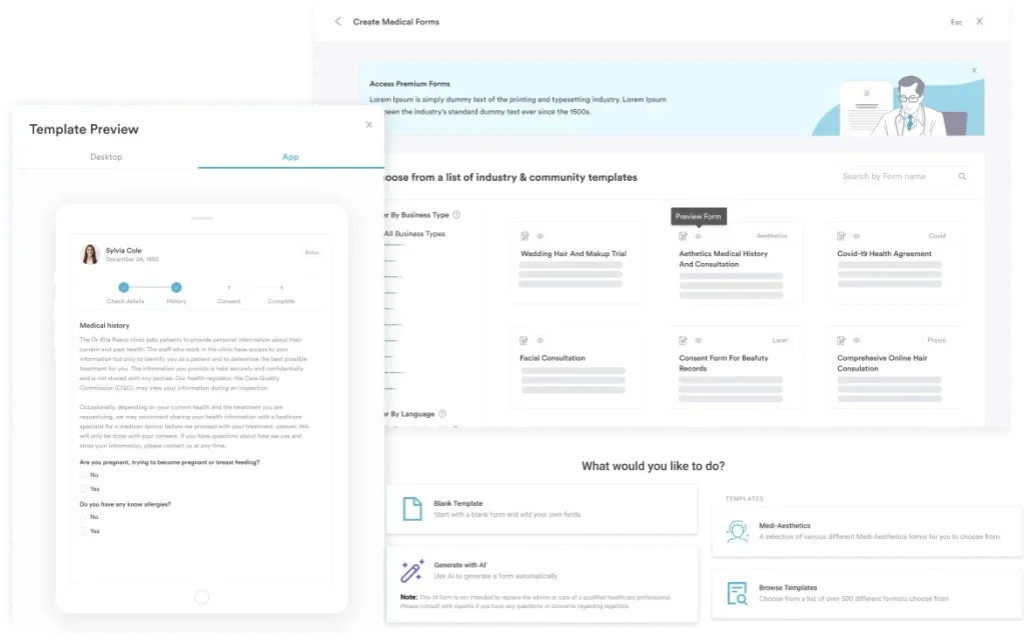
Keep this set of records with every W0390 claim.
Every major UK private insurer expects pre-authorisation before elective first MTP joint surgery. The authorisation has to name CCSD Code W0390, not a broad category or the consultant’s specialty.
See Pabau’s Bupa CCSD billing guide for Bupa-specific guidance. The table summarises typical requirements, but policy terms vary, so check with each insurer at the time of booking.
The pre-authorisation letter must carry the same CCSD code as the invoice. If the plan changes from resurfacing to fusion or excision arthroplasty, contact the insurer before the procedure date.
A clean W0390 claim links the procedure code, the diagnosis, the authorisation reference and the implant record. Follow these steps in order.
The surgeon’s W0390 fee covers the resurfacing operation itself. Knowing what sits inside that fee prevents both underbilling and improper unbundling, which risks audit and clawback.
Included in W0390 (do not bill separately):
Billed separately by others:
Check the unacceptable combinations before adding a second hallux code. CCSD lists W0380, the cheilectomy code W0860, and the excision arthroplasty codes W5700, W5701 and W5780 against W0390. The W0390 descriptor does not specify a side, so ask the insurer how it wants a bilateral case billed.
Most W0390 denials come from the paperwork around the claim, such as a missing authorisation or an implant the note never names. The choice of code is rarely the cause.
W0390 sits among the hallux codes in sub-chapter 16.11.4. The table lists only neighbours confirmed in the CCSD schedule, and each one changes the technique, the side or both.
Fusion is the clearest alternative, because it trades movement for a stable, pain-free joint. Unilateral fusion and unilateral Keller-type excision arthroplasty without an implant have their own codes in the same sub-chapter. Confirm those numbers in the current schedule before you bill either one. Larger joints are split just as finely, so a second or later revision total hip replacement takes CCSD W3740, not a first-revision code.
Before you submit a W0390 claim, check the code against the pre-authorisation letter, the operation note and the insurer fee schedule. A mismatch on any one of the three is enough to trigger a query, even when the surgery was correctly performed.
In many foot and ankle practices, the authorisation lives in an email and the operation note sits in another system. The claim is then keyed in by hand, and each handoff is a chance to lose the reference number.
Pabau keeps those steps on the patient record, with insurance billing built in. Its claims management software sends claims electronically through Healthcode and to Bupa. The authorisation code, dates and sessions sit on the patient’s case, with a warning when one is missing.
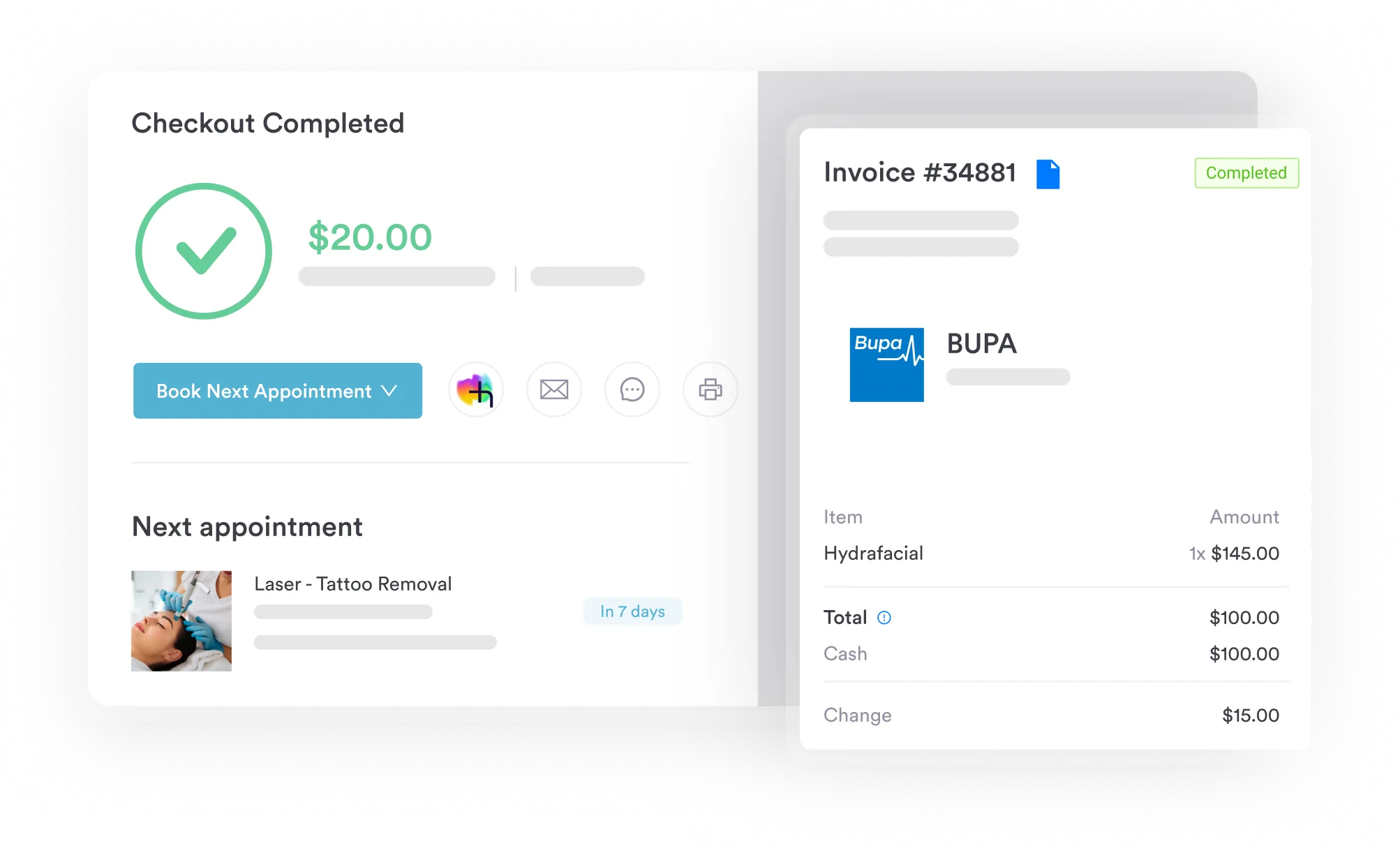
The result is fewer claims bounced for a missing reference, and a clear view of what each insurer still owes.

Pabau tracks authorisation codes on the patient’s case and sends claims electronically through Healthcode and to Bupa. You see each claim’s status without phoning the insurer.

W0390 is a precise code: resurfacing, with an implant, on the first MTP joint. Fusion and excision arthroplasty sit on different codes, and CCSD lists several of them against W0390, so the operation note decides the claim.
Get the implant details, the conservative care record and the matching authorisation in place before surgery, and the claim has little left to query. To see how Pabau handles W0390 and similar foot surgery codes, book a demo.

Coding a cheilectomy on its own? W0860 covers metatarsophalangeal cheilectomy as the sole procedure, one of the codes CCSD lists against W0390.
Need a broader CCSD billing reference for Bupa procedures? Bupa CCSD codes guide covers the Bupa procedure code schedule and submission requirements.
Billing other UK private procedures? CCSD codes reference collects our billing guides for individual CCSD codes.
CCSD Code W0390 describes interarticular resurfacing arthroplasty with implant of the metatarsophalangeal joint, listed in the hallux sub-chapter. The worn surface of the first MTP joint is resurfaced with an implant, often a synthetic cartilage device, and the joint keeps moving. Fusion and excision arthroplasty have their own codes.
Yes. Bupa, AXA Health, Aviva, Vitality and WPA expect pre-authorisation before elective first MTP joint surgery. The authorisation must name CCSD Code W0390, because approval for a different code will not cover the claim. Apply before the procedure date and put the authorisation reference on the invoice.
No. The W0390 descriptor says only that an implant is used and names no brand or manufacturer. Synthetic cartilage or PVA hydrogel implants are common, but insurers can take different views on which devices they fund. Name the device in the pre-authorisation request and keep the insurer’s written answer with the claim file.
The usual trigger is an authorisation for a different code. Others are an operation note that does not record the resurfacing step and the implant, or a code CCSD lists against W0390, such as W0380. A missing conservative care record also leads to queries. Fixing these before submission prevents most avoidable rejections.
W0380 is fusion of the first metatarsophalangeal joint on both sides, so the joints no longer move. W0390 resurfaces the joint with an implant and keeps it moving. CCSD lists the two as an unacceptable combination. Keller-type excision arthroplasty is a third option, coded in the W57xx family, such as W5780 for both sides.




