

CPT Code 30801: Superficial turbinate ablation billing guide
CPT Code 30801: Official descriptor and procedure overview The American Medical ...

Last Updated: Nov 27, 2026
W1660 is the CCSD code for tibial osteotomy, an operation that cuts and realigns the tibia to correct angular deformity at the knee. UK private insurers accept it for high and distal osteotomies, whether the surgeon uses a medial opening wedge or a lateral closing wedge.
The code covers the surgical work only. Fixation implants and bone graft usually go on separate claim lines, and every major insurer expects pre-authorization before surgery.
Let Pabau's smart automation suggest the right codes, reduce claim denials, and keep your practice compliant—effortlessly.
Automate repetitive tasks and focus on what matters most—your patients.
Reduce coding errors and ensure compliance with the latest regulations.
Clean claims, fewer denials, and faster reimbursements.
Powerful insights and reporting to help your practice thrive.
HIPAA compliant SOC 2 certified GDPR-compliant Trusted by 4,000+ clinics worldwide

CCSD code W1660 covers tibial osteotomy with either a medial opening wedge or a lateral closing wedge, and the technique never changes the code.
Fixation implants and bone graft are usually claimed on separate lines, so check each insurer’s current schedule for its bundling rules.
Bupa, AXA Health, Aviva, Vitality Health and WPA all expect pre-authorization before an elective tibial osteotomy.
The operative note must record laterality, technique, axis correction, the fixation construct and any graft source, because a missing element is a common denial trigger.
Pabau, a practice management platform, tracks authorization codes on each case and sends UK claims through Healthcode and Bupa.
CCSD code W1660 is the procedure code for tibial osteotomy in UK private healthcare. It belongs to the CCSD Schedule, which a group of major private insurers publishes as the coding standard for independent providers. The code applies to any operation in which the tibia is cut and repositioned to correct angular deformity and shift load across the knee.
The official descriptor is simply “Tibial osteotomy.” In the CCSD codes reference, W1660 sits in sub-chapter 16.10.1, Incision / Excision, within the bones, joints and connective tissue chapter.
The code covers the principal surgical work, meaning the osteotomy cut, correction of the mechanical axis, and wound closure. It applies to high tibial osteotomy (HTO), which corrects deformity near the knee, and to distal tibial osteotomy further down the shaft.
Most private orthopedic claims in the UK follow one pattern. The patient has medial compartment osteoarthritis (OA) with varus deformity, and the surgeon performs an HTO.
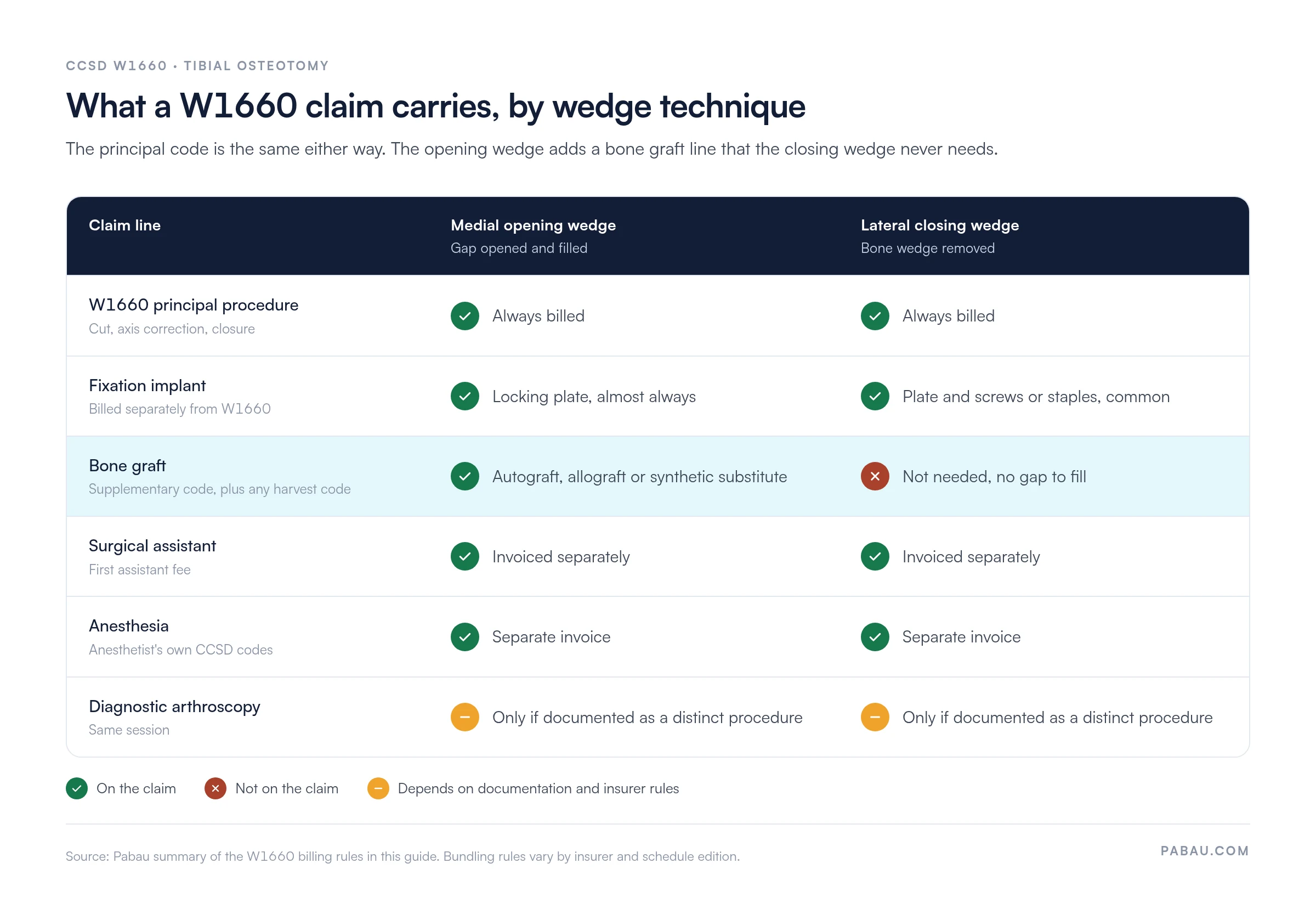
W1660 applies to both the medial opening wedge technique and the lateral closing wedge technique. Choosing one over the other doesn’t change the CCSD code. What changes is the set of supplementary items each approach brings to the claim.
UK private insurers recognize tibial osteotomy as medically necessary when conservative treatment has been exhausted and the patient meets specific clinical criteria. Submitting W1660 without documenting these criteria is a reliable path to denial.
The accepted indications are consistent across Bupa, AXA Health, Aviva, and Vitality Health, though each insurer’s clinical policy words them slightly differently. The core criteria are:
Varus deformity (genu varum, bow-legged) is the most common indication for medial opening wedge HTO. Valgus deformity (genu valgum, knock-knee) is less frequent and is usually managed with a distal femoral osteotomy rather than a tibial procedure.
Patients who fall outside these criteria, such as those with arthritis in more than one compartment, are usually assessed for knee replacement instead. A primary total knee replacement is billed under W4210, not W1660.
Pairing W1660 with an appropriate ICD-10 diagnosis code is essential for demonstrating medical necessity to UK private insurers. The table below lists the principal codes used to support tibial osteotomy claims.
M17.1 is the primary supporting diagnosis for most W1660 claims. When OA in both knees follows a documented injury, M17.2 takes the place of M17.0. Where the deformity drives the case more than established OA, add M21.16 or M21.06 as a secondary code.
Always record the ICD-10 code and its clinical description on the invoice and in the operative letter. Some insurer adjudicators check the code description against the operative note. A diagnosis code that doesn’t match the documented findings is a common and avoidable denial trigger.
W1660 covers the principal surgical work of the tibial osteotomy. Several supplementary codes are commonly billed alongside it, and a small number of adjacent codes are sometimes confused with it.
Osteotomies of other bones carry their own codes, such as CCSD W1648 for an isolated greater trochanter osteotomy or transfer. Drilling into the tibial plateau to treat early osteonecrosis is a core decompression rather than an osteotomy, billed under CCSD code W3090. Shaving a bony spur off the tibia, without cutting and realigning it, is partial excision of bone under CCSD W0850.
The most common billing error on W1660 claims is leaving out the fixation hardware code. Insurers don’t assume a plate was used. The implant has to be coded on the invoice and named in the operative note.
Medical billing software that captures CCSD supplementary codes alongside W1660 keeps the fixation line on the invoice. The matrix below shows which lines each wedge technique adds to the claim.
A complete operative note is the single most important document for a successful W1660 claim. Missing elements are the second most common denial cause after absent pre-authorization. A structured digital note template can require each element before the case is closed.
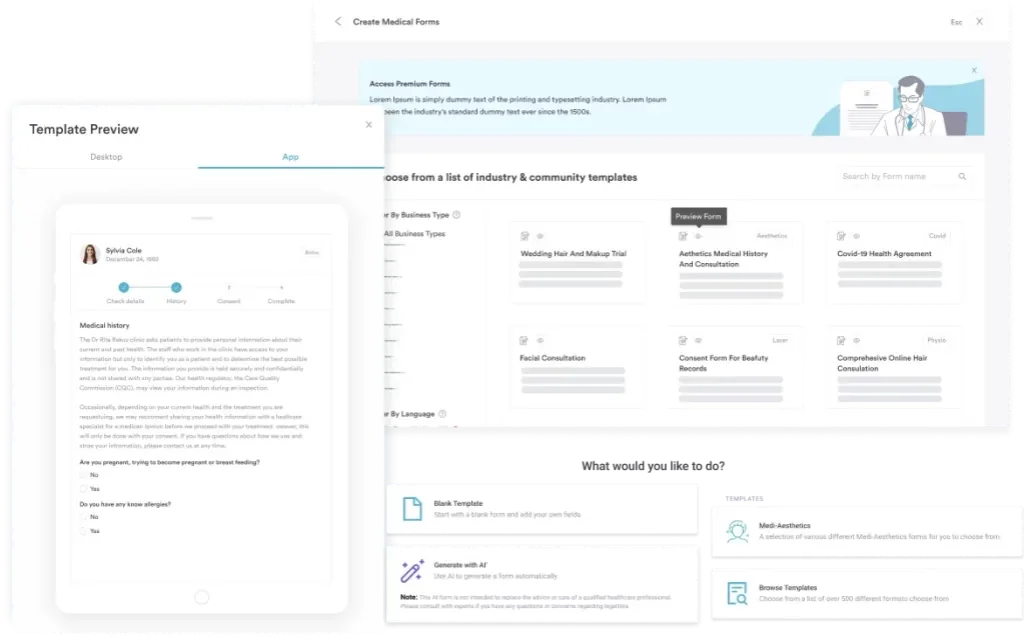
The operative note for a tibial osteotomy claim must contain all of the following:
Insurers increasingly request operative notes rather than accepting letters of operation alone. Build a standard operative note template for tibial osteotomy and keep it in your clinical records system. It cuts incomplete submissions and speeds up claim review.
All major UK private insurers require pre-authorization before elective tibial osteotomy under CCSD code W1660. Operating without it is the single most common cause of non-payment, and retrospective authorization is rarely granted for elective procedures. Bupa’s CCSD procedure codes explain how Bupa recognizes and processes orthopedic procedure claims.
Get approval before you book the operating room. Each insurer’s authorization carries a reference number that must appear on the invoice. Confirm that it names W1660 and every supplementary code you intend to bill. An authorization for the principal code alone doesn’t extend to separately claimed fixation hardware.
Tibial osteotomy claims attract a higher-than-average denial rate in UK private practice. Most denials are preventable. The root causes fall into five categories:
When a claim is denied, ask for the specific reason in writing. A vague “medical necessity not established” response usually means a document was missing, not that the insurer disputes the clinical case. Resubmitting with the operative note or a clarified ICD-10 code resolves most of these.
Run a quarterly audit of your W1660 claims. Compare authorization reference numbers against the invoices submitted, and check that every invoice carries W1660 plus any fixation or graft codes. On a regular osteotomy list, a pattern of missed supplementary codes adds up to significant lost revenue.
Surgeons working across NHS and private practice translate between two procedure coding systems. UK private insurers use CCSD, while OPCS-4 is the NHS procedure coding standard. The two systems share no codes, but the procedures they describe overlap.
Surgeons moving between NHS and private lists meet this translation whenever they set up billing or cross-reference activity data. The NHS Classifications Browser holds the current OPCS-4 codes and descriptors.
OPCS-4 has no dedicated tibial osteotomy code. It records the type of bone division performed, then adds a Z77 site code to identify the tibia. So the NHS record for one operation carries two codes, while the private invoice carries W1660 alone.
Look up the exact OPCS-4 pairing in the browser rather than relying on a fixed crosswalk. The difference matters when you prepare Private Healthcare Information Network (PHIN) submissions or compare audit data across NHS and private episodes.
In most private orthopedic practices, a W1660 claim passes through three pairs of hands. A secretary chases the authorization, the surgeon dictates the operative note, and the billing team builds the invoice days later. Each handoff is a chance for the fixation line, the graft code or the authorization number to drop out.
In Pabau, the authorization code, dates and sessions sit on the patient’s case, and a warning appears when one is missing. Structured forms capture laterality, technique, fixation and graft source at the point of care.
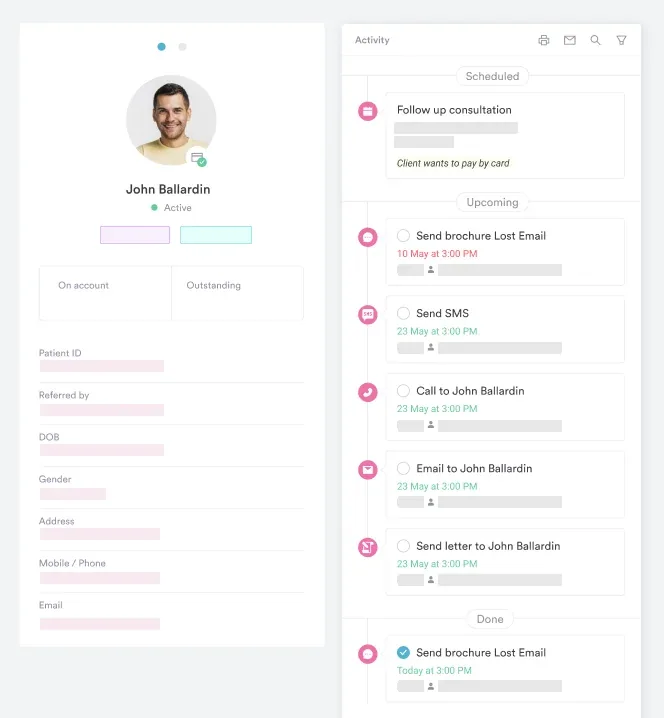
The claim then goes to the insurer through Healthcode or Bupa with those details attached. Your team spends less time answering insurer queries, and fewer W1660 invoices come back for a missing supplementary code.
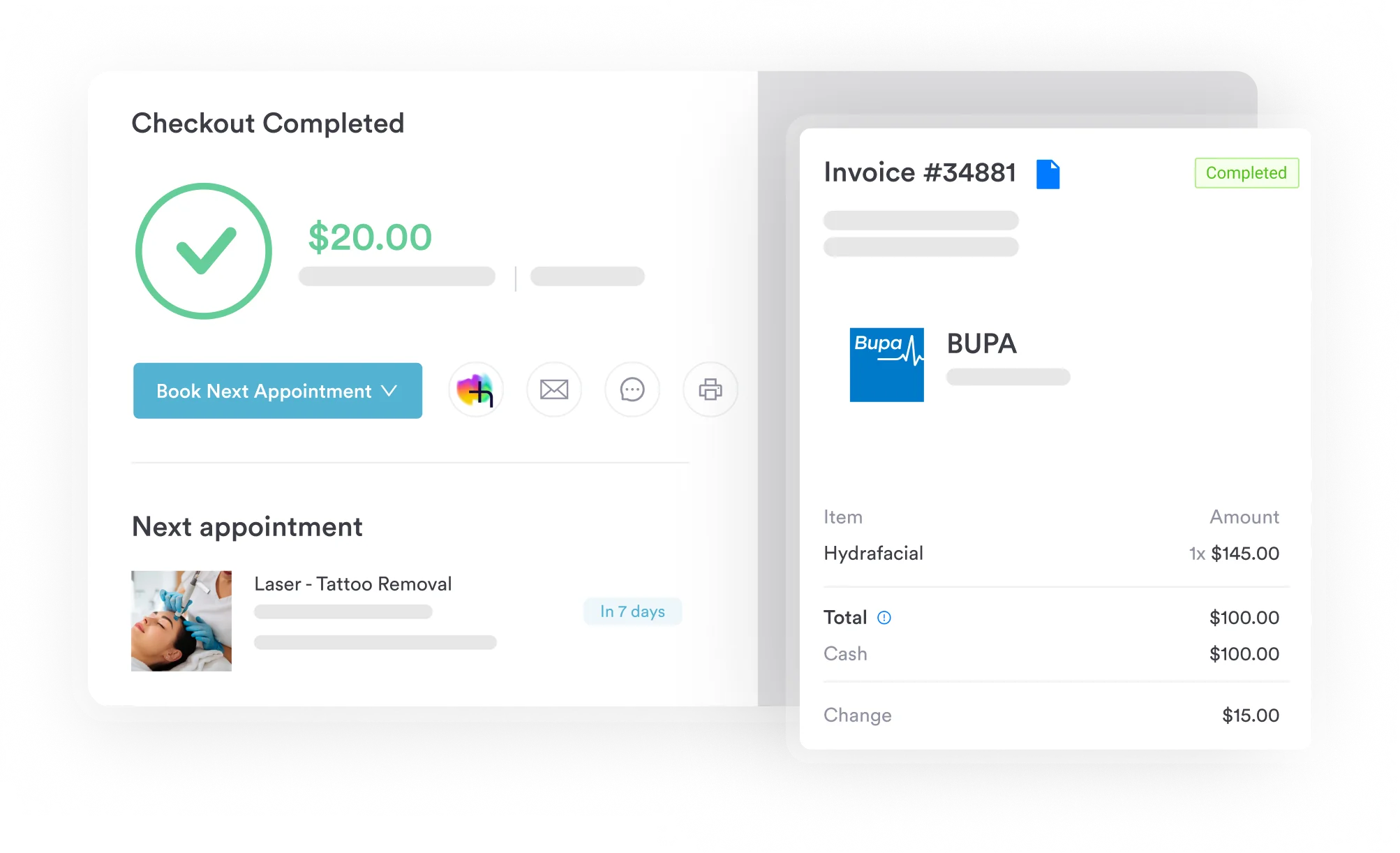

Pabau tracks authorization codes on each case, captures operative details in structured forms, and sends UK claims through Healthcode. The fixation and graft lines reach the insurer alongside W1660.

W1660 itself rarely causes a tibial osteotomy claim to fail. Claims fail on the lines around it, such as an authorization that names only the principal code or a plate that never reached the invoice.
So treat the claim as a package from the day the surgery is listed. Get the authorization to name every code you plan to bill, and make the operative note carry each detail the insurer will check. The extra structure before surgery costs far less than a resubmission after it.
Book a demo to see how Pabau keeps authorizations, operative notes and CCSD claims in one record for your orthopedic practice.

Need the full Bupa schedule? Bupa CCSD procedure codes covers how Bupa recognizes CCSD codes, fees and claim submission.
Billing an osteotomy of another long bone? CCSD code W1080 sets out the coding and documentation for osteotomy of a long bone.
Coding a pelvic osteotomy? CCSD code W1640 explains simple pelvic osteotomy and fixation billing for private insurers.
Pairing W1660 with bilateral knee OA? ICD-10 code M17.0 covers the diagnosis code for bilateral primary osteoarthritis of the knee.
CCSD code W1660 covers tibial osteotomy, the operation that cuts and repositions the tibia to correct angular deformity and offload the knee. It applies to high and distal tibial osteotomy, with either a medial opening wedge or a lateral closing wedge. Fixation hardware and bone graft aren’t included in the base code and are usually billed separately.
A valid W1660 claim needs an operative note that confirms laterality and technique. It must also give pre- and post-operative alignment measurements, the fixation construct, the graft source, and tourniquet and closure details. Many insurers now ask for the operative note itself, not just a letter of operation. The fixation construct and graft source are the details most often missing.
Yes. Bupa, AXA Health, Aviva, Vitality Health and WPA all require pre-authorization before an elective tibial osteotomy under W1660, and retrospective authorization is rarely granted. The request should include W1660, the supporting ICD-10 code, radiological evidence of the deformity, and a record of failed conservative treatment.
The first is a missing pre-authorization reference. The second is an incomplete operative note, usually without laterality or fixation detail. The third is an ICD-10 code that doesn’t match the documentation. The last two are fixation hardware billed where the insurer bundles it, and an invoice that misses the recognized fee. Each can be fixed on resubmission with supporting documents.
Bilateral tibial osteotomy in one session is uncommon. UK private insurers usually expect W1660 reported twice with bilateral notation, but the rules vary by insurer and policy year. Confirm the approach with each insurer before surgery, as some reduce the fee for the second side. Document each side separately in the operative note, with its own technique, fixation and graft details.
Fixation hardware, including locking plates and screws, is generally billed separately from W1660 in UK private practice. The base code covers the surgical work only. Implants go on the invoice under a supplementary implant code, with the manufacturer and reference listed. Bundling policies differ between Bupa, AXA Health, Aviva and Vitality Health, so check the current schedule before submitting.




