

CPT Code 30801: Superficial turbinate ablation billing guide
CPT Code 30801: Official descriptor and procedure overview The American Medical ...

Last Updated: Nov 27, 2026
W0702 is the CCSD code for excision of ectopic bone around a total hip replacement. It covers surgery to remove heterotopic bone that has formed in the soft tissue around a hip prosthesis, with the implant left in place.
If any implant component is exchanged, a hip revision code applies instead. Ectopic bone excised from a hip with no replacement is coded W0700. Most UK private medical insurers ask for prior authorization, pre-operative imaging and a Brooker grade before they pay.
Let Pabau's smart automation suggest the right codes, reduce claim denials, and keep your practice compliant—effortlessly.
Automate repetitive tasks and focus on what matters most—your patients.
Reduce coding errors and ensure compliance with the latest regulations.
Clean claims, fewer denials, and faster reimbursements.
Powerful insights and reporting to help your practice thrive.
HIPAA compliant SOC 2 certified GDPR-compliant Trusted by 4,000+ clinics worldwide

CCSD code W0702 covers surgical excision of ectopic (heterotopic) bone around a total hip replacement, with the prosthesis left in place.
Pre-operative imaging (X-ray or CT) confirming heterotopic ossification and a documented Brooker grade are the two most critical documents for insurer approval.
Most UK private medical insurers require prior authorization before W0702 is performed, because it is a planned secondary surgical episode.
An exchange of any implant component takes a hip revision code, and ectopic bone excised from a hip with no replacement is coded W0700.
Pabau’s claims management software supports private practice billing workflows, including insurance claims and clinical record management.
CCSD code W0702 is the Clinical Coding and Schedule Development procedure code for excision of ectopic bone around a total hip replacement. That descriptor is taken from the official CCSD schedule, which registered users can search by code. Ectopic bone, also called heterotopic ossification (HO), is abnormal bone that forms in the soft tissue around a hip prosthesis after total hip arthroplasty (THA).
W0702 covers the surgical removal of that bone with the prosthesis left in place. An exchange of any implant component takes a hip revision code instead. The code sits in sub-chapter 16.9.1, Incision / Excision, alongside the other hip, leg and pelvis entries among the CCSD codes.
Heterotopic ossification is the formation of lamellar bone in the soft tissue around a joint, and it most often follows total hip arthroplasty. Radiographic studies put its incidence after primary THA anywhere from 5% to 90%. Only 2% to 10% of cases cause symptoms severe enough to need surgery.
Severity is graded with the Brooker classification, which sets four grades by radiographic appearance. Surgical excision is typically indicated at Brooker Grade III or IV, where the bone is large enough to limit hip movement or function. Billers need the grade because most insurers ask for it in the clinical justification sent with the prior authorization request.
Excision of ectopic bone around a total hip replacement is typically an open procedure performed by a consultant orthopedic surgeon. The operative note must confirm each step below for the claim to hold up at audit or on appeal.
The table below sets out what W0702 covers and where another code applies. Coders tend to go wrong in one of two directions. They miss a procedure W0702 does cover, or they report a soft tissue release or an implant revision as W0702.
W0702 sits in CCSD sub-chapter 16.9.1, the incision and excision codes for the hip, leg and pelvis. The table below covers the codes most likely to be confused with it. Check current descriptors on the CCSD website before submission, because descriptors and groupings are updated periodically. For Bupa fee schedule and coding queries, also see Pabau’s guide to Bupa CCSD procedure codes.
Three questions from the operative note decide between W0702 and its neighbors, in the order shown below.
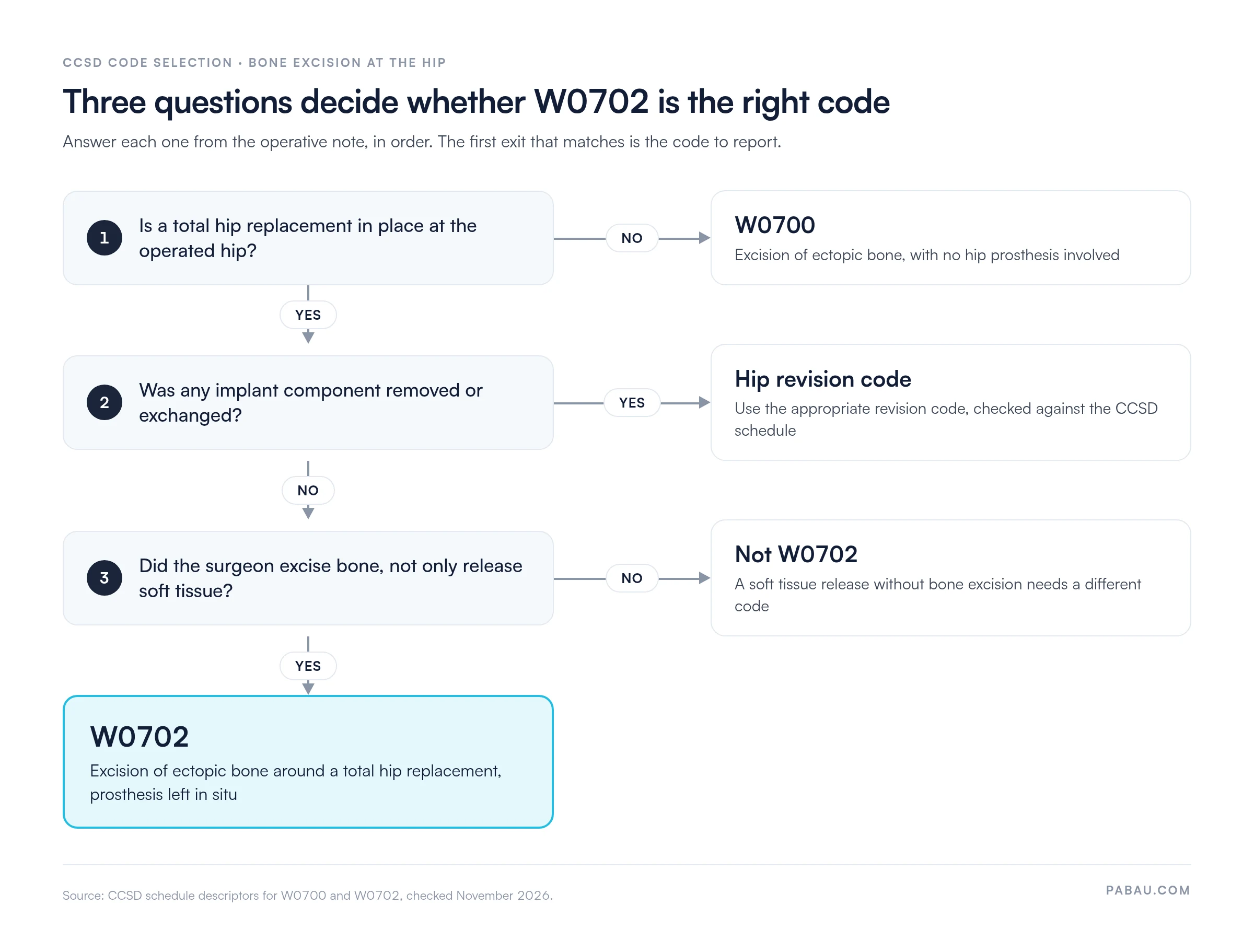
Removal of an exostosis or part of a bone with no hip prosthesis involved usually falls under the general code W0850. Implant revisions have their own codes in the W37 range, such as W3740 for a second or further revision of a total hip replacement. A planned osteotomy or transfer of the greater trochanter on its own, with no implant work, is billed under the greater trochanter osteotomy code, W1648.
OPCS-4 crosswalk note: CCSD and NHS OPCS-4 codes do not map 1:1. If a patient’s NHS records reference an OPCS-4 procedure code for heterotopic ossification excision, do not assume direct equivalence with W0702 for private billing purposes. Use the CCSD descriptor as the authority for private insurer claims.
These four errors are the ones to check for before a W0702 claim goes out. Each has a specific fix.
Insurers reviewing a W0702 claim expect the clinical documents below. A missing document is a common reason for denial, so build this checklist into the pre-submission workflow.
Before submitting a W0702 claim, check the operative note against the six documents above. Confirm the Brooker grade is recorded, the prosthesis is named, and pre-operative imaging is attached. A package that arrives complete gives the insurer fewer reasons to send an information request.
Most UK private medical insurers require pre-authorization for W0702, because it is a planned secondary surgical episode after the original total hip arthroplasty. Without authorization, payment is not guaranteed, even when the procedure is clinically appropriate and correctly coded. Request it before surgery is scheduled, not after the patient has been admitted.
The clinical package sent to obtain authorization typically includes:
Specific requirements vary by insurer. Bupa, AXA Health, Aviva, and Vitality each publish provider guidance on their portals, with payer-specific forms and timeframes. The Aviva fee schedule for providers and the AXA Health procedure code portal are the relevant starting points for those two payers.
W0702 denials from UK private medical insurers tend to fall into four categories. Each one has a clear appeal route.
Co-billing on the same operative date needs care. The table below summarizes common scenarios. Always confirm with the insurer before submission, as payer rules on unbundling vary.
In many orthopedic practices, a W0702 claim is assembled by hand. The operative note sits in one system, the imaging report arrives by email, and the authorization reference lives in the insurer’s portal. When a payer queries the claim, someone has to rebuild that pack from scratch.
Pabau, a practice management platform with built-in billing, stores the operative note, imaging report and Brooker grade against the patient record. Its claims management software supports private practice billing workflows, including insurance claims and clinical record management. In the UK, claims go to insurers through Healthcode and BUPA.
Your biller opens one record to submit the claim or answer a query. A missing document shows up while there is still time to add it to the claim.


Pabau keeps CCSD coding, clinical notes and insurer claims in one patient record. Your W0702 claim goes out with the imaging, Brooker grade and operative note it needs.

W0702 rewards a precise operative note. When the note names the prosthesis, confirms that bone was excised and records the Brooker grade, the code is hard to challenge. When it leaves one of those open, the insurer gets to decide what was done.
The practical step is to update the operative note template before the next case. Once the six documents are part of pre-authorization, the appeal pack already exists if a payer queries the claim.
Book a demo to see how Pabau keeps the operative note, the imaging report and the W0702 claim in one record for your orthopedic practice.

Need a full Bupa CCSD code reference? Bupa CCSD procedure codes covers the Bupa code schedule, fee structure, and submission requirements for private orthopedic and other specialist procedures.
Coding an implant revision instead? CCSD code W3740 covers a second, third or further revision of a total hip replacement.
Removing an exostosis with no prosthesis involved? CCSD code W0850 covers partial excision of bone, including exostoses.
Looking to cut claim denials across CCSD procedures? Pabau’s claims management software sends UK insurer claims through Healthcode and BUPA from the patient record.
CCSD code W0702 covers the surgical excision of ectopic (heterotopic) bone that has formed around a total hip replacement. It applies when the hip prosthesis stays in place and only the abnormal bone is removed. It does not cover implant revision, or soft tissue release without bone excision.
W0702 covers ectopic bone excision only, leaving the prosthesis in place. Hip revision codes cover the exchange of implant components. If no implant component was replaced, revision codes do not apply.
Yes, in most cases. Most UK private medical insurers treat W0702 as a planned secondary procedure and require pre-authorization before the operation. Request it before surgery is scheduled, with imaging, the Brooker grade, and the conservative treatment history as supporting evidence.
The most frequent reasons are a missing prior authorization and an operative note that does not link the ectopic bone to the hip prosthesis. Claims miscoded with a hip revision code and thin imaging evidence follow. Each can be addressed on appeal with the right documentation.
Insurers expect pre-operative imaging confirming HO and a Brooker grade. They also want an operative note confirming bone excision next to the prosthesis, a reference to the original THA, and evidence of conservative management. Add the histopathology result where tissue was sent for analysis.
Possibly, if the ectopic bone excision and the implant revision are distinct, separately documented procedures. Payer rules on unbundling vary, so confirm with the insurer before submission and make sure each procedure has its own operative note.




