

HCPCS Code L0472: Hyperextension TLSO billing guide
HCPCS code L0472: Official descriptor and device definition HCPCS code L0472 des...

Last Updated: Nov 5, 2026
G2710 is the CCSD code for total gastrectomy and excision of surrounding tissue, the removal of the whole stomach together with the tissue around it. UK private medical insurers such as Bupa, AXA Health, Aviva and Vitality use it for this operation, which is most often performed for stomach cancer.
The CCSD schedule places G2710 in Chapter 11, Abdomen, under the Stomach sub-chapter. A robotic-assisted total gastrectomy takes G2711 instead. CCSD lists unacceptable combinations for G2710, including partial gastrectomy code G2800, A2720 and G5020.
Let Pabau's smart automation suggest the right codes, reduce claim denials, and keep your practice compliant—effortlessly.
Automate repetitive tasks and focus on what matters most—your patients.
Reduce coding errors and ensure compliance with the latest regulations.
Clean claims, fewer denials, and faster reimbursements.
Powerful insights and reporting to help your practice thrive.
HIPAA compliant SOC 2 certified GDPR-compliant Trusted by 4,000+ clinics worldwide

CCSD Code G2710 covers total gastrectomy and excision of surrounding tissue, the removal of the whole stomach with the tissue around it.
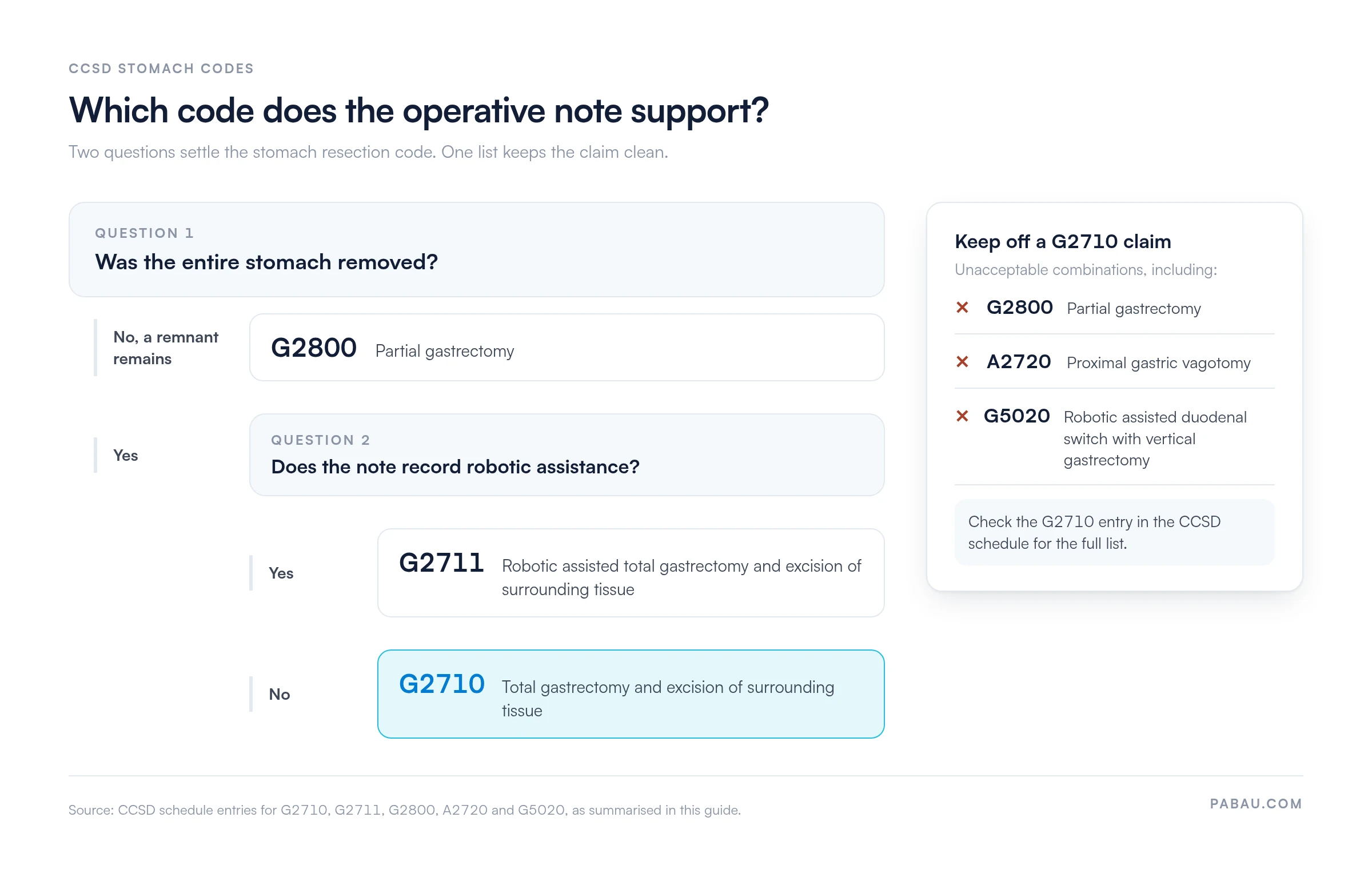
Code a robotic-assisted total gastrectomy as G2711 and a partial gastrectomy as G2800, never as G2710.
CCSD lists unacceptable combinations for G2710, including G2800, A2720 and G5020, so those codes stay off a G2710 claim.
Pair G2710 with the WHO ICD-10 C16 subcategory the pathology report supports, such as C16.0 for a tumour of the cardia.
UK private medical insurers generally require pre-authorisation for elective surgery, so record the authorisation number before admission.
CCSD Code G2710 is the code for total gastrectomy and excision of surrounding tissue in the CCSD schedule. It describes removing the entire stomach, together with the surrounding perigastric tissue, as one procedure. UK private medical insurers, including Bupa, AXA Health, Aviva and Vitality, use the code to identify this operation.
CCSD stands for Clinical Coding and Schedule Development. The CCSD Group maintains a common set of codes and narratives for private and independent healthcare in the UK. Each insurer then decides whether it covers a code and at what fee. Practices commonly send these claims through Healthcode, the UK clearing house for private medical billing.
G2710 sits in Chapter 11 of the procedural schedule, Abdomen (excluding urinary and reproductive organs), under the Stomach sub-chapter. Check the current entry on the CCSD website before billing, because the schedule changes regularly. For an overview of how the schedule works, read our guide to CCSD codes.
A total gastrectomy and excision of surrounding tissue is a major upper gastrointestinal operation. Knowing its steps helps a coder confirm that the operative note matches the G2710 narrative.
The extent of lymph node dissection (D1, D2 or D3) varies with the tumour and the surgeon. Record it in the operative note, then check the G2710 code principles in the CCSD schedule to see whether it affects coding.
G2710 applies when the surgeon plans and performs removal of the whole stomach. The most common reason is gastric cancer, where the site or spread of the tumour rules out a partial resection. Other indications include:
A distal tumour that a subtotal resection can clear takes partial gastrectomy code G2800 instead. Coding G2710 for a partial gastrectomy overstates the procedure and invites an insurer query or audit.
CCSD aims for a single code to describe the clinical activity in full in most cases. Its unacceptable combinations flag codes that should not be billed together, which is sometimes called unbundling.
The following parts of the operation are normally treated as part of the main procedure:
Some procedures performed in the same session may take their own code. Examples include a splenectomy for an extended resection, or a feeding jejunostomy. Before adding one, check that CCSD does not list it as an unacceptable combination with G2710. An open splenectomy that removes the whole spleen is coded J6900.
CCSD lists unacceptable combinations for procedures commonly coded together, so the lists are not exhaustive. Where a pairing is not listed, apply the principles in the CCSD Technical Guide and confirm with the insurer before you submit.
Selecting G2710 means confirming that the operative note describes a total gastrectomy, not a related operation. These CCSD codes sit closest to it:
The deciding question is whether the operative note records removal of the entire stomach. If any gastric remnant remains, G2710 is the wrong code. An oesophagogastrectomy or a bariatric sleeve gastrectomy has its own entry, so search the current schedule for the code that matches the note. The diagram below maps the two checks that settle the code.
Other codes in the Stomach sub-chapter include G3210 for gastro-jejunostomy and G3800 for open stomach surgery that no specific code describes.
CCSD also lists proximal gastric vagotomy as an unacceptable combination with G2710. Our guide to A2720 explains that code in detail.
UK insurers expect every G2710 claim to carry a diagnosis that supports the procedure. UK private claims use the WHO ICD-10 classification, not the US ICD-10-CM edition. Choose the most specific code the pathology report supports.
Keep the histology report in the clinical file, because an insurer may ask for it to confirm the diagnosis and procedure match. The WHO ICD-10 browser lists the current C16 subcategories.
Insurers can query a G2710 claim when the clinical file does not support the code. Build the file before theatre, not after a query arrives. A complete file includes:
UK private medical insurers generally require pre-authorisation before an elective inpatient operation such as a total gastrectomy. The insurer reviews the planned procedure and issues an authorisation number. Requirements vary by insurer and by policy, so check each one before booking theatre.
Insurers commonly ask for:
Fees differ by insurer and contract. Bupa publishes its rates in its code search portal, and our Bupa CCSD codes guide explains how the codes and fees work. For urgent surgery, ask the insurer how it handles authorisation after the event, because the rules differ.
CCSD has no CPT-style or HCPCS-style modifiers. Details such as approach and laterality live in the code narrative itself, so choosing the code records them.
The CCSD Technical Guide sets the rules. A code whose narrative names no approach is treated as open. A procedure started laparoscopically and converted to open is coded by its final approach, because CCSD has no codes for converted procedures.
Use G2711 for a robotic-assisted total gastrectomy. For a laparoscopic case, search the current schedule for a matching entry before defaulting to G2710. Laterality does not apply to the stomach. Assistant surgeons and anaesthetists bill under their own terms with each insurer, so confirm those directly.
G2710 queries and rejections follow predictable patterns, and each one can be caught before the claim goes out.
Claims management software can check each claim for missing or invalid details before it leaves the practice. That takes less effort than reworking a rejected claim afterwards.
Many surgical practices still rekey each claim into an insurer portal and chase authorisation numbers by email. A mistyped membership number or a missing authorisation reference then sends the claim back weeks later.
Pabau, the practice management and billing platform we build, sends private medical insurance claims through Healthcode to Bupa, AXA Health, Vitality and other insurers. It stores each patient’s insurer and policy details on the client card. The authorisation your team records follows the appointment through to the claim.
Your team still chooses the CCSD code and checks it against the operative note. Pabau checks the claim for missing or invalid details before submission, then tracks it from pending to paid. A rejected or short-paid G2710 claim surfaces quickly instead of sitting unnoticed.

Pabau sends private medical insurance claims through Healthcode and checks each one for missing details first. Your team chooses the CCSD code, and Pabau tracks the claim to payment.

G2710 is a high-value code for a major cancer operation, which is why insurers read its claims closely. The strongest claim starts with an operative note that names a total gastrectomy, the approach and the reconstruction in plain terms.
Before you submit, rule out G2711 and G2800, remove any unacceptable combination and confirm the authorisation number. Where the schedule is silent on an added procedure, ask the insurer before the claim goes, not after a rejection. Book a demo to see how Pabau sends surgical claims through Healthcode and tracks them to payment.

New to the CCSD schedule? CCSD codes explained covers how the schedule is structured and how UK insurers use it.
Coding a bypass instead of a resection? CCSD Code G3210: Gastro-jejunostomy explains the stomach-section code for a new gastrojejunal join.
No specific stomach code fits? CCSD Code G3800: Open stomach surgery covers the catch-all code and why insurers scrutinise it.
Checking a proximal gastric vagotomy code? CCSD Code A2720 sets out the proximal gastric vagotomy code that cannot share a claim with G2710.
Need Bupa-specific fees and coding rules? Bupa CCSD codes and fee schedule guide covers Bupa’s procedure code framework and its provider portal.
CCSD Code G2710 is the UK private healthcare code for total gastrectomy and excision of surrounding tissue. It covers removal of the whole stomach together with its surrounding tissue. Bupa, AXA Health, Aviva and Vitality use the CCSD schedule, and practices usually submit these claims through Healthcode.
Pair G2710 with the WHO ICD-10 C16 subcategory the pathology report supports. Options include C16.0 (cardia), C16.1 (fundus), C16.2 (body), C16.8 (overlapping lesion of stomach) and C16.9 (stomach, unspecified). D13.1 covers a benign neoplasm of the stomach.
Roux-en-Y oesophagojejunostomy is the usual reconstruction after a total gastrectomy and is normally treated as part of the operation. Check the G2710 code principles in the CCSD schedule before adding a separate reconstruction code. If the schedule does not settle it, confirm with the insurer.
UK private medical insurers such as Bupa, AXA Health, Aviva and Vitality generally require pre-authorisation before elective surgery like G2710. Expect to provide the CCSD code, the ICD-10 diagnosis, supporting pathology and the planned date and hospital. Requirements vary by insurer and policy, so record the authorisation number before admission.
G2710 covers total gastrectomy, where the whole stomach is removed. A partial gastrectomy, where a gastric remnant is preserved, takes G2800. CCSD lists G2710 and G2800 as an unacceptable combination, so they do not go on the same claim. If any part of the stomach remains, G2710 is the wrong code.
The D1 perigastric clearance forms part of the surrounding tissue removed under G2710. Check the G2710 code principles in the CCSD schedule before coding a more extended D2 or D3 dissection separately. If the schedule does not settle it, confirm with the insurer.



