CPT code 51797: Intra-abdominal voiding pressure add-on
What CPT code 51797 covers CPT code 51797 is the add-on code for intra-abdominal...

Last Updated: Oct 19, 2026
H6020 is the CCSD code for laying open of pilonidal sinus. The surgeon cuts away the skin roof of the sinus tract, curettes its base and leaves the wound open to heal by secondary intention. UK private medical insurers pay the surgeon's fee against this code.
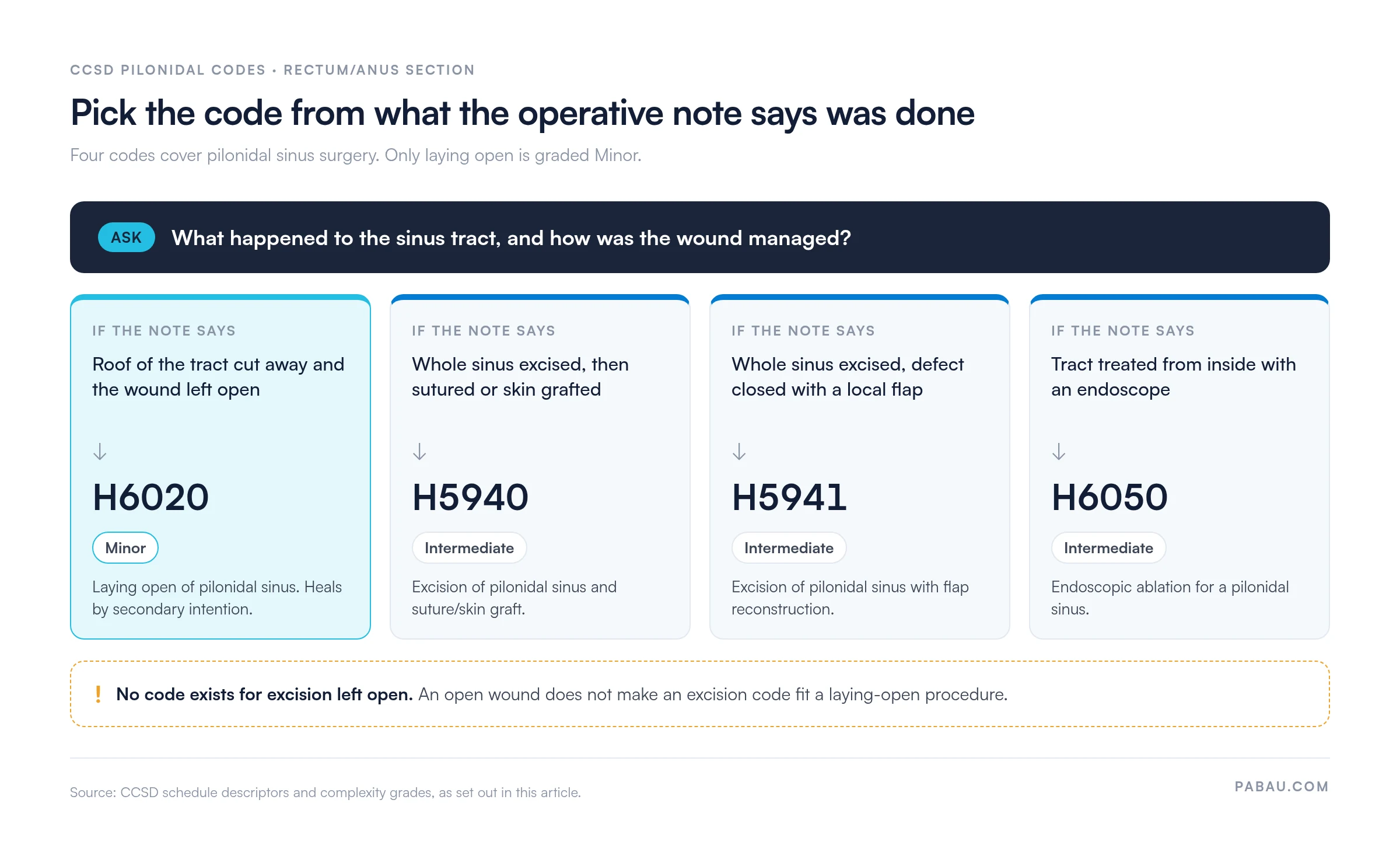
H6020 sits in the Rectum/anus section of Chapter 11 of the CCSD schedule and is graded Minor. Excision with suture or skin graft bills under H5940 instead, excision with flap reconstruction under H5941, and endoscopic ablation under H6050.
Let Pabau's smart automation suggest the right codes, reduce claim denials, and keep your practice compliant—effortlessly.
Automate repetitive tasks and focus on what matters most—your patients.
Reduce coding errors and ensure compliance with the latest regulations.
Clean claims, fewer denials, and faster reimbursements.
Powerful insights and reporting to help your practice thrive.
HIPAA compliant SOC 2 certified GDPR-compliant Trusted by 4,000+ clinics worldwide

CCSD Code H6020 covers laying open (unroofing) of a pilonidal sinus, not excision with suture, skin graft or flap reconstruction.
The operative note must say ‘laying open’ or ‘unroofing’ explicitly to separate H6020 from the excision codes H5940 and H5941.
Pre-authorisation from the patient’s insurer is required before elective H6020 in virtually all UK PMI policies, with emergency cases sometimes allowing retrospective authorisation.
Pabau, the practice management platform we build, keeps the CCSD code, diagnosis and authorisation number on one claim record, so fewer claims come back.
CCSD Code H6020 has the official descriptor “Laying open of pilonidal sinus” in the CCSD schedule maintained by the Clinical Coding and Schedule Development group. It sits in Chapter 11 of the schedule (Abdomen, excluding urinary and reproductive organs), in the Rectum/Anus section, and carries a Minor complexity grade.
H6020 is reserved for the unroofing technique. The surgeon cuts away the skin and subcutaneous tissue that form the roof of the sinus tract and leaves the wound open.
H6020 is one of four pilonidal codes in that section. The other three are H5940 (excision and suture/skin graft), H5941 (excision with flap reconstruction) and H6050 (endoscopic ablation for a pilonidal sinus). All three are graded Intermediate.
The schedule has no separate code for plain excision left open, and none for excision with primary closure. H6020 is tied to a single surgical approach, and that approach must be the one performed and documented. Neighbouring Rectum/Anus procedures each have their own page in our CCSD codes archive.
For an overview of how the schedule is structured, see our guide to Bupa CCSD procedure codes. It also explains how Bupa processes claims against the schedule.
Laying open turns the closed sinus into an open wound that heals from its base. A typical procedure runs in six steps.
The key clinical consequence of this approach is the open wound. Unlike excision with primary closure, there is no suture line to break down. The trade-off is a longer healing period, which creates the post-operative billing questions discussed later in this reference.
H6020 is used when pilonidal disease is present and laying open is the clinically appropriate surgical approach. Common indications include:
Support every H6020 claim with the matching ICD-10 diagnosis: L05.0 (pilonidal cyst and sinus with abscess) or L05.9 (pilonidal cyst and sinus without abscess). The insurer checks that the diagnosis and the procedure code agree.
Laying open is a poor fit when the patient needs a rapid return to work. Secondary-intention healing restricts sitting and physical exertion for weeks. If anatomy permits, the surgeon may instead opt for excision with suture or skin graft (H5940) or with flap reconstruction (H5941). Code the operation the surgeon performed, even when the plan changed in theatre.
The most consequential coding decision in pilonidal surgery is separating laying open from excision. H6020 is graded Minor, while the excision and ablation codes are Intermediate, so the choice changes the benefit.
Insurers audit this distinction. Billing an excision code for a laying-open procedure, or the reverse, can trigger rejection, repayment demands or a wider audit of the practice’s billing.
The crucial distinction is between H6020 and H5940. Laying open cuts away only the roof of the tract and leaves the base to granulate. H5940 removes the whole sinus and then closes the wound with sutures or a skin graft. If a flap closes the defect, the code is H5941.
The schedule has no code for excision left open, so do not reach for an excision code because the wound was not closed. If the note says “excision” when the technique was laying open, the wrong code follows. The decision below starts from the operative note, because that is the document the insurer reads.
An operative note that does not name the technique is the most preventable cause of H6020 rejection. Every claim needs the elements below.
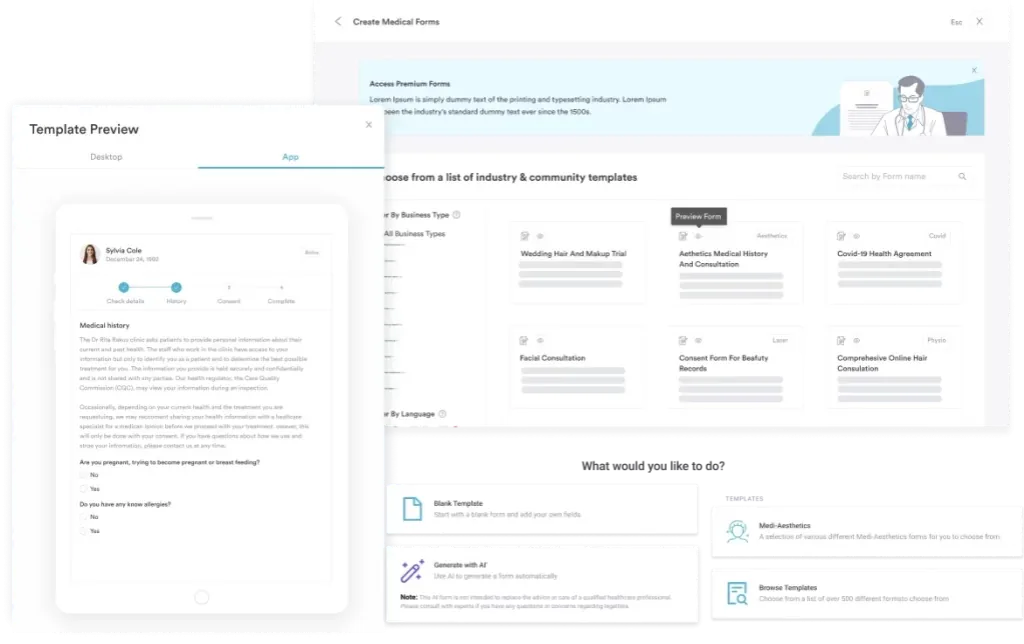
High-volume surgical practices benefit from standardised digital operative note templates that prompt surgeons for every required field.
All major UK private medical insurers require pre-authorisation before elective pilonidal sinus surgery. Performing H6020 without prior approval risks the entire claim being declined, regardless of clinical necessity or documentation quality.
The standard pathway starts with a GP referral to a consultant colorectal or general surgeon. The consultant confirms the clinical indication for surgery. The patient, or the practice on their behalf, then asks the insurer for authorisation. The insurer issues an authorisation number valid for a set period. Typical requirements across major insurers include:
For emergencies, such as an acute pilonidal abscess needing same-day surgery, most insurers permit retrospective authorisation. The practice must contact the insurer within 24 to 48 hours of the procedure. Always check the individual policy terms, as some plans require notification before any intervention regardless of urgency.
Fees for H6020 under the CCSD schedule are set by individual insurers and reviewed annually. No single benefit amount applies across all policies. The rate varies by insurer and policy tier, and sometimes by whether the procedure is a day case or inpatient stay. The following points apply across most major UK PMI plans.
CCSD fees change every year, so date any figure you quote to a patient. Confirm it against the insurer’s current schedule first. The CCSD schedule on ccsd.org.uk provides the framework within which individual insurers set their benefit rates.
H6020 claims in private practice almost always involve co-billing an anaesthetic code alongside the surgical code. The approach depends on the anaesthetic type and the insurer’s unbundling rules.
Under general anaesthetic, the anaesthetist submits their own claim using the appropriate CCSD anaesthetic code. Depending on the insurer, the benefit is calculated by time units or paid as a fixed amount. The surgeon’s H6020 claim and the anaesthetist’s claim are entirely separate submissions. The two do not bundle into a single combined code.
For procedures performed under local anaesthetic in a day-case or outpatient setting, the surgeon may administer the local anaesthetic themselves.
In this scenario, no separate anaesthetic code is submitted alongside H6020, as local anaesthetic administration is typically considered included in the surgical benefit. Confirm this with each insurer, as some have specific rules about local anaesthetic coding in a private facility versus a consulting room.
Assistant surgeon fees are permissible alongside H6020 only where clinical complexity genuinely warrants a second surgeon. The operative note should document why an assistant was required.
Most straightforward pilonidal sinus laying-open procedures will not meet the threshold for an assistant code. Submitting one routinely invites scrutiny.
Laying open leaves a wound that heals by secondary intention over four to twelve weeks. Post-operative care is therefore longer and more intensive than after primary closure. The billing question is which of those visits the H6020 fee already covers, and which can be claimed separately.
Insurer policies typically treat H6020 as including an immediate post-operative period. That covers the consultant’s review straight after surgery and the first outpatient follow-up. Beyond that, the position varies by insurer. The general principles are:
The safest approach is a separate clinical note for each post-operative attendance. Get the insurer’s guidance in writing before claiming for extended wound care. Using claims management software that tracks each episode of care against its pre-authorisation reference helps prevent unbundling errors and supports an audit trail.
Document every post-operative wound care attendance with a separate dated clinical note stating the wound dimensions, healing stage, and clinical findings. If you later need to justify separate billing for extended care, this log becomes your primary evidence. A single bundled wound care note covering six weeks of visits will not support itemised claims.
H6020 claims are rejected for a predictable set of reasons. Most are preventable with the right documentation and pre-submission checks.
Whether a well-performed procedure gets paid usually depends on what the operating surgeon tells the billing team. Four habits keep the two in step.
Operative note language to use: dictate the procedure as “laying open of pilonidal sinus”. Then describe the unroofing step, for example “the roof of the tract was incised and laid open along its full length”. Never use “excision” as a synonym, because the billing team codes from the note as written.
Handling recurrent cases: when operating on a recurrence, note the previous pilonidal surgery in the operative record. Then document that the current technique is laying open. Some insurers treat recurrent procedures differently and may require additional clinical justification before authorising H6020 a second time.
Bilateral or multi-tract sinuses: if multiple distinct sinuses are laid open in the same sitting, document each separately with its location and extent. Whether this warrants an additional code depends on the insurer’s rules. Query the insurer before submitting rather than assuming co-billing is permitted.
When to query the code pre-submission: a hybrid of partial excision and partial laying open may not map cleanly to H6020 or an adjacent code. In that case, contact the insurer’s provider relations team before submitting. A pre-submission query is far less disruptive than a rejected claim and a subsequent audit. Practices with several surgical consultants often route new or unusual code queries through one central billing process.
Pilonidal claims often stall on paperwork rather than surgery. The authorisation number sits in an email, the note sits in a dictation system, and the follow-up dressings sit in a diary.
Pabau, the practice management platform we build for private practices, keeps the CCSD code, the ICD-10 diagnosis and the authorisation number on one claim record. You submit the claim through Healthcode and track its status in the same place. Each wound care attendance is logged against the same episode, so separately billable visits are easy to evidence.
Pabau does not choose the code for you. The laying-open versus excision check above still applies, but the evidence for it travels with the claim.

Pabau supports UK private practice billing, including CCSD code submission, claim tracking and operative documentation. See how it works for colorectal and surgical practices.

H6020 fits one operation: unroofing a pilonidal tract and leaving the wound to heal from the base. Close the wound after excising the sinus and the code becomes H5940 or H5941. Treat the tract endoscopically and it becomes H6050.
The code is effectively chosen when the surgeon writes the note. A note that names the technique, the tract extent and the wound plan lets the billing team code with confidence. A long healing period then makes a clean record of each follow-up visit just as important.
Check the technique and the authorisation number before each claim leaves the practice. To see how Pabau keeps the code, diagnosis and authorisation on one claim, book a demo.

Coding another Rectum/Anus procedure? CCSD code H4200: perineal repair of prolapse of rectum covers documentation and pre-authorisation for a neighbouring code in the same section.
Billing transanal surgery as well? CCSD code H4000: transanal resection for local rectal growth explains how to code and claim that procedure for UK insurers.
CCSD Code H6020 covers laying open of pilonidal sinus. The surgeon removes the roof of the sinus tract, leaving an open wound that heals by secondary intention. It does not cover excision with suture or skin graft (H5940), excision with flap reconstruction (H5941) or endoscopic ablation (H6050).
Laying open (H6020) removes only the roof of the sinus tract, leaving the base and sides to granulate upward. Excision removes the whole sinus and then closes the wound. Closure with sutures or a skin graft is H5940, and closure with a flap is H5941. H6020 is graded Minor and both excision codes Intermediate, so healing time, aftercare and the insurer benefit all differ.
The H6020 surgical fee typically covers an immediate post-operative period and the first follow-up. Extended wound dressing appointments performed by nursing staff during the secondary-intention healing phase may be separately billable, but this varies by insurer policy. Confirm bundling rules with each insurer and document each attendance separately to support any separately billed post-operative care.
The most common reasons are a missing pre-authorisation number and a note that does not confirm the laying-open technique. A note that says “excision” often leads to the wrong code. Late submission outside the insurer’s timeframe is the other frequent cause. Including the pre-auth number and using explicit technique language in the operative note prevents the majority of denials.
Yes. When H6020 is performed under general anaesthetic, the anaesthetist submits a separate claim using the applicable CCSD anaesthetic code. The two claims are independent. When the operating surgeon gives a local anaesthetic, no separate anaesthetic code is submitted. Most UK insurers treat it as included in the surgical benefit.
Most UK private medical insurers require a GP referral, a consultant assessment confirming clinical necessity, and a pre-authorisation number issued before the procedure date. Emergency cases may qualify for retrospective authorisation if the insurer is contacted within 24 to 48 hours. Always check individual policy terms, as requirements vary between Bupa, AXA Health, Aviva, and Vitality.