HCPCS code G0257: Unscheduled or emergency dialysis billing guide
HCPCS code G0257: Official descriptor and code overview HCPCS code G0257 is defi...

Last Updated: Oct 27, 2026
H3500 is the former CCSD code for fixation of rectum for prolapse, also called rectopexy. It is no longer in the current CCSD schedule, so new claims should not carry it.
Open rectopexy now codes to H3501 when a mesh is required and H3502 when it is not. Laparoscopic ventral rectopexy codes to H3580 without mesh and H3582 with mesh.
Let Pabau's smart automation suggest the right codes, reduce claim denials, and keep your practice compliant—effortlessly.
Automate repetitive tasks and focus on what matters most—your patients.
Reduce coding errors and ensure compliance with the latest regulations.
Clean claims, fewer denials, and faster reimbursements.
Powerful insights and reporting to help your practice thrive.
HIPAA compliant SOC 2 certified GDPR-compliant Trusted by 4,000+ clinics worldwide

CCSD code H3500 (fixation of rectum for prolapse) is no longer in the current CCSD schedule, so never submit it on a new claim.
Open rectopexy now splits by mesh use. Bill H3501 when a mesh is required and H3502 when it is not.
Laparoscopic ventral rectopexy codes to H3580 without mesh and H3582 with mesh, so the operative note must say whether a mesh was placed.
Pair the procedure code with ICD-10 K62.3 (rectal prolapse), and check each insurer’s provider guidance for its pre-authorization rules.
CCSD code H3500 described fixation of rectum for prolapse, the operation also called rectopexy. The code no longer appears in the current CCSD schedule. A search of the schedule returns no record for H3500, and its former code page now returns an error.
Rectopexy itself is still covered. CCSD now codes it by surgical approach and by mesh use, so one old code has become several current ones. The right code is the one that matches what the operative note records.
Four current codes cover abdominal rectopexy. Two more cover rectal operations that are easy to confuse with it. Each descriptor below is quoted from the CCSD schedule, and our library of CCSD codes covers procedures outside rectal surgery.
Perineal operations such as the Delorme or Altemeier procedures never take a rectopexy code. Our guide to CCSD code H4200 covers the perineal route in more detail.
Two facts from the operative note decide the code. The first is the surgical approach, and the second is whether a mesh was placed. The grid below maps each combination to its current code.
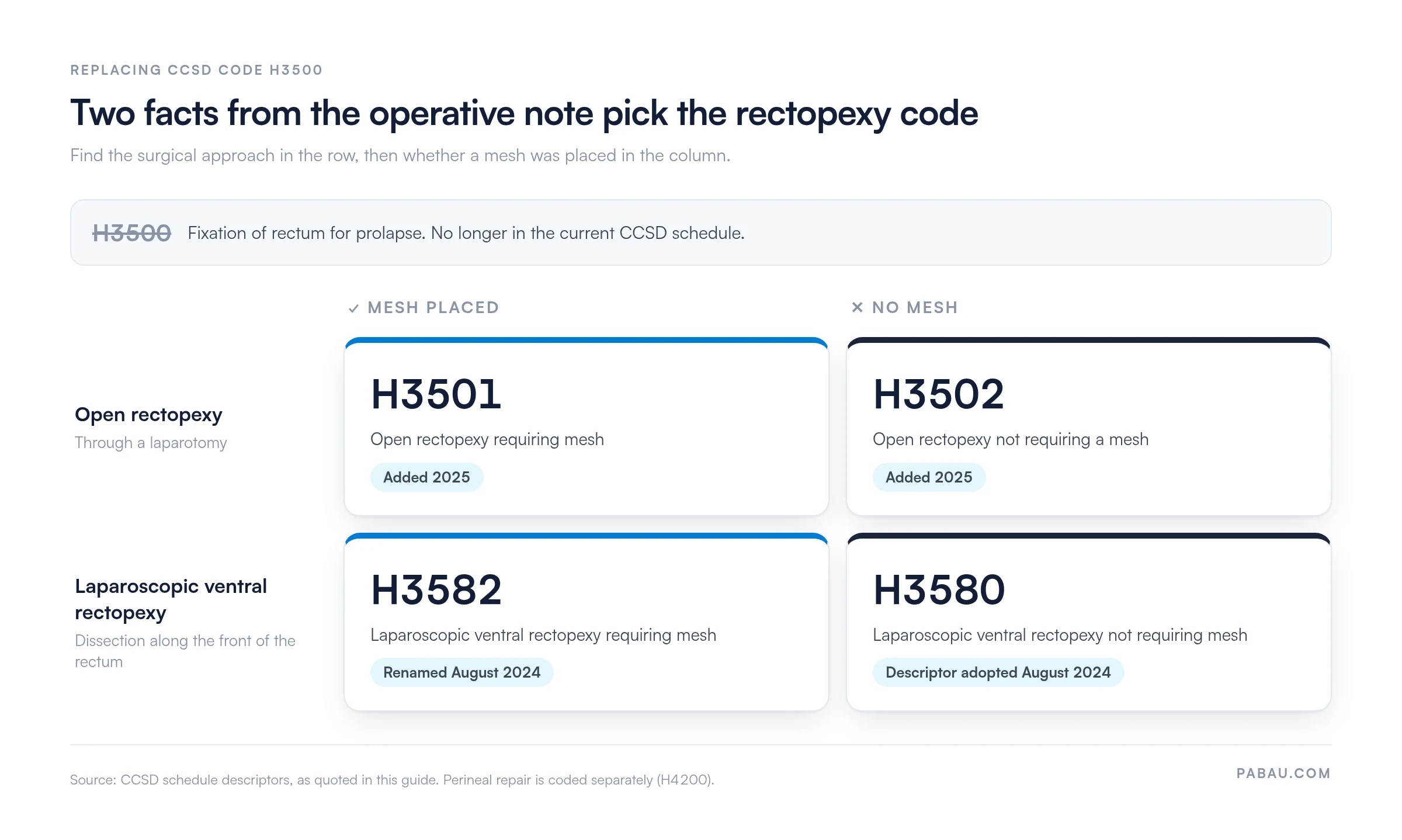
Mesh use now changes the code itself. Ask surgeons to write “mesh placed” or “no mesh” in plain words in every rectopexy note. Billing staff should never have to infer it from an implant log.
Rectopexy corrects full-thickness rectal prolapse, where the whole wall of the rectum protrudes through the anus. A consultant colorectal surgeon performs it under general anesthesia.
The surgeon frees the rectum from the surrounding pelvic tissue, lifts it back into position, and fixes it in place. Fixation uses sutures alone or a mesh secured toward the sacrum. In a ventral rectopexy, the dissection runs along the front of the rectum.
Named techniques, such as the Wells posterior mesh rectopexy, still need the approach and mesh use recorded. Code them by those two facts, not by the eponym.
Old codes linger in fee schedules, booking templates and authorization letters. Clear H3500 out of each place before it reaches a claim.
Every rectopexy claim needs a diagnosis code that supports the operation. UK coding uses the WHO edition of ICD-10, so use its codes rather than US ICD-10-CM codes.
List K62.3 first, and add secondary codes only where the clinical notes support them. Speculative secondary codes invite insurer queries and slow payment.
The operative note carries more weight than it did under H3500. It must show the two facts that pick the code, plus the diagnosis. Include these elements in every rectopexy note:
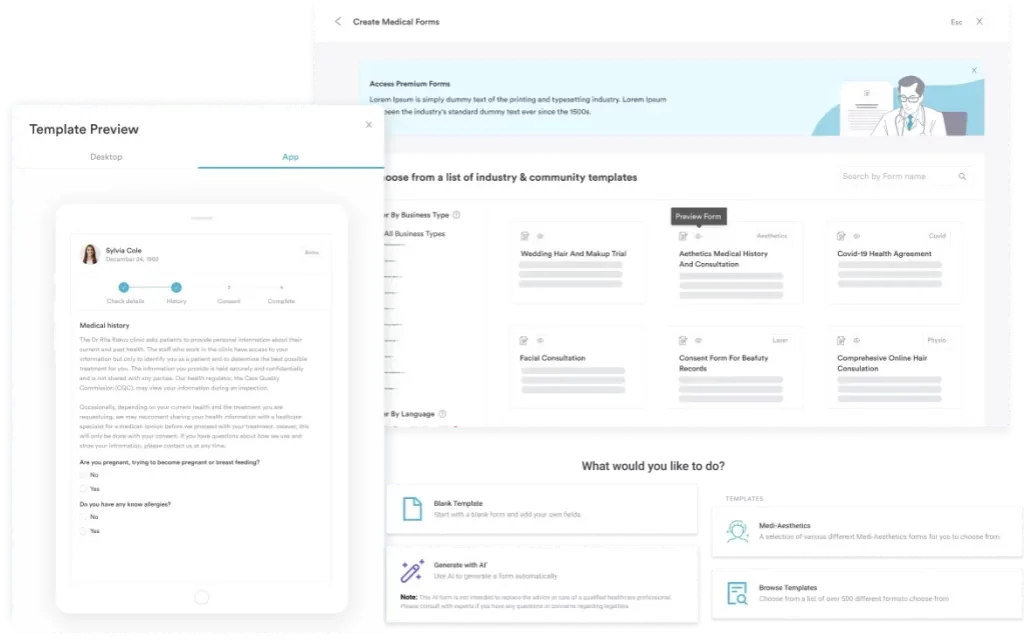
Structured digital forms can prompt surgeons for each of these fields. That way, no note reaches billing without the mesh status.
Each insurer sets its own pre-authorization rules for colorectal surgery, and those rules change. Check the insurer’s provider guidance before booking the operation, rather than relying on a general list. Our guide to Bupa CCSD codes shows how Bupa uses the schedule for claim review and payment.
Bupa publishes a procedure code lookup for providers. Vitality and Aviva publish practitioner fee schedules through the Vitality fee finder and the Aviva fee schedule. Confirm each insurer lists the current rectopexy codes before you quote a fee.
Code changes like this one catch practices that bill from memory or from an old fee list. One stale code in a procedure template can send H3500 out on claim after claim.
Pabau keeps the procedure code, diagnosis, pre-authorization reference and operative note on one patient record. Billing staff can check mesh use before they pick a code, then send the claim through claims management.
Practices moving from the NHS to private practice can build their fee schedule with current CCSD codes from day one.

Pabau links each procedure code to the operative note, diagnosis and pre-authorization reference. Book a demo to see how it supports clean CCSD claims for colorectal surgery.

Treat any H3500 still in your system as a prompt to recode before the claim goes out. The fix takes minutes per case, provided the operative note states the approach and the mesh decision.
Update fee schedules and templates now, and ask surgeons to record mesh use in plain words. The trade-off is a little more detail in each note, in exchange for claims that carry the right code the first time.
Book a demo to see how Pabau keeps CCSD codes, operative notes and insurer claims in step for colorectal practices.

Need to understand how UK private insurers process CCSD claims? Bupa CCSD procedure codes guide covers how Bupa uses the CCSD schedule for claim review and payment.
Repairing the prolapse through the perineum instead? CCSD code H4200 explains how to code perineal repair of prolapse of rectum.
Billing other rectal surgery for the same patient group? CCSD code H3334 covers coding and claims for low anterior resection.
Managing pre-authorization across multiple colorectal procedures? Private practice claims management software automates pre-auth tracking and claim submission for UK surgical practices.
No. H3500, fixation of rectum for prolapse, is not in the current CCSD schedule. Code open rectopexy to H3501 or H3502, and laparoscopic ventral rectopexy to H3580 or H3582.
Use H3501 for open rectopexy requiring mesh and H3502 for open rectopexy not requiring a mesh. The operative note must state whether a mesh was placed.
H3580 covers laparoscopic ventral rectopexy not requiring mesh, a descriptor CCSD adopted in August 2024. H3582 covers laparoscopic ventral rectopexy requiring mesh.
K62.3 (rectal prolapse) is the primary diagnosis. Add K59.0 (constipation), N81.6 (rectocele) or K62.8 (other specified diseases of anus and rectum) only where the notes document them.
Recode the claim from the operative note and resubmit it through the insurer’s usual process. For an authorization issued under H3500, ask the insurer to update it before surgery.
No. Perineal repair of prolapse of rectum has its own code, H4200. Stapled transanal rectal resection (STARR) for obstructed defecation is H3590, which is also separate.