CCSD code J1900: Gallbladder anastomosis billing guide
CCSD code J1900 joins the gallbladder to another organ CCSD code J1900 is the UK...

Last Updated: Oct 22, 2026
CCSD code H5940 covers excision of a pilonidal sinus followed by closure with sutures or a skin graft. The surgeon removes the whole sinus tract, then stitches the wound shut or covers it with a graft. UK private medical insurers pay the consultant's fee against this code.
H5940 sits in the Rectum/anus section of Chapter 11 of the CCSD schedule and is graded Intermediate. The closure method in the operative note decides the code. A flap moves the claim to H5941, laying open to H6020 and endoscopic ablation to H6050. Getting that choice right, then backing it with pre-authorisation, is what gets the claim paid.
Let Pabau's smart automation suggest the right codes, reduce claim denials, and keep your practice compliant—effortlessly.
Automate repetitive tasks and focus on what matters most—your patients.
Reduce coding errors and ensure compliance with the latest regulations.
Clean claims, fewer denials, and faster reimbursements.
Powerful insights and reporting to help your practice thrive.
HIPAA compliant SOC 2 certified GDPR-compliant Trusted by 4,000+ clinics worldwide

CCSD code H5940 covers excision of a pilonidal sinus followed by closure with sutures or a skin graft, graded Intermediate.
A flap closure moves the claim to H5941, laying open moves it to H6020, and endoscopic ablation moves it to H6050.
Insurers code from the operative note, so the note must name the excision and the closure method in plain words.
Get the insurer’s authorisation number before surgery and quote it on the Healthcode claim with the ICD-10 diagnosis.
CCSD code H5940 pays the consultant surgeon for excising a pilonidal sinus and then closing the wound. The schedule descriptor reads “Excision of pilonidal sinus and suture/skin graft”.
The code sits in Chapter 11 of the schedule (Abdomen, excluding urinary and reproductive organs), in the Rectum/anus section. It carries an Intermediate grade, which sets the benefit band insurers pay against.
Its number echoes OPCS-4 category H59, the NHS classification for pilonidal sinus excision. Private insurers bill against CCSD codes instead, so the claim carries H5940 rather than the OPCS code.
Drainage alone for an acute pilonidal abscess is a different operation again. Look up the drainage code in the insurer’s code search before you bill it.
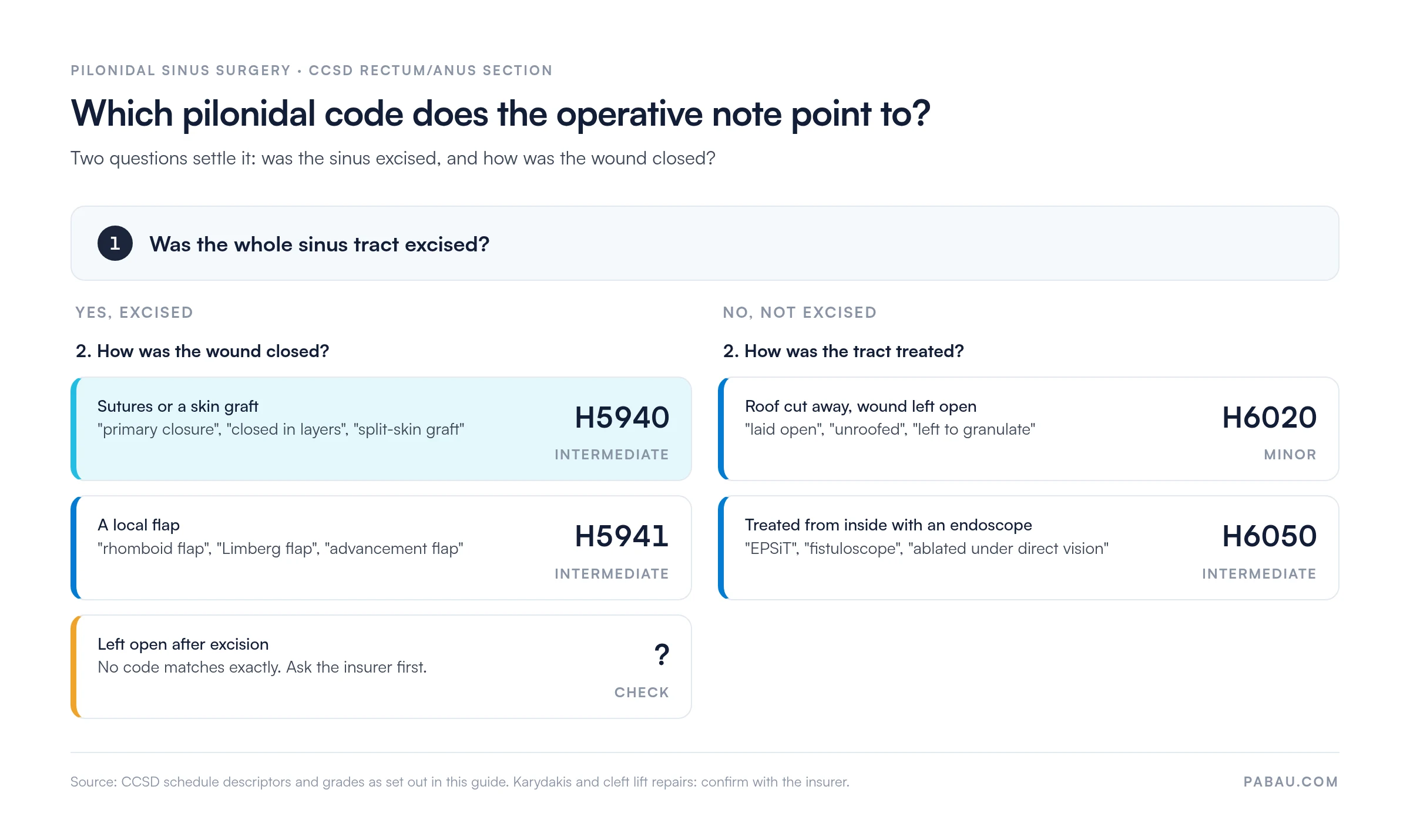
Four CCSD codes cover pilonidal sinus surgery in the Rectum/anus section. Three are graded Intermediate and one is Minor, so the wrong pick changes the benefit.
Billers code from the words on the page. These phrases in an operative note usually point one way.
Off-midline repairs such as Karydakis and the Bascom cleft lift move tissue as a flap. If the note names one, check with the insurer before you choose between H5940 and H5941.
A consultant excises a chronic sinus with two lateral openings. The note reads “sinus excised en bloc to the sacral fascia, primary midline closure over a drain”. That claim is H5940.
Now change one detail. The surgeon rotates a rhomboid flap to cover the defect instead. The excision is identical, but the closure makes it H5941.
Neither H5940 nor CCSD code H6020 describes an excision with the wound left open. When that happens, ask the insurer’s provider team how they want it coded before you submit.
Put together, the choice comes down to two questions, and the decision path below maps every answer to its code.
Pilonidal excision is elective surgery for most patients, and UK private medical insurers expect authorisation first. Operate without it and the whole fee is at risk.
The usual path runs from a GP referral to a consultant colorectal or general surgeon. The consultant confirms the indication and the planned technique. The patient, or your practice on their behalf, then requests authorisation and receives a reference number.
Each insurer publishes its own tools for checking the code and the benefit.
Authorise the technique you plan, and name it. If theatre findings force a flap, ask the insurer to update the authorisation to H5941 as soon as you can.
Urgent cases, such as an abscess that needs same-day surgery, follow each insurer’s own rules for retrospective approval. Call promptly and note who you spoke to.
The operative note is the evidence behind the code. A vague note invites a query, a downgrade or a rejection.
Add a line on histology too. An excised specimen usually goes to the lab, and the report backs up the diagnosis if the insurer asks.
A structured operative note template prompts the surgeon for each field. The record then stops depending on memory at the end of a long list.
Healthcode is the electronic billing hub most UK private insurers use for consultant claims. A clean H5940 claim usually moves in six steps.
Your fee goes on its own bill. The anaesthetist and the hospital each send separate claims for their part of the same admission.
The insurer’s benefit can sit below your fee. Agree in writing with the patient who pays any shortfall before the operation, not after the remittance arrives.
Most H5940 rejections trace back to the same handful of causes. Each one has a fix you can build into the workflow.
Two pilonidal codes on one bill for the same sinus also draw a query. Bill the single code that matches the technique performed.
Two minutes with this list catches most of the rejections above.
For the wider picture of how insurers apply the schedule, see our guide to Bupa CCSD codes.
Pilonidal claims usually stall on paperwork rather than surgery. The authorisation number sits in an email, the note sits in a dictation file, and the bill gets built from memory.
Pabau, the practice management platform we build, connects directly to Healthcode. The claim is raised from the patient record, so the CCSD code and diagnosis come from what is already documented.
Before the claim can go, Pabau checks that required fields such as the membership number and authorisation code are filled in. Each claim is then tracked through to payment and reconciled against the remittance.
The coding decision stays with the surgeon, because Pabau does not choose between H5940 and H5941. What changes is that the code, diagnosis and authorisation travel together in one claims management software record.

Pabau raises the claim from the patient record and checks the required fields. It then sends the claim through Healthcode and tracks it to payment.

H5940 belongs to one operation: excise the pilonidal sinus, then close it with sutures or a skin graft. Add a flap and the claim becomes H5941. Lay the tract open instead and it drops to H6020, a Minor procedure.
In practice, the surgeon picks the code while dictating the note. Name the closure method, match it to the authorisation and quote the diagnosis, and the insurer has little left to query.
To see a checked H5940 claim travel from the patient record through Healthcode to payment, book a demo.

Billing the laying-open technique instead? CCSD code H6020: laying open of pilonidal sinus covers the Minor-graded alternative to excision.
Coding fistula surgery in the same section? CCSD code H5520: laying open of high anal fistula explains documentation and claims for that procedure.
Claiming for rectal prolapse repair? CCSD code H4200: perineal repair of prolapse of rectum walks through pre-authorisation and billing.
Billing transanal surgery as well? CCSD code H4000: transanal resection for local rectal growth shows how to code and claim it for UK insurers.
It can be. The code stays H5940 whether the patient goes home the same day or stays overnight. Only the hospital’s bill changes with the setting.
Yes, if the repeat operation is another excision closed with sutures or a graft. Record the earlier surgery in the note, because some insurers ask for extra justification before they authorise a second procedure.
Usually. Routine post-operative review is often treated as part of the surgical fee. Extra visits, such as managing a wound that opens up, may be billable separately, so check the insurer’s bundling rules first.
Not always. Patients and referral letters often say pilonidal cyst removal or cystectomy, but that wording does not settle the code. The closure method in the operative note decides between H5940, H5941 and H6020.
Dressing changes alone are not a new operation. Further surgery on the wound is a separate procedure, with its own code and its own authorisation.