

CCSD code G5100: Bypass of duodenum billing guide
CCSD code G5100 bills a bypass that leaves the duodenum in place CCSD code G5100...

Last Updated: Oct 16, 2026
H4000 is the CCSD code for transanal resection for local rectal growth. It covers removal of a benign or malignant rectal growth through the anus, with no abdominal incision. Transanal endoscopic microsurgery (TEM) is billed separately as H4122.
The code sits in Chapter 11 of the CCSD Schedule, under Rectum / Anus, and Bupa grades it MAJOR 4. Until March 2025, its descriptor read “Transanal resection for rectal cancer”.
Let Pabau's smart automation suggest the right codes, reduce claim denials, and keep your practice compliant—effortlessly.
Automate repetitive tasks and focus on what matters most—your patients.
Reduce coding errors and ensure compliance with the latest regulations.
Clean claims, fewer denials, and faster reimbursements.
Powerful insights and reporting to help your practice thrive.
HIPAA compliant SOC 2 certified GDPR-compliant Trusted by 4,000+ clinics worldwide

CCSD Code H4000 covers transanal resection of a local rectal growth, benign or malignant, removed through the anus with no abdominal incision.
The CCSD Group dropped “rectal cancer” from the descriptor in 2025, so H4000 now covers benign adenomas as well as early cancers.
Transanal endoscopic microsurgery (TEM) has its own code, H4122, even though Bupa grades both codes MAJOR 4.
Missing pre-authorization and an operative note that doesn’t confirm the transanal route are frequent reasons H4000 claims are rejected.
Pabau, the practice management platform we build, keeps the operative note on the same record as the invoice and sends the claim through Healthcode.
CCSD Code H4000 is the code for transanal resection for local rectal growth. It applies when a colorectal surgeon removes a rectal lesion through the anus, with no abdominal incision. The lesion can be benign, such as a large adenoma, or an early cancer.
The Clinical Coding and Schedule Development (CCSD) Group changed the descriptor in its Procedural Schedule Bulletin, Issue 200. Until March 2025, H4000 read “Transanal resection for rectal cancer”.
Request 7362 replaced it with “Transanal resection for local rectal growth”, with adoption recommended from March 10, 2025.
Bupa’s February 2026 schedule words the code as “Transanal local excision for rectal growth” and grades it MAJOR 4, with a listed fee of £618. The code sits in Chapter 11 of the CCSD Schedule, under Rectum / Anus.
CCSD codes are the billing standard for UK private medical insurance (PMI). Bupa, AXA Health, Aviva, Vitality, WPA and Healix accept them on consultant invoices. NHS trusts code the same operation in OPCS-4 instead.
The surgeon works inside the rectal lumen, passing instruments through the anus. The growth comes out with a margin of normal tissue, as a mucosal or full-thickness disc of rectal wall. The defect is then closed or left to heal.
The depth of excision follows the lesion. A benign adenoma may need only a submucosal excision. An early cancer usually needs a full-thickness disc, so the pathologist can stage it accurately.
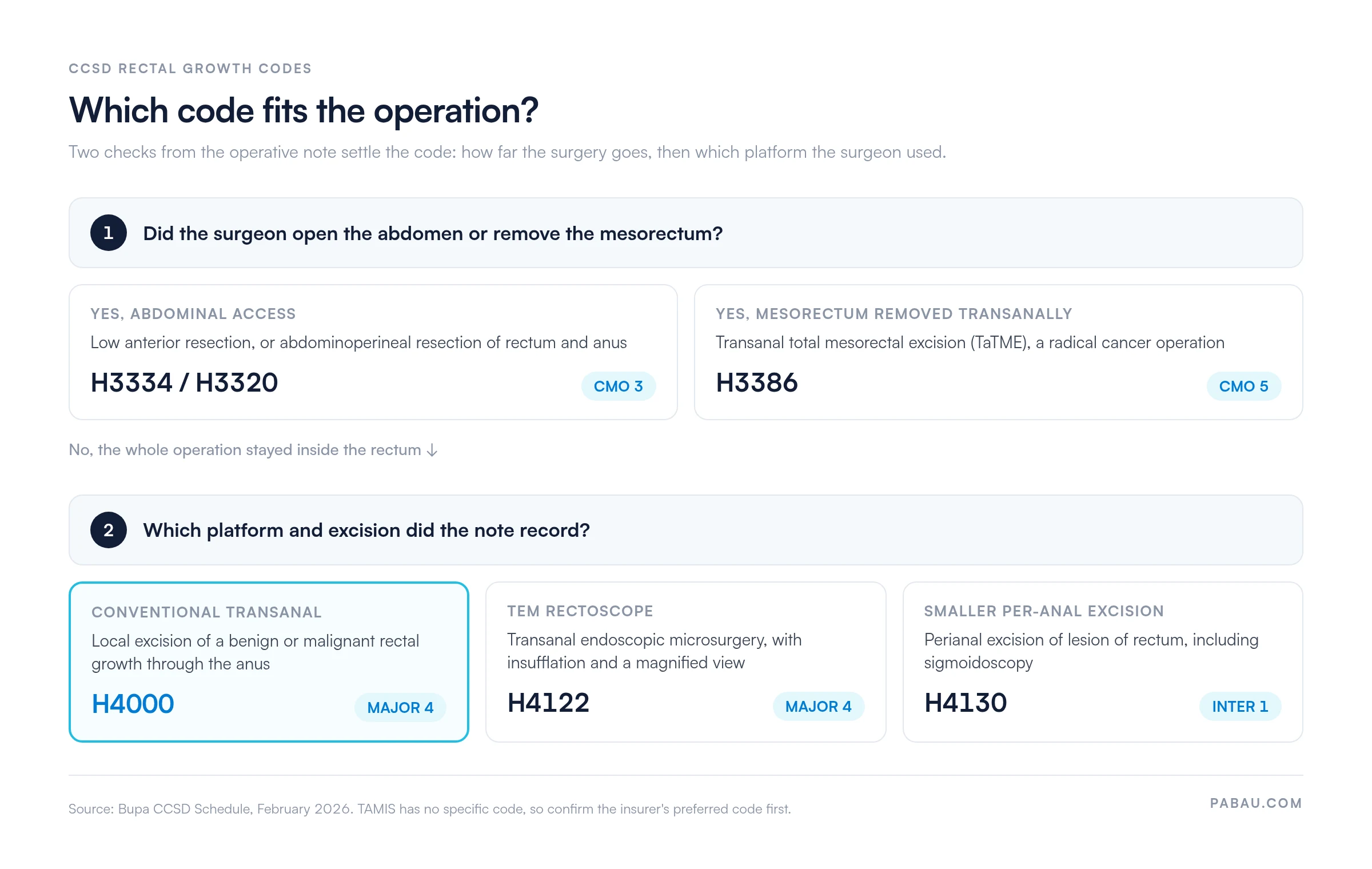
The access platform decides which code applies:
H4130, perianal excision of lesion of rectum (including sigmoidoscopy), covers smaller per-anal excisions. Bupa grades it INTER 1 at £245, well below H4000, so the operative note must justify the higher code.
Transanal local excision suits rectal growths that can be removed whole without a radical resection. Typical indications include:
When the growth is a cancer, staging still follows the TNM 8th edition. UICC’s colorectal-specific TNM 9 update is expected later in 2026. The operative note and pre-operative imaging should support the stage you record. Excision of a T3 lesion without a documented MDT decision is likely to draw an audit query.
For a benign growth, the claim rests on the biopsy result. Add the size or position that ruled out endoscopic removal.
Several CCSD codes bill operations on a rectal growth. They split by access route and by how much tissue comes out. Check the code against the Bupa CCSD code reference before you submit.
Code titles and grades come from Bupa’s CCSD Schedule reference, February 2026 edition. The CCSD Group issues bulletins through the year, so check the current edition before you submit.
The most common error since 2025 is coding from the old descriptor. Some coders still reserve H4000 for cancer and send a benign adenoma excision elsewhere. Since March 2025, a transanal excision of a benign growth belongs on H4000 too.
TEM is the second trap. A TEM excision is billed as H4122, even though both codes share the MAJOR 4 grade. Name the platform in the operative note, so the code matches the technique.
The third is the abdominal boundary. If the surgeon opens the abdomen or places laparoscopic ports, the operation is no longer H4000. Radical operations such as anterior resection, APR and TaTME carry their own codes. A colon resection does too, so excision of the sigmoid colon is billed as H1000.
The flow below runs those checks in order, starting with the abdominal boundary and then the platform.
H4000 covers the transanal excision itself. That includes tissue handling, hemostasis, and closure or packing of the defect in the same operative episode.
CCSD billing splits the episode between providers. The surgeon, anesthetist and any assistant each invoice the insurer, and H4000 appears only on the surgeon’s claim. These items are billed separately:
Confirm theater and recovery charges with the hospital billing team before you invoice. A recovery fee the hospital already charges is a frequent cause of duplicate-claim flags.
Check the Healix and Cigna fee schedules for their unbundling rules on colorectal procedures. Both insurers publish guidance on which concurrent codes they accept alongside a primary colorectal code. Submitting histopathology or assistant fees without confirming acceptance is a fast route to a partial denial.
Insurers expect an operative record that proves the transanal route and justifies H4000 over a neighboring code. The operative note should record:
Supporting documents strengthen the claim. Send the biopsy report and, for a cancer, the MRI or endorectal ultrasound staging and the MDT outcome. For a large adenoma, add the endoscopy report that shows why polypectomy wasn’t suitable.
Digital operative documentation captures each of these fields at the point of care, so the note is complete before the claim goes in.
UK private insurers expect pre-authorization before an elective H4000 operation. Treat it as mandatory, because a claim without an authorization reference is usually rejected. The request typically includes:
Bupa, AXA Health and Aviva run online pre-authorization portals, while WPA and smaller insurers may take phone or written requests. The Healix fee schedule sets out the clinical evidence it expects for major colorectal procedures.
A request that quotes the old cancer wording for a benign adenoma invites a query. Quote the current descriptor, and carry the reference number onto the invoice.
Record the insurer authorization reference against each billing party (surgeon, anesthetist and assistant) before any invoice goes out. Mismatched or missing reference numbers on multi-party claims cause processing delays, even when the clinical documentation is complete.
H4000 denials follow a consistent pattern. Check each cause below before you submit.
For an appeal, send the full operative note, the histology and staging documents, and the authorization record. If an emergency prevented pre-authorization, explain why. The Aviva fee schedule guidance describes an appeals process typical of the major UK insurers.
Consultants who work in both sectors need both systems. The NHS codes procedures in OPCS-4, while private claims use CCSD.
In OPCS-4, transanal excision of a rectal lesion sits in Chapter H, “Lower Digestive Tract”. The category is H41, “Other operations on rectum through anus”, at codes such as H41.2 and H41.5. The fourth character depends on the technique recorded in the note.
Confirm the exact code in the NHS Classifications Browser. Use the NHS episode code as a guide to the CCSD code, because a one-to-one match isn’t always possible. For the private claim, the CCSD descriptor is the controlling text.
Consultants working across NHS and private sectors should keep the two coding systems separate in their records.
A clean H4000 claim follows the same sequence from referral to payment. A missed step at any point risks a denial or a delay.
Claims management software that tracks each step keeps claims moving on busy colorectal lists with several insurers. Our guide to UK medical billing software compares the systems that submit through Healthcode.
Paperwork for a transanal excision often ends up in three places. The operative note sits in one system, the invoice in another, and the claim is re-keyed into Healthcode. Each hand-off risks an outdated descriptor or a lost authorization reference.
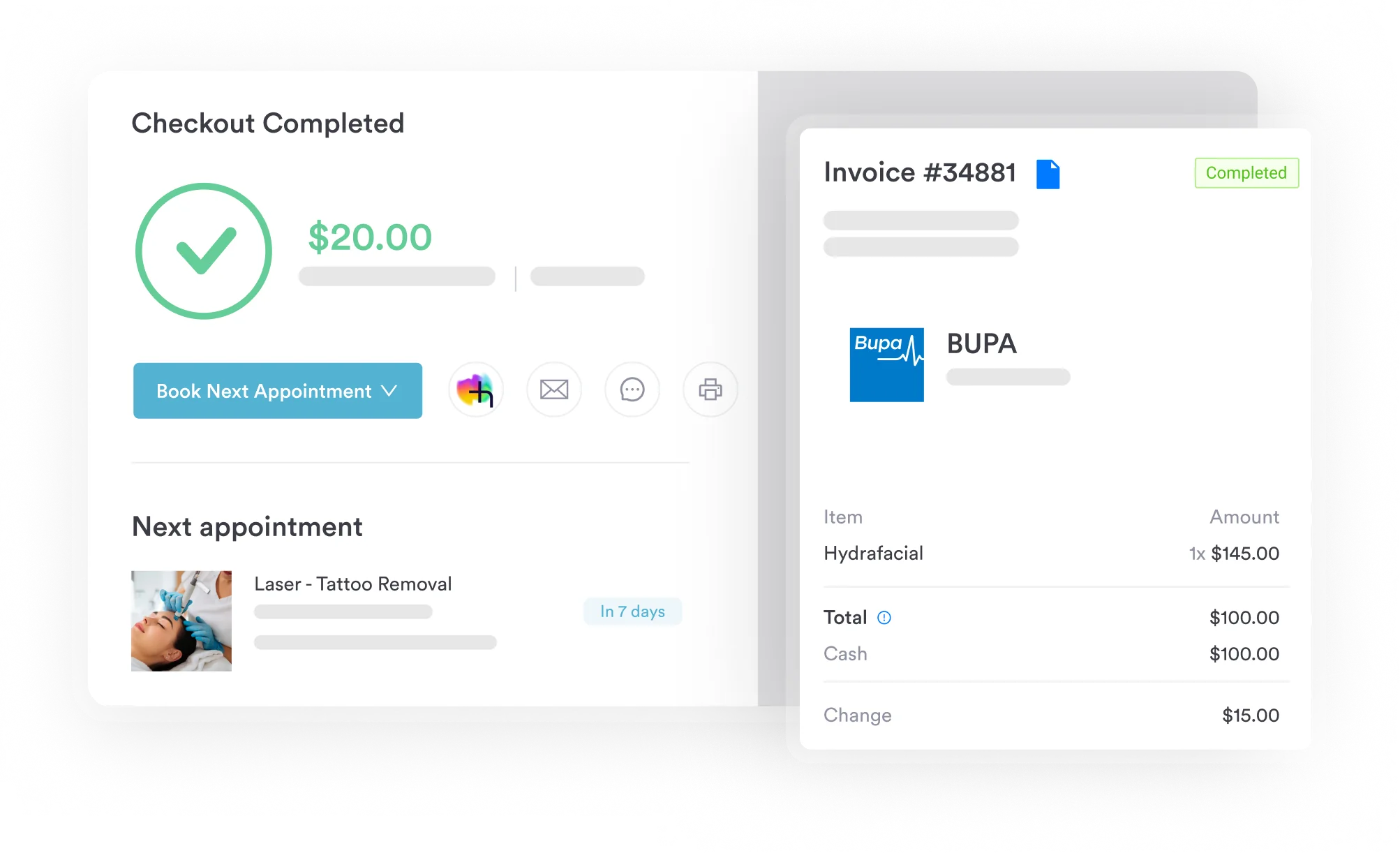
Pabau’s Healthcode integration turns the invoice you already raise into an electronic claim. The code, amounts and patient details carry over, and Healthcode’s validation rules check the claim before it’s sent.
The operative note, consent forms and biopsy report sit on the same patient record as the invoice. When an insurer queries a claim, your team finds the evidence in one place, and the claims dashboard shows its status until it settles.

Pabau turns the invoice for an H4000 operation into a Healthcode claim and checks it before it’s sent. The operative note stays on the same patient record.

Code H4000 from the descriptor the CCSD Group adopted in March 2025. It covers any local rectal growth excised through the anus, benign or malignant, and a TEM excision goes on H4122.
Before you submit, confirm three facts. The note records a purely transanal route, it names the platform, and the insurer has issued an authorization reference. If one is missing, hold the claim, because a short delay costs less than a rejection and a full resubmission.
To see how Pabau turns colorectal invoices into validated Healthcode claims you can track, book a demo.

Revising a pouch after restorative proctocolectomy? CCSD Code H0480 explains when the abdominal revision code applies.
CCSD Code H4000 covers transanal resection for local rectal growth. It applies when a surgeon removes a benign or malignant rectal growth through the anus, with no abdominal incision. The code includes the excision, hemostasis and defect management. Anesthesia, histopathology and assistant fees are billed separately.
No. Until March 2025, the descriptor read “Transanal resection for rectal cancer”. The CCSD Group’s Bulletin Issue 200 (Request 7362) changed it to “Transanal resection for local rectal growth”. The code now covers benign adenomas as well as early cancers.
No. Transanal endoscopic microsurgery has its own CCSD code, H4122. Bupa grades both H4000 and H4122 as MAJOR 4. Record the platform in the operative note, so the code matches the technique.
H4000 uses only a transanal route, with no abdominal entry and no mesorectal excision. Anterior resection needs open, laparoscopic or robotic abdominal access and has its own codes, such as H3334 for a low anterior resection. Any abdominal component rules out H4000.
Insurers expect an operative note that confirms the transanal route, platform, lesion position, excision depth and margins. Add the biopsy report. For a cancer, also send MRI or endorectal ultrasound staging and the MDT outcome letter. The pre-authorization reference must appear on the invoice.
Yes. The surgeon and anesthetist each submit their own invoice. H4000 goes on the surgeon’s claim, and the anesthetist uses their own CCSD anesthetic code. Both claims share the authorization number and hospital episode.



