CCSD code F4600 – Incision or drainage of salivary gland abscess or haematoma
Code Definition
F4600 is the CCSD code for incision or drainage of abscess or haematoma of salivary glands (i.e. including submandibular, parotid and sublingual glands). It replaced three older incision codes, F4610, F4620 and F4630, which covered each gland separately.
The operative note needs to name the gland and the pathology. An abscess usually pairs with ICD-10 code K11.3, and collections outside the gland take a different code.
Related Information
Group
6.0.0 Face, Mouth, Salivary & Thyroid
Category
6.6.0 Salivary Glands
Subcategory
Ff.051 Incision or drainage of abscess or haematoma of salivary glands
Incision or drainage of salivary gland abscess or haematoma
Codes
Suggested by Pabau AI
F4600Incision or drainage of salivary gland abscess or haematoma
CCSD Code Suggestion
AI
Suggested code
F4600Incision or drainage of salivary gland abscess or haematomaHigh match
Confidence score
98%
Why this code?
Matches patient diagnosis
Supported by clinical notes
Commonly used for this condition
Why practices choose Pabau
Save hours every week
Automate repetitive tasks and focus on what matters most—your patients.
Improve accuracy
Reduce coding errors and ensure compliance with the latest regulations.
Get paid faster
Clean claims, fewer denials, and faster reimbursements.
Grow with confidence
Powerful insights and reporting to help your practice thrive.
HIPAA compliant•SOC 2 certified•GDPR-compliant•Trusted by 4,000+ clinics worldwide
Key takeaways
CCSD code F4600 covers incision or drainage of an abscess or haematoma in the submandibular, parotid or sublingual gland.
The operative note must name the gland, the pathology type (abscess or haematoma) and the anaesthesia used to support a valid claim.
Pre-authorization rules vary by insurer and presentation, and emergency cases treated first must still be notified promptly.
Pabau, the practice management platform we build, supports CCSD billing with linked clinical notes, insurer claim submission and audit-ready records.
CCSD code F4600: What the descriptor covers
CCSD code F4600 covers incision or drainage of an abscess or haematoma of the salivary glands, including the submandibular, parotid and sublingual glands. It sits in the face, mouth, salivary and thyroid chapter of the CCSD schedule. UK private practices use that framework to bill insurers such as Bupa, AXA Health and WPA.
The official wording is “incision or drainage”, so the code is not limited to drainage alone. It absorbed three older incision codes, F4610, F4620 and F4630, which once covered the parotid, submandibular and sublingual glands separately.
Two pathologies share this single code. An abscess is a collection of pus caused by bacterial infection. A haematoma is a collection of blood, usually after trauma or as a post-operative complication.
Both bill under F4600 when the surgeon incises or drains the gland collection and the gland remains in situ. Collections outside the gland, such as lymph nodes, submandibular space infections and other head and neck abscesses, take different codes.
Like every entry in the CCSD codes set, F4600 is for private practice use only. It has no NHS equivalent billing code, and it should never appear on an NHS claim form.
Which procedures and glands does F4600 cover?
F4600 applies to incision or drainage at any of the three major salivary glands named in the official CCSD descriptor. Each gland has its own anatomy, which shapes the surgical approach and the clinical notes the claim needs.
Gland
Location
Pathology covered
Surgical approach note
Submandibular gland
Floor of mouth / submandibular triangle
Abscess or haematoma
May be approached intraorally or through an external neck incision, so note the approach used
Parotid gland
Preauricular / retromandibular region
Abscess or haematoma
Proximity to the facial nerve usually warrants general anaesthesia (GA); document the anaesthesia choice and any nerve monitoring
Sublingual gland
Floor of mouth, anterior
Abscess or haematoma
Usually approached intraorally under local anaesthesia (LA), so document floor of mouth access and the extent of drainage
The code covers both abscess and haematoma at all three sites within a single billing entry. If two separate glands need drainage in the same session, check the CCSD technical guide for multiple-procedure rules before submitting two F4600 codes.
How the procedure is performed: Clinical steps
Knowing the operative sequence helps coders check that the documentation reflects what was done. Parotid cases usually go ahead under general anaesthesia because of the facial nerve and the careful dissection involved. Submandibular and sublingual cases may proceed under local anaesthesia or sedation, depending on patient cooperation and the size of the collection.
Patient positioning and anaesthesia: The patient lies supine with the head extended. The operative note records the anaesthesia choice (GA or LA), along with any sedation or nerve monitoring used.
Incision planning: The incision is sited over the point of maximum fluctuance. For parotid cases, it follows a skin crease in front of the ear to minimize scarring and facial nerve risk.
Incision and blunt dissection: A stab incision opens the abscess cavity. Blunt dissection widens access and breaks down loculations without damaging adjacent structures.
Drainage and irrigation: Pus or blood is evacuated. The cavity is irrigated with saline until the return runs clear. The volume and character of the aspirate should be documented.
Drain insertion and wound management: A corrugated or Yates drain is placed and secured. The wound is dressed, and drain management instructions are recorded for post-operative review.
Microbiological sampling: In abscess cases, a swab or aspirate for culture and sensitivity is taken before irrigation. Antibiotic sensitivities guide adjunct therapy.
Antibiotics alone rarely resolve a fluctuant salivary gland abscess. Surgical drainage is the accepted standard of care once a collection has formed. The operative note should show that clinical reasoning, particularly when antibiotics were tried first and failed.
Clinical indications: When is F4600 appropriate?
Submitting F4600 without documented clinical justification is the fastest route to a denial. Insurers expect the record to show that surgery was clinically necessary, not merely convenient.
Fluctuant swelling: A palpable fluid collection that does not resolve with antibiotics within 24 to 48 hours is the primary indication. The operative note should describe fluctuance on examination.
Failed conservative management: Document the antibiotic prescribed, the dose, the length of treatment and the absence of clinical improvement before escalating to surgery.
Systemic signs of sepsis: Pyrexia, raised inflammatory markers or trismus (especially in submandibular cases) justify urgent drainage without a long antibiotic trial.
Haematoma with mass effect: A post-operative or traumatic haematoma causing pain, limited mouth opening or airway risk warrants drainage regardless of infection status.
Imaging confirmation: Ultrasound or CT findings showing a defined fluid collection support the clinical decision and strengthen the claim documentation.
In parotid cases, the risk to the facial nerve is itself a reason to operate under GA rather than LA. Record that reasoning in the anaesthetic assessment notes.
Documentation requirements for a valid F4600 claim
CCSD code F4600 claims are often rejected because the clinical record lacks the details insurers need to adjudicate them. The table below sets out the required elements.
Documentation element
What to record
Why it matters
Named gland
Name the gland: Submandibular, parotid or sublingual
Confirms the procedure is within F4600 scope, as a vague “salivary gland” is not enough
Pathology type
Abscess or haematoma, with clinical description
Confirms the collection fits the F4600 descriptor and drives the ICD-10 pairing
Anaesthesia type
GA, LA or sedation, plus the agent and dose if LA
Determines whether a separate anaesthetic code can be submitted alongside F4600
ICD-10 diagnosis code
K11.3 (abscess of salivary gland) for an abscess. K11 has no dedicated haematoma code, so pick the closest match, such as K11.8 (other diseases of salivary glands), per the insurer
Required on the claim form, and a diagnosis that does not fit the procedure invites rejection
Primary evidence of the procedure, so it should match the CCSD descriptor language
Referral letter (if applicable)
GDP or GP referral into secondary care OMFS
Some insurers require a referral to confirm the episode is insured secondary care
Store these records in the patient’s clinical record and link them to the claim before submission. Digital operative note templates reduce the risk of a missed field when the team is under pressure in an urgent case.
Pabau’s patient records keep the operative note, anaesthesia record and diagnosis code in one file, so each F4600 claim goes out with its evidence attached.
Pre-authorization: Do insurers require approval before treatment?
Pre-authorization requirements for F4600 vary between insurers and depend on whether the presentation is elective or an emergency. Policies also change, so check the current position on each insurer’s provider portal before submitting a claim.
Elective presentations: For a salivary gland abscess or haematoma found in a planned outpatient setting, most major UK insurers are likely to require pre-authorization. Obtain written approval and keep the authorization reference on the claim.
Emergency or urgent presentations: Same-day drainage for sepsis, airway risk or a rapidly expanding haematoma may leave no time for pre-authorization. Notify the insurer as soon as practicable (typically within 24 to 48 hours) and document the clinical urgency in full.
Insurer-specific guidance:Bupa’s code search portal lets providers check pre-authorization requirements by CCSD code. WPA’s medical fees schedule sets out its provider requirements for surgical procedures. Always check the current payer schedule rather than relying on previously approved claims.
Missing pre-authorization is a common reason an otherwise well-documented F4600 claim is denied. If that happens, check the insurer’s appeals process before resubmitting.
Pro Tip
Keep a pre-authorization log separate from the clinical record. Note the insurer name, the date you requested authorization, the reference number and the name of the person who approved it. When a claim is queried months later, this log settles the dispute quickly.
Adjacent CCSD codes: What F4600 is not
Choosing the right code means ruling out the neighboring procedures in the CCSD salivary gland section. The table below maps the key boundaries to prevent upcoding or undercoding.
Procedure
CCSD code
Key distinction from F4600
Incision or drainage of abscess or haematoma, salivary glands
F4600 (this code)
Incision or drainage of the gland collection, with the gland left in situ
Excision of submandibular gland
F4440
Gland is removed, with substantially higher procedural complexity
Excision of parotid gland (total or partial)
F4400, or F4430 for partial excision preserving the facial nerve
Partial or total gland removal with facial nerve dissection
Excision of sublingual gland
F4450
Gland is removed rather than drained
Open extraction of calculus from submandibular duct
F5120
Removes a stone from the duct, and infection may coexist but the procedure is distinct
Sialoendoscopy (diagnostic or therapeutic)
Separate CCSD endoscopy code
Endoscopic access through the duct rather than incision or drainage of a gland collection
Incision and drainage of head and neck abscess (non-gland)
Separate CCSD code for soft tissue I&D
Applies when the abscess sits in the submandibular space, Ludwig’s angina or other fascial spaces, not the gland itself
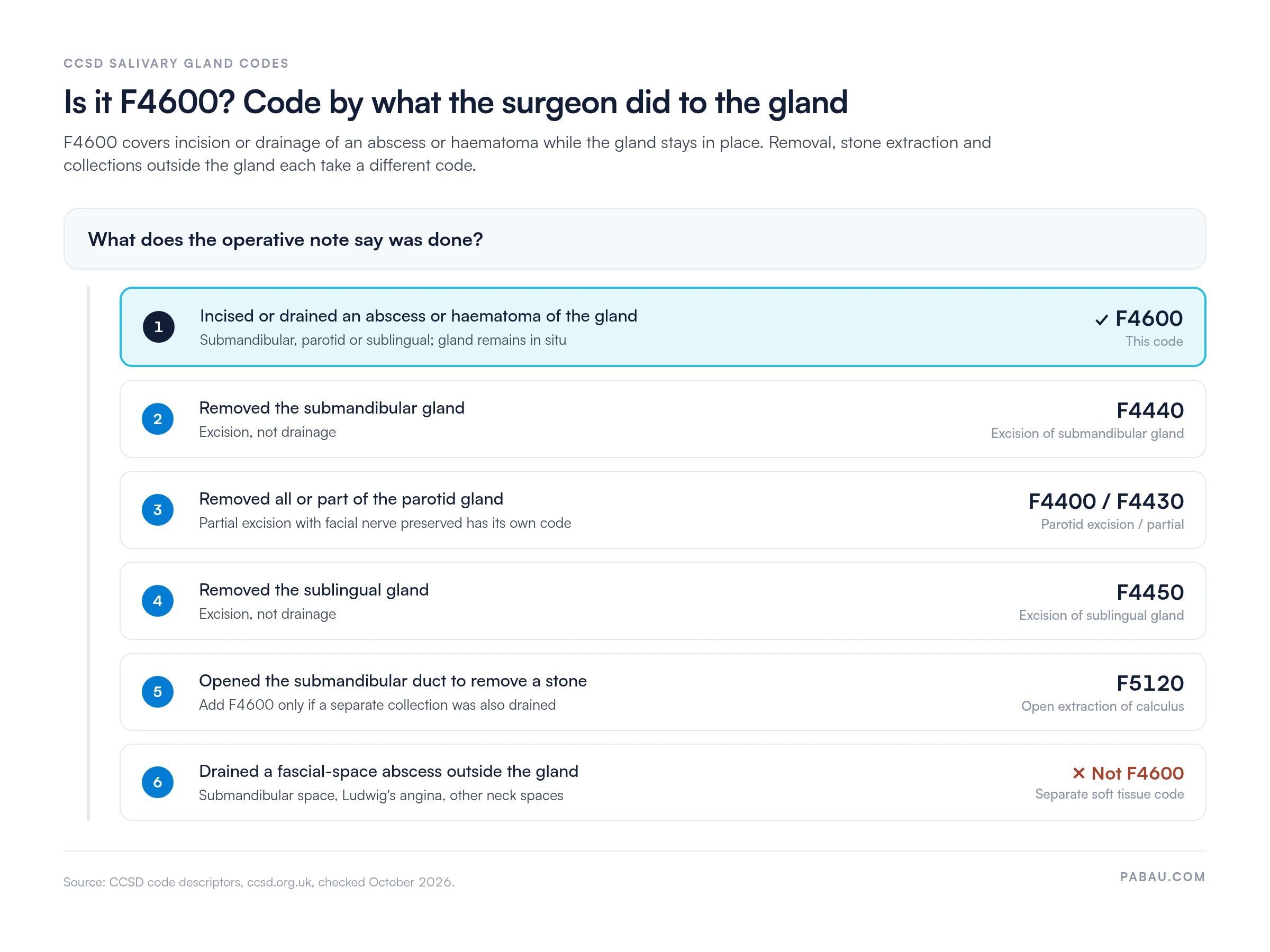
When the operative note records removal rather than drainage, the claim belongs under an excision code. That means F4440 for the submandibular gland or F4400 for the parotid.
Open removal of a stone from the submandibular duct bills under F5120, with F4600 added only when a separate collection was also drained. The chart below sorts each operative finding into its code.
The deciding question is what happened to the gland, since drainage with the gland left in place is the only route to F4600. Code numbers and descriptors are from the CCSD schedule.
Check adjacent code numbers against the current CCSD schedule before publishing internal coding guidance or training materials, because the schedule is updated periodically.
Common claim denial reasons for F4600
Each of the denial triggers below has a simple corrective action, so most are preventable before the claim goes out.
Gland not specified in notes: The operative record says “salivary gland abscess drained” without naming the gland. Update the note to name it (submandibular, parotid or sublingual) before submitting.
Abscess vs haematoma not distinguished: The claim codes the pathology as “abscess” while the note describes blood-stained fluid consistent with haematoma, or vice versa. The ICD-10 diagnosis code will also be inconsistent. Align the pathology description, operative note and diagnosis code before resubmission.
No pre-authorization reference: The insurer’s system cannot find an authorization on file. Attach the written authorization or, for emergency cases, the record of urgency and the timestamp of the retrospective notification.
Missing or inadequate operative note: The claim goes in with only a brief treatment note rather than a formal operative record. Add an addendum covering the elements in the documentation table above.
Wrong diagnosis code: A soft tissue abscess ICD-10 code is used instead of K11.3 (abscess of salivary gland). Resubmit with the correct pairing and a brief covering letter explaining the amendment.
Procedure billed under wrong code: A stone removal performed in the same session as drainage is billed as a single F4600. Code separate procedures individually, subject to CCSD bundling rules.
Bundling rules: Billing F4600 alongside other codes
Whether F4600 can go on the same claim as other CCSD codes depends on the clinical facts and the insurer’s unbundling policy. The positions below reflect common practice, but verify each against the current payer schedule and the CCSD technical guide.
Anaesthesia codes: Under GA, the anaesthetist may bill a separate CCSD anaesthesia code if they are an independent provider submitting their own claim. If the surgeon gives LA themselves, the local anaesthetic is typically bundled into F4600 and not billed separately.
Consultation codes: Insurers often query a consultation billed on the same date as F4600. It needs to have clearly preceded the surgical decision as a separate encounter. If assessment and drainage happened in one appointment, bill only F4600 unless the insurer’s schedule allows same-day consultation billing.
Post-operative review: A post-operative review code is generally billable at a later appointment if the insurer’s schedule includes one. The review must be a separate encounter with its own note.
Stone removal at the same session: A duct stone can cause obstructive sialadenitis complicated by abscess. If both are treated in one session, bill the matching stone-removal code alongside F4600 and document both procedures fully. Insurers may query the combination, and a covering letter explaining the coexisting pathologies reduces the risk of denial.
The Healix fee schedule publishes specific unbundling rules for surgical procedures. It is a useful reference for practices whose patients are insured through Healix-administered schemes.
Pro Tip
When submitting two CCSD codes for the same operative session, include a brief covering letter with the claim. Explain in two sentences what was found and why both procedures were necessary. A clear explanation up front heads off many multi-procedure queries before they delay payment.
Using Pabau to manage CCSD F4600 billing
Private dental and maxillofacial practices billing F4600 manage a documentation chain from operative note to diagnosis code, pre-authorization and claim. Pabau’s claims management software keeps that chain intact from the moment the procedure is recorded.
Pabau sends claims to UK insurers through Healthcode, so an F4600 claim leaves with its CCSD code, diagnosis code and authorization reference attached.
CCSD code library: Practitioners pick F4600 straight from the CCSD code set inside the treatment record. That avoids the transcription errors of typing codes by hand.
Linked clinical notes: Operative notes are stored against the appointment and linked to the claim. The payer receives the documentation with the code, with no separate upload.
Insurer-specific workflows: Workflows can be set up per insurer, prompting the team to capture pre-authorization references and diagnosis codes before the claim is finalized.
Audit trail: Every change to a clinical record or claim is timestamped and attributed to its author. That supports General Dental Council (GDC) record-keeping duties and insurer audit requests alike.
For practices also billing other Bupa CCSD procedure codes across a wider oral surgery caseload, Pabau handles several CCSD codes within a single patient episode.
Manage CCSD billing without the admin overhead
Pabau links operative notes to each claim, sends it to UK insurers through Healthcode and keeps the audit trail ready for any pre-authorization query.
Reach for F4600 when the note shows a collection inside a major salivary gland was incised or drained, and the gland stayed put. Excision, duct stones and fascial-space abscesses each belong under a different code, and picking the wrong one invites a query.
The trade-off is a few extra minutes on the note. Naming the gland, the pathology and the anaesthesia takes longer to write, but it is what keeps the claim from coming back weeks later.
Book a demo to see how Pabau carries an F4600 claim from operative note to insurer submission without re-keying.
Continue your research
Need a broader overview of CCSD codes for private dental billing?Bupa CCSD procedure codes covers the full code set structure and how to submit claims to Bupa.
Looking to streamline how your practice handles private claims?Pabau claims management links clinical notes to CCSD submissions and tracks authorization status in one place.
Sending tissue for diagnosis rather than draining a collection?CCSD code F4810 covers open biopsy of a salivary gland and the notes it needs.
Removing only part of the parotid?CCSD code F4430 explains billing for partial parotid excision with the facial nerve preserved.
Is the sublingual gland coming out altogether?CCSD code F4450 sets out the excision code and its documentation.
Frequently asked questions
What does CCSD code F4600 cover?
CCSD code F4600 covers incision or drainage of an abscess or haematoma of the submandibular, parotid or sublingual gland. It applies only to collections in those glands. Drainage of adjacent fascial spaces or lymph nodes falls under different CCSD codes.
Which salivary glands are included under CCSD F4600?
F4600 includes all three major salivary glands, namely the submandibular, parotid and sublingual glands. The operative note must name the gland treated, because a generic reference to “salivary gland” is not enough for claim adjudication.
What supporting evidence do insurers require for this code?
Insurers typically want a formal operative note naming the gland and pathology type, plus the anaesthesia record. They also expect an ICD-10 diagnosis, such as K11.3 for an abscess, and the clinical indication behind surgery. Add a pre-authorization reference wherever the payer’s policy requires one.
Can F4600 be used for both abscess and haematoma of the parotid gland?
Yes. The CCSD F4600 descriptor covers both abscess and haematoma at all three named glands, including the parotid. State the pathology type clearly in the operative note and match it to the right ICD-10 diagnosis code on the claim form.
Why do F4600 claims get denied?
Claims usually fail because the operative note leaves out the gland or mixes up abscess and haematoma. A missing pre-authorization reference or a mismatched diagnosis code also triggers denials. So does an operative note too brief to support the claim.
Is pre-authorization required before submitting F4600 to a dental insurer?
It depends on the insurer and the presentation. Many UK insurers expect pre-authorization for elective salivary gland surgery, while emergency cases may be treated first and notified afterward. Check each insurer’s current policy through its provider portal, as requirements change.