CCSD code F5120 – Submandibular duct calculus open extraction
Billable Code
Code Definition
F5120 is the CCSD code for open extraction of calculus from the submandibular duct. It covers removing a salivary stone from Wharton's duct through an intraoral incision, usually by an oral and maxillofacial surgeon.
Bupa's schedule places F5120 in fee category INTER 1. Endoscopic retrieval (F4831), combined open and endoscopic removal (F5121), parotid duct stones (F5110), and removal of the submandibular gland (F4440) each take their own code.
Related Information
Group
6 Face, mouth, salivary and thyroid
Category
Salivary Glands
Bupa fee category
INTER 1
Billable
Yes
Code also known as
open sialolithotomy, transoral calculus removal, Wharton's duct stone removal, salivary stone extraction
Save time. Improve accuracy. Get paid faster.
Automate coding with Pabau
Let Pabau's smart automation suggest the right codes, reduce claim denials, and keep your practice compliant—effortlessly.
F5120Submandibular duct calculus open extractionHigh match
Confidence score
98%
Why this code?
Matches patient diagnosis
Supported by clinical notes
Commonly used for this condition
Why practices choose Pabau
Save hours every week
Automate repetitive tasks and focus on what matters most—your patients.
Improve accuracy
Reduce coding errors and ensure compliance with the latest regulations.
Get paid faster
Clean claims, fewer denials, and faster reimbursements.
Grow with confidence
Powerful insights and reporting to help your practice thrive.
HIPAA compliant•SOC 2 certified•GDPR-compliant•Trusted by 4,000+ clinics worldwide
Key takeaways
CCSD code F5120 covers open surgical extraction of a calculus from the submandibular (Wharton’s) duct, performed by a specialist oral and maxillofacial surgeon.
The primary ICD-10 diagnosis to pair with it is K11.5 (sialolithiasis), with K11.2 (sialoadenitis) added only when infection is documented.
Bupa places F5120 in fee category INTER 1, while parotid duct stones (F5110) and submandibular gland excision (F4440) take their own codes.
Most UK private insurers, including Bupa and AXA Health, require pre-authorization before F5120 is performed, and a missing authorization is a common cause of denial.
Practice management software like Pabau keeps the CCSD code, pre-authorization reference, and operative note on one patient record for claim submission.
CCSD code F5120: Definition and scope
CCSD code F5120 is the procedure code for open extraction of calculus from the submandibular duct. It is maintained by the Clinical Coding and Schedule Development (CCSD) group, which sets the procedure codes used across UK private healthcare. Bupa, AXA Health, Aviva and Vitality all bill against CCSD codes, so the schedule covers far more than dental or oral surgery.
The descriptor is specific. The procedure targets the submandibular duct (Wharton’s duct), not the gland itself, and the approach is open surgery. Endoscopic stone removal and gland excision each take a different code, so billing F5120 for either will trigger a denial.
Within the schedule, F5120 sits in chapter 6 (face, mouth, salivary and thyroid) under the salivary glands section. Bupa places it in fee category INTER 1, with a fee of £245. The full index of CCSD codes lists every neighboring procedure, and the comparison further down covers the salivary codes most often confused with F5120.
The procedure: How open sialolithotomy is performed
Open extraction of a submandibular duct calculus is an intraoral surgical procedure. The approach, anesthesia type, and exact technique depend on the stone’s size and position along Wharton’s duct.
Patient assessment and anesthesia selection. The surgeon confirms stone location with ultrasound, CT, or sialography. Stones in the anterior portion of Wharton’s duct are typically removed under local anesthesia (LA). Posterior or deeply placed stones, or procedures in pediatric or anxious patients, may require general anesthesia (GA). Whether GA is separately billable depends on the insurer, so verify it with each payer before billing.
Duct identification and incision. The patient’s tongue is retracted and the submandibular duct identified along the floor of the mouth. An intraoral incision is made over the palpable stone or directly over Wharton’s duct at the appropriate point.
Stone removal. The calculus (sialolith) is isolated and extracted. Care is taken not to damage the lingual nerve, which runs in close proximity. Multiple stones, if present, are removed in the same episode.
Duct management. Depending on the extent of the incision, the duct is either sutured closed or marsupialized. Marsupialization leaves the duct open to create a wider drainage opening, particularly where recurrent obstruction is a concern.
Post-operative documentation. The operative note must specify the approach (intraoral open), confirm stone removal, document the stone size and number, and record the duct management technique. This note is required for claim substantiation.
Open extraction is the definitive treatment when conservative measures (hydration, massage, sialogogues) have failed and the stone cannot be addressed endoscopically. It offers direct visualization and a high stone clearance rate, which makes it a standard approach for palpable anterior submandibular duct stones.
Clinical indications: When is F5120 the right code?
F5120 is the right code when the referral and operative note document the criteria below. Billing staff should confirm each one is clearly stated before submission.
Confirmed submandibular duct calculus on imaging. Ultrasound, CT, or sialography must demonstrate a stone within Wharton’s duct. A clinical suspicion alone is not sufficient documentation.
Stone size or location precluding endoscopic retrieval. Sialendoscopy can typically address stones up to approximately 4-5 mm. Larger stones, or those at acute duct angulations, sit outside endoscopic techniques and need open extraction.
Failed conservative management. The clinical record should reflect at least one episode of conservative treatment before open surgery. That means hydration, massage, and antibiotics if sialoadenitis is present.
Recurrent obstructive episodes. Patients with repeated submandibular swelling, pain on eating, or episodes of sialoadenitis attributable to the calculus are appropriate candidates.
Absence of gland atrophy. Where chronic obstruction has left the submandibular gland significantly atrophied, removing the gland may be more appropriate than duct extraction alone.
Open extraction is usually performed by an oral and maxillofacial surgeon. Oral and maxillofacial surgery (OMFS) is a specialty on the General Medical Council (GMC) Specialist Register, not a scope defined by the General Dental Council. Insurers expect a recognized specialist surgeon to bill F5120, so general dental practitioners don’t use it.
Adjacent CCSD salivary gland codes and how to choose between them
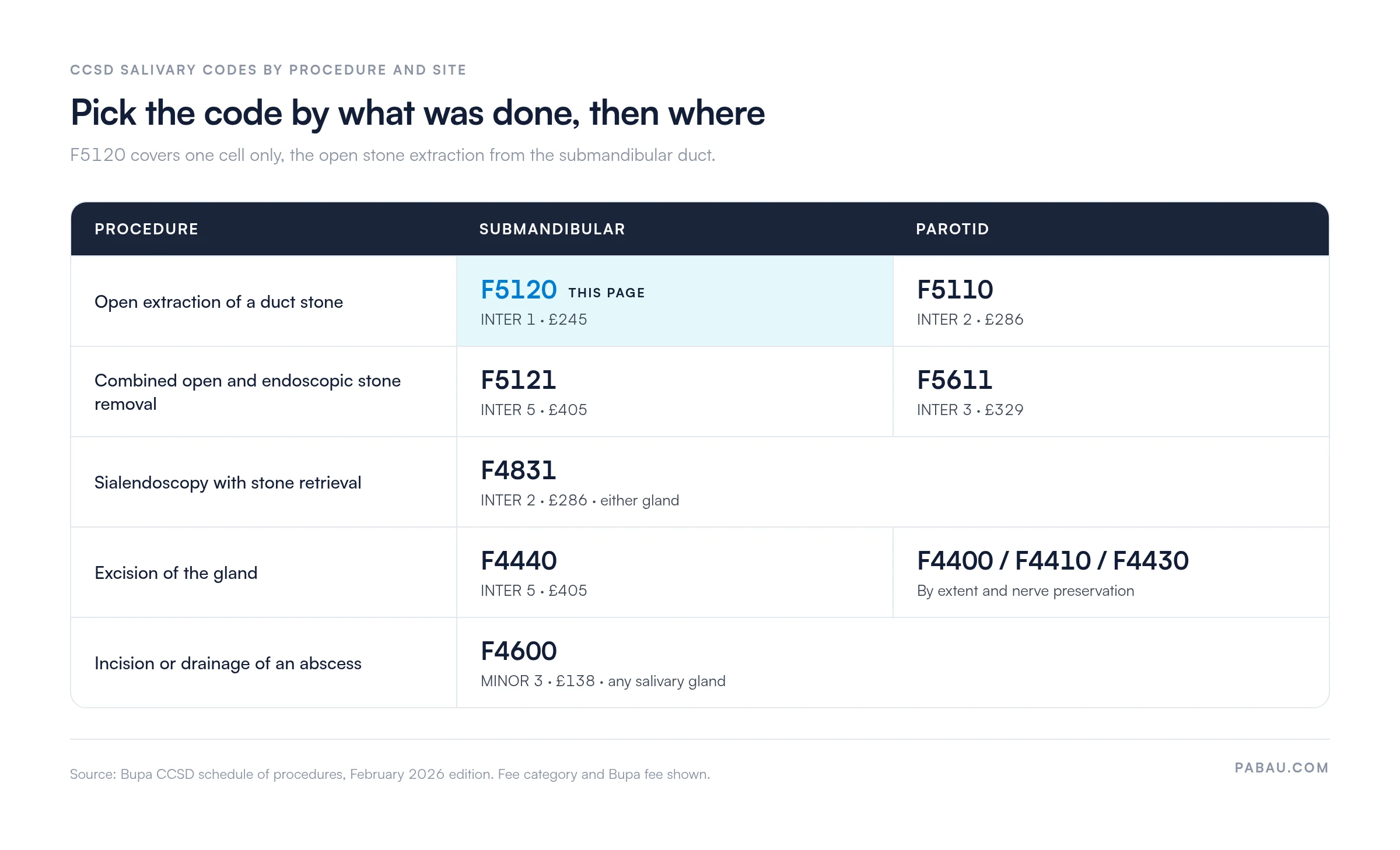
The salivary glands section of the CCSD schedule holds several closely related codes. Picking the wrong one is the most common error on these claims. Two questions settle it. What was done, and on which gland? The grid below answers both, with Bupa’s fee category for each code.
F5120 carries the lowest Bupa fee of the open and combined stone codes, so coding the wrong site or approach changes the payment. Figures from Bupa’s February 2026 CCSD schedule.
CCSD code
Descriptor
Key distinction
Bupa fee category
F5120
Open extraction of calculus from submandibular duct
Open surgical stone removal from Wharton’s duct specifically
INTER 1 (£245)
F5110
Open extraction of calculus from parotid duct
Same open approach, but on Stensen’s duct and the parotid gland
INTER 2 (£286)
F5121
Combined open and endoscopic removal of submandibular gland stone
An endoscope is used alongside the open incision in the same procedure
INTER 5 (£405)
F4831
Therapeutic sialendoscopy (including stone retrieval +/- dilation)
Endoscopic retrieval with no open incision
INTER 2 (£286)
F4440
Excision of submandibular gland
Whole-gland removal, distinct from duct extraction
INTER 5 (£405)
F4600
Incision or drainage of abscess or haematoma of salivary glands
Abscess or haematoma drainage, not stone removal
MINOR 3 (£138)
Decision rule: F5120 applies only when the approach is open, the target is the submandibular duct, and the procedure is stone extraction. If an endoscope was also used in the same procedure, the claim moves to F5121. If the whole gland is removed, it belongs under F4440 instead.
Diagnosis codes to pair with F5120
Every F5120 claim needs a paired ICD-10 diagnosis code. The primary code is K11.5 (sialolithiasis), which covers a calculus or stone in any salivary gland or duct, including Wharton’s duct. UK private insurers work from the WHO ICD-10, so use the four-character codes below rather than US ICD-10-CM subdivisions.
ICD-10 code
Description
Use when
K11.5
Sialolithiasis (calculus or stone of salivary gland or duct)
Always, as the primary diagnosis for every F5120 claim
K11.2
Sialoadenitis
Add as a secondary code when sialoadenitis is documented in the clinical record
K11.8
Other diseases of salivary glands
Secondary code only, for a documented salivary gland condition not captured elsewhere
The diagnosis must justify the procedure descriptor, which is open stone extraction from the submandibular duct. A diagnosis that points to an abscess or a gland needing removal supports a different procedure code, not F5120. Secondary codes are valid only when the matching condition is documented in the clinical record.
Documentation requirements for an F5120 claim
Missing documentation is one of the most common reasons F5120 claims get queried or refused. Treat this checklist as a pre-submission gate. If any item is absent, hold the claim and retrieve the record before submitting.
Referral letter. A letter from the referring clinician (GP, GDP, or specialist) confirming the diagnosis of submandibular duct calculus and the basis for surgical management.
Imaging report. Ultrasound, CT, or sialography report identifying the stone location within Wharton’s duct, including stone size where measurable. Most insurers require imaging to justify open surgery over conservative management.
Operative note. The note must state the open intraoral approach, confirm calculus removal, and record stone dimensions and number. It should also note the anesthesia type and the duct management technique (primary closure or marsupialization). A generic note that doesn’t name the duct or the approach is insufficient.
Anesthesia record. Required when GA is used. When LA is used, the operative note should state this explicitly.
Post-operative follow-up note. Some insurers require evidence that the procedure was completed successfully, particularly where complications occurred or where marsupialization was performed.
Pre-authorization reference. Where pre-authorization was obtained, include the authorization number on the claim form. Claims submitted without it may be rejected on administrative grounds, even when approval was granted.
Keep the referral letter, imaging report, and operative note against the same patient record. That way none of them goes missing between the surgical and billing teams. UK practices also have to hold these records in line with UK GDPR and the Data Protection Act 2018.
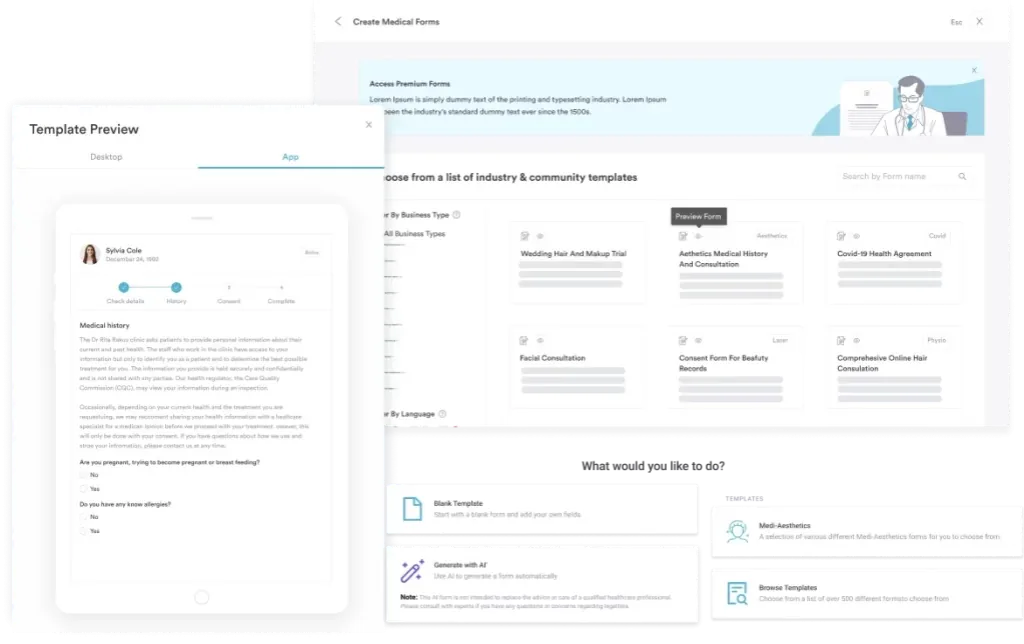
Pabau’s digital forms let you build a structured operative note template, so every F5120 note records the approach, duct site, and stone details insurers check.
Pre-authorization requirements from UK private insurers
Major UK private insurers treat F5120 as a planned surgical procedure, so pre-authorization is required before surgery. The exact evidence varies by payer, but the clinical submission package is broadly consistent.
Referral, clinical summary, CCSD code, confirmation of recognized surgeon
Cigna UK
Cigna provider helpline and patient-facing pre-auth
The member’s plan documents set the requirements, so contact Cigna directly
Insurer policies change regularly. Verify current pre-authorization requirements with each payer before submitting an F5120 claim. Record the date and outcome of each call or portal submission against the patient episode.
Common F5120 denial reasons and how to prevent them
F5120 claims are refused for a small number of recurring reasons, and most are preventable with a consistent pre-submission check. Each claim file carries special category health data under UK GDPR, so keep the checklist and its attachments in a secure system rather than email.
Denial reason
Root cause
Prevention
Wrong code: Gland vs duct
F4440 (gland excision) and F5120 (duct extraction) swapped on the claim
Confirm the operative note states duct extraction, not gland removal, and check the code against the table above
No pre-authorization
Procedure undertaken before insurer approval was sought or confirmed
Obtain and record the pre-auth reference number before scheduling surgery
Missing imaging evidence
Claim submitted without the radiology report confirming stone location
Attach the imaging report at submission and confirm it names the submandibular duct
Mismatched ICD-10 code
Diagnosis code does not match the clinical findings, such as an abscess diagnosis on a stone extraction
Use K11.5 as the primary code and add secondary codes only when documented
Non-specific operative note
Note does not confirm the open approach, duct site, or stone removal
Use a structured operative note template covering approach, anatomy, and stone details
Unbundling: GA billed separately
General anesthesia billed as a separate line when the insurer bundles it with F5120
Confirm each insurer’s anesthesia billing policy before submission
Pro Tip
Before submitting any F5120 claim, run a four-point check. Is the pre-auth reference recorded, and is K11.5 the primary ICD-10 code? Does the operative note name the submandibular duct and confirm open extraction? Is the imaging report attached? Catching one missing item here saves a full denial and resubmission cycle.
Bundling rules for F5120
Several ancillary services are commonly performed alongside open submandibular duct calculus extraction. Whether they can be billed separately depends on the insurer and how the clinical episode is structured.
General anesthesia. Some insurers bundle GA with the procedure code, while others allow it as a separate line under the anesthetist’s own code. Confirm with each payer individually.
Imaging (ultrasound / CT / sialography). Pre-operative imaging is typically billed as a separate episode before the procedure date and should not appear on the same claim as F5120. If imaging is performed on the day of surgery as a planning tool, check insurer policy.
Duct dilation or lavage. Dilation performed as a step before open extraction in the same episode is part of F5120. Don’t bill a separate dilation code for it.
Endoscopy in the same procedure. If a sialendoscope is used alongside the open incision, don’t bill F5120 plus F4831. The combined procedure has its own code, F5121.
Contralateral duct procedure. If stones in both submandibular ducts are removed on the same operating list, each side may be billable as a separate F5120. That is subject to insurer rules on bilateral procedures, so document the bilateral findings explicitly.
Abscess drainage (F4600). Drainage that happens as part of the same open extraction is not billed separately under F4600. A separately indicated abscess drainage in a distinct, earlier episode may be coded on its own.
Step-by-step guide to submitting an F5120 claim in the UK
F5120 claim submission follows a consistent eight-step workflow across most UK private insurers. A missed step usually causes a query or delay rather than outright rejection. The same steps apply to a first submission and to a resubmission.
Confirm insurer recognition. Verify that the treating surgeon holds current recognition with the patient’s insurer. An unrecognized consultant’s claims will be declined regardless of documentation quality.
Obtain referral and imaging. Confirm the written referral is in the file. Attach the imaging report (ultrasound, CT, or sialography) confirming the submandibular duct stone.
Request pre-authorization. Submit the request to the relevant insurer portal before booking the procedure. Record the authorization reference, the approving clinician’s name (where provided), and the date.
Complete the procedure and write the operative note. The note should be structured, specific, and completed on the day of surgery.
Raise the claim form. Enter F5120 as the procedure code and K11.5 as the primary diagnosis. Add the pre-auth reference, procedure date, anesthesia type, and the surgeon’s recognition number.
Attach supporting documents. The imaging report, referral letter, and operative note must accompany the claim. Some insurers accept electronic attachments through the portal, while others require postal or scanned submissions.
Submit via the insurer portal or billing address. Retain proof of submission, such as the portal confirmation email or a recorded delivery receipt.
Monitor for query or rejection. Set a follow-up reminder at 30 days. If a query arrives, respond within the insurer’s stated window and attach the requested documentation.
How Pabau helps practices manage CCSD billing for F5120
Today, an F5120 claim often lives in four places. The pre-auth reference sits in an email and the operative note in the surgical system. The imaging report is in a scanned folder, and the claim form is in the insurer portal. The billing coordinator spends the week chasing those pieces back together.
Pabau’s claims management software keeps them on one patient record instead. The CCSD code, the K11.5 diagnosis, and the authorization number sit on the treatment. The claim is then built from data the team already entered.
Pre-authorization tracking. Record pre-auth reference numbers, approval dates, and insurer contacts against each patient episode, so the reference is ready at claim submission.
Structured operative notes. Digital forms prompt the surgeon for the approach, duct site, stone details, and anesthesia type, so the note meets insurer requirements first time.
Claim status and follow-up. Track each claim’s status and set follow-up reminders, so no F5120 claim drifts past the insurer’s response window.
The outcome is fewer denials for missing paperwork, and a clean audit trail when an insurer queries a claim.
Manage CCSD billing without the admin overhead
Pabau helps UK private practices record CCSD codes, track pre-authorization status, and submit insurer claims from a single system. See how it works for oral surgery practices.
F5120 is one of the cheaper codes in the salivary section, and it is easy to lose. A combined endoscopic procedure, a parotid stone, or a gland excision each moves the claim to a different code and a different fee.
So settle the code before surgery, not after the denial. Match the planned approach and site to the grid, get pre-authorization for that exact code, and make the operative note confirm it. A claim built that way rarely comes back.
Book a demo to see how Pabau keeps pre-authorization, operative notes, and CCSD claims together for your oral surgery practice.
Continue your research
Need to understand Bupa’s CCSD code schedule?Bupa CCSD procedure codes covers how Bupa applies the CCSD schedule, accepted code ranges, and fee structure for private claims.
Billing a gland removal rather than a stone?CCSD code F4450 explains the sublingual gland excision code and how it differs from duct procedures.
Want a closer look at Bupa’s current fee schedule?Bupa procedure code fee schedule breaks down how Bupa prices CCSD-coded procedures and what practices need to verify before billing.
Frequently asked questions
What does CCSD code F5120 cover?
CCSD code F5120 covers the open surgical extraction of a calculus (salivary stone) from the submandibular duct, also called Wharton’s duct. The surgeon removes it through an intraoral incision. Endoscopic retrieval is coded F4831, and a combined open and endoscopic procedure is coded F5121. F5120 does not cover abscess drainage, gland excision, or stones in the parotid duct.
What is the difference between open and endoscopic calculus extraction from the submandibular duct?
Open extraction (F5120) uses a direct incision over Wharton’s duct to remove the stone, with direct visualization and high clearance rates. Endoscopic sialendoscopy (F4831) passes a miniaturized scope through the duct opening to retrieve or fragment smaller stones without an incision. Surgeons choose the open approach when the stone is too large or poorly positioned for the scope. The two techniques have separate CCSD codes and are not interchangeable for billing.
Which diagnosis code pairs with F5120 for claim submission?
The primary ICD-10 diagnosis code for every F5120 claim is K11.5 (sialolithiasis). K11.2 (sialoadenitis) may be added as a secondary code when infection is documented in the clinical record. UK insurers use the WHO ICD-10, so US ICD-10-CM subdivisions such as K11.20 don’t apply.
Does F5120 require pre-authorization from UK private insurers?
Yes. Major UK private insurers treat open salivary duct surgery as a planned procedure that needs pre-authorization before it takes place. A claim for surgery carried out without it is likely to be rejected outright. Record the authorization reference, the date, and the approving contact, then include the reference on the claim form.
Can F5120 be billed alongside F5110 or F4600?
F5110 is open extraction of calculus from the parotid duct, a separate anatomical procedure. If stones are removed from both ducts on the same list, billing both codes needs operative documentation confirming each procedure. F4600 covers abscess drainage, and it is not billed separately when drainage happens within the same open extraction.
Is F5120 used for submandibular gland removal or only duct calculus?
F5120 applies only to calculus extraction from the submandibular duct. Removal of the submandibular gland itself is coded F4440, which sits in a higher Bupa fee category. Billing F5120 for a gland excision is a coding error and will lead to claim rejection or recovery.