CPT code 96040: Genetic counseling service (deleted)
CPT code 96040: definition, descriptor, and deleted status CPT code 96040 report...

Last Updated: Oct 15, 2026
F4430 is the CCSD code for partial excision of parotid gland and preservation of facial nerve. It covers a superficial or partial parotidectomy, where part of the gland stays in place and the facial nerve is identified and kept intact.
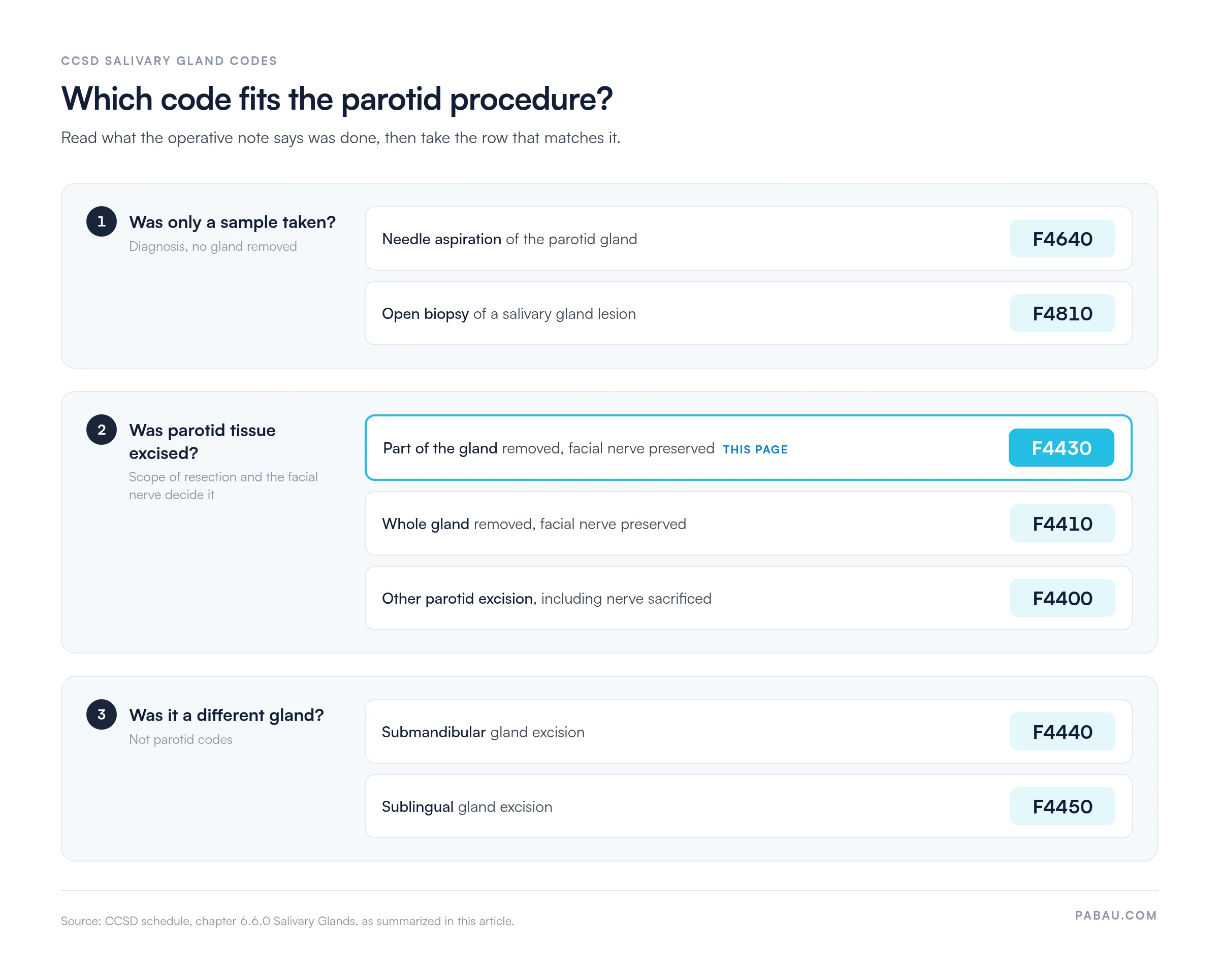
F4430 sits among the CCSD salivary gland codes F4400–F4450. Total parotid excision with the nerve preserved is F4410, and other parotid excision, including nerve sacrifice, is F4400. The operative note must confirm both the partial resection and the preserved nerve.
Let Pabau's smart automation suggest the right codes, reduce claim denials, and keep your practice compliant—effortlessly.
Automate repetitive tasks and focus on what matters most—your patients.
Reduce coding errors and ensure compliance with the latest regulations.
Clean claims, fewer denials, and faster reimbursements.
Powerful insights and reporting to help your practice thrive.
HIPAA compliant SOC 2 certified GDPR-compliant Trusted by 4,000+ clinics worldwide

CCSD code F4430 covers partial excision of the parotid gland with the facial nerve identified and preserved, and the operative note must confirm both.
Total parotid excision with the nerve preserved is F4410, and other parotid excision, including nerve sacrifice, falls under F4400.
Pleomorphic adenoma accounts for about 70% of benign parotid tumors and is the most common indication for F4430.
Missing pre-authorization is the most common reason UK insurers deny F4430 claims, so obtain it before the procedure.
Practice management software such as Pabau keeps the operative note, forms and insurer invoices in one patient record, so F4430 claims are easier to defend.
CCSD code F4430 is the code for a partial or superficial parotidectomy. Its official descriptor is “Partial excision of parotid gland and preservation of facial nerve.” Both parts of that descriptor carry equal billing weight. The resection must be partial, leaving part of the gland in situ. The facial nerve must also be identified, mapped and preserved throughout.
A claim whose operative note doesn’t explicitly confirm both elements is vulnerable to denial on audit. F4430 is a consultant surgeon code, and it covers the principal surgical procedure only. Anesthetic fees, assistant surgeon fees and intraoperative monitoring are billed separately, under their own CCSD codes or as agreed add-ons, depending on the insurer’s policy.
Partial parotidectomy with facial nerve preservation is a major ENT or maxillofacial operation, typically performed under general anesthesia. The standard approach uses a modified Blair or facelift incision, followed by dissection through the parotid fascia.
The surgeon then identifies the facial nerve trunk at the stylomastoid foramen. Its branches are traced and protected while the superficial lobe or affected portion is resected around the tumor with an adequate margin.
These intraoperative steps make the procedure codeable as F4430 rather than a simpler or more radical alternative:
Many centers use intraoperative facial nerve monitoring (IONM), typically continuous electromyography, as an adjunct. Its billing status is covered in the additional codes section below.
F4430 is used when a discrete parotid lesion needs surgical removal and the disease doesn’t warrant total excision or nerve sacrifice. Insurers expect the clinical indication to be documented clearly in the pre-authorization request and in the operative note.
Accepted indications that support an F4430 claim include:
F4430 is not appropriate for diffuse gland involvement, high-grade malignancy requiring nerve sacrifice, or recurrent disease where total excision is planned. Code F4410 if the entire gland was removed with the nerve preserved. Use F4400 for other parotid excision, for example when the nerve was sacrificed.
The salivary gland codes F4400–F4450 sit together in the CCSD schedule, but only F4400, F4410 and F4430 cover parotid excision. F4440 and F4450 are for the submandibular and sublingual glands. Picking the wrong code from this group is the second most common billing error after missing pre-authorization.
The table below sets out the key distinctions, including the biopsy codes that are sometimes confused with F4430. Every neighboring code is listed in the CCSD codes directory.
The boundary between F4430 and F4410 depends on the scope of resection documented in the operative note, not on the surgeon’s intent. If the note states the entire parotid gland was removed, the code is F4410 whatever the surgeon’s framing. F4430 also can’t be used when the nerve was sacrificed, because that case falls under F4400.
The chart below turns those rules into three questions you can answer from the operative note before you submit.
The NHS classifies procedures with OPCS-4 rather than CCSD. Surgeons who work in both NHS and private settings need to know how the two systems relate. It matters most when they share operative reports or write summary letters that quote procedure codes.
The OPCS-4 equivalent of CCSD F4430 is F44.2 (partial excision of parotid gland). The NHS Classifications Browser holds the current OPCS-4 code set, so you can verify F44.2 against the live schedule.
The two systems don’t map one-to-one. OPCS-4 codes feed NHS episode data, such as Hospital Episode Statistics (HES) returns and Payment by Results (PbR) tariff allocation. CCSD codes are used only for private insurer billing and reimbursement.
If you bill across NHS and private settings, confirm which system applies to the episode before coding. Private self-pay patients are billed under CCSD, even when the procedure takes place in an NHS facility under a private patient arrangement. Getting this right from the first private list prevents systematic coding errors later.
An F4430 claim without a compliant operative note won’t survive insurer audit. UK private medical insurers have tightened documentation requirements in recent years. For partial parotidectomy, the operative note is the primary evidence that the correct code was used.
To support an F4430 claim, the operative note must include:
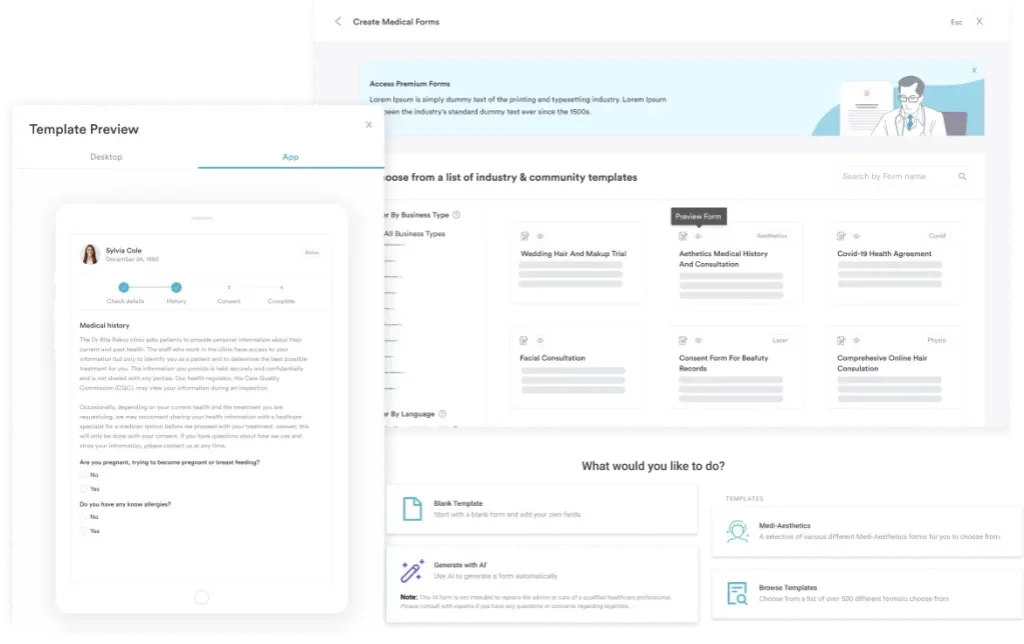
In Pabau, the practice management platform we build, the operative note sits in the same patient record as the consent forms and the insurer invoice. A note template that lists each element above helps the surgeon complete it before the claim goes out. With the note beside the invoice, audit-ready claims management becomes part of the routine.
Failing to obtain pre-authorization before the procedure is the most common reason F4430 claims are denied. Every major UK private medical insurer requires pre-authorization for parotid surgery. It doesn’t guarantee payment, but proceeding without it almost always guarantees denial.
The standard pre-authorization pack for F4430 across major insurers includes:
A malignant parotid lesion is coded under ICD-10 C07 instead. The diagnosis on the pre-authorization request should match the cytology or biopsy findings, or the insurer may query the claim later.
Each insurer adds its own rules. Bupa’s code search portal lets consultants verify recognition and fee levels before submission. AXA Health’s specialist procedure portal gives chapter-level fee information and any pre-authorization rules for F44xx parotid codes.
Both portals update annually, so check the current policy year’s requirements rather than relying on prior-year guidance. The Bupa CCSD code reference covers recognition, billing rules and submission requirements in detail.
Aviva, Cigna and Vitality Health follow broadly similar pre-authorization requirements, but they set different time limits for submitting claims after the procedure. Aviva typically requires claims within 90 days of the procedure date, while Cigna and Vitality vary by policy. Confirm submission deadlines with the insurer at the point of pre-authorization.
The CCSD schedule publishes indicative fee levels for each code. Contracted rates between individual consultants and insurers may differ, and some insurers run fixed-fee arrangements that supersede the published schedule. The table below reflects indicative CCSD benchmarks, so verify it against the current schedule year and your insurer contracts.
The Aviva fee schedule publishes procedure-level rates and is a useful cross-reference for current CCSD benchmarks. Payment depends on the consultant’s recognition status with each insurer and any agreed individual contracts. Consultants without direct recognition from an insurer may receive reduced or nil reimbursement, whatever the schedule rate.
Several adjunct services around partial parotidectomy may be billable on top of F4430, depending on insurer policy and the clinical scenario. Most aren’t included in the F4430 fee. Each needs its own claim and, in some cases, separate pre-authorization.
Confirm current bundling rules with each insurer before submitting add-on codes alongside F4430. Bundling policies change between policy years and differ materially between Bupa, AXA Health, Aviva and the smaller private medical insurers.
F4430 claims are denied for predictable, avoidable reasons. Here are the most common denial triggers and the fix for each.
A complete audit trail strengthens your position when you appeal a denial. Record the pre-authorization reference number, the date, and the name of the insurer representative who granted approval. Saved against the patient record, those details are on hand the moment a claim is challenged.
Build a pre-authorization checklist specific to F4430 and attach it to every parotid surgery booking. Include the insurer’s pre-authorization reference number, the date granted, the agreed ICD-10 code, the confirmed CCSD code and the claim submission deadline. It takes two minutes at the point of booking and removes the most common denial trigger.
Billing staff sometimes confuse the biopsy codes F4640 and F4810 with F4430. It happens most when the operative intent changes intraoperatively, or when diagnostic and therapeutic procedures are performed in the same episode.
The scope of resection documented in the operative note decides between them:
Submitting F4430 for a procedure that was a diagnostic biopsy is upcoding. It carries significant consequences under GMC conduct rules and insurer fraud policies. A note can occasionally describe a biopsy and a therapeutic excision in the same session. In that case, ask the insurer for coding guidance before submitting.
An F4430 claim passes through several hands before it’s paid. The surgeon writes the operative note, a secretary chases pre-authorization, and the billing team codes and submits the invoice. When those steps live in separate inboxes and spreadsheets, a missing nerve-preservation line or an expired authorization surfaces only after the denial.
Pabau brings that work into one system. The operative note, consent forms and insurer invoice sit in the same patient record. Your billing team can check the note against the code before the claim goes out, without asking the surgeon for a copy.
For surgical practices with a steady private parotid caseload, that means less time reworking denied claims and more time with patients.
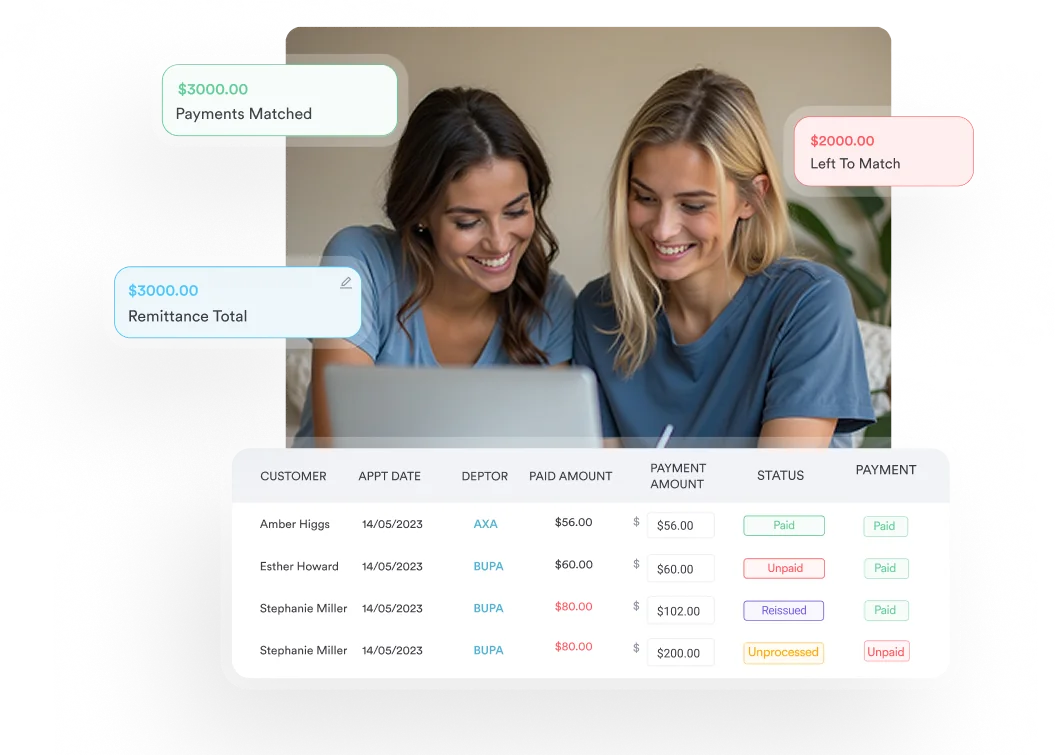

Pabau keeps operative notes, consent forms and insurer invoices in one patient record for UK private ENT and surgical practices. Your billing team spends less time chasing claims and more time getting paid.

F4430 is one of the easier parotid codes to defend, as long as the operative note does the work. If the note says part of the gland stayed and the facial nerve was preserved, the code holds. If the note is vague, the claim is exposed, whatever the surgeon intended.
So make the note template and the pre-authorization pack two checks that every parotid booking passes. Once they’re routine, F4430 denials get far less frequent, and an appeal means attaching paperwork you already hold.
Want the operative note, the forms and the insurer invoice in one record? Book a demo to see how Pabau handles CCSD billing for private surgical practices.

Billing a parotid procedure to Bupa? Bupa CCSD procedure code guide covers recognition rules, bundling restrictions and submission requirements for Bupa-specific billing.
Was the nerve sacrificed? CCSD code F4400: Parotid gland excision billing guide explains when other parotid excision falls outside F4410 and F4430.
Only a biopsy taken? CCSD code F4810: Open salivary gland biopsy billing guide covers the documentation an open biopsy claim needs.
Coding a malignant parotid lesion? ICD-10 code C07: Malignant neoplasm of parotid gland sets out the diagnosis code to pair with parotid surgery.
Working on the parotid duct instead? CCSD code F5010: Parotid duct transposition billing guide covers the code for repositioning the duct rather than excising the gland.
CCSD code F4430 covers partial excision of the parotid gland with formal identification and preservation of the facial nerve. Both elements must be present. The resection must leave residual gland tissue in situ, and the operative note must document the facial nerve as identified and preserved. ENT and maxillofacial surgeons in UK private practice bill it to private medical insurers under the CCSD schedule.
F4430 covers partial parotid excision with facial nerve preservation, while F4410 covers total excision of the parotid gland with the nerve preserved. The operative note decides which applies. If any parotid tissue was left in situ, the code is F4430. If the entire gland was removed, the code is F4410. Submitting F4410 for a partial excision overstates the procedure, which insurers can spot when they audit the operative note.
F4430 is the correct code for superficial parotidectomy with facial nerve preservation. Superficial parotidectomy removes the superficial lobe of the parotid gland, which is a form of partial excision. If the facial nerve was formally identified and preserved throughout, F4430 applies whether the operative note says “superficial” or “partial” parotidectomy.
No, intraoperative facial nerve monitoring (IONM) isn’t automatically included in the F4430 surgical fee. Whether you can bill it separately depends on the insurer and the policy year. Some insurers reimburse it under the CCSD code for intraoperative neurophysiological monitoring, with pre-authorization. Others treat it as bundled into the surgical fee and won’t fund a separate claim. Verify the current position with each insurer before submitting IONM alongside F4430.
The OPCS-4 equivalent is F44.2 (partial excision of parotid gland). OPCS-4 codes are used for NHS episode data and don’t appear on private insurer claims. CCSD F4430 is used only for private medical insurer billing. Surgeons working across NHS and private settings should confirm which system applies to the episode before submitting documentation.
The most common reasons are a missing pre-authorization and an operative note that doesn’t document facial nerve identification and preservation. Claims also fail when the wrong adjacent code is submitted, such as F4410 instead of F4430. A missing or mismatched ICD-10 code, or a claim filed after the insurer’s time limit, causes denials too. Each denial carries a reason code from the insurer, so address that specific reason in the appeal rather than resubmitting the original claim unchanged.