Pabau Engage inbox

Pabau Engage is here: every patient conversation in one inbox.

Learn more
Book a demo Book a demo
☰
CCSD Code

CCSD code F4810 – Facial surgery procedure


Code Definition

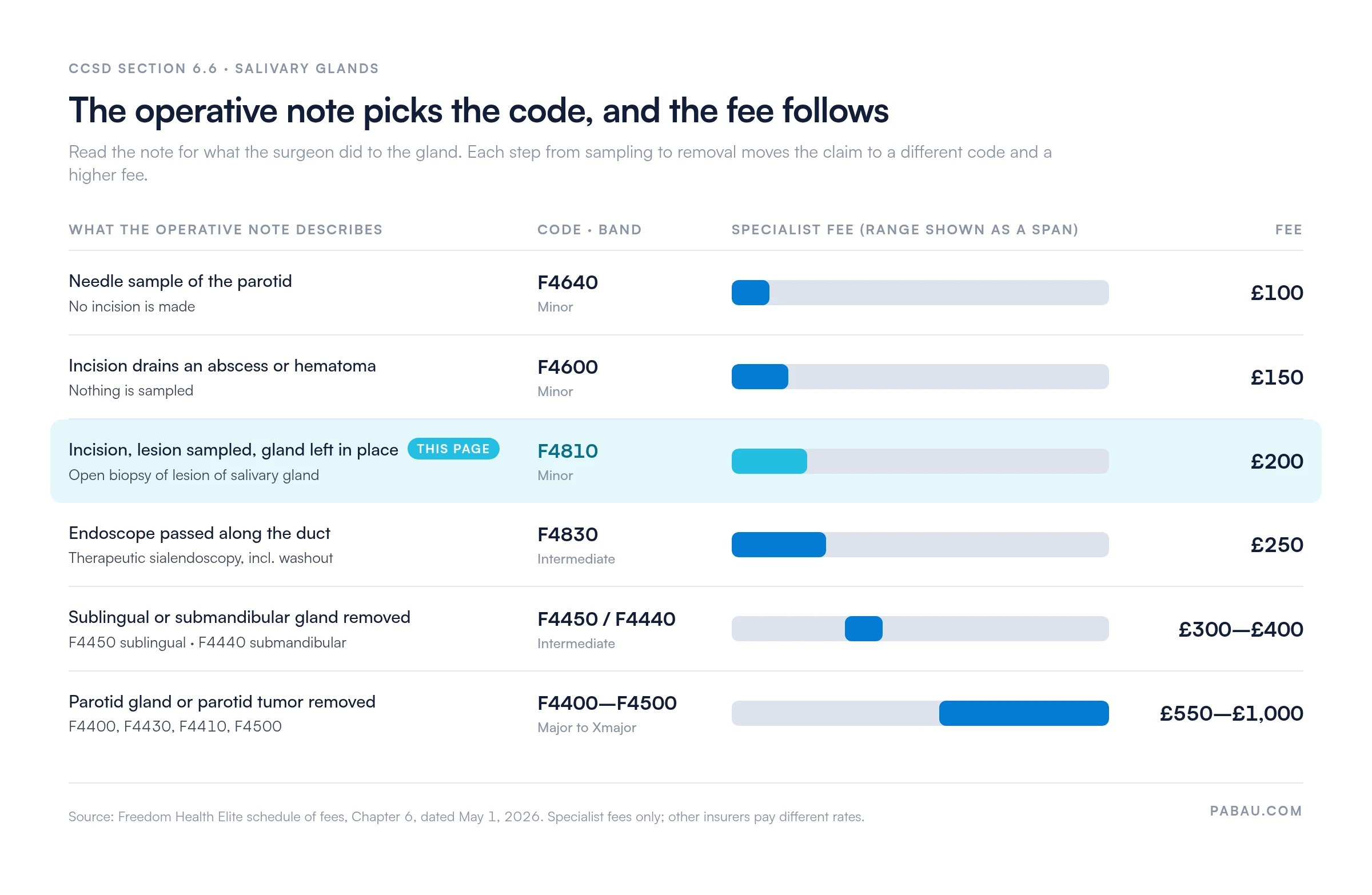
F4810 is the CCSD code for open biopsy of lesion of salivary gland.

Group
6 Face, mouth, salivary and thyroid
Category
Salivary Glands
Billable
No
Code also known as
facial surgical procedure, face surgery billing code, Chapter 6 facial code
Save time. Improve accuracy. Get paid faster.
Automate coding with Pabau

Let Pabau's smart automation suggest the right codes, reduce claim denials, and keep your practice compliant—effortlessly.

  • AI-powered code suggestions
  • Real-time compliance checks
  • Faster claims, fewer denials
Why practices choose Pabau
Save hours every week

Automate repetitive tasks and focus on what matters most—your patients.

Improve accuracy

Reduce coding errors and ensure compliance with the latest regulations.

Get paid faster

Clean claims, fewer denials, and faster reimbursements.

Grow with confidence

Powerful insights and reporting to help your practice thrive.

HIPAA compliant SOC 2 certified GDPR-compliant Trusted by 4,000+ clinics worldwide

Key Takeaways

Key Takeaways

CCSD code F4810 sits in Chapter 6 (face, mouth, salivary and thyroid) and is used for facial surgical procedures in UK private healthcare billing.

Most major PMI payers, including Bupa and AXA Health, require prior authorisation before the procedure is performed, not retrospectively.

Claims are most often rejected for missing pre-auth references, incorrect supporting codes, or insufficient operative documentation.

Pabau’s claims management software supports Healthcode integration and pre-auth tracking to reduce F4810 billing errors.

CCSD code F4810: definition and chapter context

CCSD code F4810 is a billable procedure code maintained by the Clinical Coding and Schedule Development Group (CCSD), the independent body that publishes and updates the UK private healthcare procedure code schedule. The code sits within Chapter 6 of the schedule, which groups procedures affecting the face, mouth, salivary glands, and thyroid. This chapter is the primary reference for oral and maxillofacial surgeons, plastic surgeons, and ENT consultants billing private medical insurers for surgical facial work.

CCSD codes are alphanumeric identifiers used universally across UK private healthcare. Every major PMI payer, including Bupa, AXA Health, Vitality, Freedom Health, and Allianz Care, accepts CCSD-coded invoices. Claims are submitted electronically via Healthcode, the UK private healthcare billing and processing platform, which validates CCSD code F4810 entries against the insurer’s current fee schedule before forwarding the claim for payment review.

Where F4810 sits in the CCSD schedule

The CCSD schedule organises procedure codes into chapters by anatomical area or specialty. Chapter 6 covers the face and adjacent structures. Within Chapter 6, the F48xx block groups facial surgical procedures by complexity and anatomical scope. F4810 occupies a specific position in that block, distinct from codes covering simpler or more complex interventions in the same anatomical area.

Knowing the chapter position of CCSD code F4810 matters because several adjacent codes in the F48xx range share similar descriptors. Billing the wrong code, even by one digit, is one of the most common sources of claim rejection for facial procedure claims.

What F4810 covers: inclusions and scope

CCSD code F4810 covers a defined surgical procedure on the facial structures within the scope of its official CCSD descriptor. The code applies when the consultant’s operative note documents a complete, stand-alone surgical intervention on the relevant anatomical area, performed under the appropriate grade of anaesthesia, and with all associated clinical documentation in place.

Key points about what the code includes:

  • The code covers the primary surgical procedure as described in the CCSD schedule descriptor.
  • Where the same procedure is performed bilaterally in a single operative session, insurers have different rules. Some payers reimburse both sides under a single F4810 claim; others require a modifier or a second code entry. Always check the payer’s current fee schedule before billing bilaterally.
  • Complexity modifiers within the CCSD system may apply if the procedure involved documented complications or required a significantly extended operative time. These modifiers are payer-specific and must be pre-checked against the relevant fee schedule.
  • The code includes the consultant’s procedural work. Anaesthetic fees, assistant surgeon fees, and facility charges are billed separately using the appropriate supporting codes.

What F4810 does not cover: exclusions and adjacent codes

Several procedures are specifically excluded from CCSD code F4810 and must be billed under a different code in the F48xx block or in an adjacent CCSD chapter. Billing F4810 for an excluded procedure is one of the fastest routes to a claim denial or a post-payment audit query.

Common exclusions to be aware of:

  • Procedures involving the salivary glands or thyroid, even though they fall within Chapter 6, have their own designated codes and are not captured by F4810.
  • Minor facial interventions below the complexity threshold of F4810 should be coded using a lower-complexity F48xx code.
  • Revision or corrective procedures following a previous primary F4810 procedure may require a different code with a documented indication for revision surgery.
  • Cosmetic procedures performed without a clinical indication are typically excluded from PMI reimbursement entirely, regardless of the CCSD code used.

The table below maps F4810 against commonly confused adjacent codes in Chapter 6:

Code Procedure area When to use instead of F4810
F4810 Facial surgical procedure (Chapter 6 descriptor) Primary indication as per CCSD descriptor, with full operative documentation
Adjacent F48xx Simpler or more complex facial procedures Procedure does not match F4810 descriptor in complexity or anatomical scope
Chapter 6 salivary/thyroid codes Salivary gland or thyroid procedures Procedure involves salivary or thyroid structures, not the facial area covered by F4810
Revision codes Corrective re-do procedures Procedure is a planned revision of a previous primary intervention

When in doubt, cross-reference against the CCSD schedule descriptor before submitting. The CCSD technical guide also includes unbundling rules that affect which codes can appear together on a single claim line.

How the procedure is performed and what to document

Billing staff do not need a clinical understanding of every step in the operating theatre, but they do need to know which documents must exist in the patient file before an F4810 claim is submitted. A claim with incomplete documentation is a rejection waiting to happen.

Required documentation checklist for an F4810 claim:

  • Operative note: a consultant-signed operative report describing the procedure performed, the anatomical site, the technique used, and any intraoperative findings or complications. This is the single most important document an insurer will request on a queried claim.
  • Consent record: a signed digital consent form or paper equivalent, documenting the patient’s informed agreement to the procedure. The consent record must be dated before the procedure date.
  • Pre-authorisation reference: the authorisation number issued by the insurer before the procedure was performed. This number must appear on the claim form. If authorisation was obtained verbally or retrospectively, note the authorisation date and the name of the insurer representative.
  • Referral letter: most PMI payers require a dated GP or specialist referral for surgical procedures. The referral must be from a recognised referring clinician and must identify the clinical indication.
  • Post-operative notes: a brief clinical note from the first post-operative contact confirming the procedure was completed and documenting the patient’s recovery status.

Patient data held in connection with these records is subject to UK GDPR data handling requirements. Practices must ensure that clinical documentation transmitted to insurers via Healthcode is processed in line with their data processing agreements.

Pro Tip

Audit your F4810 claims before submission by running a three-field check: pre-auth reference present, operative note signed by the consultant, and consent dated before the procedure. These three fields account for the majority of F4810 rejection triggers across UK PMI payers.

Which insurers accept CCSD F4810 and what they require

Every major UK private medical insurer accepts CCSD-coded claims, including F4810, provided the claim meets their individual prior authorisation and documentation requirements. Fee rates differ by insurer and by consultant grade (recognised, non-recognised, or out-of-network). Do not rely on this article for specific fee figures – always check the insurer’s current published fee schedule.

Insurer Prior auth required? Fee schedule reference Notes
Bupa Yes, before procedure Bupa code search Recognised consultants only; retrospective auth rarely granted
AXA Health Yes, before procedure AXA specialist procedure codes Clinical evidence required at pre-auth stage for surgical codes
Vitality Health Yes, before procedure Vitality fee finder Use fee finder to check current F4810 reimbursement band
Healix Typically required Healix fee schedule Strict unbundling rules; check Healix guidelines before adding supporting codes
Freedom Health Yes, before procedure Freedom Health provider portal Chapter 6 schedule confirmed; verify current fees via provider portal
Allianz Care UK Typically required Allianz Care provider resources Fee schedule references CCSD codes; confirm current rates before billing

For Bupa-specific CCSD billing workflows, see the Bupa CCSD billing guide for a full breakdown of submission requirements and recognised consultant criteria. For Bupa’s current procedure fee rates, consult the Bupa procedure fee schedule.

Prior authorisation requirements for F4810

Prior authorisation must be obtained before the procedure takes place, not afterwards. Most major UK PMI payers will not grant retrospective authorisation for surgical procedures. Where a procedure is performed as an emergency, contact the insurer’s provider line on the day and document the discussion.

  • Provide the insurer with the patient’s policy number, the consultant’s recognition number, and the planned CCSD code(s) at the time of requesting auth.
  • Some insurers require a copy of the referral letter and a brief clinical summary before they will issue a pre-auth reference number.
  • Record the pre-auth reference number, the date it was issued, and the name of the insurer representative who granted it. This information is required on the Healthcode claim submission.

Streamline your private practice billing

Pabau integrates with Healthcode and supports pre-auth tracking, CCSD code lookup, and claim audit trails so your billing team spends less time chasing rejections.

Pabau private practice billing dashboard

Common reasons F4810 claims are rejected

Rejection rates for facial surgical procedure codes are higher than for less complex CCSD categories, partly because the documentation requirements are more exacting and partly because the codes sit adjacent to cosmetic procedures that are routinely excluded. Understanding why F4810 claims fail is the fastest way to build a reliable submission process.

The most frequent rejection reasons, in rough order of frequency:

  • Missing or invalid pre-auth reference. The claim arrives without an authorisation number, or the number does not match the insurer’s records. This is the single most common cause of non-payment.
  • Wrong code selected. F4810 was submitted when an adjacent F48xx code was the correct match for the procedure actually performed. Insurers cross-reference the operative note against the code descriptor.
  • Insufficient operative documentation. The operative note is absent, is a generic template rather than a procedure-specific record, or is not signed by the operating consultant.
  • Incorrect consultant recognition status. The submitting consultant is not recognised by the insurer for the relevant specialty, or their recognition has lapsed. Claims submitted under an unrecognised consultant are rejected regardless of code accuracy.
  • Billing above the schedule fee. An invoice that exceeds the insurer’s published fee for F4810 will be settled at the schedule rate at best, and may trigger a query or partial payment dispute.
  • Supporting codes not permitted. An anaesthetic code or assistant surgeon code was included that the insurer’s unbundling rules do not allow alongside F4810. Always check payer-specific unbundling guidance before adding secondary codes.
  • Cosmetic exclusion applied. The insurer has determined the procedure was cosmetic rather than clinically indicated. The clinical indication must be documented in the referral letter and the operative note.

Supporting and supplementary codes used alongside F4810

CCSD code F4810 covers the consultant’s primary procedural work only. Other elements of the surgical episode are billed separately using supporting codes from the relevant CCSD chapters.

Supporting code type Billed by Insurer notes
Anaesthetic code Anaesthetist (separate claim) Billed on a separate Healthcode submission by the anaesthetist; not on the surgeon’s claim
Assistant surgeon code Assistant surgeon Only reimbursed if the insurer has pre-approved a surgical assistant for this code; varies by payer
Facility / theatre code Hospital or clinic Billed separately by the facility; insurer may cap or exclude if out-of-network
Post-operative consultation Operating consultant Some insurers include a fixed number of post-op follow-ups within the procedure bundle; confirm before billing separately

Unbundling rules vary significantly across payers. Healix, in particular, publishes detailed unbundling guidelines specifying which secondary codes can appear alongside specific Chapter 6 procedure codes. Check the current guidelines before submitting a claim that includes any supporting code alongside CCSD code F4810.

How to submit an F4810 billing code UK claim via Healthcode

Healthcode is the standard electronic submission route for CCSD-coded claims to UK PMI payers. The steps below are illustrative. Healthcode’s interface is updated periodically, so always consult the current Healthcode documentation for precise navigation steps.

  1. Log in to Healthcode using your practice’s credentials and navigate to the claims submission area for the relevant insurer.
  2. Enter patient and policy details: the patient’s full name, date of birth, insurer policy number, and the insurer’s pre-authorisation reference number for this procedure.
  3. Select the procedure code: enter CCSD code F4810 in the procedure code field. Healthcode validates the code against the insurer’s current schedule. If the code is not accepted, check whether the insurer uses a modified code list or requires an alternative identifier.
  4. Add supporting codes: if an assistant surgeon code or a post-operative consultation code applies, add these as secondary lines. Do not add anaesthetic codes on the surgeon’s claim.
  5. Enter fee details: input the fee at or below the insurer’s current schedule rate for F4810. Fees above the schedule rate will be queried or settled at the schedule amount.
  6. Attach documentation references: some insurers allow or require attachment of a clinical summary or operative note reference at submission. Check the payer’s submission requirements in Healthcode before submitting.
  7. Submit and record the submission reference: Healthcode returns a submission reference number on successful dispatch. Record this alongside the pre-auth number in your practice management system for tracking.
  8. Monitor claim status: Healthcode provides real-time status updates. If a claim is returned with a query code, address the query within the insurer’s specified response window to avoid automatic rejection.

How practice management software can streamline F4810 billing

Manual CCSD billing workflows create multiple points at which errors can enter a claim. A pre-auth reference gets transcribed incorrectly. A supporting code that the insurer does not allow for F4810 is added out of habit. An operative note sits unsigned in a paper file when the claim deadline arrives.

Practice management software with Healthcode integration closes these gaps at the workflow level rather than relying on individual staff vigilance. Pabau’s claims management software supports pre-auth reference tracking against each patient episode, code lookup aligned with the current CCSD schedule, and a full audit trail showing which codes were submitted, when, and against which authorisation reference. That audit trail is also valuable if an insurer raises a post-payment query.

Automate claims through Healthcode

For clinics running facial surgery and broader aesthetic or reconstructive work, Pabau’s skin clinic software combines CCSD billing workflows with patient record management, consent tracking, and appointment scheduling in one system. The time-saving features for private practices guide covers how these integrations reduce administrative overhead across a billing cycle.

Pro Tip

Set up a pre-submission checklist in your practice management system for every F4810 claim: pre-auth reference verified, operative note signed, consultant recognition confirmed, supporting codes cross-checked against the insurer’s unbundling rules. Four fields. Run it before every submission.

Conclusion

CCSD code F4810 is a straightforward code to select when the procedure and documentation are in order. The majority of rejections trace back to three avoidable errors: no pre-auth reference, the wrong adjacent code, or an incomplete operative note. A reliable submission process addresses all three before the claim reaches Healthcode.

Pabau’s claims management workflows track pre-auth status, flag missing documentation, and maintain a full submission audit trail, so your billing team can resolve queries quickly and keep payment cycles short. To see how it works for your practice, book a demo.

Continue your research

Continue your research

Need a full breakdown of Bupa’s CCSD requirements? Bupa CCSD codes covers recognised consultant criteria, submission rules, and common rejection causes for Bupa-insured patients.

Want to understand the broader CCSD coding structure? Bupa procedure codes fee schedule maps procedure categories to fee bands and shows how Chapter 6 codes sit within the schedule hierarchy.

Looking for ways to reduce administrative burden across your private practice? Features that save private practices time outlines the automation and integration tools that reduce manual billing and documentation work.

Frequently Asked Questions

What is CCSD code F4810?

CCSD code F4810 is a UK private healthcare procedure code within Chapter 6 of the CCSD schedule, covering a defined surgical procedure on the facial structures. It is used by oral and maxillofacial surgeons, plastic surgeons, and their billing teams when submitting claims to private medical insurers via Healthcode.

Which procedures are excluded from CCSD F4810?

Procedures involving the salivary glands or thyroid, minor facial interventions below the code’s complexity threshold, planned revision procedures, and cosmetic interventions without a documented clinical indication are all excluded from F4810 and must be coded under the appropriate adjacent CCSD code.

Does Bupa reimburse CCSD code F4810?

Yes, Bupa reimburses CCSD code F4810 for recognised consultants, provided prior authorisation was obtained before the procedure and the claim includes a valid pre-auth reference, a signed operative note, and a dated referral letter. Current Bupa fee rates are published on the Bupa code search portal.

Why would a claim for CCSD F4810 be rejected?

The most common rejection reasons are a missing or invalid pre-authorisation reference, the wrong adjacent F48xx code selected, insufficient operative documentation, an unrecognised consultant, billing above the schedule fee, and supporting codes that breach the insurer’s unbundling rules.

How do I submit a CCSD F4810 claim via Healthcode?

Log in to Healthcode, enter the patient’s policy number and pre-authorisation reference, select F4810 as the procedure code, add any permitted supporting codes, enter the fee at or below the insurer’s schedule rate, and submit. Healthcode validates the code against the insurer’s schedule and returns a submission reference number on successful dispatch.

What is the difference between F4810 and adjacent CCSD facial surgery codes?

Adjacent F48xx codes in Chapter 6 cover facial surgical procedures at different complexity levels or anatomical scopes. F4810 applies to the specific procedure described in its CCSD descriptor. Selecting the wrong adjacent code, even by one digit, is one of the most frequent causes of facial procedure claim rejections. Always cross-reference the operative note against the CCSD schedule descriptor before submitting.

×