CCSD code F5010: Parotid duct transposition billing guide
CCSD code F5010 covers parotid duct transposition, one side or both CCSD code F5...

Last Updated: Oct 9, 2026
CCSD code F4400 is the UK private billing code for excision of parotid gland (other than F4410/F4430). It covers removal of parotid tissue that fits neither of those two descriptors. F4410 and F4430 cover total and partial parotidectomy with preservation of the facial nerve.
F4400 sits in CCSD Chapter 6 (Face, mouth, salivary and thyroid), section 6.6.0 Salivary Glands, and UK private medical insurers pay against it. Because the three parotid codes split on the facial nerve, the surgeon's write-up carries the claim. The operative note must show the extent of excision and how the facial nerve was handled.
Let Pabau's smart automation suggest the right codes, reduce claim denials, and keep your practice compliant—effortlessly.
Automate repetitive tasks and focus on what matters most—your patients.
Reduce coding errors and ensure compliance with the latest regulations.
Clean claims, fewer denials, and faster reimbursements.
Powerful insights and reporting to help your practice thrive.
HIPAA compliant SOC 2 certified GDPR-compliant Trusted by 4,000+ clinics worldwide

CCSD code F4400 covers excision of the parotid gland when the operation fits neither the F4410 nor the F4430 descriptor.
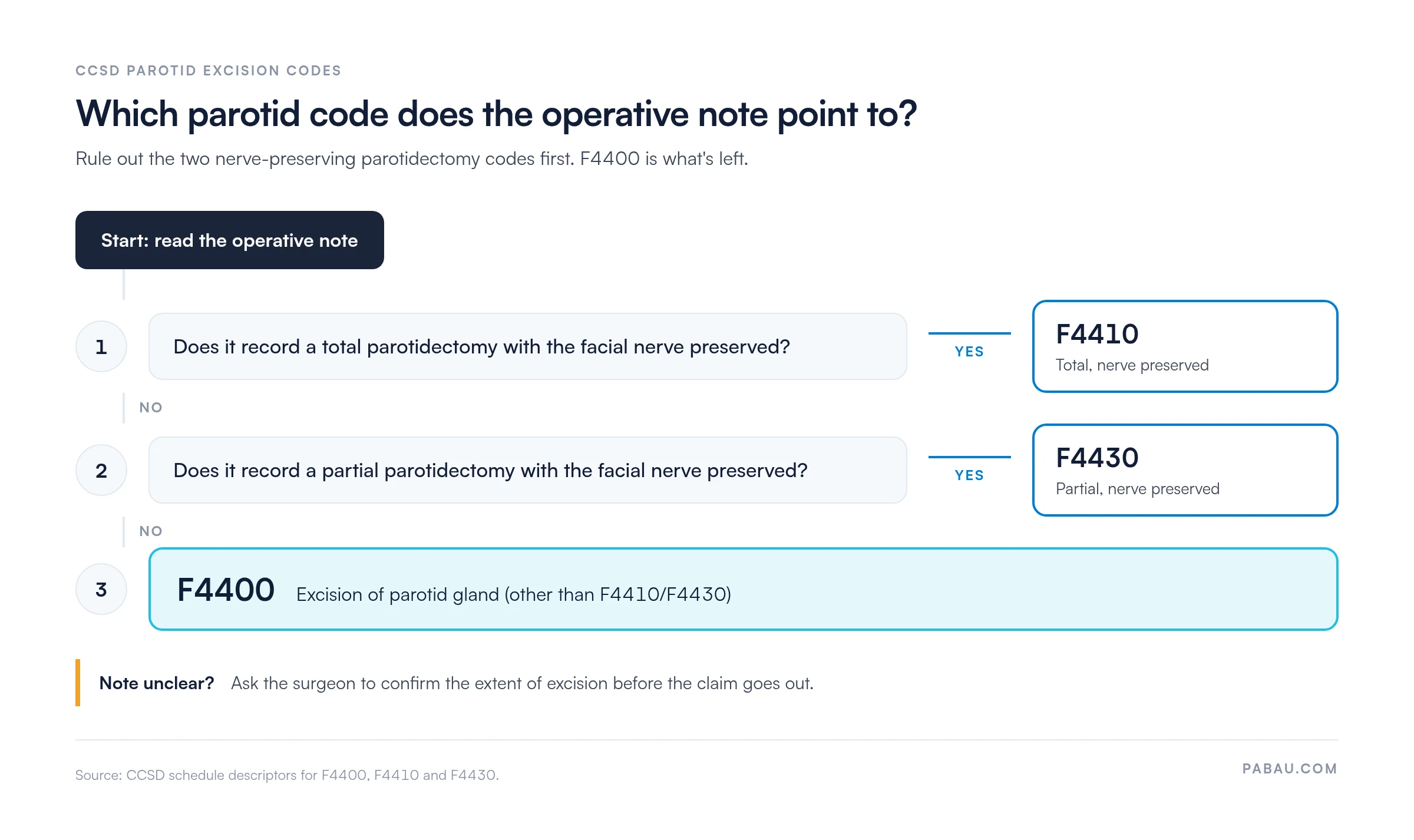
F4410 and F4430 cover total and partial parotidectomy with facial nerve preservation, so the operative note decides which code applies.
F4400 sits in CCSD Chapter 6, section 6.6.0 Salivary Glands.
Insurers expect the operative note, the histology report and a documented indication, such as a parotid tumor or chronic sialadenitis.
CCSD code F4400 is the UK private billing code for excision of parotid gland (other than F4410/F4430). The parotid is the largest salivary gland, sitting in front of the ear and over the angle of the jaw. Surgeons remove parotid tissue to treat a tumor, chronic inflammation or other disease of the gland.
The descriptor works by exclusion. F4410 and F4430 cover total and partial parotidectomy with preservation of the facial nerve. F4400 is the code for a parotid excision that fits neither of those two descriptors.
CCSD stands for Clinical Coding & Schedule Development. The CCSD group maintains the schedule of CCSD codes that UK private medical insurers use to identify procedures and pay for them. The facial nerve runs through the parotid. The right code turns on what the operative note says about the nerve and the extent of excision.
Use the reference details below to check that the code on the claim matches the operation booked.
Three CCSD codes describe parotid excision, and they’re easy to mix up. The operative note tells you which one applies.
Read the operative note before you pick a code. If it records a total or partial parotidectomy with the facial nerve preserved, bill F4410 or F4430 instead of F4400. When the note is unclear, ask the surgeon to confirm the extent of excision before the claim goes out. The decision path below sets out the order of checks.
F4400 is for the parotid only. Excision of the submandibular gland is billed as F4440, and excision of the sublingual gland as F4450.
Insurers pay for parotid surgery when the record shows a clinical reason for it. The indication should match across the referral letter, the operative note and the claim. Common indications and their ICD-10 codes include:
Final histology can change the diagnosis after surgery. Update the diagnosis code on the claim once the pathology report confirms it.
Insurers can ask for the clinical record before they settle an F4400 claim. Have these documents ready before you submit:
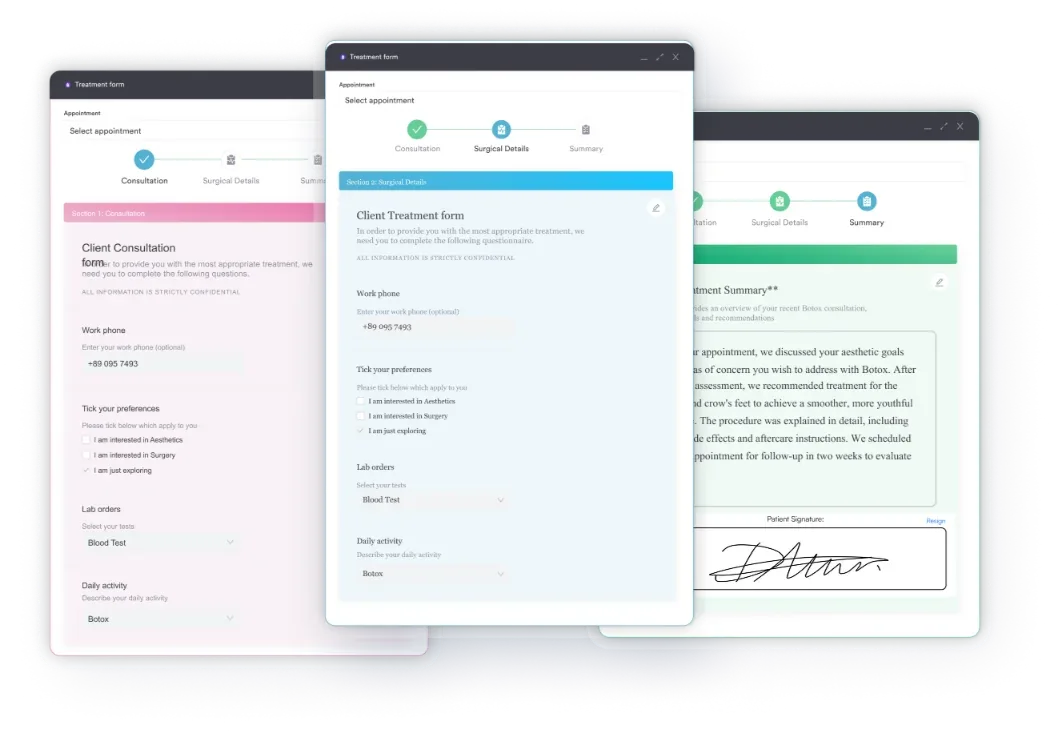
Keep the signed consent with the rest of the surgical record. A digital consent form puts it on the patient file from the start.
UK private medical insurers generally expect planned surgery to be pre-authorized. Get the authorization number before the operation and record it with the booking.
CCSD also lists unacceptable combinations against each code. These are codes that can’t be billed alongside F4400 for the same operation. Check the F4400 entry in the CCSD schedule before you add a second procedure code to the claim.
Insurer fees for F4400 vary. Look up the current figure in each insurer’s own schedule, such as the Bupa CCSD codes list, before you quote the patient.
These are the common mistakes behind a rejected F4400 claim, each paired with its fix.
Run through this checklist before the claim leaves the practice. Each item maps to one of the rejection reasons above.
Practices that bill parotid surgery often keep the referral letter, consent form and pathology report in different places. The claim then waits while someone finds the paperwork.
Pabau holds those documents in one patient record. Its Healthcode integration in claims management sends the CCSD-coded claim from that record. It also checks required fields, such as the authorization number, before the claim goes.
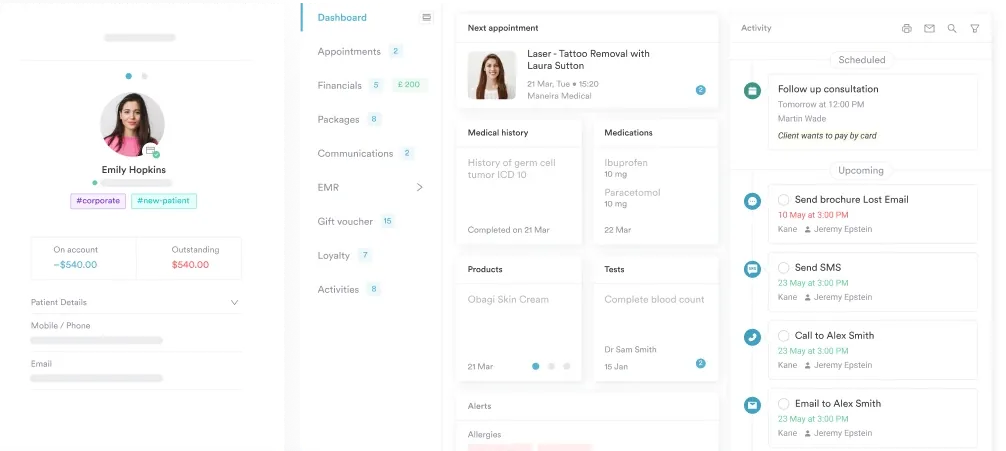
Coding decisions stay with the surgeon and the practice’s billing team. Pabau keeps the evidence for those decisions on hand when the insurer asks.

Pabau keeps consent, referral letters and pathology reports on one patient record, then sends CCSD-coded claims through Healthcode. See how it fits your practice.

F4400 is a narrow code, defined by what it is not. The operative note decides between F4400, F4410 and F4430, and the histology confirms the diagnosis on the claim.
Settle both before submission and the claim reaches the insurer with its evidence attached. To see how Pabau keeps that evidence on one record, book a demo.

Billing a salivary biopsy before surgery? CCSD code F4810 covers open salivary gland biopsy and the records insurers expect for it.
Coding a malignant parotid tumor? ICD-10 code C07 explains the diagnosis code for a malignant neoplasm of the parotid gland.
Coding salivary gland disease without a firm diagnosis? ICD-10 code K11.9 covers disease of salivary gland, unspecified.
Checking fees across the Bupa schedule? Bupa CCSD codes lists the procedure codes Bupa recognizes and how to use them.
CCSD code F4400 is excision of parotid gland (other than F4410/F4430). It covers parotid excision that fits neither nerve-preserving parotidectomy descriptor. It sits in Chapter 6, section 6.6.0 Salivary Glands.
F4410 covers total parotidectomy with preservation of the facial nerve. F4430 covers partial parotidectomy with preservation of the facial nerve. F4400 applies when the excision fits neither descriptor.
The surgeon’s operative note. It records the extent of excision and how the facial nerve was handled, which decides between F4400, F4410 and F4430.
Send the operative note, the histology report and the documented indication, such as a parotid tumor or chronic sialadenitis. Keep the signed consent and the pre-authorization number with them.
Sometimes, but CCSD lists unacceptable combinations against F4400. Check the code’s CCSD entry before you add a second code for the same operation.
No. F4400 is for the parotid gland only. Submandibular gland excision is F4440, and sublingual gland excision is F4450.
No. CCSD codes are used to bill UK private medical insurers. NHS hospitals record procedures with OPCS-4 codes instead.
It depends on the insurer. Each one publishes its own fee schedule against CCSD codes, so check the current figure before you quote the patient.