

HCPCS Code Q4175: Billing, coverage, and documentation guide
HCPCS Code Q4175: Code Description and Product Identity HCPCS Code Q4175 is the ...

Last Updated: Nov 20, 2026
F4830 is the CCSD code for therapeutic sialendoscopy (including washout). A miniature endoscope passes into the duct of the parotid or submandibular gland to treat obstruction. Through it, the surgeon flushes the duct system with saline. Stone retrieval, with or without dilation, is coded F4831 instead, and intracorporeal lithotripsy is F4832.
The code sits in chapter 6 (face, mouth, salivary and thyroid), section 6.6.0 Salivary Glands, of the CCSD Schedule. UK private medical insurers use the schedule to identify procedures on claims. Saline washout is part of the code, so it is not billed as a separate item.
Let Pabau's smart automation suggest the right codes, reduce claim denials, and keep your practice compliant—effortlessly.
Automate repetitive tasks and focus on what matters most—your patients.
Reduce coding errors and ensure compliance with the latest regulations.
Clean claims, fewer denials, and faster reimbursements.
Powerful insights and reporting to help your practice thrive.
HIPAA compliant SOC 2 certified GDPR-compliant Trusted by 4,000+ clinics worldwide

CCSD Code F4830 covers therapeutic sialendoscopy (including washout), billed by ENT and oral and maxillofacial surgeons to UK private medical insurers.
The washout and irrigation step is bundled into F4830, so it is never billed as a separate item on the same date of service.
Most UK private medical insurers, including Bupa, AXA Health and Aviva, require pre-authorization before F4830. A claim without the number is likely to be rejected.
Stone retrieval, with or without dilation, is coded F4831, and intracorporeal salivary gland lithotripsy is F4832. Neither is part of F4830.
Pabau’s claims management software tracks F4830 submissions, authorization status and denials in one place for UK private practices.
CCSD Code F4830 covers therapeutic sialendoscopy (including washout). It is listed in chapter 6 (face, mouth, salivary and thyroid), section 6.6.0 Salivary Glands, of the CCSD Schedule. The Clinical Coding and Schedule Development Group publishes the schedule.
A miniature endoscope enters the duct of a major salivary gland to treat obstruction. Under F4830, the therapeutic work is a washout: saline is flushed through the duct system to clear debris and mucous plugs.
UK private medical insurers such as Bupa, AXA Health, Aviva, Vitality, WPA and Healix use the CCSD schedule to identify procedures on claims. Each insurer sets its own fees and decides which coding principles to adopt. Our CCSD procedure code reference explains how the schedule is structured.
The descriptor “including washout” matters for billing. It confirms that saline irrigation of the duct is part of the procedure and earns no separate fee. Billing washout or ductal irrigation under an additional code on the same date of service is unbundling, and insurers are likely to reject it.
F4830 applies when the therapeutic work done through the scope is a ductal washout. Two sibling codes cover the other therapeutic work. Stone retrieval, with or without dilation, is F4831, and intracorporeal salivary gland lithotripsy is F4832.
Where the scope is introduced for inspection only, check the current CCSD schedule for the correct code before submission. Whichever code you choose, the operative report must support it. The table sets the three therapeutic sialendoscopy codes side by side, with the band and fee Bupa lists in Pabau’s Bupa CCSD code reference.
Therapeutic sialendoscopy targets the parotid gland (via Stensen’s duct) or the submandibular gland (via Wharton’s duct). These two major salivary glands account for most clinically significant ductal obstruction. The procedure is performed under general or local anesthesia depending on patient tolerance and the extent of the obstruction.
The operative sequence covered by F4830 typically follows these steps:
If the surgeon retrieves a stone, with or without dilating the duct, the procedure is coded F4831 rather than F4830. When a stone is fragmented inside the duct, intracorporeal salivary gland lithotripsy has its own code, F4832. Where a parotid duct stricture is dilated with no stone retrieved, a separate dilatation code such as F5510 may apply. Check the current CCSD schedule and the insurer’s policy before putting more than one of these codes on a claim.
UK private medical insurers expect every F4830 claim to carry an ICD-10 diagnosis code that supports the medical necessity of the procedure. The three main clinical indications map to distinct diagnosis codes. Check each code in the WHO ICD-10 browser or the insurer’s own lookup tool before submission, as some insurers validate the pairing automatically.
Use the most specific code that matches the operative findings. If multiple pathologies are present (e.g. a calculus causing secondary sialadenitis), code the primary finding first. Add the secondary code where the insurer’s policy permits. Confirm each code against the current ICD-10 release before submission.
The CCSD Group publishes coding principles alongside each code, including combinations that should not be billed together. At the time of writing, the F4830 entry on ccsd.org.uk lists these codes as unacceptable combinations:
CCSD principles are guidance, and each insurer decides whether to adopt a given combination. Before adding a second procedure code to an F4830 claim, check the current schedule (login required) and the insurer’s provider guide.
Open biopsy of a salivary gland lesion has its own code, F4810, and the two are not billed together. Neighboring salivary gland codes are listed in our CCSD code library.
A scope that starts as an inspection and ends in a washout is coded as F4830 for that encounter. If the surgeon retrieves a stone instead, the code is F4831. The code follows what the operative note records, whatever the pre-procedure plan said. If the surgeon opens the duct to remove a submandibular stone, that procedure is coded F5120 and is not billed with F4830.
F4830 is one of three therapeutic sialendoscopy codes, and the work recorded in the operative note decides which one goes on the claim. The diagram sets the three side by side, with the codes that are not billed with F4830.
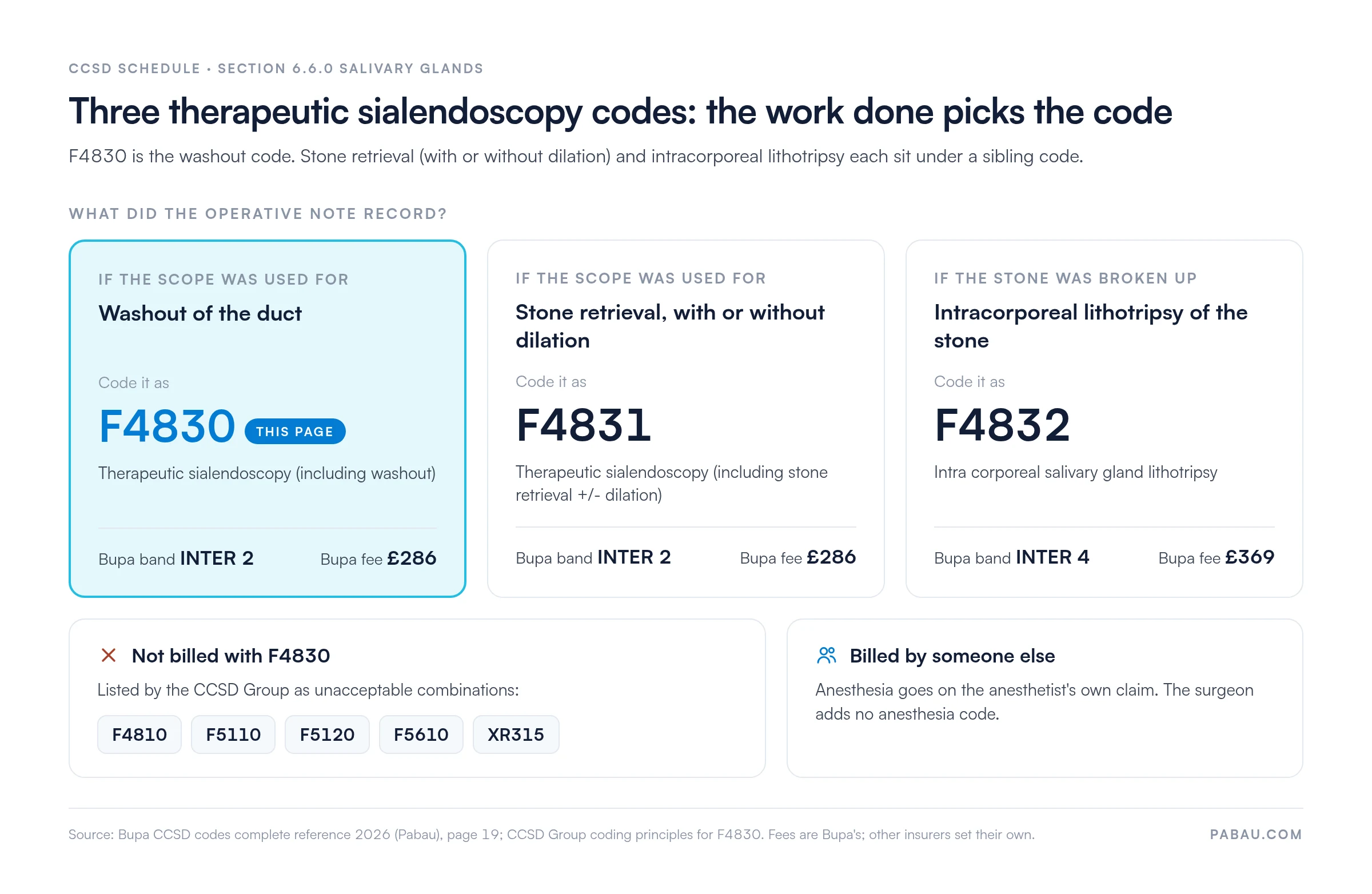
Under F4830, the washout never earns a line of its own. Other items depend on the schedule and the insurer, so the table gives the billing action for each one.
Some sessions treat more than one duct in the same visit. The insurer’s multiple-procedure or bilateral rules may apply, so confirm how it wants the claim built before submission.
Before submitting F4830, read the operative note for stone retrieval, dilation or lithotripsy. A retrieved stone points to F4831, and intracorporeal lithotripsy to F4832. If a stent was placed, check the CCSD schedule and the insurer’s policy before adding a code.
Inadequate documentation is a common reason claims are denied. The claim must be supported by a contemporaneous operative report that justifies the therapeutic intervention and confirms washout was performed. When the note is written in a structured form at the point of care, it already holds those details if an insurer audits the claim.
The operative report for F4830 must include:
Scope images or video stills stored with the patient record provide additional audit protection. Insurers may request these during a clinical review. A structured operative note template captures the required fields the same way for every patient.
Therapeutic sialendoscopy is a surgical procedure. UK private medical insurers such as Bupa, AXA Health, Aviva and Vitality generally require pre-authorization before it is performed. A claim without a valid authorization number is likely to be rejected. Authorization means the insurer has agreed to assess the claim under the patient’s policy, and payment still depends on that assessment.
The CCSD Group does not set fees or reimbursement for F4830. Bupa lists F4830 in complexity band INTER 2 at £286, the same band and fee as F4831. Each insurer sets its own fee for the code, so the amount a practice receives depends on the insurer and the patient’s policy. Check the insurer’s current fee schedule or provider guide before quoting a figure. Tell patients early about any shortfall their policy may leave them to pay.
CCSD Code F4830 claims are denied for predictable, correctable reasons. Tracking denial patterns in a claims management software system allows practices to identify recurring errors before they compound.
The table pairs each common F4830 denial reason with its root cause and the fix that clears it.
When a denial arrives, check the remittance advice for the specific rejection reason code before resubmitting. Generic appeals without addressing the stated reason are rarely successful. Tracking denial reason codes by procedure helps the billing team spot systemic issues before they affect cash flow. One example is an insurer that keeps rejecting F4830 for the same reason.
Accurate F4830 claims need three elements aligned on the same claim form. These are the correct procedure code, a matching ICD-10 diagnosis code and a valid pre-authorization number. Missing any one of these can trigger rejection before the insurer reviews clinical merit.
In the UK, most private claims go electronically through Healthcode, an independent clearinghouse that connects practices with private medical insurers. For practices billing several insurers, software that links the procedure code, authorization and diagnosis fields reduces manual error.
In Pabau, a practice management platform with built-in claims tools, billers enter F4830 alongside the supporting ICD-10 code and attach the authorization reference. The claim can then be tracked through to payment or denial. When a claim is denied, the reason appears in the same dashboard, so the biller can fix that one issue and resubmit.
Keeping billing, clinical notes and authorization tracking in one system removes a common source of error at submission. The operative report and the claim sit in the same record, so documentation an insurer requests during an audit or appeal is immediately retrievable. For how Bupa handles CCSD-coded procedures, see our Bupa fee schedule guide.
Set a workflow rule in your practice management system to flag any F4830 booking that does not yet have a prior authorization number attached. This catches missing pre-auth before the procedure date, not after the claim is denied.

Pabau helps UK private specialist practices submit CCSD claims, track pre-authorization status and resolve denials from one dashboard. See how it handles the billing workflow from operative note to payment confirmation.

F4830 pays reliably for the practice that finishes its coding work before the patient reaches the operating room. Secure pre-authorization and fix the operative note template in advance. Then check the note for stone retrieval or lithotripsy, which would move the claim to F4831 or F4832.
The trade-off is a few minutes of admin at booking against a rejected claim and an appeal weeks later. To see how Pabau keeps the operative note, the authorization and the F4830 claim on one record, book a demo.

Billing CCSD codes to UK private medical insurers? CCSD procedure code reference guide covers the structure and submission rules for the full CCSD schedule.
Working out what Bupa recognizes? Bupa procedure codes fee schedule explains how Bupa handles CCSD-coded procedures for UK private practices.
Coding other salivary gland procedures? CCSD Code F4810 covers open biopsy of a salivary gland lesion, one of the codes that cannot be billed with F4830.
Converting to an open stone removal? CCSD Code F5120 covers open extraction of a calculus from the submandibular duct.
Treating a salivary gland abscess instead? CCSD Code F4600 covers incision or drainage of a salivary gland abscess.
CCSD Code F4830 covers therapeutic sialendoscopy (including washout), an endoscopic washout of an obstructed parotid or submandibular duct. Stone retrieval, with or without dilation, is coded F4831, and intracorporeal lithotripsy is F4832. The washout is part of F4830 and cannot be billed separately on the same date of service.
F4830 is therapeutic sialendoscopy including washout, and F4831 is therapeutic sialendoscopy including stone retrieval with or without dilation. Bupa places both in complexity band INTER 2 at £286. Choose from the operative note: a retrieved stone points to F4831, and a washout without retrieval to F4830.
At the time of writing, the CCSD Group lists F4810, F5110, F5120, F5610 and XR315 as unacceptable combinations with F4830. These cover open biopsy of a salivary gland lesion, open or manipulative removal of duct stones, and stone extraction under imaging control. Each insurer decides whether to apply CCSD combination rules, so check its provider guide as well.
Yes, most UK private medical insurers require pre-authorization before therapeutic sialendoscopy is performed. The authorization number must be obtained before the procedure date and included on the claim. A claim without a valid authorization number is likely to be rejected. Requirements vary by insurer and policy, so confirm with the patient’s insurer before the procedure.
The primary ICD-10 codes paired with F4830 are K11.5 for sialolithiasis (salivary gland calculus) and K11.2 for sialadenitis. Ductal strictures without calculi may use K11.8. Use the most specific code that matches the operative findings. Check it against the insurer’s lookup tool, as some UK insurers validate the pairing automatically. If a stone is retrieved, the procedure code is F4831 rather than F4830.
Yes, anesthesia is separately billable on the same date as F4830. The anesthetist submits their own claim for the same encounter. The operating surgeon does not include an anesthesia code on the F4830 claim. Confirm with the insurer whether the hospital submits a separate facility claim alongside the surgeon’s claim.
The most common denial reasons are a missing pre-authorization number, an incorrect or non-specific ICD-10 code, and washout billed as a separate item. Insufficient operative notes, a consultant the insurer has not recognized for the procedure, and unacceptable code combinations also cause denials. The remittance advice states the reason, so address it before resubmitting.





