CCSD code G5100: Bypass of duodenum billing guide
CCSD code G5100 bills a bypass that leaves the duodenum in place CCSD code G5100...

Last Updated: Oct 16, 2026
B2984 is the CCSD code for reconstruction of breast using pedicled TRAM (including delayed reconstruction). Surgeons bill it to UK private insurers when a flap of lower abdominal skin, fat and rectus muscle rebuilds the breast. The flap stays attached to its own blood supply throughout.
A free TRAM, reconnected by microsurgery, is coded B2985 instead. Mastectomy with immediate free TRAM reconstruction has its own combined code, B2983.
Let Pabau's smart automation suggest the right codes, reduce claim denials, and keep your practice compliant—effortlessly.
Automate repetitive tasks and focus on what matters most—your patients.
Reduce coding errors and ensure compliance with the latest regulations.
Clean claims, fewer denials, and faster reimbursements.
Powerful insights and reporting to help your practice thrive.
HIPAA compliant SOC 2 certified GDPR-compliant Trusted by 4,000+ clinics worldwide

CCSD code B2984 covers breast reconstruction with a pedicled TRAM flap, including reconstruction delayed until months or years after mastectomy.
A pedicled TRAM stays attached to its own blood supply. A free TRAM, which needs microsurgery, is coded B2985 instead.
Mastectomy with immediate free TRAM reconstruction has its own combined code, B2983, so confirm the flap type before choosing between the three.
UK insurers generally treat reconstruction after breast cancer surgery as medically necessary, but they still expect pre-authorization before the operation.
The operation note should state the flap type, the timing, the laterality and the donor-site closure, because each one shapes the claim.
CCSD code B2984 is the UK private billing code for reconstruction of the breast using a pedicled TRAM flap, including delayed reconstruction. TRAM stands for transverse rectus abdominis myocutaneous. The flap moves skin, fat and part of the rectus abdominis muscle from the lower abdomen to rebuild the breast.
The code sits in Chapter 7 (Breast) of the CCSD schedule, under category 7.3.0 Reconstruction. CCSD also lists it under 15.4.1 Flaps, and it was added to the schedule on 20 January 2010.
Breast and plastic surgeons bill B2984 on claims to UK private medical insurers such as Bupa, AXA Health, Aviva and Vitality. Anesthetists usually invoice against the same procedure code. For how the wider schedule is organized, see our guide to CCSD codes.
Confirm the current descriptor in the CCSD schedule before you submit a claim. Descriptors can change between schedule releases, and insurers check the billed code against the live version.
In a pedicled TRAM, the surgeon raises an ellipse of lower abdominal skin and fat together with a strip of rectus abdominis muscle. The flap stays attached to the superior epigastric vessels running through that muscle. It is then tunneled under the upper abdominal skin to the chest and shaped into a breast.
Because the blood supply is never divided, the operation needs no microvascular anastomosis. That is the clinical line between B2984 and the free TRAM code, B2985. In a free TRAM, the flap is detached and its vessels are reconnected under a microscope.
The abdominal wall is then closed, often with mesh to reinforce the area where muscle was taken. The patient is left with a low abdominal scar running from hip to hip, as after an abdominoplasty.
B2984 describes the whole reconstruction, from flap harvest to closure of the donor site. Procedures on the other breast, later refinements and the mastectomy itself sit outside it.
Important: Insurers apply their own bundling rules on top of the CCSD descriptor. Check each payer’s schedule for how it treats mesh, bilateral cases and same-day procedures before you build the invoice.
Three neighboring CCSD codes describe TRAM breast reconstruction. The right one depends on two questions. Did the flap keep its own blood supply, and was the mastectomy done at the same operation?
If the operation note records an anastomosis to the internal mammary or thoracodorsal vessels, the flap was free, not pedicled. Our guides to CCSD code B2985 and CCSD code B2983 cover those cases. A DIEP flap spares the rectus muscle and is not a TRAM, so it is never coded B2984.
The decision path below runs both questions in the order a coder reads the operation note.
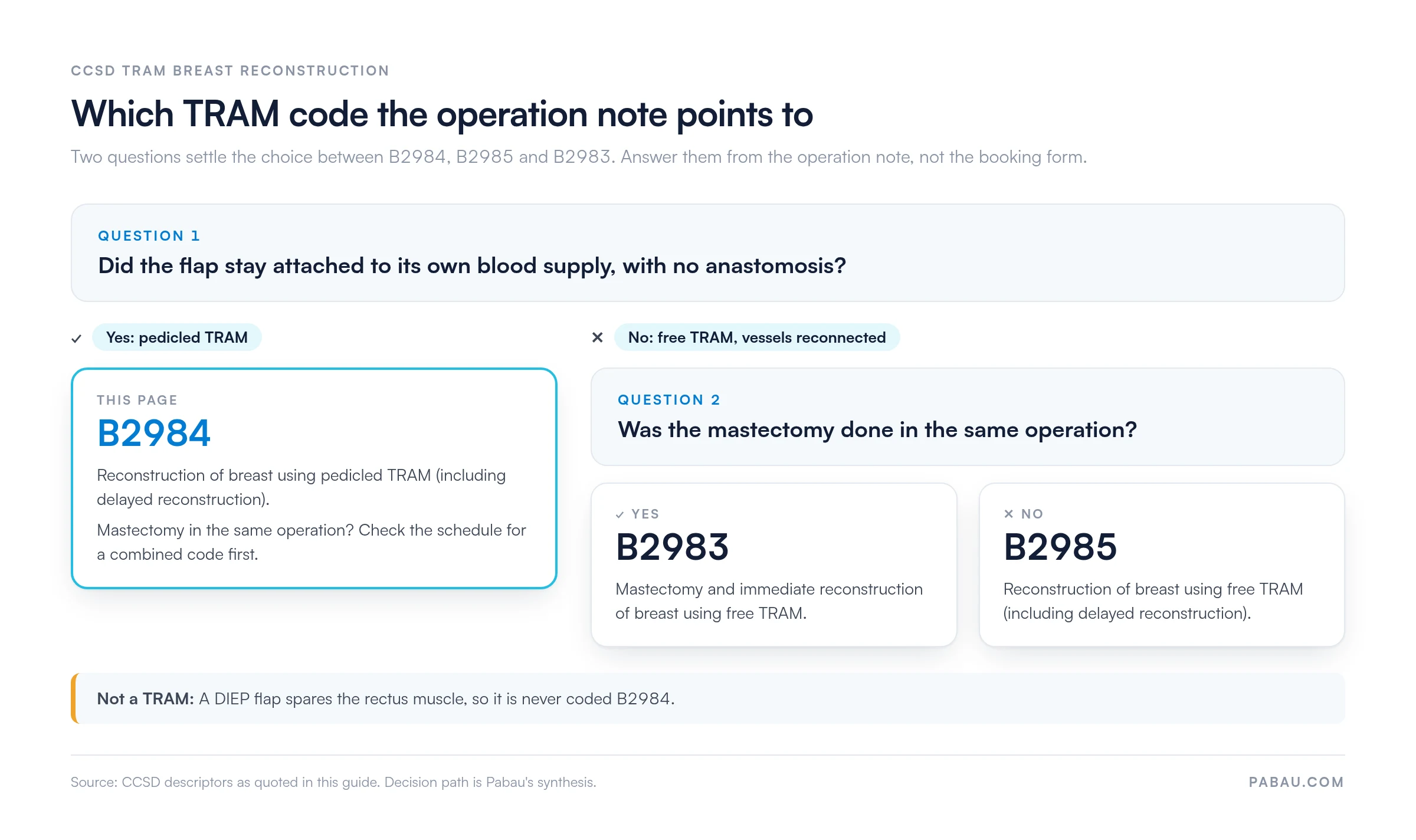
Code from the operation note, not the booking form. A case booked as a pedicled TRAM can change in theater, and the claim has to match the operation that took place.
The B2984 descriptor explicitly includes delayed reconstruction. That covers a pedicled TRAM performed months or years after the mastectomy, often once radiotherapy or chemotherapy has finished.
For a delayed case, record the date and type of the original mastectomy and any radiotherapy to the chest wall. Insurers use those details to connect the reconstruction to the original cancer claim.
When the pedicled TRAM follows a mastectomy in the same operation, check the CCSD schedule for a combined code before listing the two procedures separately. The free TRAM has one in B2983, and insurers expect the most specific code available.
The operation note decides which TRAM code applies, so it carries more weight than the referral or the booking. Every B2984 claim should be backed by a record that covers the points below.
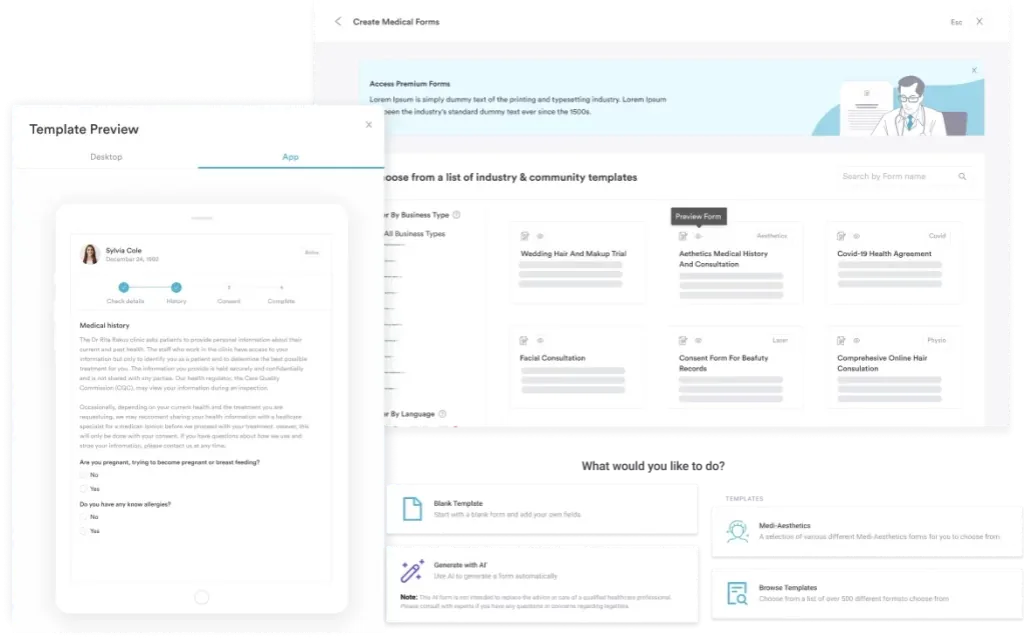
Keep these details in a structured patient record that can be produced quickly when an insurer queries the claim. A note that cannot be retrieved on request is treated the same as a missing one.
UK insurers generally treat reconstruction after breast cancer surgery as medically necessary, so B2984 is usually covered where the policy funded the cancer treatment. Cover still depends on the policy, and pre-authorization is expected before surgery.
The patient usually obtains the authorization number from the insurer, and the surgeon’s team supplies the code and clinical details. Quote B2984 exactly as it will appear on the invoice. A mismatch between the authorized and billed code is a common reason for a held claim.
Symmetrizing surgery on the other breast is where cover most often differs. Some policies fund it as part of cancer reconstruction, while others need a separate authorization, so ask before you book it.
Yes, B2984 can sit on a claim with other CCSD codes when each one describes a separate procedure. The mastectomy, symmetrizing surgery and later refinements are its usual companions.
Where the reconstruction relies on an implant alone, CCSD code B2700 covers subcutaneous mastectomy with implant. For the same TRAM operation billed in the US, see CPT code 19367.
Most B2984 rejections trace back to the flap type, the authorization or the link to the original cancer claim. Each of these is avoidable before the invoice goes out.
A B2984 claim often passes through several hands. The surgeon dictates the note, a secretary chases the authorization number, and the billing team re-keys the details into a Healthcode submission.
Pabau’s practice management and billing tools keep those steps on one patient record. The insurer and policy sit on that record, so the invoice routes to the right payer without re-keying.

With Pabau’s claims management software, claims go to Healthcode without leaving the system. Each claim shows its status as pending, submitted, processing, paid or error. A held B2984 claim then surfaces early, before it becomes a rejection letter weeks later.

Pabau keeps the operation note, insurer details and authorization reference on one patient record, then sends the claim to Healthcode and tracks it to payment.

B2984 is the right code only when the TRAM flap stayed on its own blood supply. Make that call from the operation note, and the rest of the claim follows from it.
The work that protects payment happens before surgery. Authorize the exact code, include any symmetrizing surgery, and record the timing and donor-site closure in terms an insurer can check. Delayed cases need the original mastectomy on the claim, or they are likely to be queried.
Book a demo to see how Pabau links operation notes, authorizations and Healthcode claims for breast reconstruction billing.

Need the wider Bupa picture? Bupa CCSD codes explains how Bupa uses the CCSD schedule, its fee lookups and its submission requirements.
Coding a free TRAM instead? CCSD code B2985 covers free TRAM breast reconstruction and the microsurgical detail insurers expect.
Was the free TRAM done with the mastectomy? CCSD code B2983 covers mastectomy with immediate free TRAM reconstruction as one combined code.
Billing the same operation in the US? CPT code 19367 explains single-pedicle TRAM breast reconstruction under the CPT system.
New to the CCSD schedule? CCSD codes walks through how the schedule is structured and how UK insurers use it.
CCSD code B2984 is the UK private billing code for breast reconstruction using a pedicled TRAM flap, including delayed reconstruction. The flap of lower abdominal skin, fat and rectus muscle stays attached to its own blood supply.
B2984 covers a pedicled TRAM, where the flap stays connected to its original blood vessels. B2985 covers a free TRAM, where the flap is detached and its vessels are reconnected by microsurgery.
Yes. The descriptor explicitly includes delayed reconstruction, so a pedicled TRAM performed months or years after mastectomy is still coded B2984. Record the original mastectomy date on the claim.
Usually, yes. UK insurers generally treat reconstruction after breast cancer surgery as medically necessary where the policy covered the cancer treatment. Pre-authorization is still expected before the operation.
Yes, when the mastectomy is done at the same operation, subject to CCSD combination rules. Check for a combined code first, as B2983 does for mastectomy with immediate free TRAM reconstruction.
Usually not. Closing the donor site, including mesh reinforcement, is normally treated as part of the flap harvest. Check the insurer’s bundling rules before adding a separate repair code.