CPT code 56606: Vulvar biopsy additional lesion billing guide
CPT code 56606: Official descriptor and add-on code classification CPT code 5660...

Last Updated: Nov 26, 2026
S3100 is the CCSD code for re-exploration of free flap. It covers the unplanned return to theatre when a completed microvascular free tissue transfer starts to fail. Typical triggers are arterial or venous thrombosis, a kinked pedicle, or a haematoma pressing on the vessels.
The code sits in the Flaps section (15.4.1) of the Skin and Subcutaneous Tissue chapter of the CCSD schedule. It does not cover the original free flap transfer, and the anaesthetist's fee is claimed separately.
Let Pabau's smart automation suggest the right codes, reduce claim denials, and keep your practice compliant—effortlessly.
Automate repetitive tasks and focus on what matters most—your patients.
Reduce coding errors and ensure compliance with the latest regulations.
Clean claims, fewer denials, and faster reimbursements.
Powerful insights and reporting to help your practice thrive.
HIPAA compliant SOC 2 certified GDPR-compliant Trusted by 4,000+ clinics worldwide

CCSD code S3100 applies to re-exploration of a free flap, not to the original free flap transfer.
Arterial or venous thrombosis, picked up through clinical monitoring or a lost Doppler signal, is the most common reason for an S3100 return to theatre.
The operative note is the most important document for a valid claim. It must record the clinical indication, the intraoperative findings, and the vessels addressed.
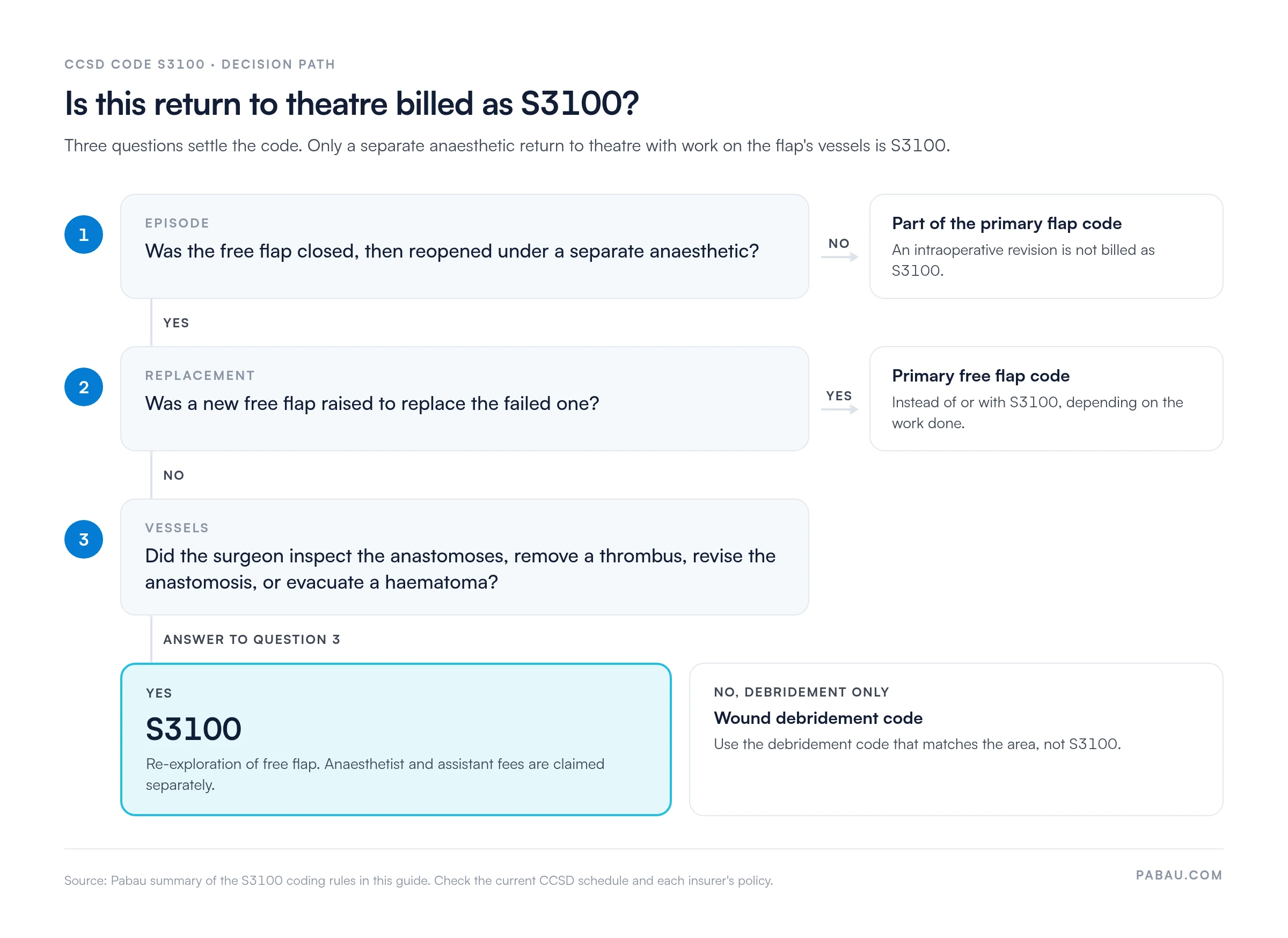
S3100 can be billed in the same admission as the primary flap only when a separate anaesthetic return to theatre took place.
Pabau, a practice management platform, keeps CCSD code entry, operative notes and insurer claims in one patient record for plastic and reconstructive surgeons.
CCSD code S3100 is the procedure code for re-exploration of a free flap in the UK private healthcare coding schedule. The CCSD Group’s standard schedule holds the procedure and diagnostic test codes for UK private healthcare. Its official descriptor for S3100 is Re-exploration of free flap.
The code applies only to the return-to-theatre episode in which the surgeon re-examines and treats a complication of a completed microvascular free tissue transfer. The primary free flap procedure has its own, separate CCSD code. When the flap is a functioning muscle moved with its own nerve, that primary operation is coded CCSD code T7620.
S3100 sits in the Flaps section (15.4.1) of the Skin and Subcutaneous Tissue chapter of the CCSD schedule. Bupa, AXA Health, Aviva, Vitality Health, Healix, and Cigna are among the UK private medical insurers (PMI payers) that accept CCSD procedure codes.
Claims are submitted electronically via Healthcode, the UK private healthcare EDI clearinghouse. The CCSD schedule is updated periodically, so check the current version before billing.
Re-exploration of a free flap is a surgical return to theatre. It is performed when clinical monitoring shows that a completed free tissue transfer is at risk of failure. The procedure follows a structured intraoperative sequence.
The whole procedure is microsurgical. It demands the same specialist skills as the original free tissue transfer, with comparable operative time and resources. That is why it carries its own CCSD code instead of being bundled into the primary flap code.
S3100 is performed when postoperative monitoring reveals signs of vascular compromise that cannot be managed conservatively. The decision to return to theatre is time-critical. Salvage rates fall the longer the flap stays ischaemic, so prompt return to theatre matters. Use S3100 when any of the following indications are documented.
These indications are well established in reconstructive microsurgery literature and consistent with guidance from the British Association of Plastic, Reconstructive and Aesthetic Surgeons (BAPRAS). Payers expect the note to name the specific clinical trigger. Recording Doppler readings and clinical observations in a structured patient record gives the claim a contemporaneous evidence trail.
The most common coding error here is selecting the primary free flap code for a re-exploration, or S3100 for a primary flap. The table below maps the key distinctions. Code numbers can change between editions of the CCSD schedule, so verify neighbouring codes against the current published version.
Flaps that are not free tissue transfers have their own CCSD codes in the same Flaps section. A distant pedicle flap is coded S1900, and a local flap under 9 cm² is coded S2500. A full thickness skin graft up to 9 cm² on the head, neck, hands or genitalia takes CCSD graft code S3624.
When the return to theatre involved wound debridement alone, a debridement code fits instead of S3100. S5712, for example, covers debridement of a wound over 25 cm².
The Bupa CCSD code schedule is a useful reference for plastic surgery code groupings on Bupa submissions. For other payers, check each insurer’s own code lookup portal.
CCSD code S3100 bundles the core surgical re-exploration episode into one line item. Knowing its scope prevents undercoding, where legitimate extra charges go unbilled. It also prevents claiming separately for work that S3100 already includes.
Documentation is where most S3100 claims are won or lost. Payers read the operative note to confirm that the surgeon took the patient back to theatre and operated on the flap. A structured digital operative note captures each required element at the point of care.
A contemporaneous note written at the time of the procedure carries more evidential weight than a retrospective summary. Time-stamped records in private practice billing software link the operative note to the claim, so an auditor can see when each entry was made.
UK private insurers generally require pre-authorisation for planned surgical procedures. Re-exploration of a free flap is unplanned by definition, because it is an emergency response to postoperative vascular compromise. Its administrative pathway therefore differs from elective pre-authorisation.
Each payer’s adjudication decision is final, so no documentation approach can guarantee payment.
Contact the insurer’s provider line within 24 hours of an unplanned re-exploration. Document the name of the agent you spoke to, the reference number given, and the agreed notification timeline. This creates an audit trail if the claim is later queried on pre-authorisation grounds.
The denial patterns below are the ones S3100 claims run into most often, each with a route to resolve it.
Billing teams often ask whether S3100 can be billed alongside the primary free flap code when re-exploration happens in the same hospital admission. The answer depends on what happened clinically, not on the admission date.
Suppose the primary free tissue transfer was completed and closed, and re-exploration later needed a separate anaesthetic. S3100 is then a distinct operative episode, billable in addition to the primary flap code. The two claims cover two separate surgical procedures in the same admission.
Sometimes the surgeon fixes a technical problem during the original free flap procedure, without closing and reopening the patient. That intraoperative revision is part of the primary procedure and is not billable as S3100. The key distinction is whether a separate anaesthetic return to theatre occurred. The decision path below applies that test to each scenario in this guide.
Payers may still query same-admission dual billing, so the records should make the operative sequence unambiguous. Each episode needs its own anaesthetic consent form, theatre booking record and operative note, all with distinct timestamps.
Healthcode is the EDI clearinghouse through which the majority of UK private healthcare claims are submitted electronically. The steps below reflect general Healthcode submission practice. Submission workflows can change, so check the current Healthcode documentation for portal updates.
Surgical practices billing CCSD codes to several insurers need claim status and the operative record in one view. Our comparison of UK medical billing software covers the systems practices use for that work.
In many surgical practices, a re-exploration is documented in one system and claimed in another. The surgeon writes the operative note, someone phones the insurer, and the billing team rebuilds the episode days later. Each handover risks a lost notification reference, or an episode coded as the primary flap.
Pabau holds the operative note, the insurer details and the claim in the same patient record. The authorisation or notification reference is tracked on the case, with a warning when one is missing. Claims go to UK insurers through Healthcode and Bupa, built from the note that supports them.
The result is a claim that agrees with its operative note. When an insurer queries it, the indication, findings and timestamps are already attached.

Pabau links CCSD code entry, operative notes and insurer claims in one patient record. Plastic and reconstructive surgery teams across the UK can then defend every S3100 claim with the note behind it.

S3100 claims rarely fail on the code itself. They fail when the operative note cannot show a separate return to theatre, or when the insurer hears about the re-exploration too late.
Write the indication, the findings and the vessels addressed into the note on the day. Log the notification reference before the claim is opened. A practice that does both removes the two most common grounds for querying an S3100 claim.
Book a demo to see how Pabau keeps the operative note, the insurer reference and the S3100 claim in one patient record.

Need a broader CCSD billing reference? Bupa CCSD code schedule covers Bupa-specific procedure code groupings for plastic and reconstructive surgery billing.
Billing a pedicled flap instead? Large island skin flap billing guide explains when CCSD code S2000 applies and what the claim needs.
Closing the defect with a skin graft? Split autograft of skin, trunk and limbs sets out how CCSD code S3500 is documented and billed.
CCSD code S3100 is the UK private healthcare billing code for re-exploration of a free flap. It covers the return to theatre in which a surgeon inspects and treats vascular compromise in a completed microvascular free tissue transfer. That includes vessel inspection, anastomotic revision, thrombectomy and haematoma evacuation where relevant. Anaesthetic fees and assistant surgeon charges are billed separately.
Re-exploration of a free flap is a return to theatre after a microvascular free tissue transfer, triggered when monitoring shows vascular compromise. Typical causes are arterial or venous thrombosis, anastomotic failure, or a haematoma compressing the pedicle. The surgeon re-examines the anastomoses, revises them where needed, and confirms flap perfusion before closure.
Yes, provided the re-exploration was a distinct operative episode with a separate anaesthetic return to theatre. An intraoperative revision during the original procedure does not qualify. To withstand payer scrutiny, keep separate anaesthetic records, theatre booking records and operative notes, each with distinct timestamps.
The operative note is the most critical document. It must state the clinical indication, the intraoperative findings, the procedure performed and the vessels addressed, plus the postoperative Doppler outcome. Payers also typically request the original free flap operative note and the postoperative monitoring records. An authorisation or retrospective notification reference must be in place before submission.
The leading denial triggers are an incomplete operative note, a missed retrospective notification, and the primary free flap code entered in place of S3100. Some payers also bundle same-admission claims. Each can be appealed with supporting documentation, but thorough operative record-keeping prevents most of them.
Because re-exploration is an unplanned, emergency procedure, formal pre-authorisation is typically not feasible. Most UK PMI payers accept retrospective notification, with the window set by each insurer, so check the payer’s current policy. Record the notification reference number and the agent’s name in the claim file.