CPT code 36468: Injection sclerotherapy of telangiectasia billing guide
CPT code 36468 covers spider veins on a limb or the trunk CPT code 36468 reports...

Last Updated: Nov 13, 2026
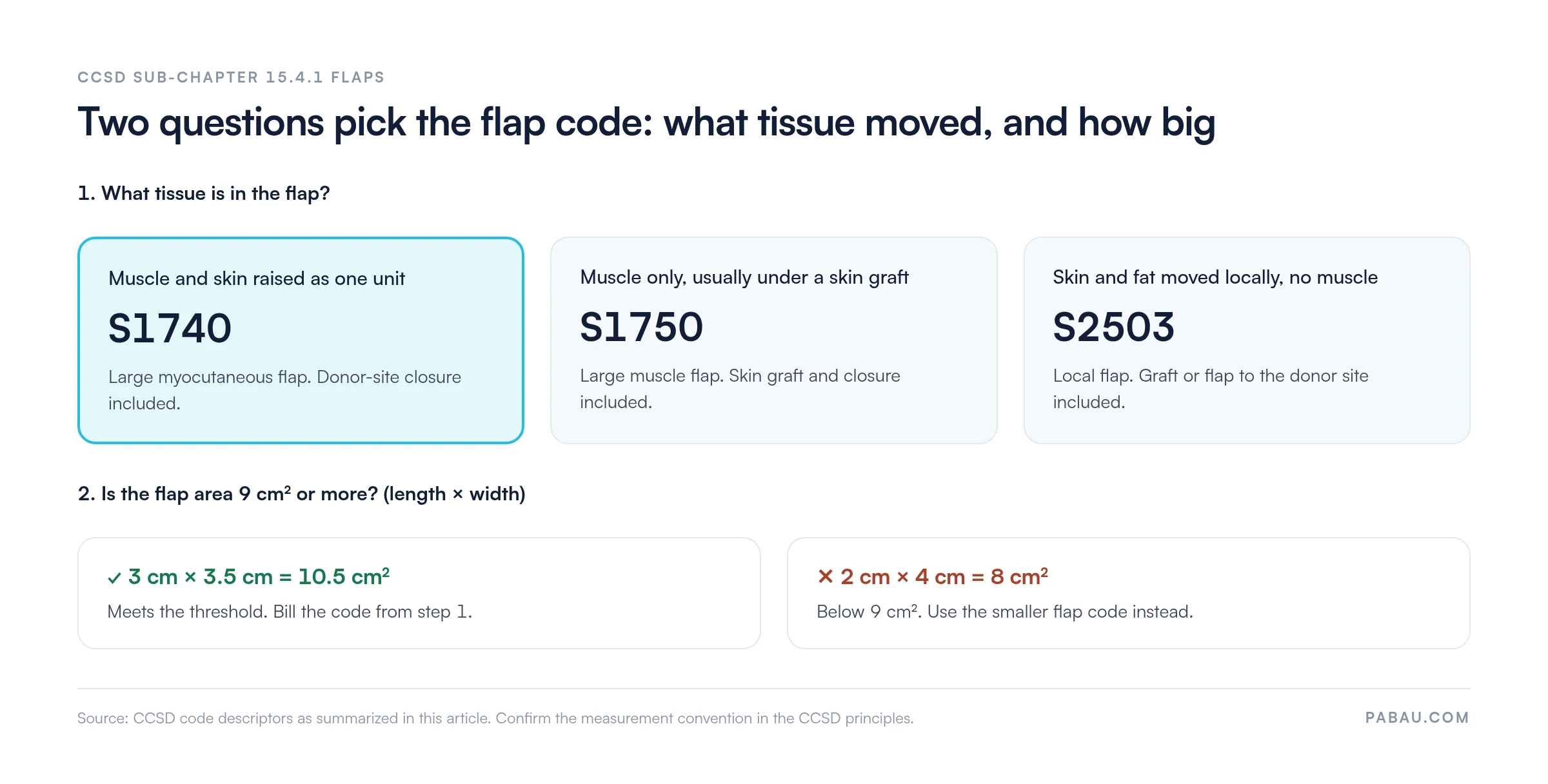
S1740 is the CCSD code for a large myocutaneous (muscular/cutaneous) flap of 9 cm² or more, including closure of the secondary defect. It covers raising muscle, fat and skin as one unit to close a defect, then repairing the donor site in the same operation.
The code sits in sub-chapter 15.4.1 (Flaps) of the CCSD schedule used by UK private medical insurers such as Bupa and AXA. A large muscle flap is billed as S1750, and a local flap of 9 cm² or more as S2503.
Let Pabau's smart automation suggest the right codes, reduce claim denials, and keep your practice compliant—effortlessly.
Automate repetitive tasks and focus on what matters most—your patients.
Reduce coding errors and ensure compliance with the latest regulations.
Clean claims, fewer denials, and faster reimbursements.
Powerful insights and reporting to help your practice thrive.
HIPAA compliant SOC 2 certified GDPR-compliant Trusted by 4,000+ clinics worldwide

CCSD Code S1740 covers a myocutaneous flap of 9 cm² or more, with closure of the secondary defect included in the code.
The 9 cm² threshold is measured on the flap itself, so the operation note needs numeric dimensions, not a size word.
Billing the donor-site closure as a separate line is unbundling, and the CCSD lists S4230 as an unacceptable combination with S1740.
CCSD sets codes, not fees, so Bupa, AXA and other UK insurers each decide what they pay for S1740.
Most S1740 claims go to UK insurers through Healthcode, and the insurer’s pre-authorisation number belongs on every invoice.
CCSD Code S1740 covers a large myocutaneous (muscular/cutaneous) flap of 9 cm² or more, including closure of the secondary defect. It sits in sub-chapter 15.4.1 (Flaps) of the CCSD schedule, the procedure code set UK private medical insurers use.
The descriptor carries two billing conditions. The flap must reach 9 cm², and the donor-site repair is part of the code. The operation note has to support both before the claim goes to the insurer.
A myocutaneous flap moves muscle, fat and skin as one composite unit. The muscle brings its own blood supply through perforating vessels, so the flap survives where a skin-only flap would fail. Surgeons in plastic surgery practices use it most often on the trunk, breast and limbs.
The surgeon designs the flap around the blood supply of the chosen muscle. Skin, subcutaneous fat and the full thickness of the muscle are then raised as a single unit.
The flap is rotated or advanced into the primary defect and inset. The donor site, or secondary defect, is closed directly, with a skin graft or with a further local flap. That closure is part of S1740, whichever method the surgeon uses.
Most S1740 flaps stay attached to their vascular pedicle throughout. A free flap, which is detached and re-joined to recipient vessels under the microscope, is a different operation. Check the current CCSD schedule before billing free tissue transfer under S1740. Breast reconstruction with a pedicled TRAM flap, also a myocutaneous flap, has its own code, B2984.
S1740 is used when a defect is too large, too deep or too poorly vascularised for direct closure or a graft alone. The usual clinical scenarios are:
Record the indication in both the referral and the operation note. UK insurers cover reconstructive surgery, not cosmetic surgery, so the clinical reason must be explicit before the insurer authorises treatment.
Insurers read the 9 cm² as the area of the flap itself. Confirm the measurement convention in the CCSD principles for S1740. Recording the two longest perpendicular dimensions of the skin island in centimetres, and their product, gives the auditor the figure to check.
A flap of 3 cm × 3.5 cm gives 10.5 cm², so it qualifies for S1740. A flap of 2 cm × 4 cm gives 8 cm², which falls below the threshold for this code. Area is the second check, after the tissue in the flap, as the diagram below shows.
An insurer’s claims auditor cannot confirm the threshold from a phrase such as “a large flap was raised”. Write the figures out in full: “a myocutaneous flap of [X] cm × [Y] cm ([Z] cm²) was raised.”
Record flap size as length × width = area in cm² in the operation note. Say whether the figure describes the skin island, the muscle or both. Auditors look for a number, and one missing figure is enough to prompt a query.
The S1740 descriptor ends with “including closure of secondary defect”. The donor-site repair is therefore part of the code and the fee the insurer pays for it.
That covers direct layered closure, local advancement or a split-thickness skin graft to the donor site in the same operation. Billing any of these as a separate line is unbundling, and insurers reject or recover it.
A genuinely separate procedure at a distant site, under a separate anaesthetic, is a different case. Document the clinical reason and confirm with the insurer before you bill it.
The CCSD lists unacceptable combinations for S1740, and the codes below are among them. Each one either duplicates work S1740 already includes or describes a procedure that already contains a flap.
Read the full descriptor for each code in the CCSD schedule before you build a multi-line claim. The schedule is searchable by registered CCSD users. Check the CCSD licence terms for your practice.
Several flap codes sit close to S1740 in sub-chapter 15.4 of the schedule UK insurers use. Picking the wrong one is a common reason for an insurer query. The table below shows where the lines fall.
Check the current CCSD schedule and the CCSD technical guide for the codes below 9 cm² and for free flaps. The schedule is updated through the year, so confirm each code before you bill.
UK insurers expect a diagnosis that explains why a large flap was needed. The ICD-10 code should match the confirmed indication in the clinical record. The table shows common pairings, which are examples rather than a fixed list.
Incomplete documentation is the easiest cause of a rejected S1740 claim to control. Before you submit, the clinical file should hold the following.
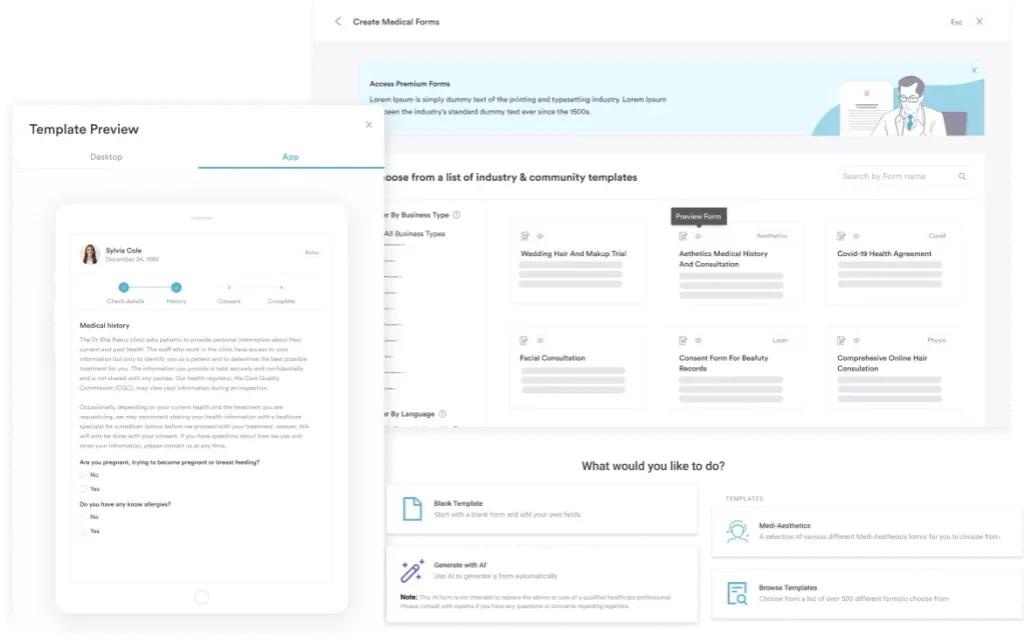
Pabau, the practice management platform we build, has digital forms that let you build the operation note around these points. Flap dimensions, tissue layers and donor-site closure become fields to complete.
Insured patients need their insurer’s authorisation before planned surgery, and a large reconstructive flap is no exception. Bupa, AXA and the other UK insurers each run their own process, but the request usually needs the same core details.
Rules differ by insurer and by policy. Check the current process with each insurer, and use Bupa’s procedure code search to confirm whether Bupa lists S1740 and what it pays. Our guide to Bupa CCSD codes explains how Bupa’s procedure list works.
CCSD codes describe procedures. They carry no fees and no CPT-style modifiers. The CCSD group states that it does not set fees or reimbursement, and each insurer decides what it pays. The S5322 keloid scar injection code shows the result, since Bupa lists it with no category or fee.
Ask the insurer before surgery if any of these is unclear. A shortfall the patient learns about afterwards is the complaint practices most want to avoid.
S1740 claims are rejected or queried for a predictable set of reasons. Most can be caught with a check before submission.
Two coding errors carry the highest risk on S1740: unbundling and upcoding. Both are picked up by insurer audits.
Unbundling means splitting one procedure into several lines to raise the total paid. On S1740, the usual form is billing the donor-site closure separately when it was done in the same operation. The descriptor’s “including closure of secondary defect” makes that a clear bundling error.
Upcoding means billing S1740 when the flap was smaller than 9 cm² or contained no muscle. The insurer’s auditor compares the operation note with the descriptor and can recover the difference.
Repeated errors can lead an insurer to review a consultant’s recognition, and deliberate miscoding can be treated as fraud. Code only what the operation note supports.
Before any S1740 claim goes out, run a three-point check. The authorisation number is on file. The flap area is recorded in cm². No closure code has been added for the donor site.
In many plastic surgery practices, the authorisation sits in an email, the operation note in another system, and the claim is keyed in by hand. Every handoff is a chance to lose the reference number or send the wrong fee.
Pabau keeps those steps on one patient record. Its claims software for private practices sends claims electronically through Healthcode and tracks each one’s status. The authorisation number and the operation note sit on the patient’s case, ready for the invoice.
Pabau sends and tracks the claim data your team enters, and the coding decision stays with your coder. The gain is fewer claims bounced for a missing reference, and a clear view of what each insurer still owes.
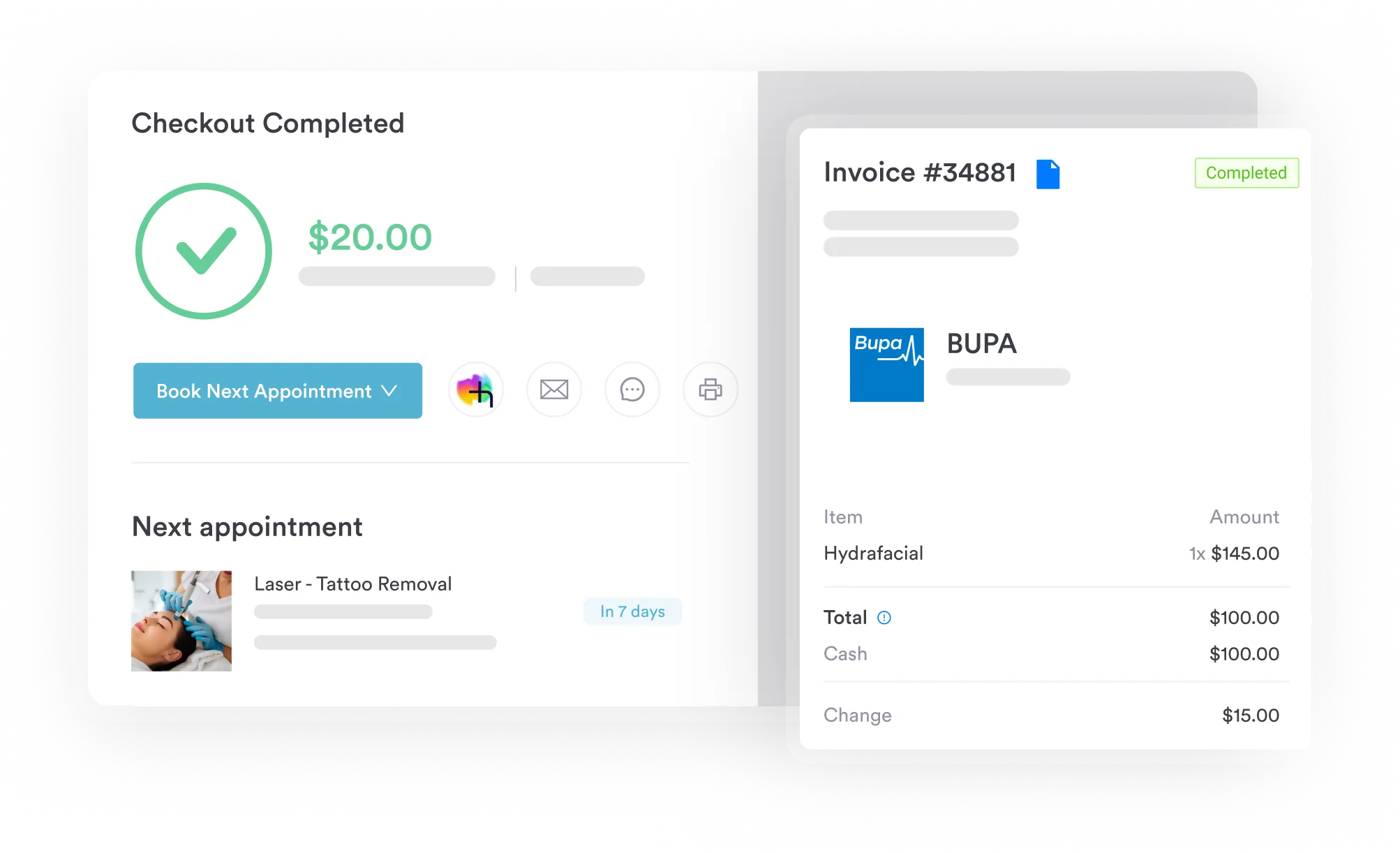

Pabau keeps the authorisation number, the operation note and the invoice on one patient record. It sends claims electronically through Healthcode and shows each claim’s status without a call to the insurer.

S1740 rewards precise notes. The code turns on two facts. The flap measures 9 cm² or more with muscle in it, and the donor site is closed in the same operation.
Get the measurement into the operation note, leave the donor-site closure off the claim, and hold the authorisation number before admission. Those three habits prevent most S1740 queries. Book a demo to see how Pabau tracks authorisations and sends your Healthcode claims from one patient record.

Need the wider CCSD picture? CCSD codes explains how the schedule is structured and how UK insurers use it.
Billing Bupa for reconstructive surgery? Bupa CCSD codes covers Bupa’s procedure list, recognition and claim process.
Coding a skin-only local flap? CCSD Code S2503 covers a local flap of 9 cm² or more.
CCSD Code S1740 covers a large myocutaneous (muscular/cutaneous) flap of 9 cm² or more, including closure of the secondary defect. Muscle and overlying skin are raised as one unit to cover a defect. UK private insurers such as Bupa and AXA use the code.
The minimum is 9 cm², which insurers read as the area of the flap itself. Confirm the measurement convention in the CCSD principles. A flap below that size falls under a smaller flap code, even when the same technique is used.
Yes. The CCSD descriptor includes closure of the secondary defect, so the donor-site repair is part of the code. Billing a separate closure code for the donor site, such as S4230, is unbundling and insurers reject it.
The CCSD’s unacceptable combinations for S1740 include B2986, B2989, S3102, S4230 and W0951. Check each full descriptor in the CCSD schedule before you build a claim with more than one procedure line.
Insured patients need their insurer’s authorisation before planned surgery. Quote S1740 in the request, include the referral and supporting clinical detail, and put the authorisation number on the invoice. Each insurer runs its own process.
The CCSD group does not set fees or reimbursement. Each UK insurer decides what it pays for S1740, so check the insurer’s published fee before surgery and tell the patient about any shortfall.