

HCPCS Code Q4185: Cellesta flowable amnion billing guide
HCPCS Code Q4185: definition and official descriptor HCPCS Code Q4185 is the Lev...

Last Updated: Nov 20, 2026
S2000 is the CCSD code for a large island skin flap of 9cm² or more, such as a radial forearm flap. The code includes closure of the secondary defect. UK private medical insurers, such as Bupa and AXA Health, use the CCSD schedule on specialist invoices.
Flap size decides the code. An island flap under 9cm² is coded S2002, so the operative note needs the flap's measurements.
Let Pabau's smart automation suggest the right codes, reduce claim denials, and keep your practice compliant—effortlessly.
Automate repetitive tasks and focus on what matters most—your patients.
Reduce coding errors and ensure compliance with the latest regulations.
Clean claims, fewer denials, and faster reimbursements.
Powerful insights and reporting to help your practice thrive.
HIPAA compliant SOC 2 certified GDPR-compliant Trusted by 4,000+ clinics worldwide

CCSD code S2000 covers a large island skin flap of 9cm² or more, such as a radial forearm flap, including closure of the secondary defect.
It is a reconstructive surgical code in the UK CCSD schedule, which private medical insurers such as Bupa and AXA Health use on specialist invoices.
Flap size decides the code: an island flap under 9cm² is S2002, so the operative note must record the flap’s measurements.
The CCSD Group defines the code but doesn’t set fees or decide cover, so check each insurer’s own rules and fee schedule.
Most queries come from a missing flap size, a donor-site code added on top, or a local or free flap coded as S2000.
CCSD code S2000 is billed when a surgeon raises an island skin flap of 9cm² or more and moves it into a defect. A radial forearm flap is the classic example.
The Clinical Coding & Schedule Development Group (CCSD) lists it as Large island skin flap (9cm2 or more) (e.g. radial forearm) (including closure of secondary defect).
Two details in that line do most of the work. The 9cm² threshold splits it from the small island flap code, and closing the donor site is already inside the code.
The CCSD schedule is the coding set UK private medical insurers read on specialist invoices. Bupa, AXA Health, Aviva and Vitality all use it. The Group states that its codes and principles don’t determine reimbursement. Each insurer applies its own fee schedule and cover rules to S2000.
An island flap is a paddle of skin that stays attached to the body only by its feeding vessels. The surgeon divides the skin around it, so it can swing or tunnel into a defect some distance away. That reach is what sets it apart from a local flap, which keeps a skin attachment to its base.
The radial forearm flap is the example the descriptor names. Its paddle is raised on the radial artery and its veins, then rotated into place. Surgeons reach for an island flap when nearby skin can’t close the defect but the patient doesn’t need a free flap. Typical situations include:
Coding follows the flap’s design, not the defect’s location. A free flap is detached and reconnected to new vessels with microsurgery, so it isn’t an island flap for coding. A pedicled flap from a distant site, held in place for weeks, is coded S1900. A burn scar excision before the flap carries its own code. On the hand, head or neck, an excision of more than 25 cm² is burn excision code S5523.
The descriptor answers most inclusion questions. It covers raising the island flap, moving it into the defect and closing the donor site in the same session. Anything outside that session needs its own code and its own date.
The CCSD schedule also publishes coding notes and unacceptable combinations for each code. That detail sits behind a registered login on the CCSD website.
Check S2000’s current entry before you build a multi-code invoice. Do the same before you add a graft code for the donor site, such as S3500 for a split autograft on the trunk or limbs.
Most coding errors here come from two questions. Was it an island flap or a local flap, and was it bigger or smaller than 9cm²?
The local flap codes split at the same size, so both questions matter. A large local flap with a graft or flap to its donor site, for example, is coded S2503.
Here’s the rule of thumb. Decide the flap type from the operative note first, then let the measurement pick the code. The diagram below runs both questions in order. If the note can’t answer either one, the invoice isn’t ready.
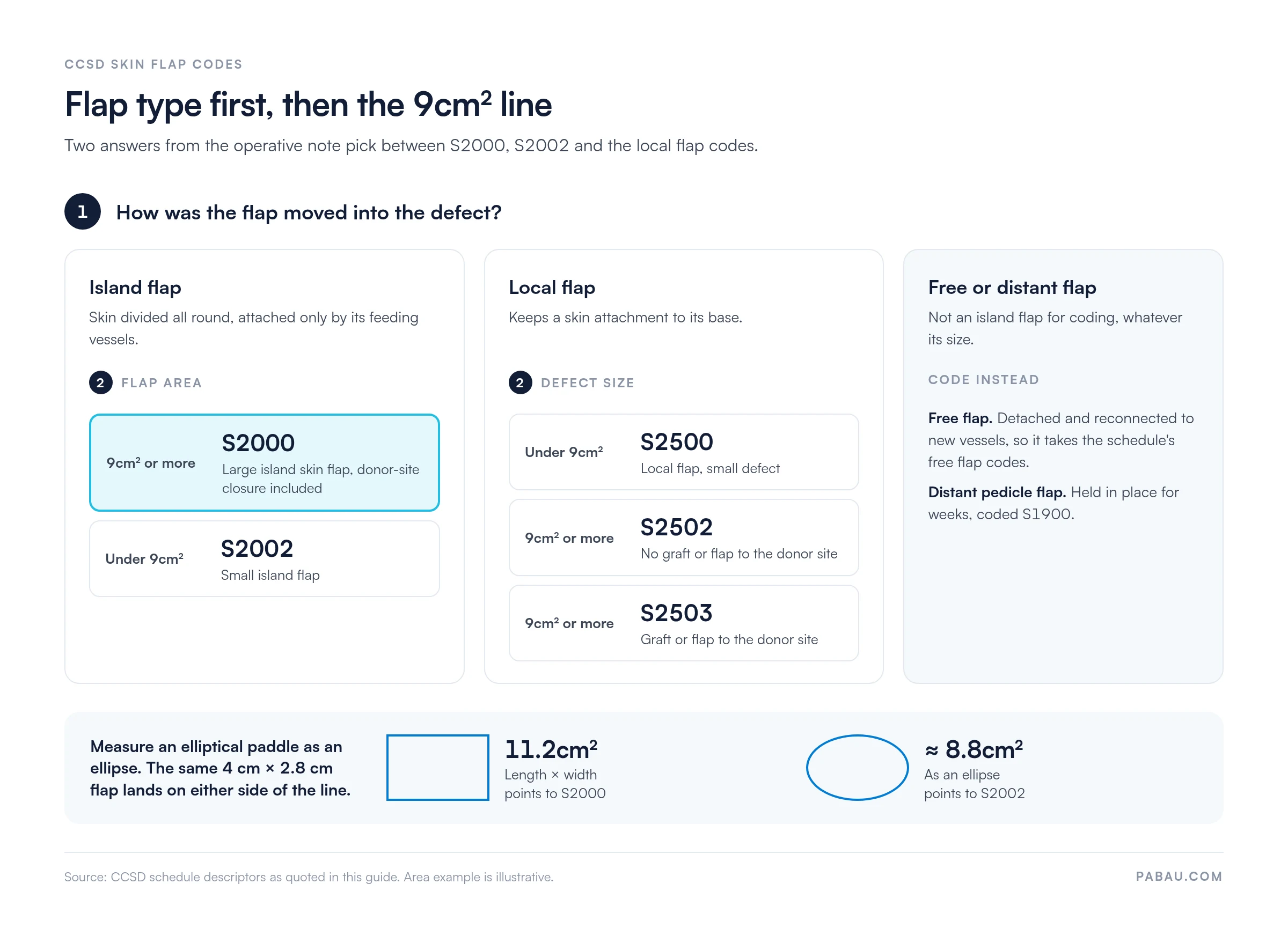
The 9cm² line sounds simple until you look at how flap paddles are drawn. Most are ellipses, not rectangles, and length times width overstates an ellipse. A true ellipse covers about 79% of the rectangle around it.
Near the line, the method you use decides the code. Here’s how one paddle can land on either side:
The CCSD descriptor doesn’t say how to measure, and we couldn’t confirm a published method. So write the shape and both dimensions in the note. When a flap sits close to 9cm², ask the insurer how it wants the area stated.
UK insurers expect a WHO ICD-10 diagnosis on the invoice, not a US ICD-10-CM code. The diagnosis should explain why the defect needed a flap. These categories are common starting points, and you code to the full character the insurer asks for.
Keep the diagnosis consistent with the operative note and the pre-authorization. A mismatch between the three is one of the quickest ways to get a claim queried.
An island flap claim follows the same path as most UK surgical invoices. Here’s how it usually runs with a private medical insurer.
Most insurers take specialist invoices electronically through Healthcode, the UK clearing service for private healthcare billing. The anesthesia team sends its own invoice with the same authorization number and diagnosis.
Take an illustrative case. A patient has a skin cancer excised from the back of the hand, which leaves exposed extensor tendons. A skin graft won’t take on bare tendon, and there isn’t enough local skin for a local flap.
The surgeon plans a radial forearm island flap and the practice asks the insurer to authorize S2000. The diagnosis is the C44 code for the excised lesion. In theater, the surgeon raises an elliptical paddle of 5 cm by 3 cm on the radial vessels. They turn it into the hand defect and close the forearm donor site.
The note records an ellipse of 5 cm by 3 cm, about 11.8cm², so the flap is clear of the line. The invoice goes in as S2000, and the donor-site closure doesn’t appear as a second line. The excision is invoiced only if the insurer’s combination rules allow it.
Most problems come from a handful of mistakes. Each one has a simple fix if you catch it before the invoice goes out.
An island flap claim depends on three records lining up: the authorization, the operative note and the invoice. In Pabau, a practice management platform, all three sit on one patient record.
Your team records the insurer’s authorization code on the case. The operative note, with its flap measurements, sits in the patient’s medical record beside the invoice. When the insurer queries the size, the answer is one click away instead of in a paper folder.
For UK claims, Pabau’s claims management sends invoices to insurers through its Healthcode integration. It checks each claim before submission and tracks its status afterward.
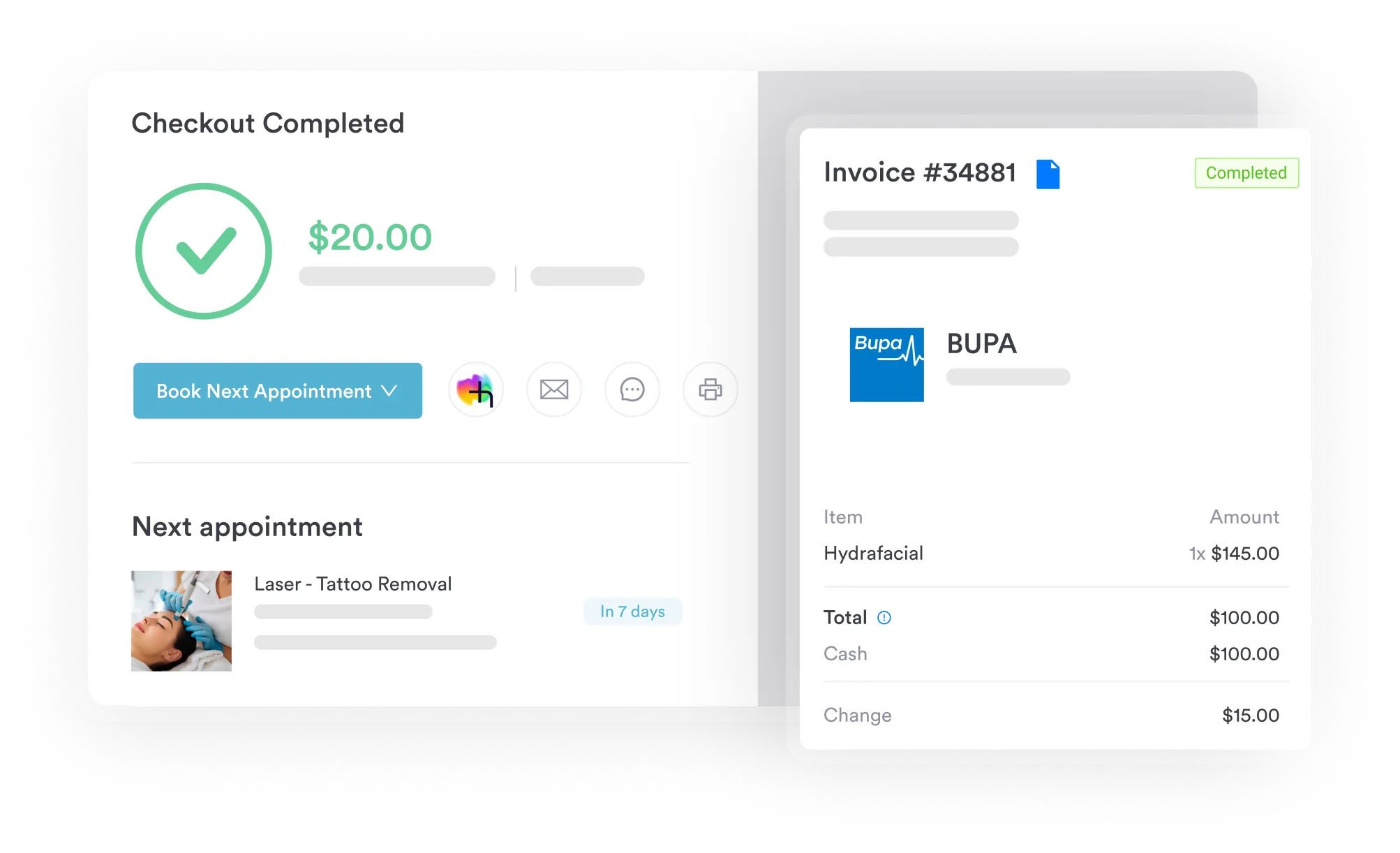

Pabau keeps the insurer’s authorization and your operative notes beside each invoice. UK claims go to insurers through Healthcode, checked before they leave.

S2000 comes down to two facts in the operative note. The flap is an island flap, and it measures 9cm² or more. Get those on paper and the code picks itself.
The rest is discipline. Authorize before the operation, keep the donor-site closure off the invoice, and match the diagnosis to the note. Then the claim reads as one clean reconstruction from start to finish.
Book a demo to see how Pabau keeps flap notes, authorizations and insurer invoices on one record.

Coding a local flap instead? CCSD code S2503 covers a local flap of 9cm² or more with the donor site repaired.
Moving a flap from a distant site? CCSD code S1900 explains billing for a distant pedicle flap.
Reconstructing with a muscle-based flap? CCSD code S1740 covers large myocutaneous flap surgery.
Need the wider CCSD picture? CCSD codes explains how specialists and UK insurers use the schedule.
No, it’s reconstructive. Insurers may still check that the flap repairs a wound, a cancer defect or burn damage. Dated photographs and a clear operative note answer that.
No. NHS hospitals record procedures in OPCS-4, the NHS procedure classification. CCSD codes such as S2000 are used on invoices to UK private medical insurers.
The CCSD schedule shows S2000 as added on November 4, 2011. The small island flap code, S2002, dates from January 20, 2010.
The consultant surgeon who raises the flap, often a plastic or hand surgeon. The anesthesia team invoices separately under its own codes.
On the CCSD website, after you register for access. The entry shows the descriptor, coding notes and unacceptable combinations. Each insurer’s own fee schedule shows what it pays.





