HCPCS Code A4709: Acid concentrate solution for hemodialysis
What is HCPCS code A4709? HCPCS code A4709 is the Healthcare Common Procedure Co...

Last Updated: Oct 15, 2026
B2985 is the CCSD code for reconstruction of breast using free TRAM (including delayed reconstruction). It covers the full surgical episode, from harvesting the flap at the lower abdomen to closing the donor site. The transfer relies on microsurgical anastomosis of the inferior epigastric vessels to recipient vessels at the chest.
The word free is what separates B2985 from the pedicled TRAM code, which keeps its original vascular pedicle. The flap is detached completely, so the operative note has to record the anastomosis. B2985 applies to immediate and delayed reconstruction alike.
Let Pabau's smart automation suggest the right codes, reduce claim denials, and keep your practice compliant—effortlessly.
Automate repetitive tasks and focus on what matters most—your patients.
Reduce coding errors and ensure compliance with the latest regulations.
Clean claims, fewer denials, and faster reimbursements.
Powerful insights and reporting to help your practice thrive.
HIPAA compliant SOC 2 certified GDPR-compliant Trusted by 4,000+ clinics worldwide

CCSD Code B2985 covers free TRAM flap breast reconstruction, including delayed cases after an earlier mastectomy.
Microsurgical anastomosis transfers a free TRAM, which is what separates it from the pedicled TRAM.
The operative note has to record that detachment and anastomosis, or the insurer can downcode the claim.
Nearly every UK private medical insurer requires written pre-authorisation before surgeons perform B2985.
Practice management software like Pabau keeps pre-authorisation references and operative notes on one patient record.
CCSD Code B2985 is the Clinical Coding and Schedule Development (CCSD) procedure code for breast reconstruction using a free TRAM flap, including delayed reconstruction. B2985 sits in chapter 7, Breast, alongside the adjacent reconstructive and symmetrisation codes.
The CCSD schedule is the standard reference for UK private medical insurance billing. The CCSD Group, whose members are Bupa, AXA Health, Aviva and VitalityHealth, governs the schedule. Grant Thornton UK LLP runs the schedule on the group’s behalf.
The code covers the complete surgical episode:
Two qualifiers sit inside the descriptor. The word free means the flap fully detaches and depends on microsurgical anastomosis for its blood supply. A pedicled TRAM keeps its original vascular pedicle instead. The phrase including delayed reconstruction confirms that B2985 applies whenever reconstruction happens relative to mastectomy.
A free TRAM flap reconstruction takes skin, subcutaneous fat, and a segment of the rectus abdominis muscle from the lower abdomen. The surgeon transfers that tissue to the chest wall to rebuild the breast mound.
Surgeons perform it under general anaesthesia, and it typically lasts six to ten hours. Two surgical teams often work at the same time, one on the donor site and one on the chest.
The key surgical steps are:
For coders, step three is the one that decides the code. The microsurgical anastomosis separates a free TRAM (B2985) from a pedicled TRAM, which keeps the muscle and pedicle intact and carries a different code. If the note does not confirm that the surgeon detached the flap and microsurgically anastomosed it, the insurer may downcode the claim to the pedicled TRAM code.
B2985 explicitly covers both immediate and delayed free TRAM reconstruction. The distinction matters clinically and for pre-authorisation documentation, though it does not change the code itself.
Where the same-session reconstruction uses an expandable prosthesis instead of a free flap, the episode falls under CCSD code B3012. That code covers removal of the breast and insertion of a tissue expander in one operative episode, on one side.
When submitting a delayed reconstruction claim, include the date of the original mastectomy in the pre-authorisation documentation. Insurers use that date to confirm the clinical pathway and the timing classification on the claim.
Surgeons choose free TRAM reconstruction where other methods are less suitable. Confirming that a B2985 claim is clinically appropriate matters when an insurer reviews the record for medical necessity.
Where the patient prefers an implant to autologous tissue, the surgeon bills the fixed prosthesis code B3015. That code applies whether the implant goes in at the mastectomy or as a delayed episode months later.
Autologous reconstruction is not limited to flap surgery. Where the surgeon rebuilds volume with transferred fat instead, the claim goes under B3017.
The operative note and the pre-authorisation request should both name the indication that applies. Insurers reviewing high-value reconstruction claims routinely ask for the clinical rationale, and a documented indication reduces the medical-necessity denial risk. Patient records that hold the clinical reasoning next to the surgical plan make that evidence quick to retrieve.
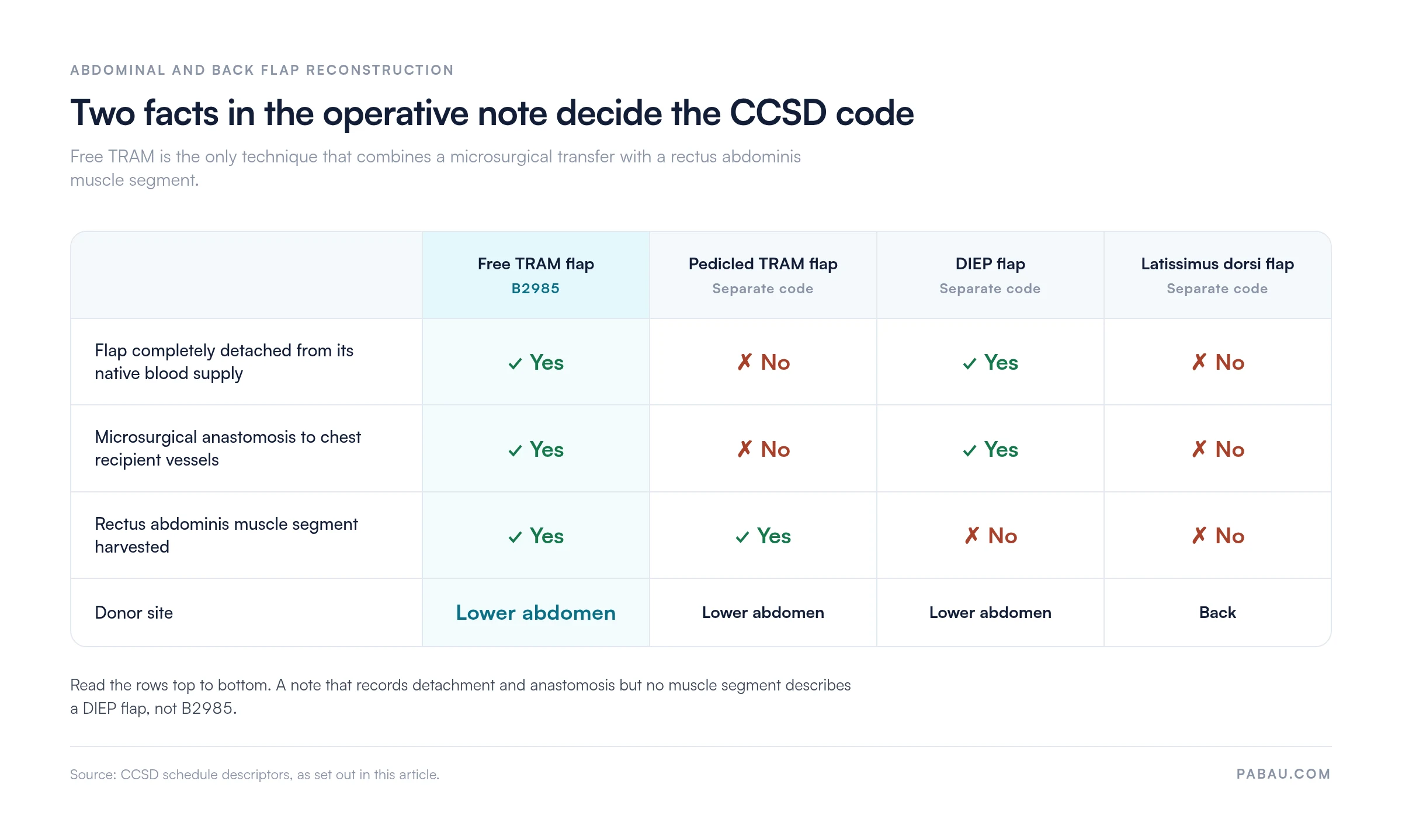
Selecting the wrong code is the most common reason insurers deny or downgrade free TRAM claims. Coders confuse three codes with B2985 most often: the pedicled TRAM code, the DIEP flap code, and the latissimus dorsi flap code. In each case the flap type and the presence of microsurgery decide which code applies.
The latissimus dorsi row carries one further distinction. Where an implant supports that flap, the reconstruction is billed under B2913.
The free-versus-pedicled distinction does the most work here. Both procedures use abdominal TRAM tissue, but only B2985 requires microsurgery, and the muscle segment then separates it from a DIEP flap. A pedicled TRAM carries its own code, B2984, whose descriptor covers delayed reconstruction as well.
Confirm the exact pedicled TRAM and DIEP codes against the current CCSD Technical Guide before submission. Code numbers for related procedures change when the schedule is updated.
B2985 covers the primary reconstructive procedure. A complete reconstruction episode often involves extra surgical components that carry their own codes and bill separately, and the table below names them.
Insurers apply strict unbundling rules to reconstruction episodes. Before billing any companion code alongside B2985, check that the insurer’s policy permits separate payment for that component. Pabau’s CCSD codes index collects the individual code guides in one place, which helps when you are checking a companion code.
Bupa’s code search tool publishes unbundling guidance for reconstructive procedures.
Run a pre-submission companion-code check against each named insurer’s current unbundling rules before billing nipple reconstruction or contralateral symmetrisation alongside B2985. Insurers treat these as elective enhancements and routinely deny them without explicit prior approval, even when performed at the same operative session.
The operative note is the primary supporting document for a B2985 claim. Insurers reviewing a high-value reconstruction code need to see that the surgeon used a free flap technique rather than a pedicled one.
A generic operative report that skips the technical elements of a free TRAM is the second most common denial reason, after absent pre-authorisation. The note for B2985 must include:
Practices that capture operative notes on structured digital forms can build these elements into a procedure-specific template. That leaves an auditable record matching the insurer’s documentation checklist, which matters when a claim is reviewed or appealed.
B2985 is a high-value procedure code. Bupa, AXA Health, Aviva, VitalityHealth, WPA and Allianz Care all require written pre-authorisation before surgeons perform free TRAM reconstruction. Submitting a claim without a valid pre-auth reference makes the procedure self-funded, whatever the patient’s policy covers.
The pre-authorisation request for B2985 typically requires:
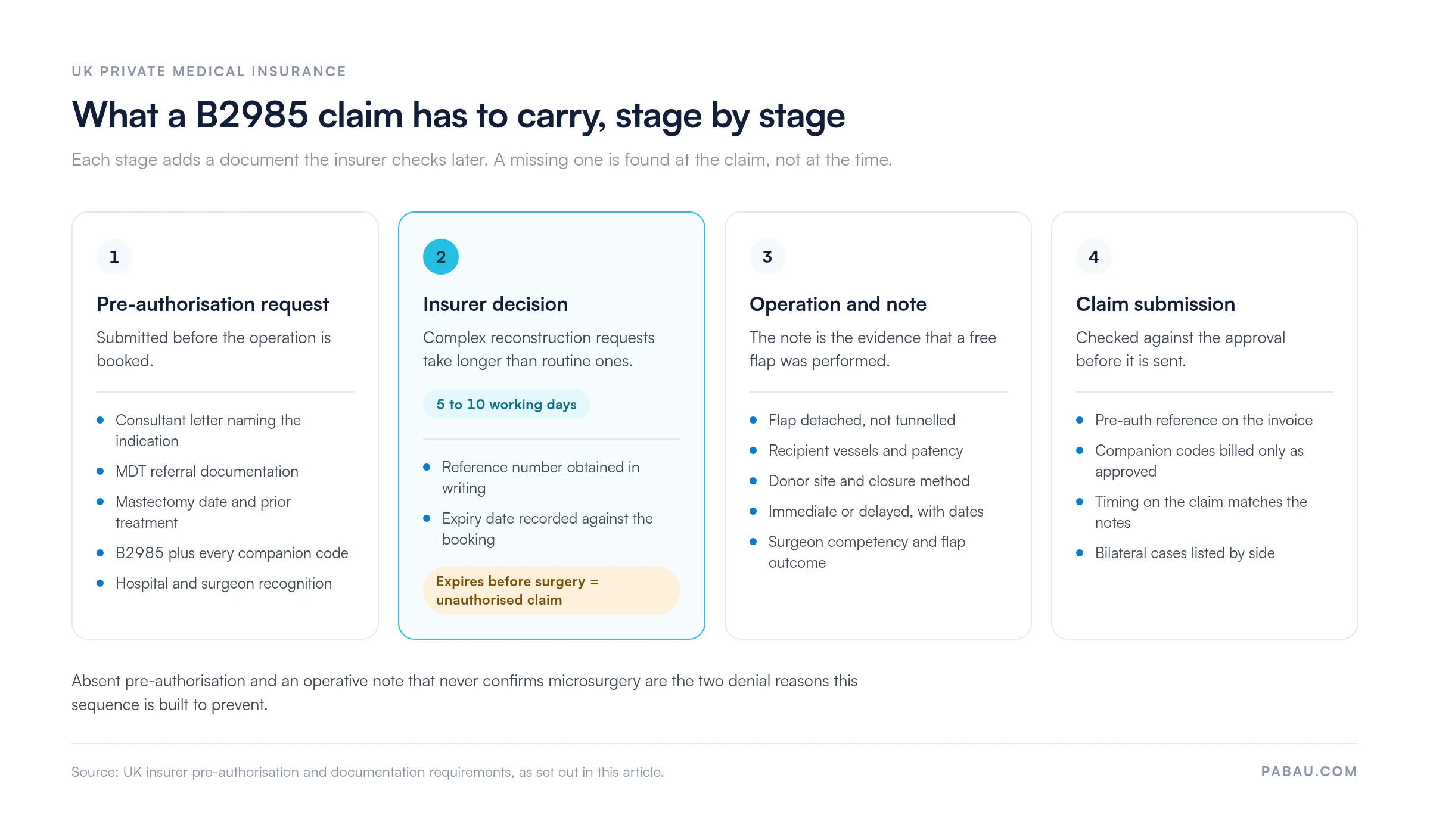
Insurers usually answer pre-auth requests for complex reconstructive procedures within five to ten working days. The practice can raise urgent cases through the insurer’s medical case management team. Always obtain the reference number in writing and put it on the invoice.
Tracking each authorisation request, its expiry date and the approving clinician prevents the common failure here. A pre-auth obtained early can expire before the operation date, which leaves the practice holding an unauthorised claim. Bupa applies the schedule in its own way, and the Bupa CCSD codes guide sets out how its pre-authorisation and code rules work.
The four stages below show what has to be on file at each point of the claim.
Free TRAM claims are denied more often than routine surgical codes. The complexity, the fee value and the number of documentation elements insurers check all contribute. The most common reasons are predictable and largely preventable.
A pre-submission review against this list, run by the billing team before every B2985 claim, cuts the denial rate for this code. It is cheaper to catch a missing pre-auth reference than to appeal one.
Build a B2985 pre-submission checklist into your billing workflow. Check that the pre-auth reference is confirmed and in date. Check that the operative note confirms the free flap and the microsurgery. Check that companion codes were pre-authorised separately and pass each insurer’s unbundling rules. Check that the timing classification matches the clinical record. Five minutes at submission prevents weeks of appeals.
Bilateral free TRAM reconstruction is less common than unilateral, but it does occur. Surgeons see it in patients with BRCA mutations having bilateral prophylactic mastectomy with immediate reconstruction, and in bilateral breast cancer.
The general approach is to list B2985 twice on the claim, once for each side. Note clearly that the surgeon reconstructed the left and right breasts separately. Insurer-specific rules then vary:
Bilateral billing rules differ by insurer and by policy year. Verify the approach with each named insurer before the claim goes out, rather than assuming a universal rule. The Aviva fee schedule carries bilateral modifier guidance that works as a starting reference.
Free TRAM claims have more moving parts than most surgical codes. Pre-authorisation across several insurers, companion-code planning, microsurgery documentation, timing classification and bilateral rules all have to line up.
Most practices hold those pieces in separate places. The pre-auth letter sits in an email thread, the operative note in the EMR, and the code list on the biller’s spreadsheet. Nobody sees the whole picture until a claim comes back.
Practice management software like Pabau keeps them on one patient record. The system captures the authorisation reference against the appointment before the procedure date. Structured forms hold the operative note, and our claims management software carries the code list through to the invoice.
The outcome is fewer claims failing over paperwork. A biller can see, before submission, whether the reference is in date and whether the note records the microsurgery.

Pabau helps plastic surgery and reconstructive practices structure operative documentation, manage pre-authorisation workflows, and keep patient records audit-ready for UK private medical insurers.

CCSD Code B2985 covers one of the most technically complex procedures in private reconstructive surgery, and the billing carries that complexity with it. The free flap distinction, the microsurgery documentation, the pre-authorisation obligation and the unbundling rules each give a claim somewhere to fail.
Treat B2985 as a workflow rather than a code, and the denials mostly stop. Track the authorisation, template the operative note, and get every companion code approved on its own before the patient reaches theatre.
The trade-off is a few minutes of admin per case against weeks of appeal correspondence. Book a demo to see how Pabau keeps pre-authorisation and operative documentation together for UK reconstructive practices.

Setting up CCSD billing for the first time? Bupa CCSD procedure codes guide walks through how the CCSD schedule is structured and how Bupa applies it to private surgical claims.
Billing the same procedure in the US? CPT code 19367 covers TRAM flap breast reconstruction, with the documentation and modifier rules US payers apply.
Coding a DIEP flap instead? HCPCS code S2068 sets out how the perforator flap is billed and where payers draw the line against a free TRAM.
CCSD Code B2985 covers breast reconstruction using a free transverse rectus abdominis myocutaneous (TRAM) flap. It also covers delayed reconstruction, performed weeks, months or years after the original mastectomy. The code applies either way.
The most common reasons are absent or expired pre-authorisation and an operative note that never confirms microsurgical anastomosis. Billing the pedicled TRAM code instead of the free one is next, followed by an incorrect timing classification. Unbundling errors with companion codes complete the list. A pre-submission checklist covering those five prevents most denials.
Insurers expect an operative note that confirms the free flap technique and names the recipient vessels used for the anastomosis. It should also describe the donor site and closure method, state the timing relative to mastectomy, and confirm surgeon qualifications. A pre-authorisation reference number must accompany the claim.
The major UK private medical insurers generally cover B2985, including Bupa, AXA Health, Aviva, VitalityHealth, WPA and Allianz Care. Cover depends on medical necessity, insurer pre-authorisation, and a recognised consultant plastic surgeon performing the procedure. Policy terms vary, so check each patient’s policy before proceeding.