HCPCS code J0360: Hydralazine hydrochloride injection billing guide
HCPCS code J0360: official descriptor and drug overview HCPCS code J0360 covers ...

Last Updated: Oct 15, 2026
B2700 is the CCSD code for subcutaneous mastectomy with immediate implant. It covers removal of the breast glandular tissue under a preserved skin envelope, with a permanent implant placed in the same operative episode. It is a Major procedure in Chapter 7 (Breast), section 7.3 Reconstruction. Delayed reconstruction after an earlier mastectomy is coded B3014 or B3015 instead.
Let Pabau's smart automation suggest the right codes, reduce claim denials, and keep your practice compliant—effortlessly.
Automate repetitive tasks and focus on what matters most—your patients.
Reduce coding errors and ensure compliance with the latest regulations.
Clean claims, fewer denials, and faster reimbursements.
Powerful insights and reporting to help your practice thrive.
HIPAA compliant SOC 2 certified GDPR-compliant Trusted by 4,000+ clinics worldwide

CCSD Code B2700 covers subcutaneous mastectomy with immediate prosthesis placement in a single operative episode.
The code applies to both therapeutic and prophylactic (risk-reducing) mastectomy with immediate reconstruction, not to staged or delayed procedures.
All four major UK private insurers require pre-authorisation before an elective B2700 procedure. Proceeding without it is the most common denial trigger.
Pabau’s practice software pairs a built-in CCSD code library with pre-authorisation tracking, so private breast surgical practices submit cleaner B2700 claims.
The CCSD code schedule defines CCSD Code B2700 as “Subcutaneous mastectomy with immediate implant.” The surgeon excises the breast glandular tissue through a skin-preserving approach. A permanent prosthesis goes in during the same anaesthetic episode.
B2700 sits in Chapter 7 (Breast) of the CCSD schedule, in section 7.3 Reconstruction. The Clinical Coding and Schedule Development Group maintains the schedule. UK private medical insurers (PMIs) such as Bupa, AXA Health, Aviva and VitalityHealth use it to code procedures. Our Bupa CCSD code guide shows how Bupa applies the codes across surgical specialties.
The critical distinction coded within B2700 is immediacy. The subcutaneous mastectomy and the implant happen in the same operative episode. When reconstruction follows an earlier mastectomy in a separate admission, the delayed route is B3014 for an expandable prosthesis or B3015 for a fixed one. Confusing immediate with delayed reconstruction produces a code mismatch that insurers query.
Subcutaneous mastectomy with immediate implant reconstruction follows a consistent operative sequence, though individual surgical technique varies by indication, patient anatomy, and surgeon preference.
B2700 is one coding option for NSM or SSM with an immediate implant, alongside B3012 and B3013. Choose the code whose descriptor matches the operation recorded in the note. Where the surgeon performs no reconstruction, code a skin-sparing or nipple-sparing mastectomy as B2760. Code a subcutaneous mastectomy with no implant as B2752.
Removing the whole breast and overlying skin is a different procedure from the subcutaneous mastectomy in B2700. Code a modified radical mastectomy performed without lymph node sampling as B2743.
The indication documented in the operative note affects how insurers assess the claim. It decides whether the procedure sits within the patient’s policy benefit for therapeutic or prophylactic surgery. The list below gives the three principal indications that support a B2700 submission.
Gender-affirming chest surgery may use a similar operative technique, but the clinical, regulatory, and insurer policy context differs significantly from oncological and prophylactic indications. Practices coding gender-affirming chest surgery should seek specialist coding guidance rather than applying B2700 from a breast oncology framework.
Knowing the scope of CCSD Code B2700 prevents under-claiming, where separately codable work goes unbilled. It also prevents over-claiming, where you bundle in procedures that need their own codes. The CCSD technical guide sets out the general bundling principles that apply across all surgical codes.
The implant supply cost is the most contested item. Some insurers include it within the overall procedure fee. Others require the surgeon or hospital to submit a separate implant supply code or cost schedule. Confirm the position with each insurer before submitting the claim.
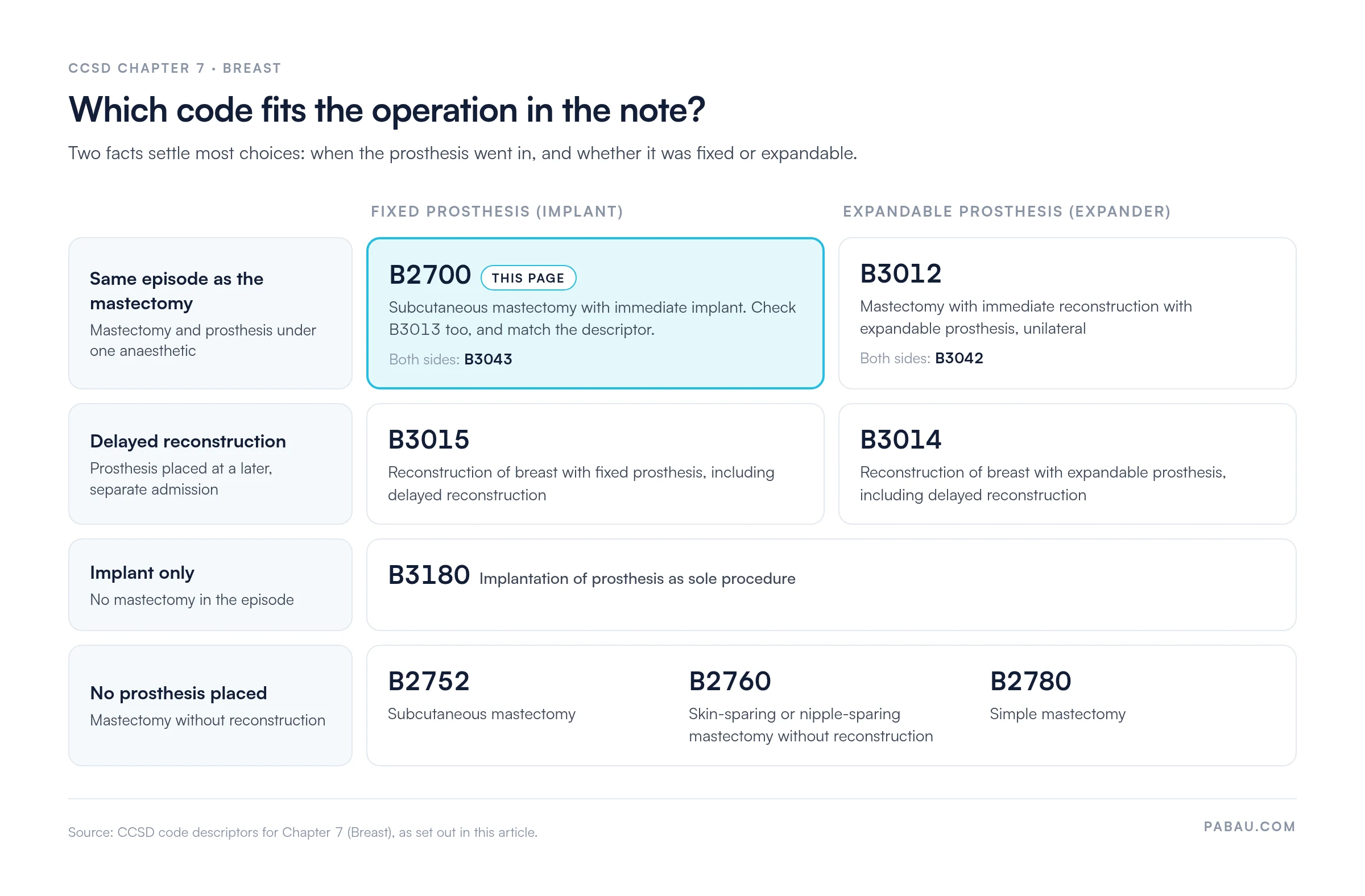
Insurers often query a B2700 claim because the coder picked the wrong neighbouring Chapter 7 (Breast) code. The table maps the closest codes and the scenarios that separate them. The full schedule sits in our CCSD code directory.
B2700 requires the mastectomy and the implant in one episode, while B3014 and B3015 cover reconstruction that includes a delayed operation. A note reading “mastectomy and reconstruction” without confirming one anaesthetic pushes coders towards a delayed code.
The grid below sorts the neighbouring codes by timing and prosthesis type.
Surgeons legitimately perform several procedures in the same session as B2700. Code and bill them separately rather than absorbing them into the mastectomy code. Payer-specific bundling rules vary, so confirm them with each insurer before submitting.
Document every procedure performed in the same session in a single structured operative note rather than across multiple dictation entries. A consolidated note makes it straightforward for the coder to identify each separately billable component and reduces the risk of omitting a legitimate additional code.
UK private insurers reviewing a B2700 claim look for specific clinical evidence in the operative note and supporting record. Missing even one element can trigger a request for additional information, which delays payment. Digital operative notes and clinical records linked directly to the invoice remove the manual step of attaching supporting documents before submission.
The operative note for a B2700 claim must include all of the following:
All four principal UK private medical insurers require pre-authorisation before the surgeon performs an elective B2700 procedure. Proceeding without authorisation is the single most preventable cause of non-payment. In most cases, insurers grant retrospective authorisation only for emergencies, not for elective breast surgery scheduled in advance.
The following summarises the pre-authorisation requirements for the major UK PMIs. Verify current requirements directly with each insurer’s provider portal, as referral and documentation thresholds change annually.
Denial patterns for B2700 are consistent across UK insurers. Most rejections stem from administrative errors that are preventable with robust pre-submission checks, not from clinical disputes about whether the procedure was appropriate.
Surgeons perform bilateral subcutaneous mastectomy with immediate implant reconstruction in a single operative session, most commonly for BRCA carriers undergoing risk-reducing surgery. Coding and billing the bilateral case requires additional attention because each insurer applies its own bilateral fee rules.
B2700 has no bilateral variant. CCSD codes bilateral mastectomy and immediate reconstruction separately, as B3042 with expandable prostheses and B3043 with fixed prostheses. Check whether one of those descriptors matches the operation before listing B2700 for each side.
Where an insurer accepts B2700 per side, it applies its own fee rules to the second side, so confirm them against its current provider schedule.
Documentation for bilateral cases must include separate implant records for each side, covering size, type and manufacturer reference. The operative note must confirm the surgeon operated on both breasts in the same session. Include the genetics or MDT documentation that justified bilateral surgery. Some insurers require the pre-authorisation to specify bilateral surgery explicitly rather than inferring it from a unilateral authorisation.
When obtaining pre-authorisation for a bilateral prophylactic mastectomy, request the bilateral code (B3042 or B3043) or name both sides explicitly. An authorisation issued for a unilateral procedure will not automatically cover the second side, which creates a denial on the second line.
B2700 is one option for nipple-sparing mastectomy (NSM) with an immediate implant, alongside B3012 and B3013. Pick the code whose descriptor matches the operation. Check the type of prosthesis and the extent of the mastectomy in the note. Without reconstruction, code a skin-sparing or nipple-sparing mastectomy as B2760 instead.
Record the approach in the operative note, NSM (nipple-areola complex preserved) or SSM (nipple-areola complex removed). Code nipple areola complex reconstruction at a later admission as B3580, not B2700. That holds whatever approach the original mastectomy used.
Private breast surgical practices submitting B2700 claims deal with a billing workflow that spans clinical documentation, pre-authorisation tracking, code selection, invoice generation, and denial management. Each of those steps is a potential failure point when handled across disconnected systems. Pabau consolidates them into a single platform built for UK private healthcare providers.
Practices that run plastic surgery alongside breast oncology need only one Pabau subscription. Each surgical team works in the same system, with no separate tool per specialty.

Pabau gives private breast surgical practices a built-in CCSD code library and pre-authorisation tracking on each patient record. Invoices pull straight from clinical documentation, so fewer claims come back rejected.

Treat the operative note as the place where B2700 is won or lost. A note that names the prosthesis type and says it went in under the mastectomy anaesthetic settles the code. The choice between B2700, B3012, B3013 and the delayed codes then follows from it.
The trade-off is a few extra lines dictated in theatre against a queried claim and a second submission. Put the authorisation reference on the record before the procedure date, and settle each insurer’s implant-cost position before you invoice.
Book a demo to see how Pabau keeps the authorisation number, operative note and invoice on one patient record for your breast surgery claims.

Need a reference for other Bupa CCSD codes? Bupa CCSD codes guide covers the full schedule structure, how Bupa applies codes, and common billing rules across specialties.
Placing an expander instead of a fixed implant? CCSD Code B3012 explains how mastectomy with immediate expandable prosthesis reconstruction is coded and documented.
Coding other breast procedures? CCSD Code B2810 covers segmental resection and quadrantectomy, the breast-conserving alternatives to mastectomy.
Checking what an insurer pays for a code? Bupa procedure codes and fee schedule lists Bupa codes alongside their published fees in one reference.
Working a rejected claim? Denial codes in medical billing explains what each denial code means and how to fix the claim before resubmitting.
CCSD Code B2700 covers subcutaneous mastectomy with immediate implant. The breast glandular tissue is removed through a skin-preserving approach, and a permanent prosthesis is placed in the same operative episode. It applies to therapeutic and prophylactic mastectomy with immediate reconstruction. An expander placed at mastectomy is coded B3012, and delayed reconstruction is coded B3014 or B3015. Nipple areola complex reconstruction at a later admission is coded B3580.
B2700 is a subcutaneous mastectomy with an implant placed in the same operative episode, in the Major band. B3013 is mastectomy with immediate reconstruction with a fixed prosthesis, unilateral. B3015 is fixed prosthesis reconstruction including delayed reconstruction, used when the implant follows an earlier mastectomy. Match the descriptor to the operation recorded in the note.
Not universally. Some UK private insurers bundle the implant supply cost within the B2700 procedure fee. Others require a separate implant supply code or cost schedule from the hospital. Confirm the position with each insurer before submitting the claim. The wrong approach generates a denial, however accurate the B2700 selection is.
It can be, when a permanent implant is placed in the same operative episode. B2700 is one option alongside B3012 and B3013, so match the descriptor to the operation recorded. A skin-sparing or nipple-sparing mastectomy without reconstruction is coded B2760. Record the approach in the operative note.